2007 DODGE SPRINTER load capacity
[x] Cancel search: load capacityPage 209 of 393
208 OperationTires and wheels
4
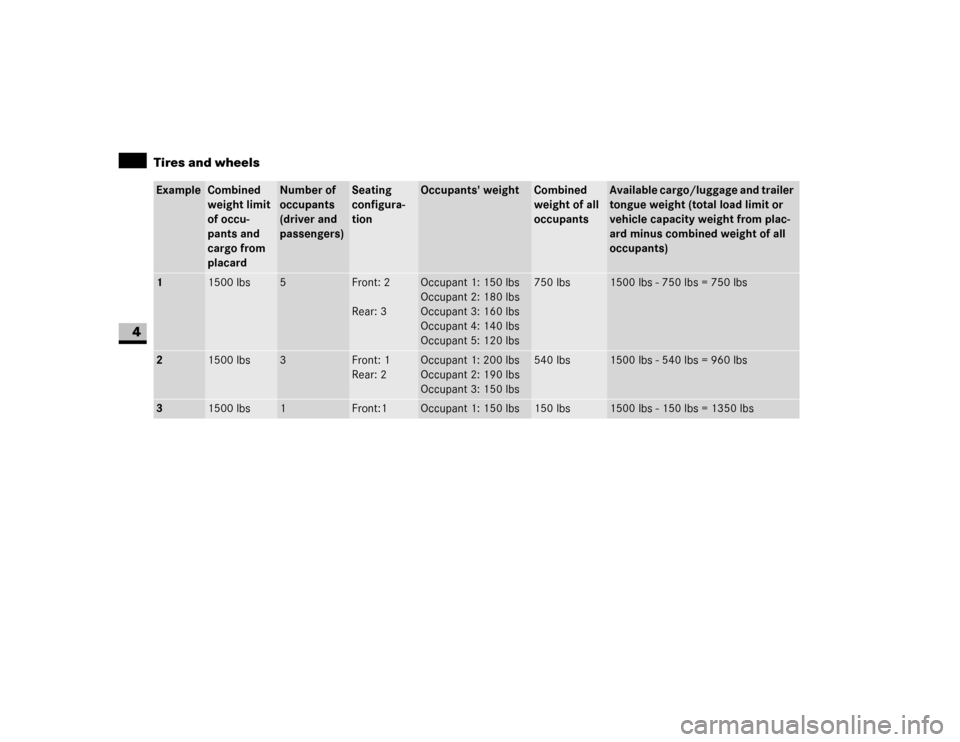
Example
Combined
weight limit
of occu-
pants and
cargo from
placard
Number of
occupants
(driver and
passengers)
Seating
configura-
tion
Occupants' weight
Combined
weight of all
occupants
Available cargo/luggage and trailer
tongue weight (total load limit or
vehicle capacity weight from plac-
ard minus combined weight of all
occupants)
1
1500 lbs
5
Front: 2
Rear: 3
Occupant 1: 150 lbs
Occupant 2: 180 lbs
Occupant 3: 160 lbs
Occupant 4: 140 lbs
Occupant 5: 120 lbs
750 lbs
1500 lbs - 750 lbs = 750 lbs
2
1500 lbs
3
Front: 1
Rear: 2
Occupant 1: 200 lbs
Occupant 2: 190 lbs
Occupant 3: 150 lbs
540 lbs
1500 lbs - 540 lbs = 960 lbs
3
1500 lbs
1
Front:1
Occupant 1: 150 lbs
150 lbs
1500 lbs - 150 lbs = 1350 lbs
Page 210 of 393
209 Operation
Tires and wheels
4
Certification label
Even after careful determination of the
combined weight of all occupants, cargo
and the trailer tongue load (if applicable)
as to not exceed the permissible load limit,
you must make sure that your vehicle nev-
er exceeds the Gross Vehicle Weight Rat-
ing (GVWR) and the Gross Axle Weight
Rating (GAWR) for either the front or rear
axle and the Gross Combination Weights
Rating (GCWR) (if applicable).
Under a maximum loaded vehicle condi-
tion, gross axle weight ratings (GAWR’s) for
the front and rear axles must not be ex-
ceeded. USA only - for vehicles with a gross weight
capacity less than 10,000 lbs (4500 kg)
only:
To determine the maximum loading condi-
tions of your vehicle, locate the statement
"The combined weight of occupants and
cargo should never exceed XXX kg or
XXX lbs." on the tire and loading informa-
tion placard. The combined weight of occu-
pants, cargo/luggage and trailer tongue
weight (if applicable) should never exceed
the weight referenced here.
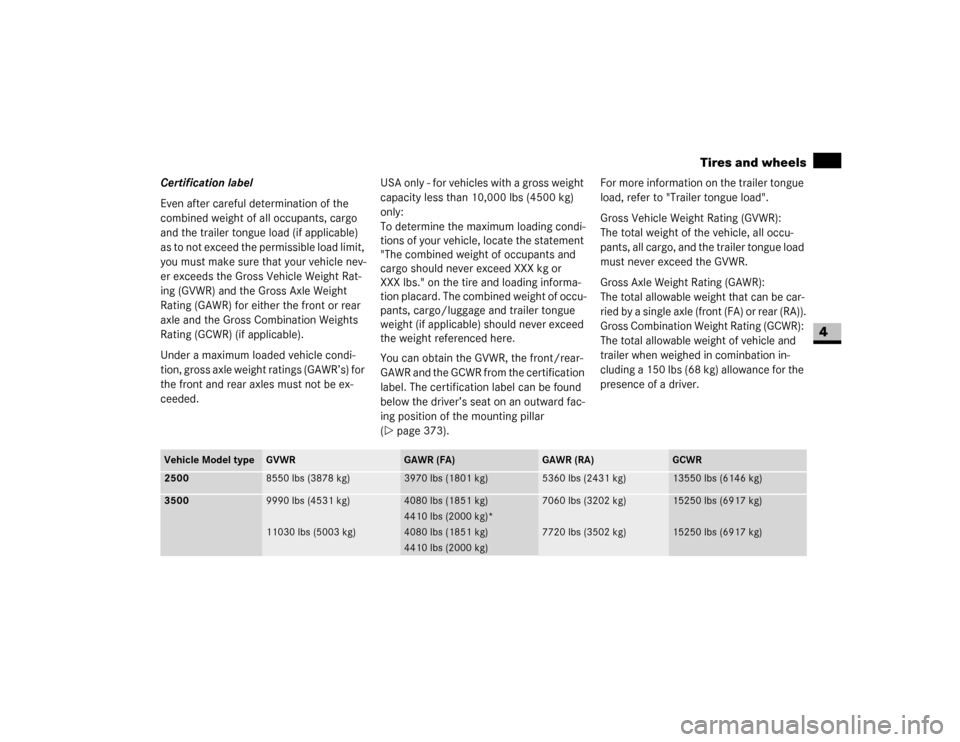
You can obtain the GVWR, the front/rear-
GAWR and the GCWR from the certification
label. The certification label can be found
below the driver’s seat on an outward fac-
ing position of the mounting pillar
(\2page 373).For more information on the trailer tongue
load, refer to "Trailer tongue load".
Gross Vehicle Weight Rating (GVWR):
The total weight of the vehicle, all occu-
pants, all cargo, and the trailer tongue load
must never exceed the GVWR.
Gross Axle Weight Rating (GAWR):
The total allowable weight that can be car-
ried by a single axle (front (FA) or rear (RA)).
Gross Combination Weight Rating (GCWR):
The total allowable weight of vehicle and
trailer when weighed in cominbation in-
cluding a 150 lbs (68 kg) allowance for the
presence of a driver.
Vehicle Model type
GVWR
GAWR (FA)
GAWR (RA)
GCWR
2500
8550 lbs (3878 kg)
3970 lbs (1801 kg)
5360 lbs (2431 kg)
13550 lbs (6146 kg)
3500
9990 lbs (4531 kg)
11030 lbs (5003 kg)
4080 lbs (1851 kg)
4410 lbs (2000 kg)*
4080 lbs (1851 kg)
4410 lbs (2000 kg)
7060 lbs (3202 kg)
7720 lbs (3502 kg)
15250 lbs (6917 kg)
15250 lbs (6917 kg)
Page 211 of 393
210 OperationTires and wheels
4
To assure that your vehicle does not ex-
ceed the maximum permissible weight lim-
its (GVWR and GAWR for front and rear
axle), have the loaded vehicle (including
driver, passengers and all cargo and, if ap-
plicable, trailer fully loaded) weighed on a
suitable commercial scale.
Trailer tongue load
The tongue load (tongue weight at the
hitch ball) of any trailer is an important
weight to measure because it affects the
load you can carry in your vehicle. If a trail-
er is towed, the tongue load must be added
to the weight of all occupants riding and
any cargo you are carrying in the vehicle to
prevent exceeding your Sprinter tow vehi-
cle’s rear GAWR. The tongue load typically
is between 10% and 15% of the trailer
weight and everything loaded in it.
For example, if the trailer tongue load
equals 1 40 lbs and the determined avail-
able cargo/luggage and trailer tongue
weight equals 750 lbs, the amount of avail-
able cargo and luggage load capacity is
610 lbs. (750 – 140 = 610 lbs.)For further information on vehicle and trail-
er weights and ratings, loading a trailer and
trailer towing, see “Trailer towing”
(\2page 175).Your vehicle is equipped with either the
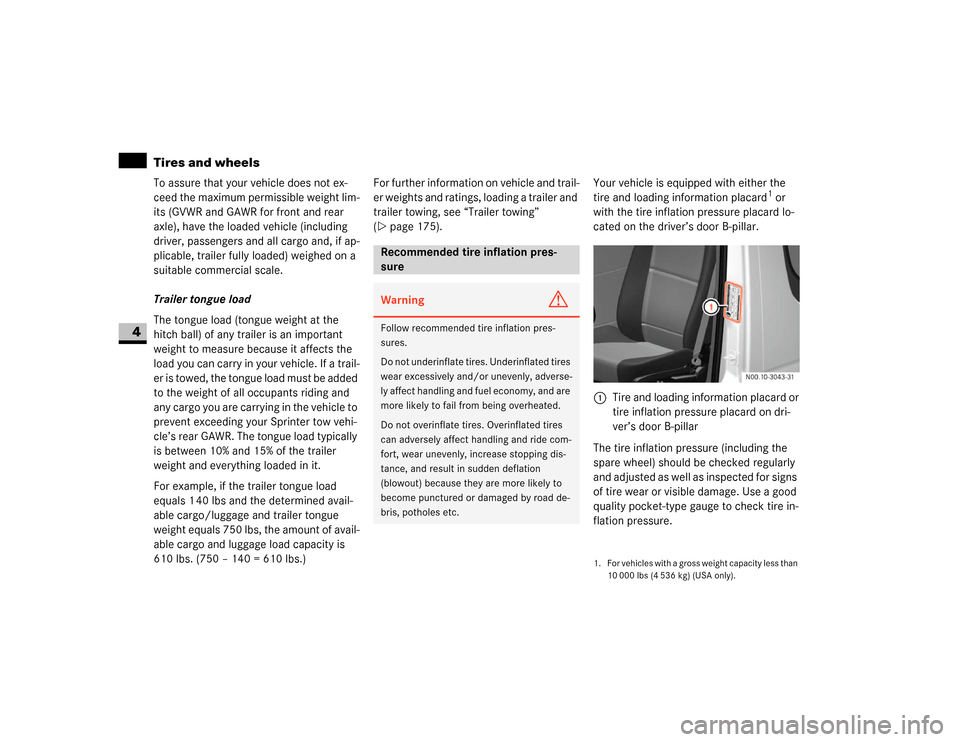
tire and loading information placard
1 or
with the tire inflation pressure placard lo-
cated on the driver’s door B-pillar.
The tire inflation pressure (including the
spare wheel) should be checked regularly
and adjusted as well as inspected for signs
of tire wear or visible damage. Use a good
quality pocket-type gauge to check tire in-
flation pressure.
Recommended tire inflation pres-
sureWarning
G
Follow recommended tire inflation pres-
sures.
Do not underinflate tires. Underinflated tires
wear excessively and/or unevenly, adverse-
ly affect handling and fuel economy, and are
more likely to fail from being overheated.
Do not overinflate tires. Overinflated tires
can adversely affect handling and ride com-
fort, wear unevenly, increase stopping dis-
tance, and result in sudden deflation
(blowout) because they are more likely to
become punctured or damaged by road de-
bris, potholes etc.
1. For vehicles with a gross weight capacity less than
10 000 lbs (4 536 kg) (USA only).1Tire and loading information placard or
tire inflation pressure placard on dri-
ver’s door B-pillar
Page 212 of 393
211 Operation
Tires and wheels
4
Do not make a visual judgment when de-
termining proper inflation. Radial tires may
look properly inflated even when they are
underinflated.
The tire inflation pressure should be
checked regularly, i.e. at least each time
you refuel the vehicle, and should only be
adjusted on cold tires. The preferred inter-
val for checking the tire inflation pressure,
however, is before each trip.
The tires can be considered cold if the ve-
hicle has been parked for at least 3 hours
or driven less than 1 mile (1.6 km) at an
ambient temperature of approximately
68 °F (20 °C).
Follow recommended cold tire inflation
pressures listed on vehicle placard.
Keeping the tires properly inflated provi-
des the best handling, tread life and riding
comfort.
The pressure difference between the tires
on a single axle should not exceed 1.5 psi
(10 kPa).
In addition to the placard, also consult the
tire inflation pressure table (\2page 370).For more information, refer to “Important
notes on tire inflation pressure”.
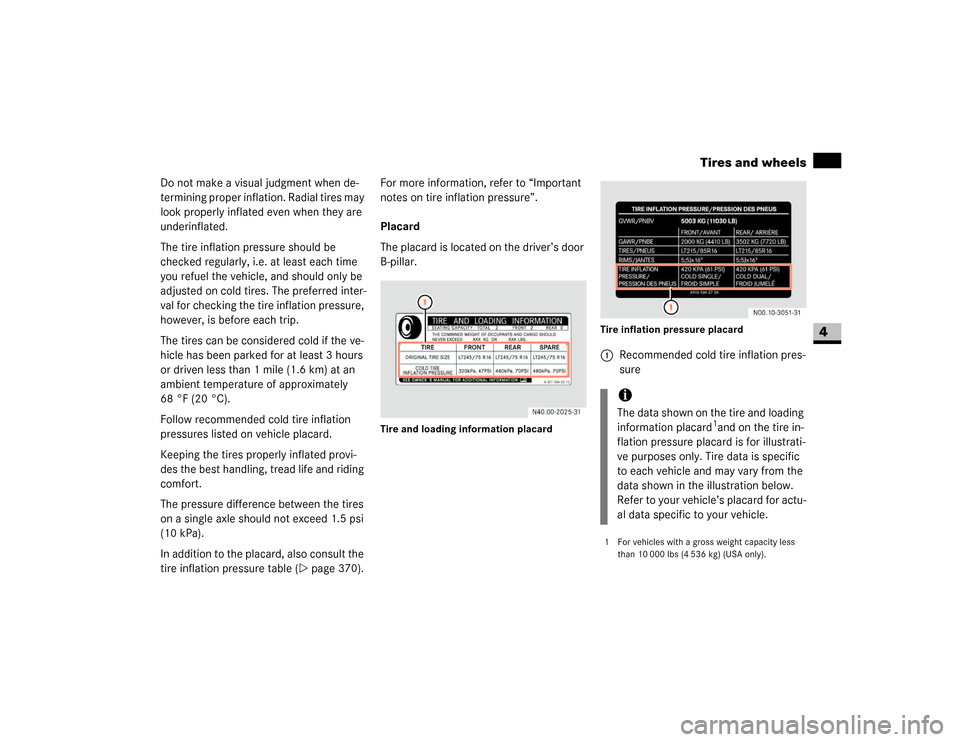
Placard
The placard is located on the driver’s door
B-pillar.
Tire and loading information placardTire inflation pressure placard
1Recommended cold tire inflation pres-
sure
iThe data shown on the tire and loading
information placard
1and on the tire in-
flation pressure placard is for illustrati-
ve purposes only. Tire data is specific
to each vehicle and may vary from the
data shown in the illustration below.
Refer to your vehicle’s placard for actu-
al data specific to your vehicle.
1 For vehicles with a gross weight capacity less
than 10 000 lbs (4 536 kg) (USA only).
Page 228 of 393
227 Operation
Tires and wheels
4
For more information on tire load rating,
refer to "Tire size designation, load and
speed rating" (\2page 222).
For information on calculating total and
cargo load capacities, refer to "Tire and
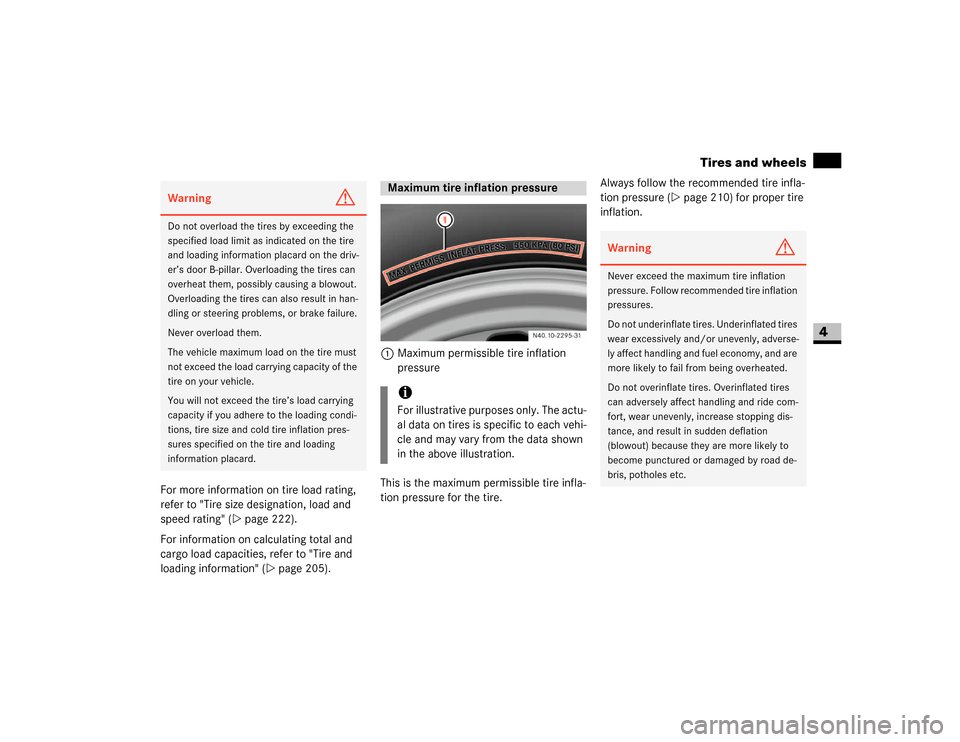
loading information" (\2page 205). 1Maximum permissible tire inflation
pressure
This is the maximum permissible tire infla-
tion pressure for the tire.Always follow the recommended tire infla-
tion pressure (\2page 210) for proper tire
inflation.Warning
G
Do not overload the tires by exceeding the
specified load limit as indicated on the tire
and loading information placard on the driv-
er’s door B-pillar. Overloading the tires can
overheat them, possibly causing a blowout.
Overloading the tires can also result in han-
dling or steering problems, or brake failure.
Never overload them.
The vehicle maximum load on the tire must
not exceed the load carrying capacity of the
tire on your vehicle.
You will not exceed the tire’s load carrying
capacity if you adhere to the loading condi-
tions, tire size and cold tire inflation pres-
sures specified on the tire and loading
information placard.
Maximum tire inflation pressureiFor illustrative purposes only. The actu-
al data on tires is specific to each vehi-
cle and may vary from the data shown
in the above illustration.
Warning
G
Never exceed the maximum tire inflation
pressure. Follow recommended tire inflation
pressures.
Do not underinflate tires. Underinflated tires
wear excessively and/or unevenly, adverse-
ly affect handling and fuel economy, and are
more likely to fail from being overheated.
Do not overinflate tires. Overinflated tires
can adversely affect handling and ride com-
fort, wear unevenly, increase stopping dis-
tance, and result in sudden deflation
(blowout) because they are more likely to
become punctured or damaged by road de-
bris, potholes etc.
Page 229 of 393

228 OperationTires and wheels
4
1Plies in side wall
2Plies under tread
This marking tells you about the type of
cord and number of plies in the side wall
and under the tread.Accessory weight
The combined weight (in excess of those
standard items which may be replaced) of
automatic transmission, power steering,
power brakes, power windows, power
seats, radio, and heater, to the extent that
these items are available as factory-in-
stalled equipment (whether installed or
not).
Air pressure
The amount of air inside the tire pressing
outward on each square inch of the tire.
Air pressure is expressed in pounds per
square inch (psi), or kilopascal (kPa) or
bars.
Aspect ratio
Dimensional relationship between the tire
section height and the section width ex-
pressed in percentage.Bar
Another metric unit for air pressure. There
are 14.5038 pounds per square inch (psi)
to 1 bar; there are 100 kilopascals (kPa)
to 1 bar.
Bead
The tire bead contains steel wires wrapped
by steel cords that hold the tire onto the
rim.
Cold tire inflation pressure
Tire inflation pressure when your vehicle
has been sitting for at least 3 hours or driv-
en no more than 1 mile (1.6 km).
Curb weight
The weight of a motor vehicle with stan-
dard equipment including the maximum
capacity of fuel, oil, and coolant, and, if so
equipped, air conditioning and additional
optional equipment, but without passen-
gers and cargo.Tire ply materialiFor illustrative purposes only. The actu-
al data on tires is specific to each vehi-
cle and may vary from the data shown
in the above illustration.
Tire and loading terminology
Page 230 of 393
229 Operation
Tires and wheels
4
DOT (D
epartment O
f T
ransportation)
A tire branding symbol which denotes that
the tire meets the requirements of the
U.S. Department of Transportation.
GAWR (G
ross A
xle W
eight R
ating)
The GAWR is the maximum permissible
axle weight. The gross vehicle weight on
each axle must never exceed the GAWR for
the front and rear axle indicated on the
certification label located on the driver’s
door B-pillar.
GTW (G
ross T
railer W
eight)
The GTW is the weight of the trailer plus
the weight of all cargo, equipment, luggage
etc. loaded on the trailer.GVW (G
ross V
ehicle W
eight)
The GVW comprises the weight of the vehi-
cle including fuel, tools, spare wheel, in-
stalled accessories, passengers and cargo
and, if applicable, trailer tongue load. The
GVW must never exceed the GVWR indicat-
ed on the certification label located on the
driver’s door B-pillar.
GVWR (G
ross V
ehicle W
eight R
ating)
This is the maximum permissible vehicle
weight of the fully loaded vehicle (weight of
the vehicle including all options, passen-
gers, fuel, and cargo and, if applicable,
trailer tongue load). It is indicated on the
certification label located on the driver’s
door B-pillar.
Kilopascal (kPa)
The metric unit for air pressure. There are
6.9kPa to 1psi; another metric unit for air
pressure is bars. there are 100 kilopascals
(kPa) to 1 bar.Maximum load rating
The maximum load in kilograms and
pounds that can be carried by the tire.
Maximum loaded vehicle weight
The sum of curb weight, accessory weight,
vehicle capacity weight and production op-
tions weight.
Maximum tire inflation pressure
This number is the greatest amount of air
pressure that should ever be put in the tire
under normal driving conditions.
Normal occupant weight
The number of occupants the vehicle is de-
signed to seat, multiplied by 68 kilograms
(150 lbs).
Occupant distribution
The distribution of occupants in a vehicle
at their designated seating positions.
Page 232 of 393

231 Operation
Tires and wheels
4
TWR (T
ongue W
eight R
ating)
Maximum permissible weight on the trailer
tongue.
Uniform tire quality grading standards
A tire information system that provides
consumers with ratings for a tire’s traction,
temperature and treadwear. Ratings are
determined by tire manufacturers using
government testing procedures. The rat-
ings are molded into the side wall of the
tire.
Vehicle capacity weight
Rated cargo and luggage load plus
68 kilograms (150 lbs) times the vehicle’s
designated seating capacity.
Vehicle maximum load on the tire
Load on an individual tire that is deter-
mined by distributing to each axle its share
of the maximum loaded vehicle weight and
dividing it by two.
Tires on the front and rear axles of vehicles
operate at different loads and perform dif-
ferent steering, driving and braking func-
tions. For these reasons, they wear at unequal rates, and develop irregular wear
patterns. These effects can be reduced by
timely rotation of tires.
The benefits of rotation are especially
worthwhile with aggressive tread designs
such as those on On/Off Road type tires.
Rotation will increase tread life, help to
maintain mud, snow, and wet traction lev-
els, and contribute to a smooth ride.
If applicable to your vehicle’s tire configu-
ration, tires can be rotated according to
the tire manufacturer’s recommended in-
tervals in the tire manufacturer’s warranty
pamphlet located in your vehicle literature
portfolio. If none is available, tires should
be rotated every 10,000 miles
(16,000 km), or sooner if necessary, ac-
cording to the degree of tire wear.
The same rotation (spinning) direction
must be maintained when mounted, see
"Direction of rotation" (\2page 204).
Rotate tires before the characteristic tire
wear pattern becomes visible (shoulder
wear on front tires and tread center wear
on rear tires).
Rotating tiresWarning
G
Rotate front and rear wheels only if they are
of the same dimension.
Changing the tire dimension for an axle
\4could cause the tire to come into con-
tact with the vehicle body or axle parts.
Damage to the tire or the vehicle may be
the result.
\4could result in changes to steering, han-
dling, and braking of your Sprinter vehi-
cle. This can cause unpredictable
handling and stress to steering and sus-
pension components. You could lose
control and have an accident resulting in
serious injury or death.
\4could result in tire overloading and fail-
ure, if the tires' load index are not iden-
tical. You could lose control and have an
accident.