2007 DODGE SPRINTER fuel cap
[x] Cancel search: fuel capPage 212 of 393
211 Operation
Tires and wheels
4
Do not make a visual judgment when de-
termining proper inflation. Radial tires may
look properly inflated even when they are
underinflated.
The tire inflation pressure should be
checked regularly, i.e. at least each time
you refuel the vehicle, and should only be
adjusted on cold tires. The preferred inter-
val for checking the tire inflation pressure,
however, is before each trip.
The tires can be considered cold if the ve-
hicle has been parked for at least 3 hours
or driven less than 1 mile (1.6 km) at an
ambient temperature of approximately
68 °F (20 °C).
Follow recommended cold tire inflation
pressures listed on vehicle placard.
Keeping the tires properly inflated provi-
des the best handling, tread life and riding
comfort.
The pressure difference between the tires
on a single axle should not exceed 1.5 psi
(10 kPa).
In addition to the placard, also consult the
tire inflation pressure table (\2page 370).For more information, refer to “Important
notes on tire inflation pressure”.
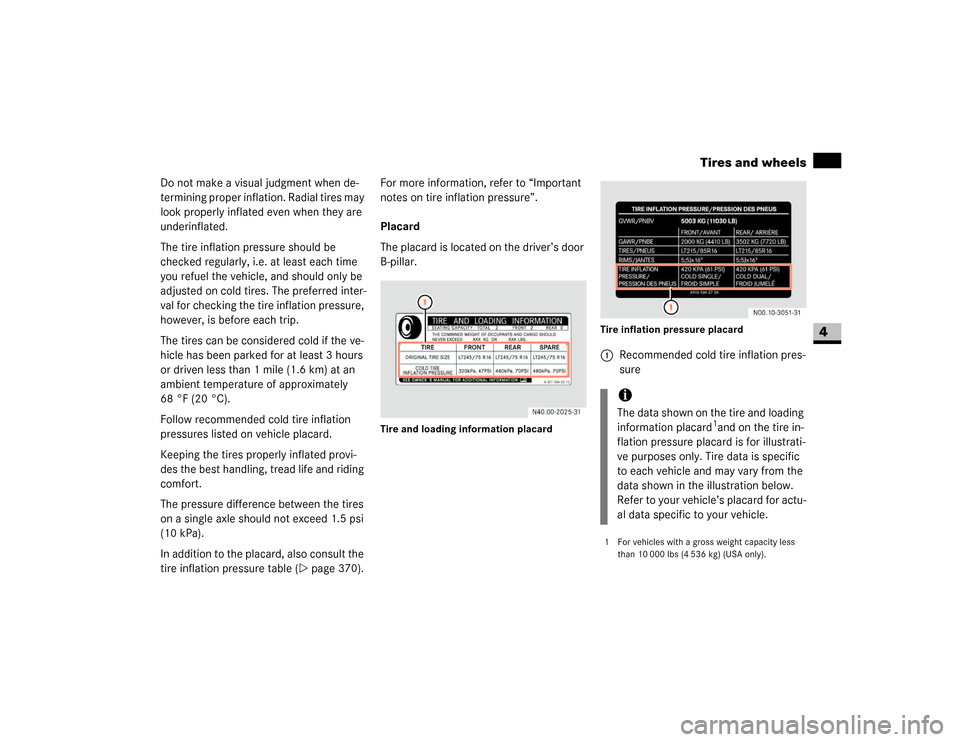
Placard
The placard is located on the driver’s door
B-pillar.
Tire and loading information placardTire inflation pressure placard
1Recommended cold tire inflation pres-
sure
iThe data shown on the tire and loading
information placard
1and on the tire in-
flation pressure placard is for illustrati-
ve purposes only. Tire data is specific
to each vehicle and may vary from the
data shown in the illustration below.
Refer to your vehicle’s placard for actu-
al data specific to your vehicle.
1 For vehicles with a gross weight capacity less
than 10 000 lbs (4 536 kg) (USA only).
Page 214 of 393
213 Operation
Tires and wheels
4
The tire inflation pressure should be
checked regularly, i.e. at least each time
you refuel the vehicle. The preferred inter-
val for checking the tire inflation pressure,
however, is before each trip.
The inflation pressures specified either on
the tire and loading information placard on
the driver’s door B-pillar or on tire pressure
label below the driver’s seat on an outward
facing position of the mounting pillar are
always cold tire inflation pressures. Check
and adjust the tire inflation pressure when
the tires are cold. Cold tire inflation pres-
sure is defined as the tire pressure after
the vehicle has been parked for at least
3 hours or driven less than 1 mile (1.6 km)
at an ambient temperature of approxi-
mately 68 °F (20 °C).
The cold tire inflation pressure must not
exceed the maximum tire inflation pres-
sure molded into the tire side wall, see
"Tire labeling" (\2page 222).
If you check the tire inflation pressure
when the tires are warm (the vehicle has
been driven for several miles or sitting less than 3 hours), the reading will be higher
than the cold reading. This is normal. Do
not let air out to match the specified cold
tire inflation pressure. Otherwise, the tire
will be underinflated.Checking tire inflation pressure manu-
ally
Follow the steps below to achieve correct
tire inflation pressure:
\1Remove the cap from the valve on one
tire.
\1Firmly press a tire gauge onto the
valve.
\1Read the tire inflation pressure on the
tire gauge and compare it with the rec-
ommended tire inflation pressure on
the placard on the driver’s door B-pillar
or on the tire pressure label below the
driver’s seat. If necessary, add air to
achieve the recommended tire inflation
pressure.
\1Reattach the valve cap.Checking tire inflation pressure
Warning
G
Observe the recommended tire inflation
pressures.
Do not underinflate tires. Underinflated tires
wear excessively and/or unevenly, adverse-
ly affect handling and fuel economy, and are
more likely to fail from being overheated.
Do not overinflate tires. Overinflated tires
can adversely affect handling and ride com-
fort, wear unevenly, increase stopping dis-
tance, and result in sudden deflation
(blowout) because they are more likely to
become punctured or damaged by road de-
bris, potholes etc.
Do not overload the tires by exceeding the
specified load limit as indicated on the tire
and loading information placard on the driv-
er’s door B-pillar. Overloading the tires can
overheat them, possibly causing a blowout.
iIf you have overfilled the tire, release
tire inflation pressure by pushing the
metal stem of the valve with for exam-
ple a tip of a pen. Then recheck the tire
inflation pressure with the tire gauge.
Page 228 of 393
227 Operation
Tires and wheels
4
For more information on tire load rating,
refer to "Tire size designation, load and
speed rating" (\2page 222).
For information on calculating total and
cargo load capacities, refer to "Tire and
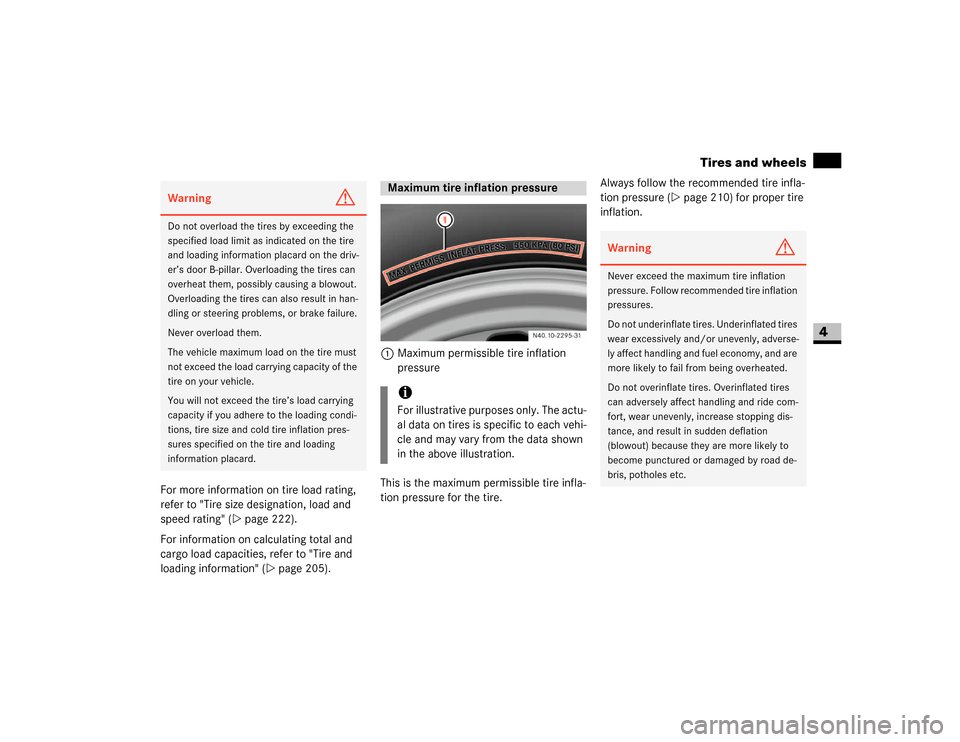
loading information" (\2page 205). 1Maximum permissible tire inflation
pressure
This is the maximum permissible tire infla-
tion pressure for the tire.Always follow the recommended tire infla-
tion pressure (\2page 210) for proper tire
inflation.Warning
G
Do not overload the tires by exceeding the
specified load limit as indicated on the tire
and loading information placard on the driv-
er’s door B-pillar. Overloading the tires can
overheat them, possibly causing a blowout.
Overloading the tires can also result in han-
dling or steering problems, or brake failure.
Never overload them.
The vehicle maximum load on the tire must
not exceed the load carrying capacity of the
tire on your vehicle.
You will not exceed the tire’s load carrying
capacity if you adhere to the loading condi-
tions, tire size and cold tire inflation pres-
sures specified on the tire and loading
information placard.
Maximum tire inflation pressureiFor illustrative purposes only. The actu-
al data on tires is specific to each vehi-
cle and may vary from the data shown
in the above illustration.
Warning
G
Never exceed the maximum tire inflation
pressure. Follow recommended tire inflation
pressures.
Do not underinflate tires. Underinflated tires
wear excessively and/or unevenly, adverse-
ly affect handling and fuel economy, and are
more likely to fail from being overheated.
Do not overinflate tires. Overinflated tires
can adversely affect handling and ride com-
fort, wear unevenly, increase stopping dis-
tance, and result in sudden deflation
(blowout) because they are more likely to
become punctured or damaged by road de-
bris, potholes etc.
Page 229 of 393

228 OperationTires and wheels
4
1Plies in side wall
2Plies under tread
This marking tells you about the type of
cord and number of plies in the side wall
and under the tread.Accessory weight
The combined weight (in excess of those
standard items which may be replaced) of
automatic transmission, power steering,
power brakes, power windows, power
seats, radio, and heater, to the extent that
these items are available as factory-in-
stalled equipment (whether installed or
not).
Air pressure
The amount of air inside the tire pressing
outward on each square inch of the tire.
Air pressure is expressed in pounds per
square inch (psi), or kilopascal (kPa) or
bars.
Aspect ratio
Dimensional relationship between the tire
section height and the section width ex-
pressed in percentage.Bar
Another metric unit for air pressure. There
are 14.5038 pounds per square inch (psi)
to 1 bar; there are 100 kilopascals (kPa)
to 1 bar.
Bead
The tire bead contains steel wires wrapped
by steel cords that hold the tire onto the
rim.
Cold tire inflation pressure
Tire inflation pressure when your vehicle
has been sitting for at least 3 hours or driv-
en no more than 1 mile (1.6 km).
Curb weight
The weight of a motor vehicle with stan-
dard equipment including the maximum
capacity of fuel, oil, and coolant, and, if so
equipped, air conditioning and additional
optional equipment, but without passen-
gers and cargo.Tire ply materialiFor illustrative purposes only. The actu-
al data on tires is specific to each vehi-
cle and may vary from the data shown
in the above illustration.
Tire and loading terminology
Page 230 of 393
229 Operation
Tires and wheels
4
DOT (D
epartment O
f T
ransportation)
A tire branding symbol which denotes that
the tire meets the requirements of the
U.S. Department of Transportation.
GAWR (G
ross A
xle W
eight R
ating)
The GAWR is the maximum permissible
axle weight. The gross vehicle weight on
each axle must never exceed the GAWR for
the front and rear axle indicated on the
certification label located on the driver’s
door B-pillar.
GTW (G
ross T
railer W
eight)
The GTW is the weight of the trailer plus
the weight of all cargo, equipment, luggage
etc. loaded on the trailer.GVW (G
ross V
ehicle W
eight)
The GVW comprises the weight of the vehi-
cle including fuel, tools, spare wheel, in-
stalled accessories, passengers and cargo
and, if applicable, trailer tongue load. The
GVW must never exceed the GVWR indicat-
ed on the certification label located on the
driver’s door B-pillar.
GVWR (G
ross V
ehicle W
eight R
ating)
This is the maximum permissible vehicle
weight of the fully loaded vehicle (weight of
the vehicle including all options, passen-
gers, fuel, and cargo and, if applicable,
trailer tongue load). It is indicated on the
certification label located on the driver’s
door B-pillar.
Kilopascal (kPa)
The metric unit for air pressure. There are
6.9kPa to 1psi; another metric unit for air
pressure is bars. there are 100 kilopascals
(kPa) to 1 bar.Maximum load rating
The maximum load in kilograms and
pounds that can be carried by the tire.
Maximum loaded vehicle weight
The sum of curb weight, accessory weight,
vehicle capacity weight and production op-
tions weight.
Maximum tire inflation pressure
This number is the greatest amount of air
pressure that should ever be put in the tire
under normal driving conditions.
Normal occupant weight
The number of occupants the vehicle is de-
signed to seat, multiplied by 68 kilograms
(150 lbs).
Occupant distribution
The distribution of occupants in a vehicle
at their designated seating positions.
Page 235 of 393

234 OperationWinter driving
4
\3 Winter drivingHave your vehicle winterproofed at the
onset of winter at an authorized Sprinter
Dealer. This service includes the following:
\4Oil change, if the current engine oil
used has not been approved for winter
use
\4The antifreeze / anti-corrosion concen-
tration in the coolant is checked
\4The addition of a concentrated clean-
ing agent to the water in the windshield
washer system
\4Battery check
\4A tire change
You will find information about diesel fuel
for use at low outside temperatures in the
“Technical data” section (\2page 360).
Please also observe the information about
winter driving (\2page 235).Always use winter tires at temperatures
below 45°F (7°C) and whenever wintry
road conditions prevail. Winter tires should
be of the same size and type construction
as the summer tires.
Winter tires should also be operated as
printed on the tire and loading information
placard, refer to "Tires and wheels"
(\2page 199). Not all M+S rated radial-ply
tires provide special winter performance.
Make sure the tires you use show M+S and
the mountain/snowflake marking.on
the tire side wall. These tires meet specific
snow traction performance requirements
of the Rubber Manufacturers Association
(RMA) and the Rubber Association of Can-
ada (RAC) and have been designed specif-
ically for use in snow conditions. Use of
winter tires is the only way to achieve the
maximum effectiveness of the ABS, BAS,
ASR and ESP
® in winter operation.
For safe handling, make sure all winter
tires mounted are of the same make and
have the same tread design.Always observe the speed rating of the
winter tires installed on your vehicle. If the
maximum speed for which your tires are
rated is below the speed rating of your ve-
hicle, you must place a notice to this effect
where it will be seen by the driver. Such no-
tices are available at your tire dealer or any
authorized Sprinter Dealer.
\1Reactivate the tire pressure monitor.
While studded tires improve performance
on ice, skid and traction capability on wet
or dry surfaces may be poorer than that of
non-studded tires. Some states prohibit
studded tires; therefore, local laws should
be checked before using these tire types.
Winter tires
Warning
G
Winter tires with a tread depth under 1/6 in
(4 mm) must be replaced. They are no long-
er suitable for winter operation.
Page 277 of 393

276 Practical hintsWhat to do if ...
5
•
The red coolant warning lamp
lights up while the engine is run-
ning.
The coolant temperature is too high.
\1Do not drive any further.
\1Consult an authorized Sprinter Dealer.
If the vehicle is switched off after being
subjected to extreme loads (for example
driving in mountainous terrain, trailer
towing, etc.), the coolant warning lamp
may light up when the ignition is switched
on or the engine is restarted. Run the en-
gine for approximately 1 minute at idling
speed.
Consult an authorized Sprinter Dealer if
the coolant warning lamp remains lit.
A
The yellow reserve fuel warning
lamp lights up while the vehicle is
in motion.
The fuel level has fallen into the reserve
range.
\1Refuel at the nearest refueling station
(\2page 184).
A
The yellow reserve fuel warning
lamp lights up while the engine is
running and the gauge for the fuel
tank shows zero although there is
still fuel in the tank.
The fuel filler cap is not closed.
\1Close the fuel filler cap. A clicking
sound indicates that the fuel filler cap
is closed.
\1If the malfunction continues to be in-
dicated, have it rectified immediately
at an authorized Sprinter Dealer.
q
The yellow preglow indicator lamp
lights up while the engine is running.
There is a malfunction in the preglow sys-
tem.
\1Consult an authorized Sprinter Dealer.
Problem
Possible cause / result
Suggested solutions
Page 298 of 393

297 Practical hints
Display messages
5
N
Engine oil level
Reduce
oil level
You have added too much engine oil.
There is a risk of damage to the engine or
the catalytic converter.
\1Check the engine oil level and have any
excess oil siphoned off at the nearest re-
fueling station (\2page 190).
The engine or the catalytic converter could
be damaged.
\1If the oil level is correct, have the mal-
function rectified as soon as possible at
an authorized Sprinter Dealer.
Oil sensor
Visit
workshop
The measuring system is malfunctioning.
\1Have the measuring system checked at
an authorized Sprinter Dealer.
Engine oil level
Not when eng. run-
ning
You are attempting to check the engine
oil level even though the engine is run-
ning.
\1Switch off the engine.
\1Check the engine oil level (\2page 187).
W
Reserve fuel
Drive to a
gas station
The fuel level has fallen into the reserve
range.
\1Refuel at the nearest gas station
(\2page 184).
Tank open
Check
filler cap
The fuel filler cap is not closed.
\1Close the fuel filler cap. A clicking sound
indicates that the fuel filler cap is closed.
\1If the malfunction continues to be indi-
cated, have it rectified immediately at an
authorized Sprinter Dealer.
Display symbol
Display message
Possible cause / result
Possible solution