Page 224 of 492
one and stop the search. Pressing a pre-set memory
button during a music type scan, will call up the memory
channel and stop the search.
PTY Button(SEEK(
When the desired program is obtained, press the9SEEK9
button within five seconds. The channel will change to
the next channel that matches the program type selected.
Satellite Antenna
To ensure optimum reception, do not place items on the
roof around the rooftop antenna location. Metal objects
placed within the line of sight of the antenna will cause
decreased performance. Larger luggage items should be
placed as far forward as possible. Do not place items
directly on or above the antenna.
Reception Quality
Satellite reception may be interrupted due to one of the
following reasons.
²The vehicle is parked in an underground parking
structure or under a physical obstacle.
²Dense tree coverage may interrupt reception in the
form of short audio mutes.
²Driving under wide bridges or along tall buildings can
cause intermittent reception.
²Placing objects over or too close to the antenna can
cause signal blockage.
UNDERSTANDING YOUR INSTRUMENT PANEL 223
4
Page 230 of 492

Recirculation Modes (Panel or Bi-Level)
Select the recirculation modes when
the outside air contains smoke or
odors. This feature allows for recircu-
lation of interior air only. Air flows
through the panel outlets in this mode.
Air flows through the panel only or
through both the panel and floor vents
depending on the selected mode (panel vs bi-level).
Bi-Level
Outside air flows through the outlets located in the
instrument panel and at the floor.
Mix
Outside air flows in equal proportions through the
floor and defroster outlets.
Defrost
Outside air is primarily directed to the windshield
through the defroster outlets located at the base of
the windshield, and the demister outlets located at the
edge of each side of the instrument panel.
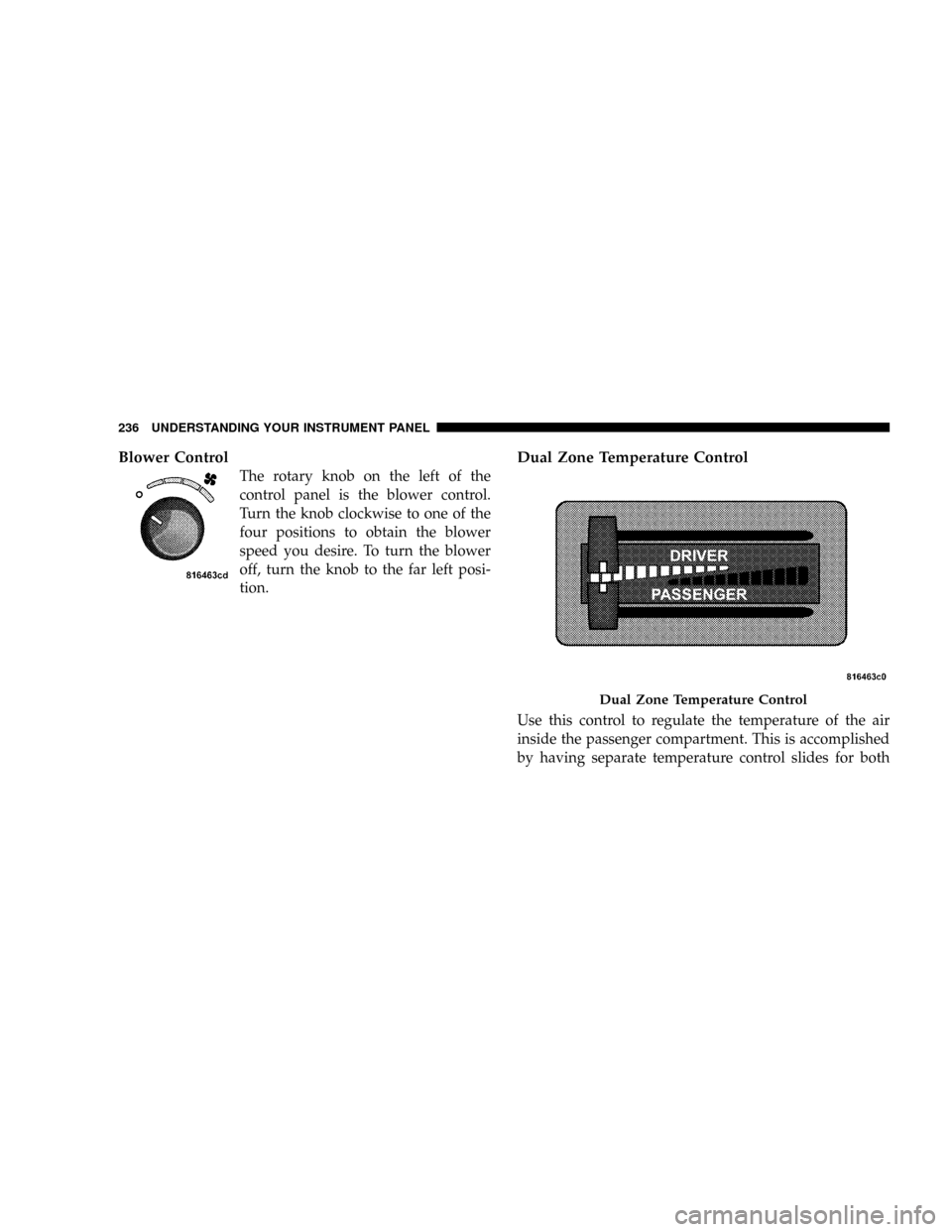
Blower Control
The rotary knob on the left of the
control panel is the blower control.
Turn the knob clockwise to one of the
four positions to obtain the blower
speed you desire. To turn the blower
off, turn the knob to the far left posi-
tion.
UNDERSTANDING YOUR INSTRUMENT PANEL 229
4
Page 233 of 492

Bi-Level
Outside air flows through the outlets located in the
instrument panel and at the floor.
Floor
Outside air flows primarily through the floor out-
lets located under the instrument panel.
Mix
Outside air flows in equal proportions through the
floor and defroster outlets, and the air conditioning
may be on.
Defrost
Outside air is primarily directed to the windshield
through the defroster outlets located at the base of
the windshield, and the demister outlets located at the
edge of each side of the instrument panel, and the air
conditioning may be on.
Blower Control
The rotary knob on the left of the
control panel is the blower control.
Turn the knob clockwise to one of the
four positions to obtain the blower
speed you desire. To turn the blower
off, turn the knob to the far left posi-
tion.
Temperature Control
The rotary knob at the center of the
control panel controls the temperature
of the interior air. You can choose your
degree of comfort by rotating the
knob. The coldest temperature setting
is to the extreme left (blue region) and
the warmest setting is to the extreme
right (red region) of the rotation.
232 UNDERSTANDING YOUR INSTRUMENT PANEL
Page 237 of 492
Blower Control
The rotary knob on the left of the
control panel is the blower control.
Turn the knob clockwise to one of the
four positions to obtain the blower
speed you desire. To turn the blower
off, turn the knob to the far left posi-
tion.
Dual Zone Temperature Control
Use this control to regulate the temperature of the air
inside the passenger compartment. This is accomplished
by having separate temperature control slides for both
Dual Zone Temperature Control
236 UNDERSTANDING YOUR INSTRUMENT PANEL
Page 242 of 492
STARTING AND OPERATING
CONTENTS
mStarting Procedures ± Gas Engines...........245
NManual Transmission..................245
NAutomatic Transmission................245
NNormal Starting......................246
NIf Engine Fails To Start.................246
NAfter Starting........................248
mEngine Block Heater Ð If Equipped.........249
mAutomatic Transmission..................249
NAutomatic Transmission With Overdrive.....250mManual Transmission....................255
NManual Transmission Ð 6 Speed (G56)......256
NRecommended Vehicle Shift Speeds........257
NDownshifting ± All Manual Transmissions....257
mFour-Wheel- Drive Operation..............258
NManually Shifted Transfer Case Operating
Information/Precautions................258
NShifting Procedure - Manually Shifted Transfer
Case..............................261
NTransfer Case Reminder Light............262
5
Page 243 of 492

mLimited-Slip Differential Ð If Equipped.......262
mDriving On Slippery Surfaces..............263
mAxle Locker System.....................264
mStabilizer/Sway Bar System...............267
mPower Wagon ± Safe Off-Road Driving.......268
NOff-Road Driving Tips And Vehicle
Characteristics.......................268
NDriving In Snow, Mud And Sand..........273
NCrossing Obstacles (Rocks And Other High
Points).............................275
NHill Climbing........................278
NDriving Through Water.................281
NAiring Down For Off-Road Driving........283
NVehicle Recovery......................284NAfter Driving Off-Road.................288
mWinch Usage ± If Equipped...............289
NThings To Know Before Using Your Winch . . . 289
NUnderstanding The Features Of Your Winch . . 291
NWinch Accessories.....................293
NOperating Your Winch..................294
NRigging Techniques....................305
mParking Brake.........................308
mBrake System..........................309
NBrake Noise.........................310
NFour-Wheel Anti-Lock Brake System (ABS)Ð
If Equipped.........................310
mPower Steering........................312
242 STARTING AND OPERATING
Page 246 of 492

STARTING PROCEDURES ± GAS ENGINES
The starter should not be operated for more than 15-
second intervals. Waiting a few seconds between such
intervals will protect the starter from overheating.
WARNING!
Be sure to turn off the engine if you want to rest or
sleep in your car. Accidents can be caused by inad-
vertently moving the gear selection lever or by
pressing the accelerator pedal. This may cause exces-
sive heat in the exhaust system, resulting in over-
heating and vehicle fire which may cause serious or
fatal injuries.
WARNING!
Do not leave children or animals inside parked
vehicles in hot weather. Interior heat build up may
cause serious injury or death.
Manual Transmission
Apply the parking brake, place the gearshift control lever
in NEUTRAL and depress the clutch pedal to the floor
before starting the vehicle. This vehicle is equipped with
a clutch interlocking ignition system. It will not start
unless the clutch is fully depressed.
Automatic Transmission
Start the engine with the selector lever in NEUTRAL or
PARK position. Apply the brake before shifting to any
driving range.
STARTING AND OPERATING 245
5
Page 247 of 492

Normal Starting
Normal starting of either a warm or cold engine is
obtained without pumping or depressing the accelerator
pedal. Turn the key to the START position and release
when the engine starts. If the engine fails to start within
10 seconds, turn the key to the OFF position, wait 5
seconds, then repeat the starting procedure.
NOTE: This vehicle is equipped with a transmission
shift interlocking system. The brake pedal must be
depressed to shift out of Park (P).
Tip Start Feature Ð Automatic Transmission Only
Do notpress the accelerator. Turn the ignition key briefly
to START position, and release it. The starter motor will
continue to run, but will automatically disengage itself
when the engine is running.
If Engine Fails To Start
If the engine fails to start after you have followed the
normal starting procedure, it may be flooded. Push the
accelerator pedal all the way to the floor and hold it there
while cranking the engine. This should clear any excess
fuel in case the engine is flooded.
Ignition Key Positions
246 STARTING AND OPERATING