Page 301 of 492
9. Connect the remote control to the winch control box,
located behind the front bumper. Be careful not to let the
remote control cord dangle in front of the winch. If you
choose to control the winch from inside your vehicle,
always pass the remote through a window to avoid
pinching the cord in the door. Always disconnect the
remote control when not in use.10. Put wire rope under tension. Using the remote con-
trol switch, slowly wind the wire rope until no slack
remains. Once the wire rope is under tension, stand well
clear and never step over it.
11. Check your anchor. Make sure all connections are
secured and free of debris before continuing with the
winching procedure.
300 STARTING AND OPERATING
Page 304 of 492

NOTE:Avoid overheating the winch motor. For ex-
tended winching, stop at reasonable intervals to allow
the winch motor to cool down.
NOTE: What to look for under load:The wire rope
must always spool onto the drum as indicated by the
drum rotation decal on the winch. As you power-in,
make sure the wire rope winds evenly and tightly on the
drum. This prevents the outer wire wraps from drawing
into the inner wraps, binding and damaging the wire
rope. Avoid shock loads by using the control switch
intermittently to take up wire rope slack. Shock loads can
momentarily far exceed the winch and wire rope ratings.
During side pulls the wire rope tends to stack up at oneend of the drum. This stack can become large enough to
cause serious damage to the winch. So, line up pulls as
straight ahead as possible and stop winching if the wire
rope comes close to the tie rods or mounting plate. To fix
an uneven stack, spool out that section of the rope and
reposition it to the opposite end of the drum, which will
free up space for continued winching.
16. Secure vehicle. Once recovery of the vehicle is com-
plete, be sure to secure the vehicle's brakes and put the
transmission in9park9(automatic) or9low9gear for
9manual9transmissions. Release tension in the wire rope.
17. Disconnect wire rope. Disconnect from the anchor.
STARTING AND OPERATING 303
5
Page 307 of 492
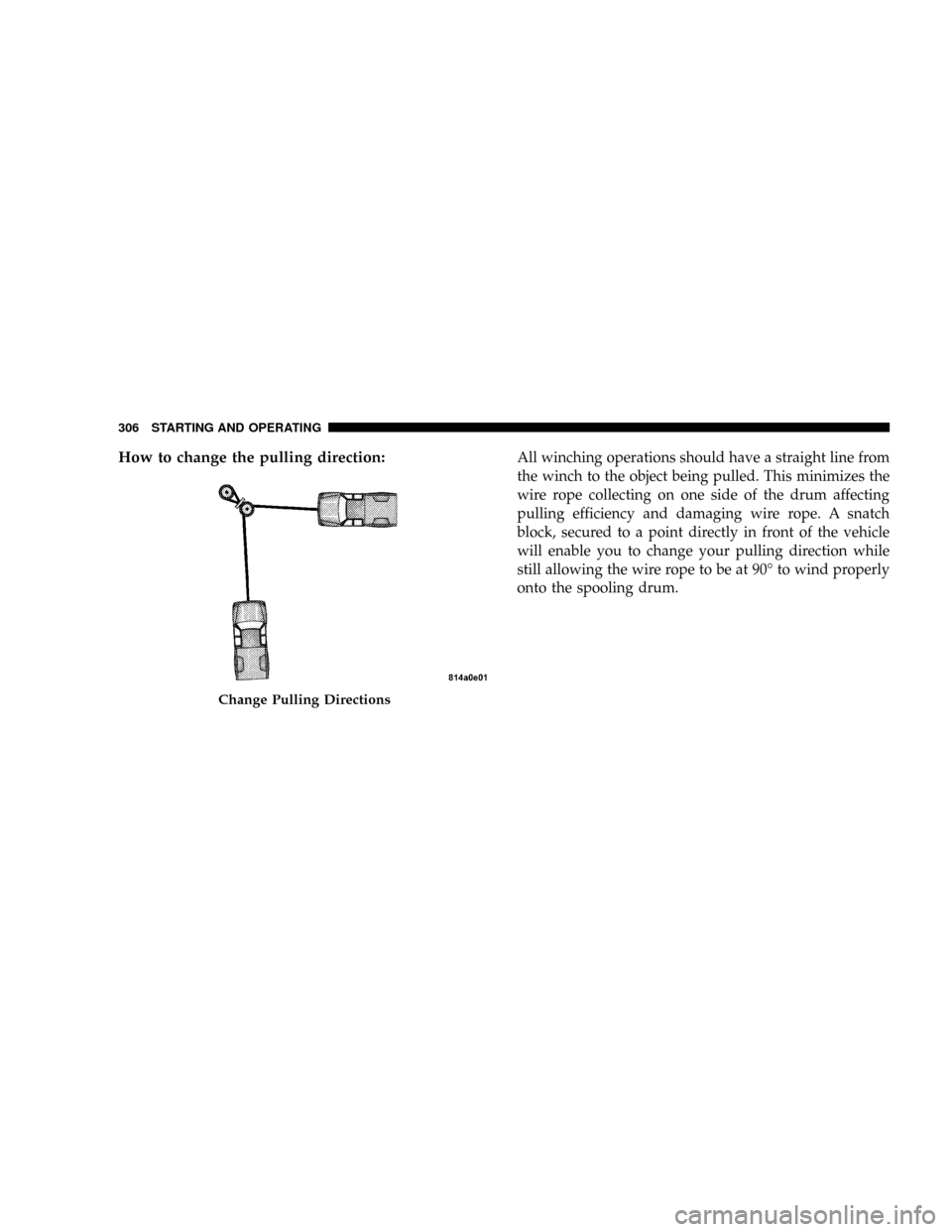
How to change the pulling direction:All winching operations should have a straight line from
the winch to the object being pulled. This minimizes the
wire rope collecting on one side of the drum affecting
pulling efficiency and damaging wire rope. A snatch
block, secured to a point directly in front of the vehicle
will enable you to change your pulling direction while
still allowing the wire rope to be at 90É to wind properly
onto the spooling drum.
Change Pulling Directions
306 STARTING AND OPERATING
Page 309 of 492

vehicle's frame/tow hook and run the wire rope through
a snatch block. Disengage the clutch and, using the
snatch block, pull out enough wire to reach your anchor
point. Do not attach hook to mounting kit. Secure to the
anchor point with a tree trunk protector or choker chain.
Attach the clevis/shackle. Attach the shackle to the two
ends of the strap/chain, being careful not to over tighten
(tighten and back-off 1/2 turn).
PARKING BRAKE
The foot operated parking brake is positioned below the
lower left corner of the instrument panel. To release the
parking brake, pull the parking brake release handle.
NOTE:The instrument cluster red brake warning light
will come on and flash to indicate that the parking brake
is applied. You must be sure that the parking brake is
fully applied before leaving the vehicle.Be sure the parking brake is firmly set when parked and
the gear shift lever is in the PARK position. When
parking on a hill you should apply the parking brake
before placing the gear shift lever in PARK, otherwise the
load on the transmission locking mechanism may make it
difficult to move the selector out of PARK.
Parking Brake Release
308 STARTING AND OPERATING
Page 344 of 492

Curb Weight
The curb weight of a vehicle is defined as the total weight
of the vehicle with all fluids, including vehicle fuel, at full
capacity conditions, and with no occupants or cargo
loaded into the vehicle. The front and rear curb weight
values are determined by weighing your vehicle on a
commercial scale before any occupants or cargo are
added.
Loading
The actual total weight and the weight of the front and
rear of your vehicle at the ground can best be determined
by weighing it when it is loaded and ready for operation.
The entire vehicle should first be weighed on a commer-
cial scale to insure that the GVWR has not been exceeded.
The weight on the front and rear of the vehicle should
then be determined separately to be sure that the load is
properly distributed over front and rear axle. Weighing
the vehicle may show that the GAWR of either the frontor rear axles has been exceeded but the total load is
within the specified GVWR. If so, weight must be shifted
from front to rear or rear to front as appropriate until the
specified weight limitations are met. Store the heavier
items down low and be sure that the weight is distributed
equally. Stow all loose items securely before driving.
Improper weight distributions can have an adverse effect
on the way your vehicle steers and handles and the way
the brakes operate.
CAUTION!
Do not load your vehicle any heavier than the
GVWR or the maximum front and rear GAWR. If
you do, parts on your vehicle can break, or it can
change the way your vehicle handles. This could
cause you to lose control. Also overloading can
shorten the life of your vehicle.
STARTING AND OPERATING 343
5
Page 353 of 492

CAUTION!
²Avoid towing a trailer for the first 500 miles (805
km) of vehicle operation. Doing so may damage
your axles, driveline and vehicle.
²During the first 500 miles (805 km) of trailer
towing, limit your speed to 50 mph (80 km/h).
Perform the maintenance listed in Section 8 of this
manual. When towing a trailer, never exceed the GAWR,
or GCWR, ratings.
WARNING!
Improper towing can lead to an injury accident.
Follow these guidelines to make your trailer towing
as safe as possible:
Make certain that the load is secured in the trailer
and will not shift during travel. When trailering
cargo that is not fully secured, dynamic load shifts
can occur that may be difficult for the driver to
control. You could lose control of your vehicle and
have an accident.
²When hauling cargo or towing a trailer, do not over-
load your vehicle or trailer. Overloading can cause a
loss of control, poor performance or damage to brakes,
axle, engine, transmission, steering, suspension, chas-
sis structure or tires.
352 STARTING AND OPERATING
Page 410 of 492

Inspect all hose connections such as clamps and cou-
plings to make sure they are secure and no leaks are
present.
Components should be replaced immediately if there is
any evidence of wear or damage that could cause failure.
Brake System
Power Disc Brakes (front and rear)
Disc brakes do not require adjustment; however, several
hard stops during the break-in period are recommended
to seat the linings and wear off any foreign material.
Brake Master Cylinder
The fluid level of the master cylinder should be checked
when performing under the hood service, or immedi-
ately if the brake system warning lamp indicates system
failure.
The brake master cylinder has a translucent plastic
reservoir. On the outboard side of the reservoir, there is aªMAXº dot and an ªMINº dot. The fluid level must be
kept within these two dots. Do not add fluid above the
MAX mark, because leakage may occur at the cap.
With disc brakes the fluid level can be expected to fall as
the brake linings wear. However, an unexpected drop in
fluid level may be caused by a leak and a system check
should be conducted.
Refer to Fluids, Lubricants and Genuine Parts for the
correct Fluid type.
WARNING!
Use of a brake fluid that may have a lower initial
boiling point, or is unidentified as to specification,
may result in sudden brake failure during hard
prolonged braking. You could have an accident.
MAINTAINING YOUR VEHICLE 409
7
Page 475 of 492

Adding Fuel........................... 339
Air Cleaner, Engine (Engine Air Cleaner Filter) . 393,417
Air Conditioner Maintenance............... 397
Air Conditioning Refrigerant.............397,398
Air Conditioning System................230,397
Air Conditioning System, Zone Control........ 233
Air Pressure, Tires....................323,332
Airbag..............................45,51
Airbag Light........................164,174
Airbag On/Off Switch..................... 51
Airbag, Side............................ 54
Alarm (Security Alarm).................18,176
Alarm System (Security Alarm)............... 18
Alignment and Balance................... 331
Alterations/Modifications, Vehicle............. 7
Antenna, Satellite Radio................... 223
Antifreeze (Engine Coolant)...........404,405,441
Disposal............................ 406
Anti-Lock Warning Light...............178,310Anti-Theft Security Alarm (Theft Alarm)........ 18
Anti-Theft System.....................18,176
Appearance Care........................ 420
Ashtray............................... 150
Automatic Dimming Mirror................. 84
Automatic Transaxle...................... 13
Interlock System........................ 16
Automatic Transmission
Adding Fluid......................... 413
Fluid and Filter Changes................. 415
Fluid Level Check...................412,413
Fluid Type........................414,443
Shift Indicator........................ 176
Shifting............................. 250
Special Additives...................... 415
Axle Fluid.......................... 411,443
Axle Lubrication (Axle Fluid)............... 411
Ball Joints............................. 399
474 INDEX