Page 310 of 400
CAUTION!
Overfilling or underfilling will cause oil aeration or
loss of oil pressure. This could damage your engine.
Checking Oil Level — 5.7L Engine
To assure proper engine lubrication, the engine oil must
be maintained at the correct level. Check the oil level at
regular intervals, such as every fuel stop.The best time to check the engine oil level is about 5
minutes after a fully warmed engine is shut off or before
starting the engine after it has sat overnight.
Checking the oil while the vehicle is on level ground will
improve the accuracy of the oil level readings. Maintain
the oil level in the “SAFE” range. Adding 1.0 quart (1.0L)
of oil when the reading is at the bottom of the “SAFE”
range will result in an oil level at the top of the “SAFE”
range on these engines.
Engine Oil Dipstick
Engine Oil Dipstick
310 MAINTAINING YOUR VEHICLE
Page 312 of 400

American Petroleum Institute (API) Engine Oil
Identification Symbol
This symbol means that the oil has
been certified by the American
Petroleum Institute (API). The
manufacture only recommends
API Certified engine oils.
Engine Oil Viscosity (SAE Grade) — 2.7L and 5.7L
Engines
SAE 5W-20 engine oil is recommended for all operating
temperatures. This engine oil improves low temperature
starting and vehicle fuel economy.
The engine oil filler cap also shows the recommended
engine oil viscosity for your engine. For information on
engine oil filler cap location, refer to the “Engine Com-
partment” illustration in this section.
NOTE:Vehicles equipped with a 5.7L engine must use
SAE 5W-20 oil. Failure to do so may result in improperoperation of the Multiple Displacement System (MDS).
Refer to “Multi Displacement System” under “Starting
and Operating” for details.
In areas where these grades are not generally available,
higher SAE grades may be used. Lubricants that have
both an SAE grade number and the API Certification
Symbol or ACEA category shown on the container
should be used.
Lubricants that do not have both the engine oil certifica-
tion mark and the correct SAE viscosity grade number
should not be used.
Engine Oil Viscosity (SAE Grade) — 3.5L Engine
SAE 10W-30 engine oil is preferred for use in 3.5L
Engines within the operating temperatures shown in the
engine oil viscosity chart. SAE 5W-30 Engine Oil is
allowed for use in the 3.5L Engine during cold weather
only to improve cold weather starting.
312 MAINTAINING YOUR VEHICLE
Page 315 of 400
WARNING!
The air induction system (air cleaner, hoses, etc) can
provide a measure of protection in the case of engine
backfire. Do not remove the air induction system (air
cleaner, hoses, etc) unless such removal is necessary
for repair or maintenance. Make sure that no one is
near the engine compartment before starting the
vehicle with the air induction system (air cleaner,
hoses, etc) removed. Failure to do so can result in
serious personal injury.
Fuel Filter
A plugged fuel filter can cause stalling, limit the speed at
which a vehicle can be driven or cause hard starting.
Should an excessive amount of dirt accumulate in the
fuel tank, filter replacement may be necessary. See your
local dealer for service.
Catalytic Converter
The catalytic converter requires the use of unleaded fuel
only. Leaded gasoline will destroy the effectiveness of the
catalyst as an emission control device.
Under normal operating conditions, the catalytic con-
verter will not require maintenance. However, it is im-
portant to keep the engine properly tuned to assure
proper catalyst operation and prevent possible catalyst
damage.
CAUTION!
Damage to the catalytic converter can result if your
vehicle is not kept in proper operating condition. In
the event of engine malfunction, particularly involv-
ing engine misfire or other apparent loss of perfor-
mance, have your vehicle serviced promptly. Contin-
ued operation of your vehicle with a severe
malfunction could cause the converter to overheat,
resulting in possible damage to the converter and the
vehicle.
MAINTAINING YOUR VEHICLE 315
7
Page 327 of 400

Hoses and Vacuum/Vapor Harnesses
Inspect surfaces of hoses and nylon tubing for evidence
of heat and mechanical damage. Hard or soft spots,
brittle rubber, cracking, tears, cuts, abrasions, and exces-
sive swelling indicate deterioration of the rubber.
Pay particular attention to those hoses nearest to high
heat sources such as the exhaust manifold. Inspect hose
routing to be sure hoses do not come in contact with any
heat source or moving component, which may cause heat
damage or mechanical wear.
Insure nylon tubing in these areas has not melted or
collapsed.
Inspect all hose connections such as clamps and cou-
plings to make sure they are secure and no leaks are
present.
Components should be replaced immediately if there is
any evidence of wear or damage that could cause failure.
Fuel System
The Electronic Fuel Injection high-pressure fuel system’s
hoses and quick connect fittings have unique material
characteristics that provide adequate sealing and resist
attack by deteriorated gasoline.
You are urged to use only the manufacture specified
hoses with quick connect fittings, or their equivalent in
material and specification, in any fuel system servicing. It
is mandatory to replace any damaged hoses or quick
connect fittings that have been removed during service.
Care should be taken in installing quick connect fittings
to insure they are properly installed and fully connected.
See your authorized dealer for service.
Brake System
In order to assure brake system performance, all brake
system components should be inspected periodically.
Suggested service intervals can be found in the “Mainte-
nance Schedule” in this manual.
MAINTAINING YOUR VEHICLE 327
7
Page 340 of 400
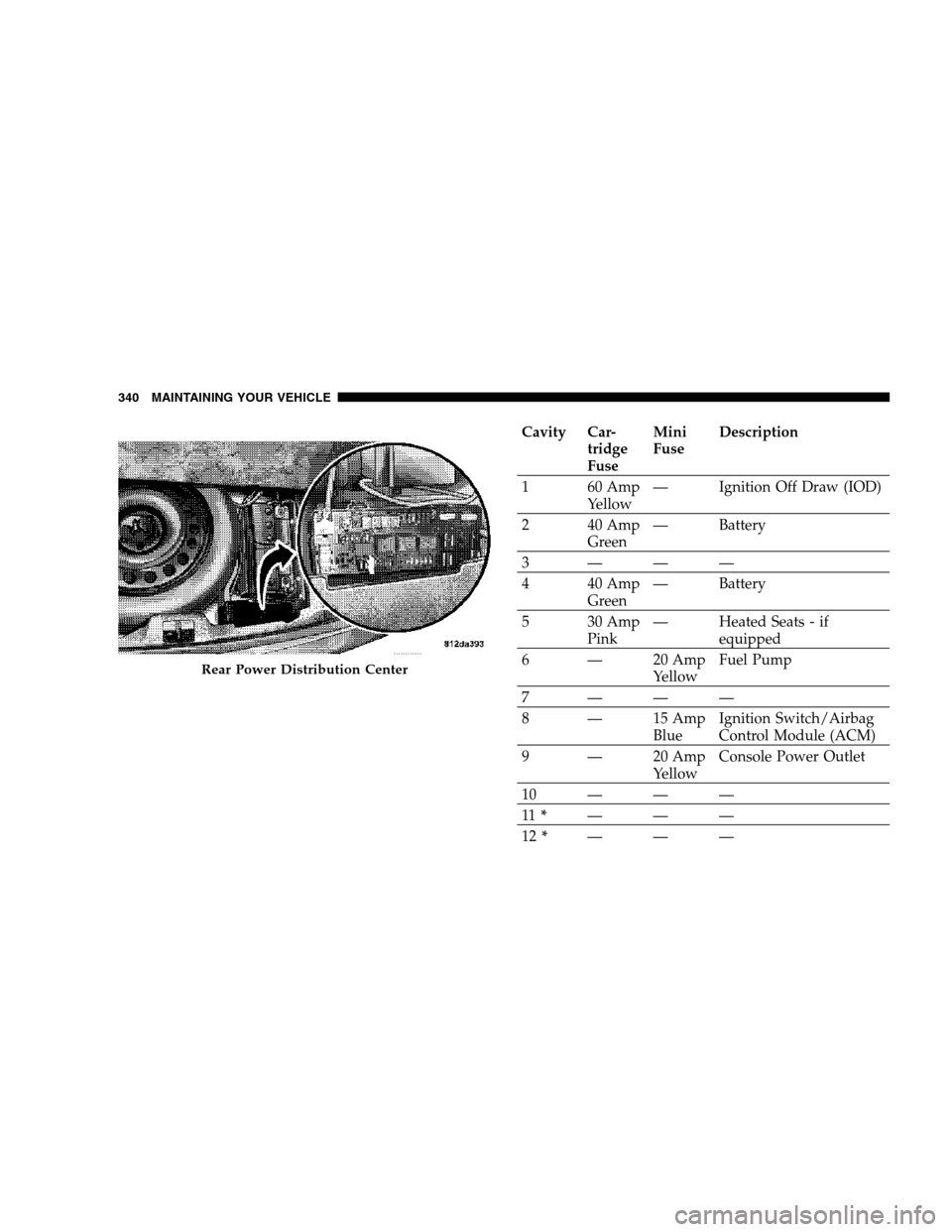
Cavity Car-
tridge
FuseMini
FuseDescription
1 60 Amp
Yellow— Ignition Off Draw (IOD)
2 40 Amp
Green— Battery
3———
4 40 Amp
Green— Battery
5 30 Amp
Pink— Heated Seats - if
equipped
6 — 20 Amp
YellowFuel Pump
7———
8 — 15 Amp
BlueIgnition Switch/Airbag
Control Module (ACM)
9 — 20 Amp
YellowConsole Power Outlet
10 — — —
11*———
12*———
Rear Power Distribution Center
340 MAINTAINING YOUR VEHICLE
Page 350 of 400

FLUIDS AND CAPACITIES
U.S. Metric
Fuel (approximate)
2.7 Liter Engine 18 gallons 68 liters
3.5 Liter Engine without All Wheel Drive 18 gallons 68 liters
3.5 Liter Engine with All Wheel Drive 19 gallons 72 liters
5.7 Liter Engine 19 gallons 72 liters
Engine Oil-With Filter
2.7 Liter Engine (SAE 5W-20, API Certified) 6.0 qts. 5.7 liters
3.5 Liter Engine (SAE 10W-30, API Certified) 6.0 qts. 5.7 liters
5.7 Liter Engine (SAE 5W-20, API Certified) 7.0 qts. 6.6 liters
Cooling System *
2.7 Liter Engine (Mopar�Antifreeze/Coolant 5 Year/100,000 Mile Formula)
or equivalent.9.9 qts 9.4 liters
3.5 Liter Engine without All Wheel Drive (Mopar�Antifreeze/Coolant 5
Year/100,000 Mile Formula) or equivalent.11.1 qts 10.5 liters
3.5 Liter Engine with All Wheel Drive (Mopar�Antifreeze/Coolant 5 Year/
100,000 Mile Formula) or equivalent.11.4 qts 10.8 liters
5.7 Liter Engine without Severe Duty II Cooling System (Mopar�
Antifreeze/Coolant 5 Year/100,000 Mile Formula) or equivalent.14.7 qts 13.9 liters
5.7 Liter Engine with Severe Duty II Cooling System (Mopar�Antifreeze/
Coolant 5 Year/100,000 Mile Formula) or equivalent.15.1 qts 14.3 liters
* Includes heater and coolant recovery bottle filled to MAX level.
350 MAINTAINING YOUR VEHICLE
Page 351 of 400

FLUIDS, LUBRICANTS, AND GENUINE PARTS
Engine
Component Fluids, Lubricants, and Genuine Parts
Engine Coolant Mopar�Antifreeze/Coolant 5 Year/100,000 Mile Formula HOAT (Hybrid Or-
ganic Additive Technology) or equivalent
Engine Oil (2.7 Liter) Use API Certified engine oil. SAE 5W-20 is recommended. Refer to the en-
gine oil fill cap for the correct SAE grade meeting DaimlerChrysler Material
Standard MS-6395.
Engine Oil (3.5 Liter) Use API Certified engine oil. SAE 10W-30 is recommended. Refer to the en-
gine oil viscosity chart for the correct SAE grade meeting DaimlerChrysler
Material Standard MS-6395.
Engine Oil (5.7 Liter) Use API Certified engine oil. SAE 5W-20 is recommended. Refer to the en-
gine oil fill cap for the correct SAE grade meeting DaimlerChrysler Material
Standard MS-6395.
Oil Filter (2.7 Liter) Mopar�05281090 or equivalent.
Oil Filter (3.5 Liter) Mopar�05281090 or equivalent.
Oil Filter (5.7 Liter) Mopar�05281090 or equivalent.
Spark Plugs Refer to the Vehicle Emission Control Information label in the engine com-
partment.
Fuel Selection (2.7 Liter) 87 Octane
Fuel Selection (3.5 Liter) 87 to 89 Octane
Fuel Selection (5.7 Liter) 87 to 89 Octane
MAINTAINING YOUR VEHICLE 351
7
Page 355 of 400

•Extensive engine idling.
•Driving in dusty conditions.
•Short trips of less than 10 miles (16 km).
•More than 50% of your driving is at sustained high
speeds during hot weather, above 90°F (32°C).
•Trailer towing.
•Taxi, police, or delivery service (commercial ser-
vice).
•Off-road or desert operation.
NOTE:IfANYof these apply to you, then change your
engine oil every 3,000 miles (5 000 km) or 3 months,
whichever comes first, and follow the maintenance rec-
ommendations in Schedule “B” in this section.
NOTE:IfANYof these apply to you, then flush and
replace the engine coolant every 102,000 miles (170 000
km) or 60 months, whichever comes first, and follow the
maintenance recommendations in Schedule “B” in this
section.
NOTE:Most vehicles are operated under the conditions
listed for Schedule�B.�
Second is Schedule“A.”It is for vehicles that are not
operated under any of the conditions listed under Sched-
ule�B.�
Use the schedule that best describes your driving condi-
tions. Where time and mileage are listed, follow the
interval that occurs first.
NOTE:Under no circumstances should oil change
intervals exceed 6,000 miles (10 000 km) or 6 months
whichever comes first.
CAUTION!
Failure to perform the required maintenance items
may result in damage to the vehicle.
At Each Stop for Fuel
•
Check the engine oil level about 5 minutes after a fully
warmed engine is shut off. Checking the oil level while
MAINTENANCE SCHEDULES 355
8
M
A
I
N
T
E
N
A
N
C
E
S
C
H
E
D
U
L
E
S