Page 73 of 400

Safety Checks You Should Make Inside The
Vehicle
Heater Defroster Ducts
Inspect the heater defroster ducts for proper operation.
Check for proper air flow through all defroster ducts. If
there are any question regarding the operation of your
heater defroster ducts, have the system checked by an
authorized dealer
Seat Belts
Inspect the belt system periodically, checking for cuts,
frays and loose parts. Damaged parts must be replaced
immediately. Do not disassemble or modify the system.
Seat belt assemblies must be replaced after an accident if
they have been damaged (bent retractor, torn webbing,
etc.) or if the front airbags have deployed. If there is any
question regarding belt or retractor condition, replace the
belt.
Airbag Light
The light should come on and remain on for 6 to 8
seconds as a bulb check when the ignition switch is first
turned ON. If the light is not lit during starting, see you
authorized dealer. If the light stays on, flickers or comes
on while driving, have the system checked by an autho-
rized dealer. If there is a problem with the airbag light the
seatbelt light will flash.
Safety Checks You Should Make Outside The
Vehicle
Tires
Examine tires for tread wear or uneven wear patterns.
Check for stones, nails, glass or other objects lodged in
the tread.
Inspect for tread cuts or sidewall cracks. Check wheel
nuts for tightness and tires for proper pressure.
THINGS TO KNOW BEFORE STARTING YOUR VEHICLE 73
2
Page 83 of 400
WARNING!
Adjusting a seat while the vehicle is moving is
dangerous. The sudden movement of the seat could
cause you to lose control. The seat belt might not be
properly adjusted and you could be injured. Adjust
any seat only while the vehicle is parked.
Front Seats Manual Seat Recliners
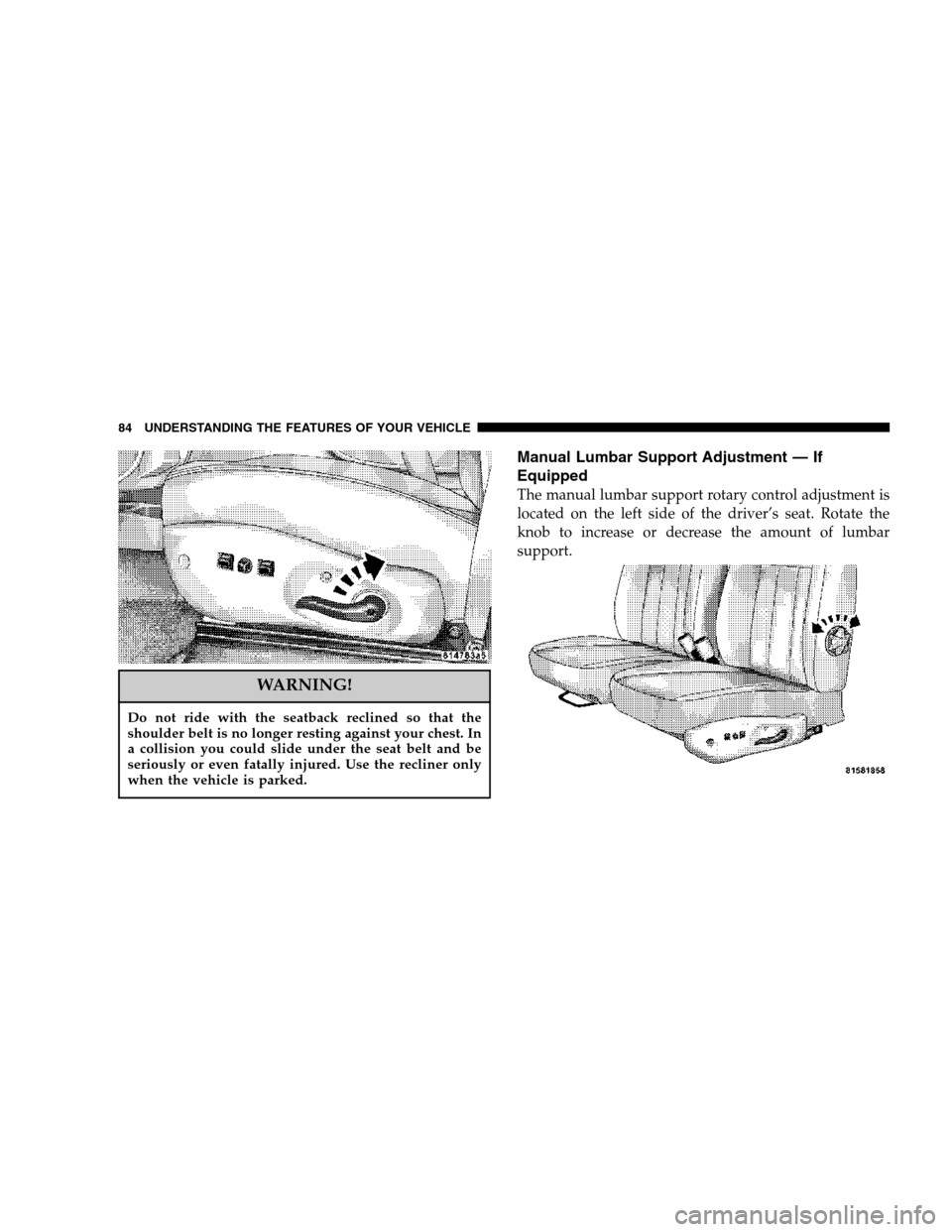
The front seats are equipped with recliners. The reclining
mechanism is operated by a lever located on the right
side of the passenger’s seat and the left side of the
driver’s seat. To recline, lean forward slightly before
lifting the lever, then push back to the desired position
and release the lever. Lean forward and lift the lever to
return the seatback to its normal position. Using body
pressure, lean forward and rearward on the seat to be
sure the seatback is locked.
UNDERSTANDING THE FEATURES OF YOUR VEHICLE 83
3
Page 84 of 400
WARNING!
Do not ride with the seatback reclined so that the
shoulder belt is no longer resting against your chest. In
a collision you could slide under the seat belt and be
seriously or even fatally injured. Use the recliner only
when the vehicle is parked.
Manual Lumbar Support Adjustment — If
Equipped
The manual lumbar support rotary control adjustment is
located on the left side of the driver’s seat. Rotate the
knob to increase or decrease the amount of lumbar
support.
84 UNDERSTANDING THE FEATURES OF YOUR VEHICLE
Page 118 of 400

the sunroof and the sunroof will remain in the partial
vent position until the switch is pushed forward again.
Express Open Feature
During the Express Open operation, any movement of
the switch will stop the sunroof and it will remain in a
partial open position. Again, momentarily pressing the
switch rearward will activate the Express Open Feature.
To close the sunroof, hold the switch in the forward
position. Again, any release of the switch will stop the
movement and the sunroof will remain in a partial open
condition until the switch is pushed forward again. The
sunroof is not completely closed until the rear of the
sunroof glass moves upward at the end of it’s travel.
The sunshade can be opened manually. It will also open
as the sunroof opens. The sunshade cannot be closed if
the sunroof is open.
WARNING!
•In an accident, there is a greater risk of being
thrown from a vehicle with an open sunroof. You
could also be seriously injured or killed. Always
fasten your seat belt properly and make sure all
passengers are properly secured too.
•Do not allow small children to operate the sun-
roof. Never allow fingers or other body parts, or
any object to project through the sunroof opening.
Injury may result.
118 UNDERSTANDING THE FEATURES OF YOUR VEHICLE
Page 137 of 400

left/right turn signal is left on with the engine RPM
vehicle speed greater than 15 mph (24 km/h) for more
than one mile.
4. Low Fuel Warning Light
This indicator lights when the fuel gauge reads 1/8
of a tank or less. There is a pointer on the side of
this symbol that indicates the side that your fuel
filler door is located.
5. High Beam Indicator
Indicates that headlights are on high beam.
6. Seat Belt Reminder Light
This light comes on for several seconds after the
ignition is turned ON as a reminder to “buckle
up.” This light will remain on as long as the seat
belt remains unbuckled. If this light flashes, it indicates a
fault in the airbag system. Have the system checked by
an authorized dealer.7. Fog Light Indicator — If Equipped
This light shows when the fog lights are ON.
8. Coolant Temperature Light
This light warns of an overheated engine condi-
tion. For a bulb check, this light will come on
momentarily when the ignition is turned On. If the
light turns on while driving, stop the vehicle, shift into N
(Neutral) and increase the engine speed for 2 to 3
minutes. If the temperature reading does not return to
normal, seek authorized service immediately.
INSTRUMENT PANEL AND CONTROLS 137
4
Page 284 of 400
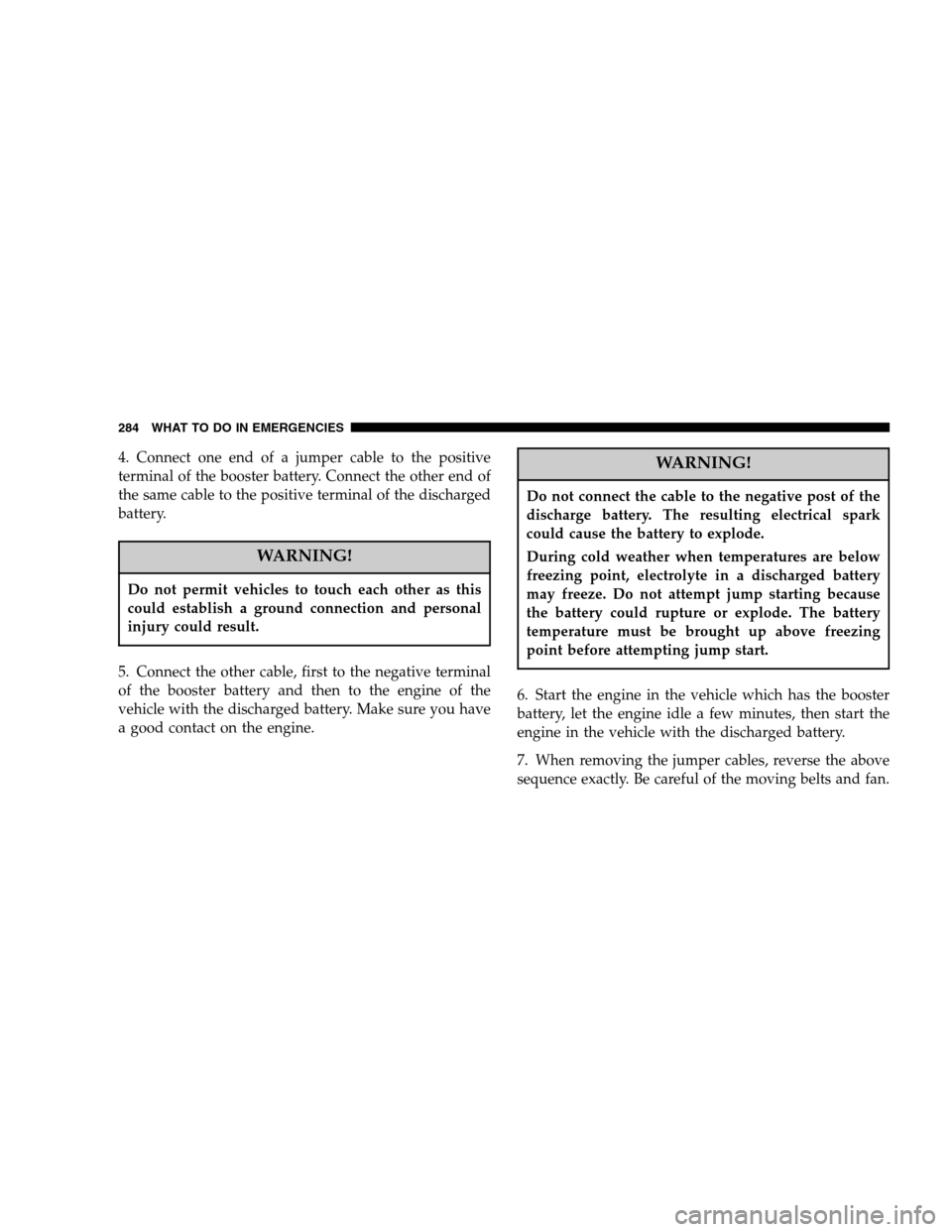
4. Connect one end of a jumper cable to the positive
terminal of the booster battery. Connect the other end of
the same cable to the positive terminal of the discharged
battery.
WARNING!
Do not permit vehicles to touch each other as this
could establish a ground connection and personal
injury could result.
5. Connect the other cable, first to the negative terminal
of the booster battery and then to the engine of the
vehicle with the discharged battery. Make sure you have
a good contact on the engine.
WARNING!
Do not connect the cable to the negative post of the
discharge battery. The resulting electrical spark
could cause the battery to explode.
During cold weather when temperatures are below
freezing point, electrolyte in a discharged battery
may freeze. Do not attempt jump starting because
the battery could rupture or explode. The battery
temperature must be brought up above freezing
point before attempting jump start.
6. Start the engine in the vehicle which has the booster
battery, let the engine idle a few minutes, then start the
engine in the vehicle with the discharged battery.
7. When removing the jumper cables, reverse the above
sequence exactly. Be careful of the moving belts and fan.
284 WHAT TO DO IN EMERGENCIES
Page 289 of 400
MAINTAINING YOUR VEHICLE
CONTENTS
�3.7L/4.7L Engine Compartment.............292
�Onboard Diagnostic System — OBD II........293
▫Loose Fuel Filler Cap Message............293
�Emissions Inspection And Maintenance
Programs............................294
�Replacement Parts......................295
�Dealer Service.........................296
�Maintenance Procedures..................296
▫Engine Oil..........................297▫Engine Oil Filter......................300
▫Drive Belts — Check Condition And Tension . . 301
▫Spark Plugs.........................301
▫Engine Air Cleaner Filter................302
▫Engine Fuel Filter.....................302
▫Catalytic Converter....................302
▫Maintenance Free Battery................304
▫Air Conditioner Maintenance.............305
▫Power Steering — Fluid Check............306
7
Page 301 of 400

Drive Belts — Check Condition and Tension
Belt tension is controlled by means of an automatic
tensioner. No belt tension adjustments are required.
However, belt and belt tensioner condition should be
inspected at the specified intervals, and replaced if re-
quired. See your authorized dealer for service
At the mileage indicated in the maintenance schedule, all
belts and tensioner should be checked for condition.
Improper belt tension can cause belt slippage and failure.
Belts should be inspected for evidence of cuts, cracks,
glazing, or frayed cords and replaced if there is indication
of damage which could result in belt failure. Low gen-
erator belt tension can cause battery failure.
Also check belt routing to make sure there is no interfer-
ence between the belts and other engine components.
Spark Plugs
Spark plugs must fire properly to assure proper engine
performance and emission control. The plugs installed in
your vehicle should operate satisfactorily in normal
service for the mileage indicated in the Maintenance
Chart. New plugs should be installed at this mileage. The
entire set should be replaced if there is any malfunction
due to a faulty spark plug. Check the Vehicle Emissions
Control Information label for the proper type of spark
plug for your vehicle.
CAUTION!
When replacing plugs, do not overtighten. You could
damage them and cause them to leak.
MAINTAINING YOUR VEHICLE 301
7