Page 192 of 400
WARNING!
Your vehicle could move and injure you and others if
it is not completely in P (Park). Check by trying to
move the gearshift lever back and forth without first
pulling the lever toward you, after you have set it in
P (Park). Make sure it is in Park before leaving the
vehicle.
WARNING!
Never use Park position on an automatic transmis-
sion as a substitute for the parking brake. Always
apply parking brake fully when parked to guard
against vehicle movement and possible injury or
damage.
WARNING!
It is dangerous to shift the selector lever out of “P” or
“N” if the engine speed is higher than idle speed. If
your foot is not firmly on the brake pedal, the
vehicle could accelerate quickly forward or in re-
verse. You could lose control of the vehicle and hit
someone or something. Only shift into gear when
the engine is idling normally and when your right
foot is firmly on the brake pedal.
192 STARTING AND OPERATING
Page 193 of 400

“R” Reverse
Use this range only after the vehicle has come to a
complete stop.
“N” Neutral
Shift to Neutral when vehicle is standing for prolonged
periods with engine running. Engine may be started in
this range. Set the parking brake if you must leave the
vehicle.
“D” Drive
For most city and highway driving.
“2” Second
For driving slowly in heavy city traffic or on mountain
roads where more precise speed control is desirable. Use
it also when climbing long grades, and for engine brak-
ing when descending moderately steep grades. To pre-
vent excessive engine speed do not exceed 45 miles per
hour (72 km/h) in this range.“1” First
For driving up very steep hills and for engine braking at
low speeds 25 mph (40 km/h) or less when going down
hill. To prevent excessive engine speed do not exceed 25
mph (40 km/h) in this range.
Overdrive Operation
The overdrive automatic transmission contains an elec-
tronically controlled fourth and fifth (if equipped) speed
(Overdrive). The transmission will automatically shift
from Drive to Overdrive if the following conditions are
present:
•the transmission selector is in Drive;
•the engine coolant has reached normal operating tem-
perature;
•vehicle speed is above approximately 30 mph (48
km/h);
•the “TOW/HAUL” switch has not been activated;
STARTING AND OPERATING 193
5
Page 194 of 400

•transmission has reached normal operating tempera-
ture.
NOTE:If the vehicle is started in extremely cold tem-
peratures, the transmission may not shift into Overdrive
and will automatically select the most desirable gear for
operation at this temperature. Normal operation will
resume when the transmission fluid temperature has
risen to a suitable level. Refer also to the Note under
torque converter clutch, later in this section.
If the transmission temperature gets extremely hot, the
transmission will automatically select the most desirable
gear for operation at this temperature. If the transmission
temperature becomes hot enough the TRANS TEMP light
may illuminate and the transmission may downshift out
of Overdrive until the transmission cools down. After
cooldown, the transmission will resume normal opera-
tion.The transmission will downshift from Overdrive to Drive
if the accelerator pedal is fully depressed at vehicle
speeds above approximately 35 mph (56 km/h).
When To Use “TOW/HAUL” Mode
When driving in hilly areas, towing a trailer, carrying a
heavy load, etc., and frequent transmission shifting oc-
curs, press the “TOW/HAUL” button. This will improve
194 STARTING AND OPERATING
Page 195 of 400

performance and reduce the potential for transmission
overheating or failure due to excessive shifting. When
operating in “TOW/HAUL” mode, 5th gear (if
equipped) is disabled and 2-3 and 3-4 shift patterns are
modified. Shifts into Overdrive (4th gear) are allowed
during steady cruise (for improved fuel economy) and
automatic closed-throttle downshifts to 3rd gear (for
improved braking) will occur during steady braking.
The “TOW/HAUL” light will illuminate in the instru-
ment cluster to indicate when the switch has been
activated. Pressing the switch a second time restores
normal operation. If the “TOW/HAUL” mode is desired,
the button must be pressed each time the engine is
started.
Torque Converter Clutch
A feature designed to improve fuel economy is included
in all automatic transmissions. A clutch within the torque
converter engages automatically at a calibrated speed atlight throttle. It engages at higher speeds under heavier
acceleration. This may result in a slightly different feeling
or response during normal operation in high gear. When
the vehicle speed drops below a calibrated speed, or
during acceleration, the clutch automatically and
smoothly disengages. The feature is operational in Over-
drive and in Drive.
NOTE:The torque converter clutch will not engage
until the transmission fluid and engine coolant are warm
[usually after 1-3 miles (1.6 - 4.8 km) of driving]. Because
the engine speed is higher when the torque converter
clutch is not engaged, it may seem as if the transmission
is not shifting into Overdrive when cold. This is normal.
Pressing the�TOW/HAUL�button, when the transmis-
sion is sufficiently warm, will demonstrate that the
transmission is able to shift into and out of Overdrive.
NOTE:If the vehicle has not been driven in several
days, the first few seconds of operation after shifting the
STARTING AND OPERATING 195
5
Page 196 of 400

transmission into gear may seem sluggish. This is due to
the fluid partially draining from the torque converter into
the transmission. This condition is normal and will not
cause damage to the transmission. The torque converter
will refill within five seconds of shifting from Park into
any other gear position.
MANUAL TRANSMISSION
WARNING!
You or others could be injured if you leave the
vehicle unattended without having the parking
brake fully applied. The parking brake should al-
ways be applied when the driver is not in the
vehicle, especially on an incline.
This model is equipped with a clutch interlocking igni-
tion system. The clutch pedal must be fully depressed to
start the vehicle.
Fully depress the clutch pedal before shifting gears. As
you release the clutch pedal, lightly depress the accelera-
tor pedal. When launching a stationary vehicle, keep the
engine speed low until the clutch is fully engaged.
NOTE:Always launch in first gear. Damage to the
clutch can result from launching in 2nd gear or 3rd gear.
Use each gear in numerical order, do not skip a gear.
When shifting from 5th to 6th gear, do not apply exces-
sive knob load toward the Reverse gear gate, as you may
overpower Reverse crash-through load and unintention-
ally clash into Reverse gear. Also, when shifting from 6th
to 5th gear, excessive knob load toward the Reverse gear
gate will result in blocking of the shift.
196 STARTING AND OPERATING
Page 197 of 400
To shift into Reverse, come to a complete stop. Depress
the clutch and pause briefly to allow the gear train to
stop. Reverse has a�crash-through�lockout feature. In
order to get into the reverse gate you should start in
neutral 3/4 and move rapidly into the reverse gate in one
swift motion. If you move slowly toward reverse you will
encounter a very high load which makes it difficult to
enter the gate.
Never drive with your foot resting on the clutch pedal, or
attempt to hold the vehicle on a hill with the clutch pedal
partially engaged, as this will cause abnormal wear on
the clutch.
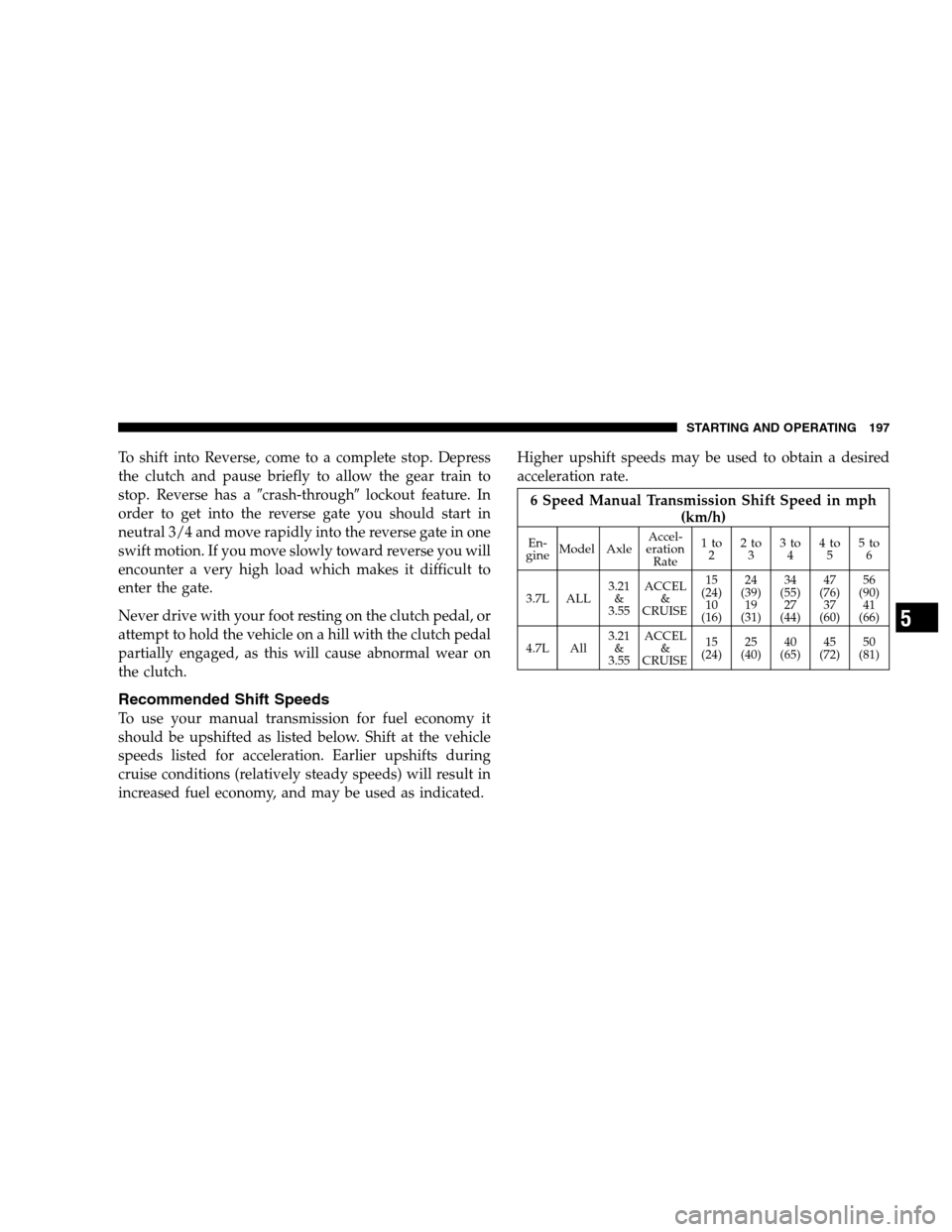
Recommended Shift Speeds
To use your manual transmission for fuel economy it
should be upshifted as listed below. Shift at the vehicle
speeds listed for acceleration. Earlier upshifts during
cruise conditions (relatively steady speeds) will result in
increased fuel economy, and may be used as indicated.Higher upshift speeds may be used to obtain a desired
acceleration rate.
6 Speed Manual Transmission Shift Speed in mph
(km/h)
En-
gineModel AxleAccel-
eration
Rate1to
22to
33to
44to
55to
6
3.7L ALL3.21
&
3.55ACCEL
&
CRUISE15
(24)
10
(16)24
(39)
19
(31)34
(55)
27
(44)47
(76)
37
(60)56
(90)
41
(66)
4.7L All3.21
&
3.55ACCEL
&
CRUISE15
(24)25
(40)40
(65)45
(72)50
(81) STARTING AND OPERATING 197
5
Page 199 of 400

FOUR-WHEEL DRIVE OPERATION
NV233/243 GII Transfer Case Operating
Information/Precautions
The NV233/243 is an electric shift transfer case and is
operated by the 4WD Control Switch (Transfer Case
Switch), which is located on the instrument panel.
The NV233/243 transfer case provides 4 mode positions:
2 (rear) wheel drive high range, 4 wheel drive high range,
4 wheel drive low range, and neutral.
The NV233/243 transfer case is designed to be driven in
the 2 wheel drive position (2WD) for normal street and
highway conditions (dry hard surfaced roads).
When additional traction is required, the transfer case
4WD LOCK and 4WD LOW positions can be used to lock
the front and rear driveshafts together and force the front
and rear wheels to rotate at the same speed. This is
accomplished by rotating the 4WD Control Switch to thedesired position - see Shifting Procedure section for
specific shifting instructions. The 4WD LOCK and 4WD
LOW positions are designed for loose or slippery road
surfaces only. Driving in the 4WD LOCK and 4WD LOW
positions on dry hard-surfaced roads may cause in-
creased tire wear and damage to the driveline compo-
nents.
The transfer case Neutral (N) position is selected by
depressing the recessed button located on the lower left
hand corner of the 4WD Control Switch.
NOTE:The transfer case Neutral (N) position is to be
used for recreational towing only. See Recreational Tow-
ing section for specific procedures on shifting into and
out of Neutral (N).
Transfer Case Position Indicator Lights
Transfer case position indicator lights are located on the
instrument cluster. If there is no indicator light on or
flashing, the transfer case position is two-wheel drive
STARTING AND OPERATING 199
5
Page 202 of 400

4WD LOCK
4 Wheel Drive Lock (4WD LOCK) Range - Locks the front
and rear driveshafts together. Forces the front and rear
wheels to rotate at the same speed. Additional traction
for loose or slippery road surfaces only.
4WD LOW
4 Wheel Drive Low (4WD LOW) Range - Low speed 4
wheel drive. Locks the front and rear driveshafts to-
gether. Forces the front and rear wheels to rotate at the
same speed. Additional traction and maximum pulling
power for loose or slippery road surfaces only. Do not
exceed 25 mph (40 km/h).
N
Neutral - Disengages both the front and rear driveshafts
from the powertrain. To be used for flat towing behind
another vehicle. See Recreational Towing for more infor-
mation.Shifting Procedure - NV233/243 Transfer Case
NOTE:If any of the requirements to select a new
transfer case position have not been met, the transfer case
will not shift, the indicator light for the previous position
will remain ON, and the newly selected position indica-
tor light will continue to flash until all the requirements
for the selected position have been met. To retry a shift:
202 STARTING AND OPERATING