Page 245 of 384
Base System — If Equipped
The Tire Pressure Monitor System (TPMS) uses wireless
technology with wheel rim mounted electronic sensors to
monitor tire pressure levels. Sensors, mounted to each
wheel as part of the valve stem, transmit tire pressure
readings to the Receiver Module.
NOTE:It is particularly important for you to check the
tire pressure in all of the tires on your vehicle regularly
and to maintain the proper pressure.
The TPMS consists of the following components:
•Receiver Module
•4 Tire Pressure Monitoring Sensors
•Tire Pressure Monitoring Telltale Light
Tire Pressure Monitoring Low Pressure Warnings
The Tire Pressure Monitoring Telltale Light will
illuminate in the instrument cluster and an audible
chime will sound when tire pressure is low in one
or more of the four active road tires. The audible chime
will sound once every ignition cycle for each condition
that it detects. Should this occur, you should stop as soonas possible, check the inflation pressure of each tire on
your vehicle, and inflate each tire to the vehicle’s recom-
mended cold placard pressure value. Once the system
receives the updated tire pressures, the system will
automatically update and the Tire Pressure Monitoring
Telltale Light will turn off. The vehicle may need to be
driven for up to 10 minutes above 15 mph (25 km/h) in
order for the TPMS to receive this information. Low
pressure in the spare tire will not cause the Tire Pressure
Monitoring Telltale Light to illuminate or the chime to
sound.
Check TPMS Warning
The Tire Pressure Monitoring Telltale Light will flash on
and off for 60 seconds and an audible chime will sound
when a system fault is detected. The flash cycle will
repeat every ten minutes, without an audible chime, until
the fault condition no longer exists. If the ignition key is
cycled, this sequence will repeat, providing the system
fault still exists.
STARTING AND OPERATING 245
5
Page 247 of 384
Tire Pressure Monitoring Low Pressure Warnings
The Tire Pressure Monitoring Telltale Light will
illuminate in the instrument cluster and an audible
chime will sound when tire pressure is low in one
or more of the four active road tires. The audible chime
will sound once every ignition cycle for each condition
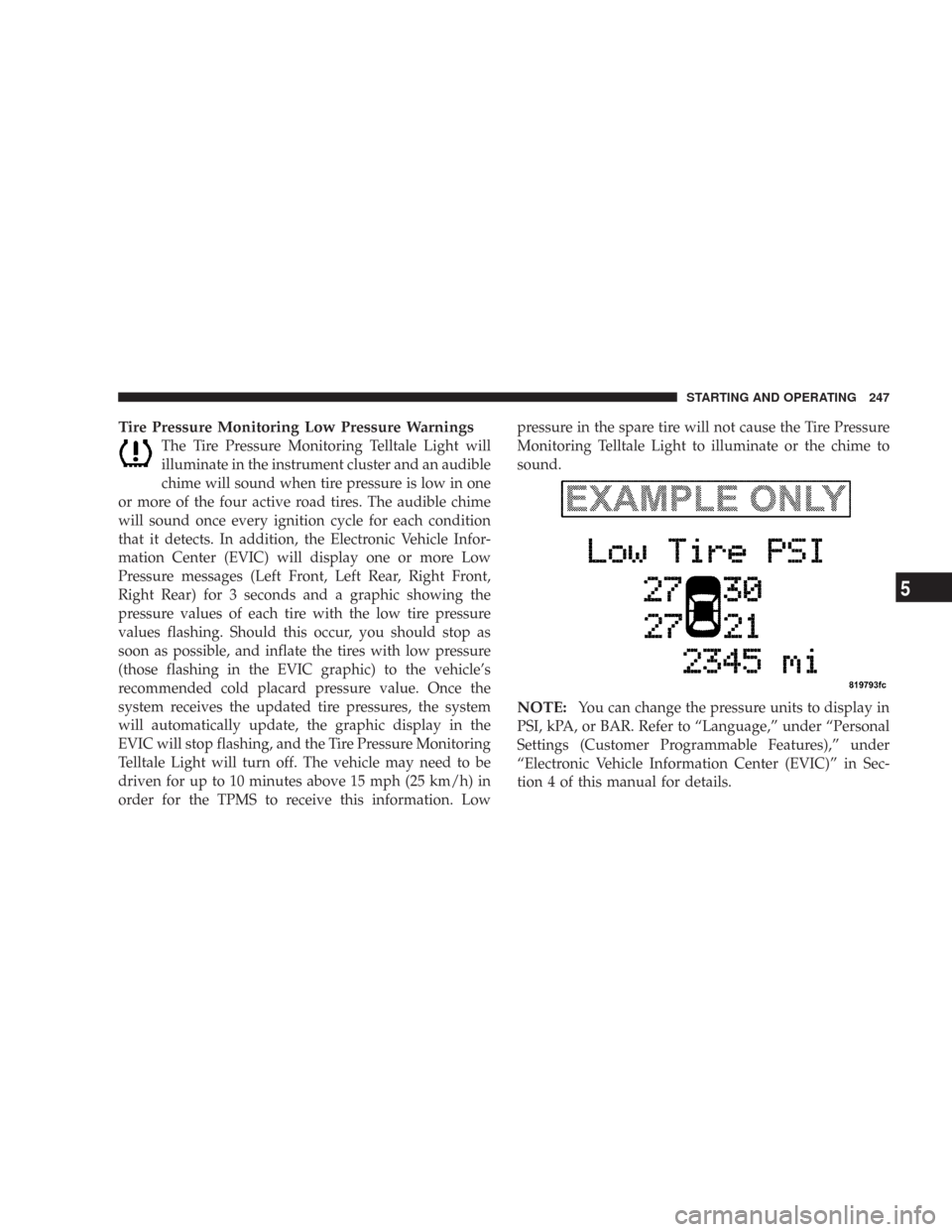
that it detects. In addition, the Electronic Vehicle Infor-
mation Center (EVIC) will display one or more Low
Pressure messages (Left Front, Left Rear, Right Front,
Right Rear) for 3 seconds and a graphic showing the
pressure values of each tire with the low tire pressure
values flashing. Should this occur, you should stop as
soon as possible, and inflate the tires with low pressure
(those flashing in the EVIC graphic) to the vehicle’s
recommended cold placard pressure value. Once the
system receives the updated tire pressures, the system
will automatically update, the graphic display in the
EVIC will stop flashing, and the Tire Pressure Monitoring
Telltale Light will turn off. The vehicle may need to be
driven for up to 10 minutes above 15 mph (25 km/h) in
order for the TPMS to receive this information. Lowpressure in the spare tire will not cause the Tire Pressure
Monitoring Telltale Light to illuminate or the chime to
sound.
NOTE:You can change the pressure units to display in
PSI, kPA, or BAR. Refer to “Language,” under “Personal
Settings (Customer Programmable Features),” under
“Electronic Vehicle Information Center (EVIC)” in Sec-
tion 4 of this manual for details.
STARTING AND OPERATING 247
5
Page 266 of 384
•Vehicles with trailers should not be parked on a grade.
When parking, apply the parking brake on the tow
vehicle. Put the tow vehicle automatic transmission in
P for Park. Always, block or�chock�the trailer wheels.
•GCWR must not be exceeded.
•Total weight must be distributed between the tow
vehicle and the trailer such that the following four
ratings are not exceeded:
1. GVWR
2. GTW
3. GAWR
4. Tongue weight rating for the trailer hitch utilized
(This requirement may limit the ability to always
achieve the 10% to 15% range of tongue weight as a
percentage of total trailer weight).
Towing Requirements — Tires
Do not attempt to tow a trailer while using a compact
spare tire.
Proper tire inflation pressures are essential to the safe
and satisfactory operation of your vehicle. Refer to
“Tires–General Information” in this section for infor-
mation on tire pressures and for proper tire inflation
procedures.
Also, check the trailer tires for proper tire inflation
pressures before trailer usage.
Check for signs of tire wear or visible tire damage
before towing a trailer. Refer to “Tires–General Infor-
mation” in this section for information on tread wear
indicators and for the proper inspection procedure.
When replacing tires, refer to “Tires–General Informa-
tion” in this section for information on replacement
tires and for the proper tire replacement procedures.
Replacing tires with a higher load carrying capacity
will not increase the vehicle’s GVWR and GAWR
limits.
266 STARTING AND OPERATING
Page 271 of 384
WHAT TO DO IN EMERGENCIES
CONTENTS
�Hazard Warning Flasher.................272
�If Your Engine Overheats................272
�Jacking And Tire Changing...............274
▫Preparations For Jacking................274
▫Jack Location/Spare Tire Stowage..........275
▫Jacking And Changing a Tire.............277
▫Compact Spare Tire....................280
▫Wheel Cover Installation (If Required)......281
�Jump-Starting Procedures................282
�Freeing A Stuck Vehicle.................284
�Towing A Disabled Vehicle...............285
▫Without The Ignition Key...............285
▫Towing This Vehicle Behind Another Vehicle
(Flat Towing With All Four Wheels
On The Ground)......................285
▫Towing This Vehicle Behind Another Vehicle
With A Tow Dolly.....................286
6
Page 277 of 384
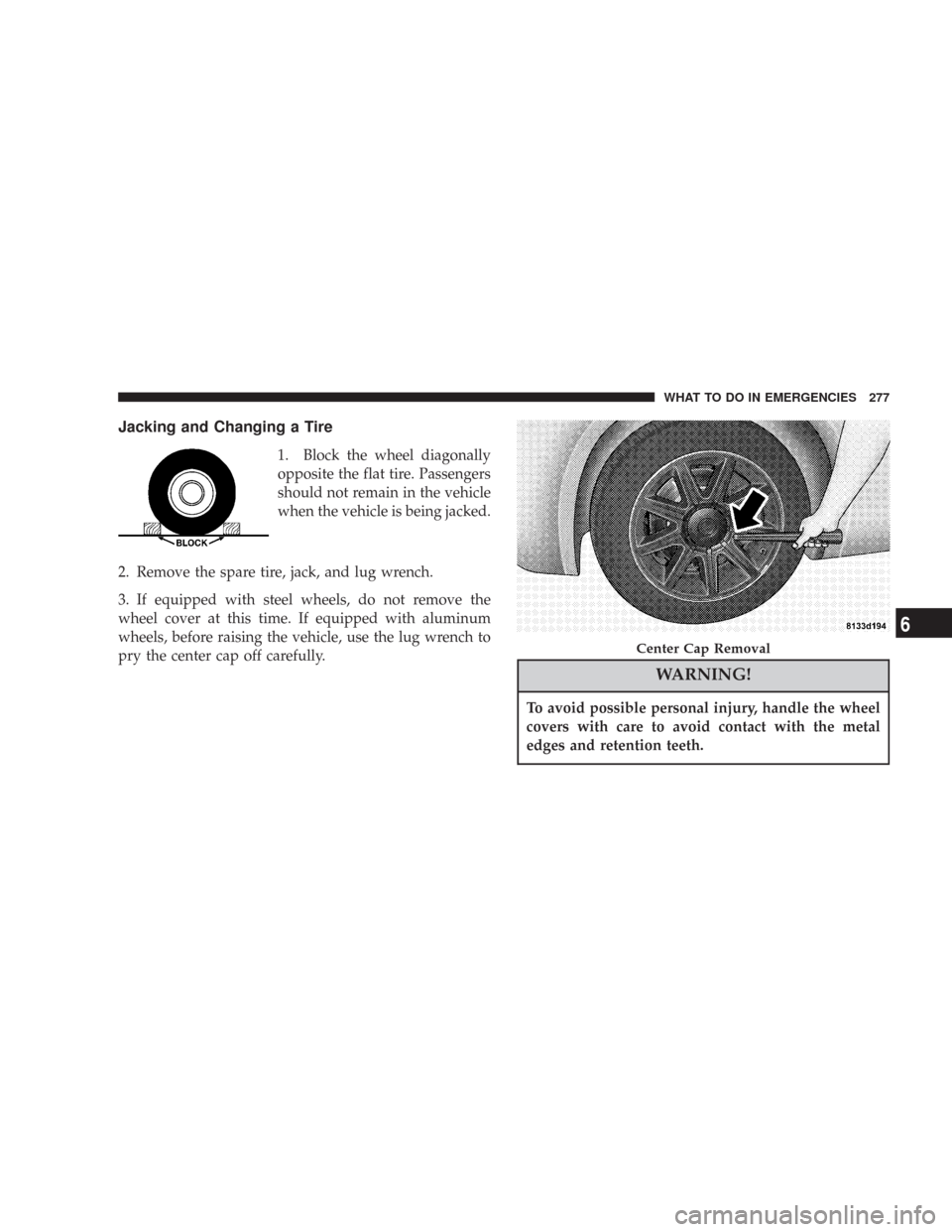
Jacking and Changing a Tire
1. Block the wheel diagonally
opposite the flat tire. Passengers
should not remain in the vehicle
when the vehicle is being jacked.
2. Remove the spare tire, jack, and lug wrench.
3. If equipped with steel wheels, do not remove the
wheel cover at this time. If equipped with aluminum
wheels, before raising the vehicle, use the lug wrench to
pry the center cap off carefully.
WARNING!
To avoid possible personal injury, handle the wheel
covers with care to avoid contact with the metal
edges and retention teeth.
Center Cap Removal
WHAT TO DO IN EMERGENCIES 277
6
Page 278 of 384
4. Before raising the vehicle, use the lug wrench to
loosen, but not remove, the lug nuts on the wheel with
the flat tire. Turn the lug nuts counter-clockwise one turn
while the wheel is still on the ground.5. Place the jack underneath the lift area that is closest to
the flat tire. Turn the jack screw clockwise to firmly
engage the jack saddle with the lift area of the sill flange.
278 WHAT TO DO IN EMERGENCIES
Page 280 of 384
6. Raise the vehicle just enough to remove the flat tire
and install the spare tire.
WARNING!
Raising the vehicle higher than necessary can make
the vehicle less stable. It could slip off the jack and
hurt someone near it. Raise the vehicle only enough
to remove the tire.
7. Remove the lug nuts, wheel cover (if equipped), and
tire. Remove the cover by hand. Do not pry it off.
8. Mount the spare tire. For vehicles equipped with
wheel covers, refer to “Wheel Cover Installation.” Do not
attempt to install a wheel cover on a compact spare.
9. Tighten all the lug nuts on the mounting studs.
10. Lower the vehicle to the ground by turning the jack
handle counter-clockwise.
11. Fully tighten the lug nuts. Torque the wheel lug nuts
to 100 ft/lb. (135 N. m).12. Store the flat tire, jack, and tools.
WARNING!
A loose tire or jack thrown forward in a collision or
hard stop could endanger the occupants of the ve-
hicle. Always stow the jack parts and the spare tire in
the places provided.
Compact Spare Tire
The compact spare tire is for temporary emergency use
with radial tires. It is engineered to be used on your style
vehicle only. Since this tire has limited tread life, the
original tire should be repaired (or replaced) and rein-
stalled at the first opportunity.
•Keep tire inflated to 60 PSI (414 KPa) Cold Inflation
Pressure.
•Avoid driving more than 50 miles (80 km) before
replacing tire and wheel.
•This tire is designed as an emergency spare only. Do
not exceed 50 MPH (80 km/h) speed.
280 WHAT TO DO IN EMERGENCIES
Page 285 of 384
CAUTION!
•When “rocking” a stuck vehicle by moving be-
tween “First” and R (Reverse), do not spin the
wheels faster than 15 mph (24 km/h), or drivetrain
damage may result.
•Racing the engine or spinning the wheels too fast
may lead to transmission overheating and failure.
It can also damage the tires. Do not spin the
wheels above 35 mph (55 km/h).
WARNING!
Fast spinning tires can be dangerous. Forces gener-
ated by excessive wheel speeds may cause tire dam-
age or failure. A tire could explode and injure
someone. Do not spin your vehicle’s wheels faster
than 35 mph (55 km/h) when you are stuck, and don’t
let anyone near a spinning wheel, no matter what the
speed.
TOWING A DISABLED VEHICLE
WITHOUT THE IGNITION KEY
Special care must be taken when the vehicle is towed
with the ignition in the LOCK position. The only ap-
proved method of towing without the ignition key is
with a flat bed truck. Proper towing equipment is neces-
sary to prevent damage to the vehicle.
TOWING THIS VEHICLE BEHIND ANOTHER
VEHICLE (Flat towing with all four wheels on the
ground)
Flat towing of vehicles equipped with an automatic
transmission, is only permitted within the following
limitations:
With The Ignition Key
Your vehicle may be towed under the following condi-
tions: The gear selector must be in NEUTRAL, the
distance to be traveled must not exceed 30 miles (48 km),
and the towing speed must not exceed 30 mph (48
WHAT TO DO IN EMERGENCIES 285
6