Page 390 of 464
hot fluid when systems are under pressure (during
vehicle operation), should be noted before a hose is
replaced based on leakage.
NOTE:Inspection of brake hoses should be performed
whenever the brake system is serviced and at every
engine oil change. Inspect hydraulic brake hoses for
surface cracking, scuffing, or worn spots. If there is any
evidence of cracking, scuffing, or worn spots, the hose
should be replaced immediately! Eventual deterioration
of the hose can take place resulting in a possibility of a
burst failure.
WARNING!
Worn brake hoses can burst and cause brake failure.
You could have an accident. If you see any signs of
cracking, scuffing, or worn spots, have the brake
hoses replaced immediately.
Master Cylinder — Brake Fluid Level Check
The fluid level in the master cylinder should be checked
when performing underhood services, or immediately if
the brake system warning light indicates system failure.
Clean the top of the master cylinder area before removing
the cap. Add fluid to bring the level up to the top of the
“FULL” mark on the side of the master cylinder reservoir.
Overfilling of fluid is not recommended because it may
cause leaking in the system.
Add enough fluid to bring the level up to the require-
ments described on the brake fluid reservoir. With disc
brakes, fluid level can be expected to fall as the brake
pads wear. However, low fluid level may be caused by a
leak and a checkup may be needed.
Use only manufacturers recommended brake fluid, refer
to Fluids, Lubricants and Genuine Parts for correct fluid
type.
390 MAINTAINING YOUR VEHICLE
Page 391 of 464
WARNING!
•Overfilling the brake fluid reservoir can result in
spilling brake fluid on hot engine parts and the
brake fluid catching fire.
•Use of brake fluid that may have a lower initial
boiling point or unidentified as to specification,
may result in sudden brake failure during hard
prolonged braking. You could have an accident.
Use only brake fluid that has been in a tightly closed
container to avoid contamination from foreign matter or
moisture.
CAUTION!
Do not allow petroleum base fluid to contaminate
the brake fluid, all brake seal components could be
damaged causing partial or complete brake failure.
Fuel System Hoses
Electronic Fuel Injection high pressure fuel systems are
designed with hoses and quick connect fittings which
have unique material characteristics to provide adequate
sealing and resist attack by deteriorated gasoline.
You are urged to use only the manufacture specified
hoses with quick connect fittings, or their equivalent in
material and specification, in any fuel system servicing. It
is mandatory to replace any damaged hoses or quick
connect fittings that have been removed during service.
MAINTAINING YOUR VEHICLE 391
7
Page 392 of 464
Care should be taken in installing quick connect fittings
to insure they are properly installed and fully connected.
See your authorized dealer for service.
Automatic Transmission
The automatic transmission and differential assembly are
contained within a single housing.
All automatic transmissions are equipped with a conven-
tional filler tube and dipstick. If fluid is added, it should
be added through the dipstick hole in the case.
The dipstick is located just behind the radiator, lower
right side.
Selection of Lubricant
It is important that the proper lubricant is used in the
transmission to assure optimum transmission perfor-
mance. Use only manufacturers recommended transmis-
sion fluid, refer to Fluids, Lubricants and Genuine Partsfor correct fluid type. It is important that the transmission
fluid be maintained at the prescribed level using the
recommended fluid.
CAUTION!
Using a transmission fluid other than the manufac-
turers recommended fluid may cause deterioration
in transmission shift quality and/or torque converter
shudder. Using a transmission fluid other than the
manufacturers recommended fluid will result in
more frequent fluid and filter changes. Refer to
Fluids, Lubricants and Genuine Parts for correct
fluid type.
392 MAINTAINING YOUR VEHICLE
Page 393 of 464
Procedure For Checking Fluid Level
The fluid level in the automatic transmission should be
checked whenever the vehicle is serviced. Operation with
an improper fluid level will greatly reduce the life of the
transmission and of the fluid.
To properly check the automatic transmission fluid level,
the following procedure must be used:
1. The vehicle must be on level ground.
2. The engine should be running at curb idle speed for a
minimum of 60 seconds.3. Fully apply parking brake.
4. Place the gear selector momentarily in each gear
position ending with the lever in P (PARK). Wipe the area
around the dipstick clean to eliminate the possibility of
dirt entering the transmission.
5. Remove the dipstick and determine if the fluid is hot
or warm. Hot fluid is approximately 180°F (82°C), which
is the normal operating temperature after the vehicle has
been driven at least 15 miles (24 km). The fluid cannot be
comfortably held between the finger tips. Cold is when
the fluid is below 80°F (27°C).
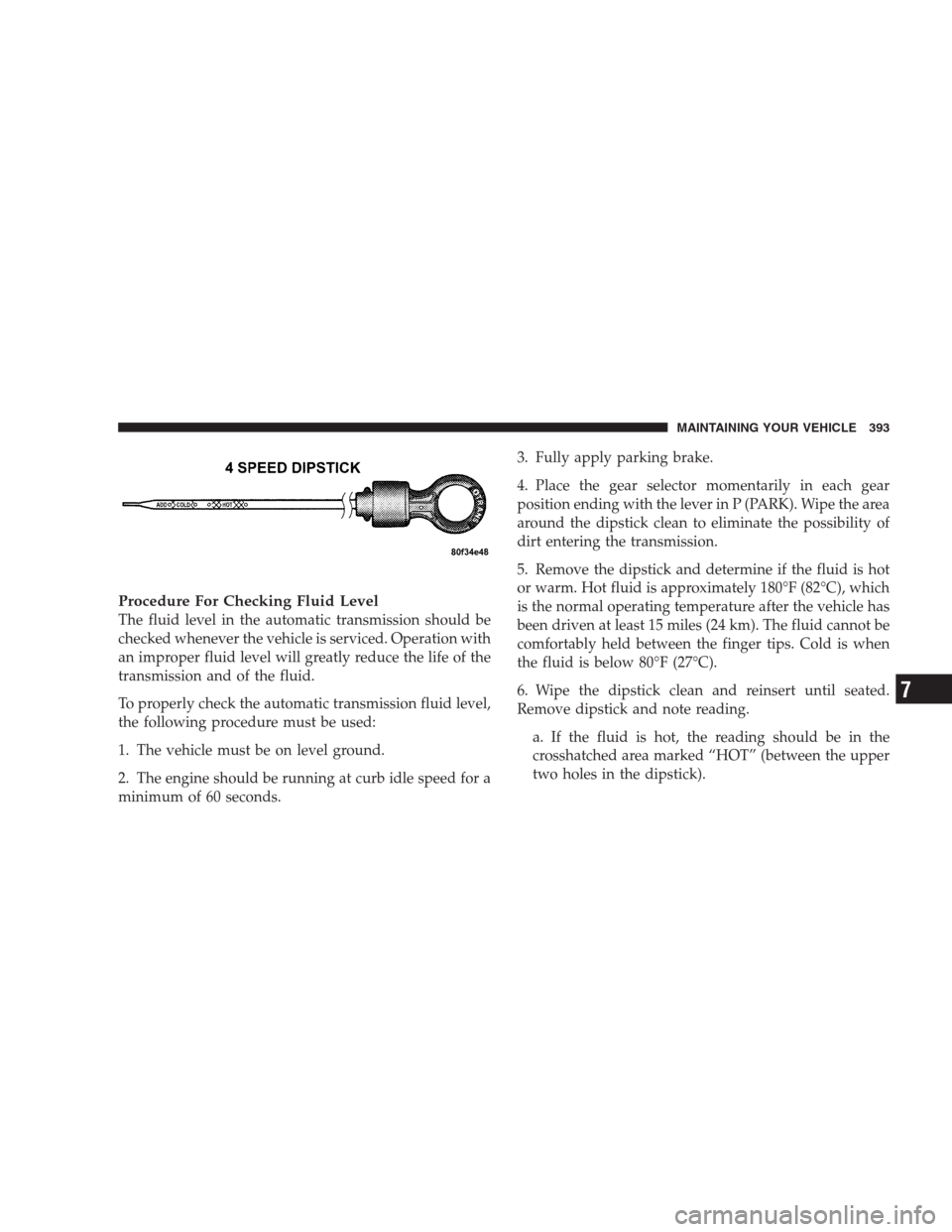
6. Wipe the dipstick clean and reinsert until seated.
Remove dipstick and note reading.
a. If the fluid is hot, the reading should be in the
crosshatched area marked “HOT” (between the upper
two holes in the dipstick).
MAINTAINING YOUR VEHICLE 393
7
Page 395 of 464
All Wheel Drive (AWD) — If Equipped
Under normal operating conditions, periodic fluid level
checks and lubricant changes for the Power Transfer Unit
and Rear Carrier, are not required. However when the
vehicle is serviced for other reasons, the exterior surface
of these components should be inspected for evidence of
fluid leaks. Confirmed leaks should be repaired as soon
as possible.
Power Transfer Unit
The fill plug is located on the side of the power transfer
unit housing. The fluid should be maintained at a level
even with the bottom of the fill plug hole when the
vehicle is parked on a level surface. If it becomes neces-
sary to add or replace the fluid, use only the manufac-
turers recommended fluid, refer to Fluids, Lubricants
and Genuine Parts for correct fluid type.
Rear Carrier
The fill plug is located on the side of the rear carrier
housing. The fluid should be maintained at a level even
with the bottom of the fill plug hole when the vehicle is
parked on a level surface. if it becomes necessary to add
or replace the fluid, use only the manufacturers recom-
mended fluid, refer to Fluids, Lubricants and Genuine
Parts for correct fluid type.
Fluid Changes
The fluid should be changed as follows:
Normal UsageNo Service Required
Severe Usage Service Required
Power Transfer Unit Refer to Maintenance
Schedule “B”
Rear Carrier Refer to Maintenance
Schedule “B”
MAINTAINING YOUR VEHICLE 395
7
Page 405 of 464
CAUTION!
•When installing the Integrated Power Module
cover, it is important to ensure the cover is prop-
erly positioned and fully latched. Failure to do so
may allow water to get into the Integrated Power
Module, and possibly result in a electrical system
failure.
•When replacing a blown fuse, it is important to
use only a fuse having the correct amperage
rating. The use of a fuse with a rating other than
indicated may result in a dangerous electrical
system overload. If a properly rated fuse contin-
ues to blow, it indicates a problem in the circuit
that must be corrected.
VEHICLE STORAGE
If you are leaving your vehicle dormant for more than 21
days you may want to take steps to protect your battery.
You may:
•Disconnect the negative cable from the battery.
•Anytime you store your vehicle, or keep it out of
service (i.e. vacation) for two weeks or more, run the
air conditioning system at idle for about five minutes
in the fresh air and high blower setting. This will
insure adequate system lubrication to minimize the
possibility of compressor damage when the system is
started again.
MAINTAINING YOUR VEHICLE 405
7
Page 407 of 464
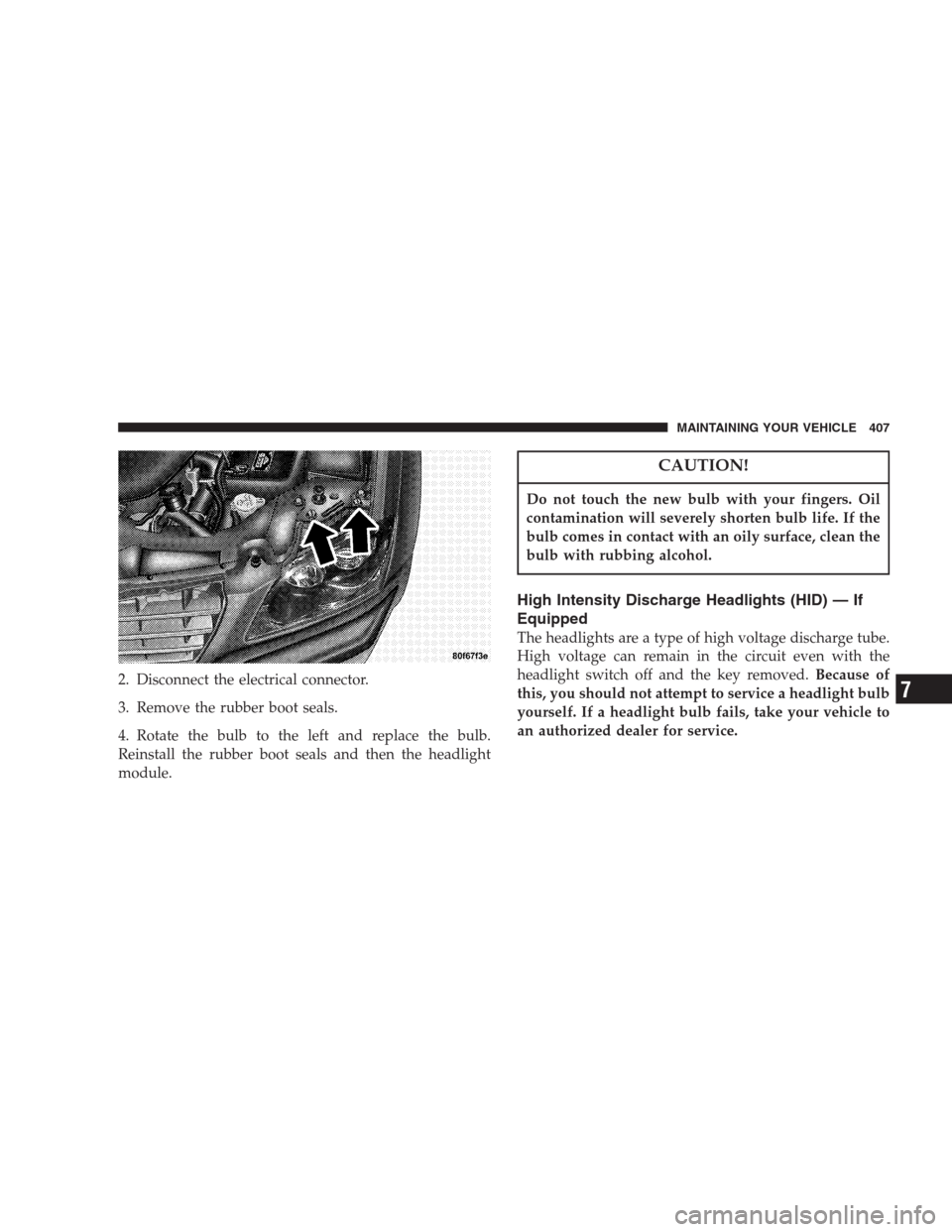
2. Disconnect the electrical connector.
3. Remove the rubber boot seals.
4. Rotate the bulb to the left and replace the bulb.
Reinstall the rubber boot seals and then the headlight
module.
CAUTION!
Do not touch the new bulb with your fingers. Oil
contamination will severely shorten bulb life. If the
bulb comes in contact with an oily surface, clean the
bulb with rubbing alcohol.
High Intensity Discharge Headlights (HID) — If
Equipped
The headlights are a type of high voltage discharge tube.
High voltage can remain in the circuit even with the
headlight switch off and the key removed.Because of
this, you should not attempt to service a headlight bulb
yourself. If a headlight bulb fails, take your vehicle to
an authorized dealer for service.
MAINTAINING YOUR VEHICLE 407
7
Page 408 of 464
WARNING!
A transient high tension occurs at the bulb sockets of
High Intensity Discharge (HID) headlights when the
headlight switch is turned ON. It may cause serious
electrical shock or electrocution if not serviced prop-
erly. See your authorized dealer for service.
NOTE:On vehicles equipped with High Intensity Dis-
charge Headlights (HID), when the headlights are turned
on there is a blue hue to the lights. This diminishes and
becomes more white after approximately 10 seconds, as
the system charges.
Front Park/Turn Signal and Sidemarker Lights
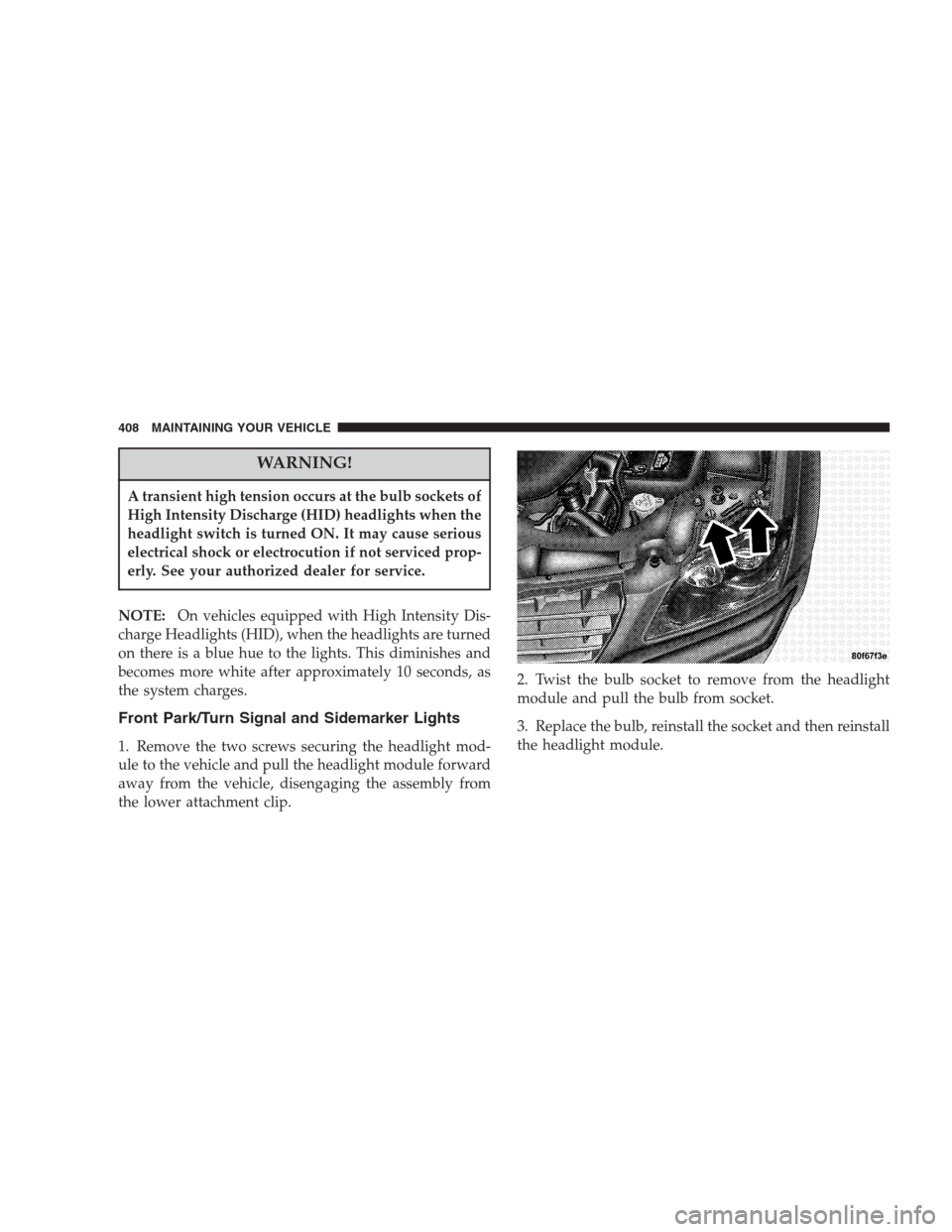
1. Remove the two screws securing the headlight mod-
ule to the vehicle and pull the headlight module forward
away from the vehicle, disengaging the assembly from
the lower attachment clip.2. Twist the bulb socket to remove from the headlight
module and pull the bulb from socket.
3. Replace the bulb, reinstall the socket and then reinstall
the headlight module.
408 MAINTAINING YOUR VEHICLE