2007 CHRYSLER PACIFICA tire pressure
[x] Cancel search: tire pressurePage 315 of 464

NOTE:A low spare tire will not cause the Tire Pressure
Monitoring System Telltale Lamp to illuminate or the
chime to sound.
Should a low tire condition occur on any of the four
active road tire(s), you should stop as soon as possible,
and inflate the low tire(s) that is/are flashing on the
graphic display to the vehicle’s recommended cold plac-
ard pressure value. The system will automatically up-
date, the graphic display of the pressure value(s) will
stop flashing, and the Tire Pressure Monitoring System
Lamp will extinguish once the updated tire pressure(s)
have been received.
NOTE:The vehicle may need to be driven for up to 10
minuets above 15 mph (25 km/h) to receive this infor-
mation.Service Tire System Soon
The Tire Pressure Monitoring Telltale Lamp will flash on
and off for 60 seconds in the instrument cluster, and an
audible chime when a system fault is detected. The flash
cycle will repeat every 10 minutes, without an audible
chime, until the fault condition not longer exists.
In addition the Electronic Vehicle Information Center
(EVIC) will display a“SERVICE TIRE SYSTEM SOON”
text message for 3 seconds. This text message is then
followed by “— —”, for the pressure value indicating
which of the Tire Pressure Monitoring Sensor(s) is not
being received.
If the ignition key is cycled, this sequence will repeat,
providing the system fault still exists. Iff the system fault
no longer exists, the Tire Pressure Monitoring System
Telltale Lamp will no longer flash, the“SERVICE TIRE
SYSTEM SOON”text message will no longer display,
and a pressure value will be displayed instead of dashes.
STARTING AND OPERATING 315
5
Page 316 of 464

NOTE:Your vehicle is equipped with a compact spare
wheel and tire assembly that does not have a tire pressure
monitoring sensor. Therefore, it will not be monitored by
the Tire Pressure Monitoring System. In the event that a
compact spare tire is used to replace a low pressure road
tire, the next ignition key cycle will still show the Tire
Pressure Monitoring Lamp to be ON, a Chime will
sound, and the Electronic Vehicle Information Center
(EVIC) will still show the low tire pressure value flashing
on the graphic display. This sequence will repeat for
every key cycle until the original Tire Pressure Monitor-
ing System (TPMS) tire has been properly repaired (or
replaced) and put back on the vehicle in place of the
compact spare tire.CAUTION!
The Tire Pressure Monitoring System (TPMS) has
been optimized for the original equipment tires and
wheels. TPMS pressures have been established for
the tire size equipped on your vehicle. Undesirable
system operation or sensor damage may result when
using replacement equipment that is not of the same
size, type, and/or style. After-market wheels can
cause sensor damage. Do not use tire sealant from a
can, or balance beads if your vehicle is equipped
with a TPMS, as damage to the sensors may result.
316 STARTING AND OPERATING
Page 317 of 464

CAUTION!
After inspecting or adjusting the tire pressure al-
ways reinstall the valve stem cap. This will prevent
moisture and dirt from entering the valve stem,
which could damage the wheel rim sensor.
NOTE:
•The Tire Pressure Monitoring System (TPMS) is not
intended to replace normal tire care and maintenance,
nor to provide warning of a tire failure or condition.
•It is the driver’s responsibility to maintain correct tire
pressure, even if under-inflation has not reached the
level to trigger illumination of the Tire Pressure Moni-
toring Telltale Lamp.
•The Tire Pressure Monitoring System (TPMS) should
not be used as a tire pressure gauge while adjusting
your tire pressure.
General Information
This device complies with Part 15 of the FCC rules and
RSS 210 of Industry Canada. Operation is subject to the
following conditions:
•This device may not cause harmful interference.
•This device must accept any interference received,
including interference that may cause undesired op-
eration.
The tire pressure sensors are covered under one of the
following licenses:
United States.....................KR5S120123
Canada........................2671-S120123
STARTING AND OPERATING 317
5
Page 338 of 464
4. Tongue weight rating for the trailer hitch utilized
(This requirement may limit the ability to always
achieve the 10% to 15% range of tongue weight as a
percentage of total trailer weight).
Towing Requirements — Tires
Do not attempt to tow a trailer while using a compact
spare tire.
Proper tire inflation pressures are essential to the safe
and satisfactory operation of your vehicle. Refer to the
Tires–General Information section of this manual on
Tire Pressures for proper tire inflation procedures.
Also, check the trailer tires for proper tire inflation
pressures before trailer usage.
Check for signs of tire wear or visible tire damage
before towing a trailer. Refer to the Tires–General
Information section of this manual on Tread Wear
Indicators for the proper inspection procedure.
When replacing tires refer to the Tires–General Infor-
mation section of this manual on Replacement Tires for
proper tire replacement procedures. Replacing tires
with a higher load carrying capacity will not increase
the vehicle’s GVWR and GAWR limits.
Towing Requirements — Trailer Brakes
Donotinterconnect the hydraulic brake system or
vacuum system of your vehicle with that of the trailer.
This could cause inadequate braking and possible
personal injury.
An electronically actuated trailer brake controller is
required when towing a trailer with electronically
actuated brakes. When towing a trailer equipped with
a hydraulic surge actuated brake system, an electronic
brake controller is not required.
338 STARTING AND OPERATING
Page 346 of 464
WARNING!
A hot engine cooling system is dangerous. You or
others could be badly burned by steam or boiling
coolant. You may want to call a service center if your
vehicle overheats. If you decide to look under the
hood yourself, see Section 7, Maintenance, of this
manual. Follow the warnings under the Cooling
System Pressure Cap paragraph.
JACKING AND TIRE CHANGING
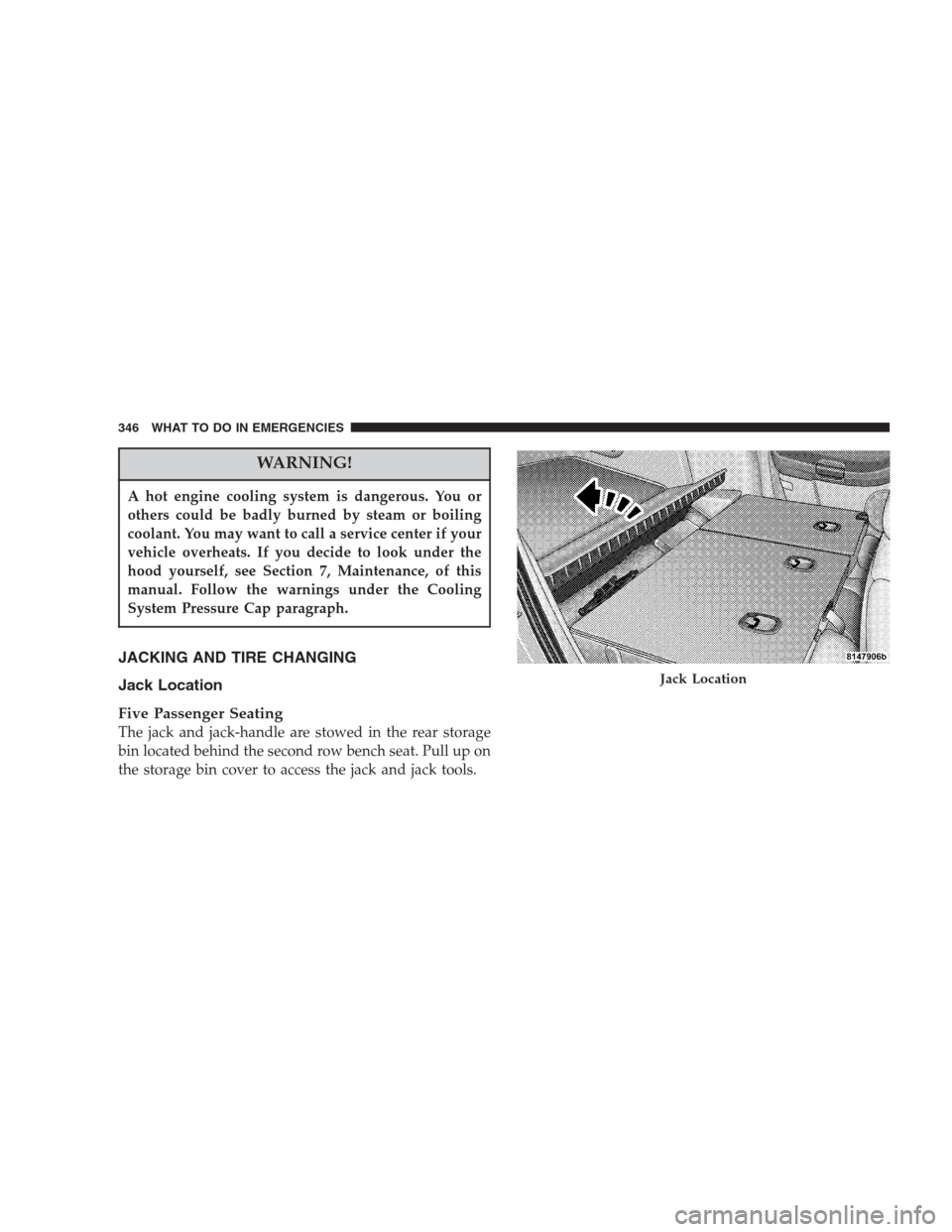
Jack Location
Five Passenger Seating
The jack and jack-handle are stowed in the rear storage
bin located behind the second row bench seat. Pull up on
the storage bin cover to access the jack and jack tools.
Jack Location
346 WHAT TO DO IN EMERGENCIES
Page 353 of 464

lug nuts until each nut has been tightened twice. Correct
wheel nut tightness is 130 N·m (95 ft. lbs). If in doubt
about the correct tightness, have them checked with a
torque wrench by your dealer or at a service station.
11. Lower the jack to its fully closed position.
WARNING!
A loose tire or jack, thrown forward in a collision or
hard stop could endanger the occupants of the ve-
hicle. Always stow the jack parts and the spare tire in
the places provided.
12. Secure the flat or spare tire as follows:
•If your vehicle is equipped with cast aluminum
wheels, the center cap of the wheel must be re-
moved prior to flat tire stowage. Store the center cap
inside the glove box or other storage compartment.
•Turn the wheel so that the valve-stem is down. Slide
the wheel retainer through the center of the wheel
and position it properly across the wheel opening.
•For convenience in checking the spare tire inflation,
stow with the valve-stem toward the rear of the
vehicle.
•Using the jack-handle, rotate the drive nut to the
right until the wheel is drawn into place against the
underside of the vehicle.
•Continue to rotate the nut until you hear the mecha-
nism click three times. It cannot be overtightened.
Push against the tire several times to be sure it is
securely in place.
13. Stow the jack and jack handle.
14. Check the tire pressure as soon as possible. Correct
pressure as required.
WHAT TO DO IN EMERGENCIES 353
6
Page 354 of 464

NOTE:When reinstalling the wheel center cap, insure
that the valve stem symbol on the back of the cap is
pointed toward the wheel valve stem. Install the center
cap using hand pressure only. Do not use a hammer.
Wheel Nuts
All wheel nuts should be tightened occasionally to elimi-
nate the possibility of wheel studs being sheared or the
bolt holes in the wheels becoming elongated. This is
especially important during the first few hundred miles
of operation, and after each time a tire is changed, to
allow the wheel nuts to become properly set. All nuts
should first be firmly seated against the wheel. The nuts
should then be tightened to recommended torque.
Tighten the nuts to final torque in increments. Progress
around the bolt circle, tightening the nut opposite to the
nut just previously tightened until final torque is
achieved. Recommended torque is 130 N·m (95 ft. lbs).
JUMP-STARTING PROCEDURE
WARNING!
•Do not attempt to push or tow your vehicle to get it started.
Vehicles equipped with an automatic transmission cannot be
started this way. Unburned fuel could enter the catalytic
converter and once the engine has started, ignite and damage
the converter and vehicle. If the vehicle has a discharged
battery, booster cables may be used to obtain a start from
another vehicle. This type of start can be dangerous if done
improperly, so follow this procedure carefully.
•Battery fluid is a corrosive acid solution; do not allow battery
fluid to contact eyes, skin or clothing. Don’t lean over battery
when attaching clamps or allow the clamps to touch each other.
If acid splashes in eyes or on skin, flush contaminated area
immediately with large quantities of water.
•A battery generates hydrogen gas which is flammable and
explosive. Keep flame or spark away from the vent holes. Do
not use a booster battery or any other booster source with an
output that exceeds 12 volts.
•Take care to avoid the radiator cooling fan whenever the hood
is raised. It can start anytime the ignition switch is on. You can
be hurt by the fan.
354 WHAT TO DO IN EMERGENCIES
Page 384 of 464
Engine Coolant Checks
Check the engine coolant (antifreeze) protection every 12
months (before the onset of freezing weather, where
applicable). If coolant is dirty or rusty in appearance, the
system should be drained, flushed and refilled with fresh
coolant. Check the front of the A/C condenser for any
accumulation of bugs, leaves, etc. If dirty, clean by gently
spraying water from a garden hose vertically down the
face of the condenser.
Check the coolant recovery bottle tubing for brittle rub-
ber, cracking, tears, cuts and tightness of the connection
at the bottle and radiator. Inspect the entire system for
leaks.
With the engine at normal operating temperature (but
not running), check the cooling system pressure cap for
proper vacuum sealing by draining a small amount of
coolant from the radiator drain cock. If the cap is sealing
properly, the engine coolant (antifreeze) will begin todrain from the coolant recovery bottle. DO NOT RE-
MOVE THE COOLANT PRESSURE CAP WHEN THE
COOLING SYSTEM IS HOT.
Cooling System — Drain, Flush and Refill
At the intervals shown on the Maintenance Schedules,
the system should be drained, flushed and refilled.
If the solution is dirty or contains a considerable amount
of sediment, clean and flush with a reliable cooling
system cleaner. Follow with a thorough rinsing to remove
all deposits and chemicals. Properly dispose of old
antifreeze solution.
Selection Of Engine Coolant
Use only the manufacturers recommended coolant, refer
to Fluids, Lubricants and Genuine Parts for correct
coolant type.
384 MAINTAINING YOUR VEHICLE