Page 269 of 464
WARNING!
Do not attempt to push or tow your vehicle to get it
started. Vehicles equipped with an automatic trans-
mission cannot be started this way. Unburned fuel
could enter the catalytic converter and once the
engine has started, ignite and damage the converter
and vehicle. If the vehicle has a discharged battery,
booster cables may be used to obtain a start from a
booster battery or the battery in another vehicle. This
type of start can be dangerous if done improperly.
See section 6 of this manual for the proper jump
starting procedures and follow them carefully.
If the engine has been flooded, it may start to run, but not
have enough power to continue running when the key is
released. If this occurs, continue cranking with the accel-
erator pedal pushed all the way to the floor. Release the
accelerator pedal and the key once the engine is running
smoothly.
If the engine shows no sign of starting after two 15
second periods of cranking with the accelerator pedal
held to the floor, the normal starting procedure should be
repeated.
After Starting
The idle speed will automatically decrease as the engine
warms up.
STARTING AND OPERATING 269
5
Page 367 of 464
cap until a�clicking�sound is heard. This is an indication
that the gas cap is properly tightened. Press the odometer
reset button to turn the message off. If the problem
persists, the message will appear the next time the
vehicle is started. This might indicate a damaged cap. If
the problem is detected twice in a row, the system will
turn on the Malfunction Indicator Light (MIL). Resolving
the problem will turn the MIL light off.
EMISSIONS INSPECTION AND MAINTENANCE
PROGRAMS
In some localities, it may be a legal requirement to pass
an inspection of your vehicle’s emissions control system.
Failure to pass could prevent vehicle registration.
For states, which have an I/M (Inspection and
Maintenance) requirement, this check verifies the
following: the MIL (Malfunction Indicator Lamp)is functioning and is not on when the engine is running,
and that the OBD (On Board Diagnostic) system is ready
for testing.
Normally, the OBD system will be ready. The OBD
system maynotbe ready if your vehicle was recently
serviced, if you recently had a dead battery, or a battery
replacement. If the OBD system should be determined
not ready for the I/M test, your vehicle may fail the test.
Your vehicle has a simple ignition key actuated test,
which you can use prior to going to the test station. To
check if your vehicle’s OBD system is ready, you must do
the following:
1. Insert your ignition key into the ignition switch.
2. Turn the ignition to the ON position, but do not crank
or start the engine.
3. If you crank or start the engine, you will have to start
this test over.
MAINTAINING YOUR VEHICLE 367
7
Page 368 of 464
4. As soon as you turn your key to the ON position, you
will see your MIL symbol come on as part of a normal
bulb check.
5. Approximately 15 seconds later, one of two things will
happen:
a. The MIL will flash for about 10 seconds and then
return to being fully illuminated until you turn off the
ignition key or start the engine. This means that your
vehicle’s OBD system isnot readyand you shouldnot
proceed to the I/M station.
b. The MIL will not flash at all and will remain fully
illuminated until you turn off the ignition key or start
the engine. This means that your vehicle’s OBD system
isreadyand you can proceed to the I/M station.
If your OBD system isnot ready,you should see your
authorized dealer or repair facility. If your vehicle was
recently serviced or had a battery failure or replacement,you may need to do nothing more than drive your
vehicle as you normally would in order for your OBD
system to update. A recheck with the above test routine
may then indicate that the system is now ready.
Regardless of whether your vehicle’s OBD system is
ready or not ready, if the MIL symbol is illuminated
during normal vehicle operation, you should have your
vehicle serviced before going to the I/M station. The I/M
station can fail your vehicle because the MIL symbol is on
with the engine running.
REPLACEMENT PARTS
Use of genuine Mopar�parts for normal/scheduled
maintenance and repairs is highly recommended to in-
sure the designed performance. Damage or failures
caused by the use of non-Mopar�parts for maintenance
and repairs will not be covered by the manufacturer’s
warranty.
368 MAINTAINING YOUR VEHICLE
Page 447 of 464
Selection Of Lubricant................392,413
Shifting............................. 272
Special Additives...................... 394
Automatic Transmission................... 392
Adding Fluid......................... 393
Fluid and Filter Changes................. 394
Fluid Change......................... 394
Fluid Level Check...................... 393
Fluid Type........................... 392
Autostick...........................151,274
Ball Joints............................. 380
Battery............................... 376
Gas Caution.......................... 377
Jump Starting......................... 354
Keyless Transmitter Replacement (RKE)....... 25
Bearings.............................. 396
Belts, Drive............................ 374
Body Mechanism Lubrication............... 381B-Pillar Location........................ 293
Brake, Parking.......................... 276
Brake System........................278,389
Anti-Lock (ABS)....................... 279
Fluid Check.......................390,413
Hoses.............................. 389
Warning Light........................ 182
Brakes.............................278,389
Brake/Transmission Interlock............... 271
Break-In Recommendations, New Vehicle........ 79
Bulb Replacement....................... 406
Bulbs, Light............................ 406
Calibration, Compass..................... 197
Camera, Rear........................... 146
Capacities, Fluid........................ 411
Caps, Filler
Fuel................................ 321
Oil (Engine).......................372,373
INDEX 447
10
Page 462 of 464
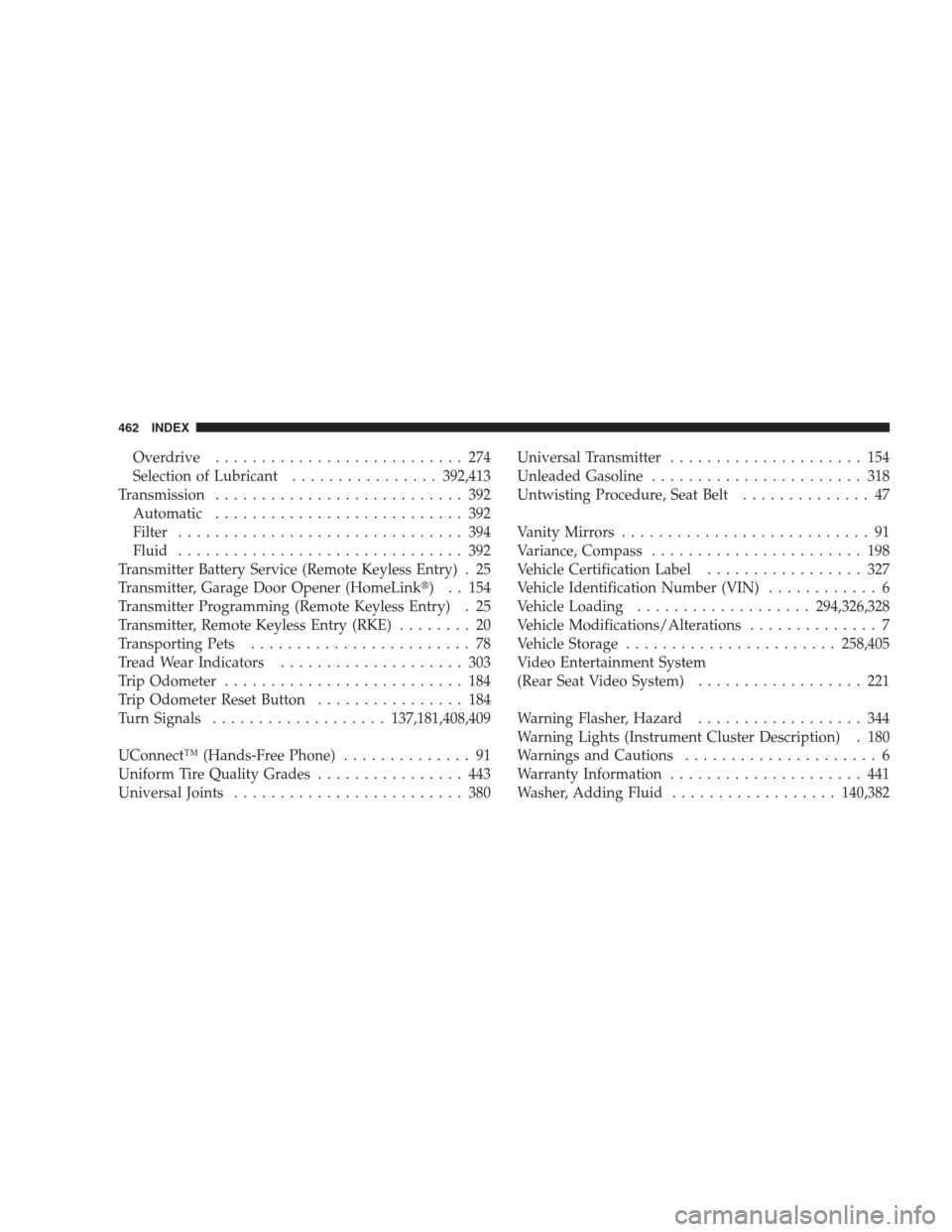
Overdrive........................... 274
Selection of Lubricant................392,413
Transmission........................... 392
Automatic........................... 392
Filter............................... 394
Fluid............................... 392
Transmitter Battery Service (Remote Keyless Entry) . 25
Transmitter, Garage Door Opener (HomeLink�) . . 154
Transmitter Programming (Remote Keyless Entry) . 25
Transmitter, Remote Keyless Entry (RKE)........ 20
Transporting Pets........................ 78
Tread Wear Indicators.................... 303
Trip Odometer.......................... 184
Trip Odometer Reset Button................ 184
Turn Signals...................137,181,408,409
UConnect™ (Hands-Free Phone).............. 91
Uniform Tire Quality Grades................ 443
Universal Joints......................... 380Universal Transmitter..................... 154
Unleaded Gasoline....................... 318
Untwisting Procedure, Seat Belt.............. 47
Vanity Mirrors........................... 91
Variance, Compass....................... 198
Vehicle Certification Label................. 327
Vehicle Identification Number (VIN)............ 6
Vehicle Loading...................294,326,328
Vehicle Modifications/Alterations.............. 7
Vehicle Storage.......................258,405
Video Entertainment System
(Rear Seat Video System).................. 221
Warning Flasher, Hazard.................. 344
Warning Lights (Instrument Cluster Description) . 180
Warnings and Cautions..................... 6
Warranty Information..................... 441
Washer, Adding Fluid..................140,382
462 INDEX