2007 CHRYSLER PACIFICA instrument cluster
[x] Cancel search: instrument clusterPage 180 of 464

INSTRUMENT CLUSTER DESCRIPTIONS
1. Voltage Light
This light monitors the electrical system voltage.
The light should turn on momentarily as the
engine is started. If the light stays on or turns on while
driving, it indicates a problem with the charging system.
Immediate service should be obtained.
2. Temperature Gauge
The temperature gauge shows engine coolant tempera-
ture. Any reading within the normal range indicates that
the engine cooling system is operating satisfactorily.
The gauge pointer will likely indicate a higher tempera-
ture when driving in hot weather, up mountain grades,
or when towing a trailer. It should not be allowed to
exceed the upper limits of the normal operating range.
CAUTION!
Driving with a hot engine cooling system could
damage your vehicle. If temperature gauge reads
“H”, pull over in a safe area as soon as possible and
stop the vehicle. Idle the vehicle with the air condi-
tioner turned off until the pointer drops back into
the normal range. If the pointer remains on the “H”,
and you hear continuous chimes, turn the engine off
immediately, and call for service.
180 UNDERSTANDING YOUR INSTRUMENT PANEL
Page 185 of 464

Loose Fuel Filler Cap
If the vehicle diagnostic system determines that the fuel
filler cap is loose, improperly installed, or damaged,
GASCAP will be displayed in the instrument cluster
odometer. Tighten the fuel filler cap properly and press
the odometer reset button to turn the GASCAP message
off. If the problem continues, the message will appear the
next time the vehicle is started. See Section 7 of this
manual for more information.
14. Cruise Indicator
This display indicator shows that the Speed Control
System is ON.
15. Malfunction Indicator Light
This light is part of an onboard diagnostic system
called OBD that monitors engine and automatic
transmission control systems. The light will illu-
minate when the key is in the ON position before enginestart. If the bulb does not come on when turning the key
from OFF to ON, have the condition checked promptly.
Certain conditions such as a loose or missing gas cap,
poor fuel quality, etc. may illuminate the light after
engine start. The vehicle should be serviced if the light
stays on through several of your typical driving cycles. In
most situations the vehicle will drive normally and will
not require towing.
The Malfunction Indicator Light flashes to alert you to
serious conditions that could lead to immediate loss of
power or severe catalytic converter damage. The vehicle
should be serviced as soon as possible if this occurs.
16. High Beam Light
This light shows that the headlights are on high
beam. Pull the Multi-Function lever towards the
steering wheel to switch the headlights from high or low
beam.
UNDERSTANDING YOUR INSTRUMENT PANEL 185
4
Page 187 of 464
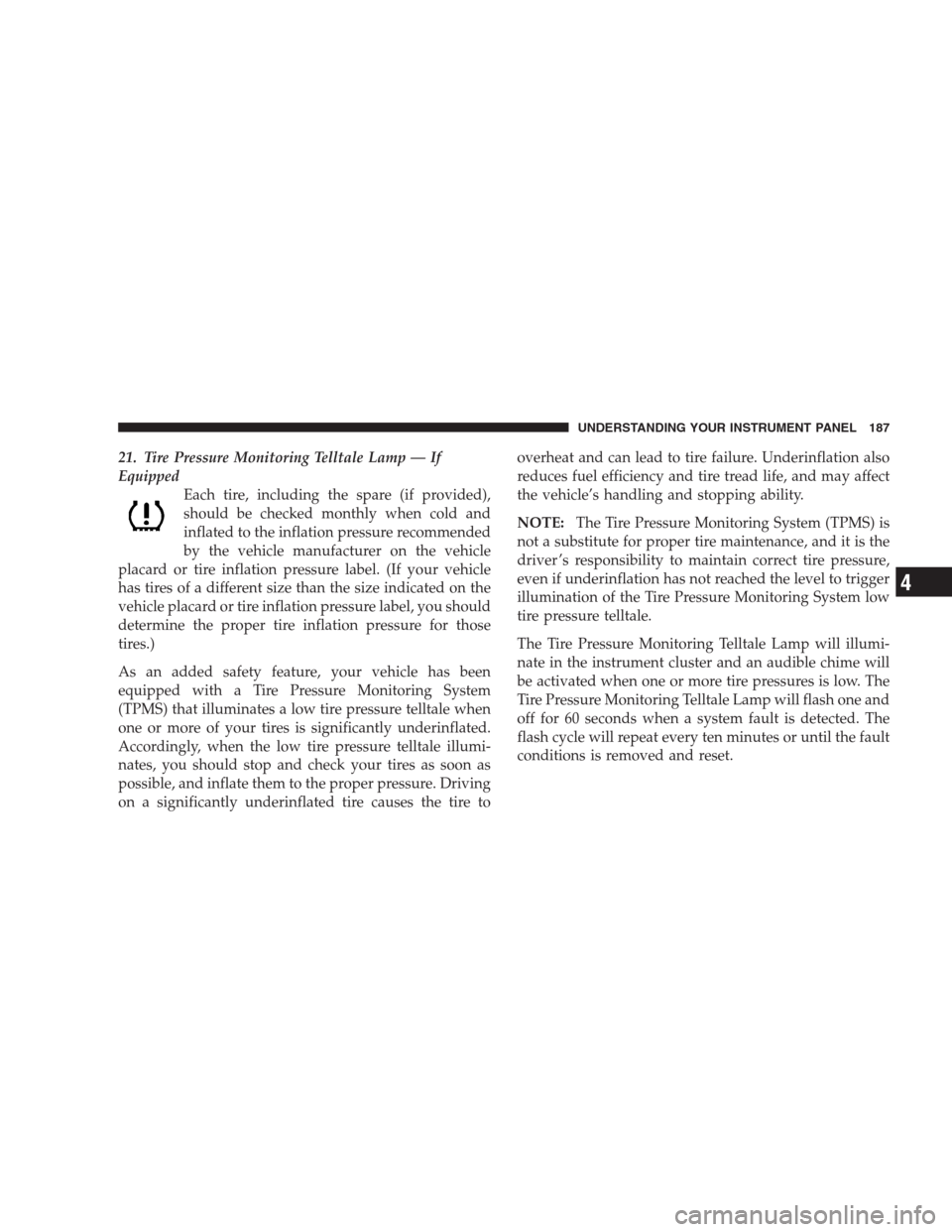
21. Tire Pressure Monitoring Telltale Lamp — If
Equipped
Each tire, including the spare (if provided),
should be checked monthly when cold and
inflated to the inflation pressure recommended
by the vehicle manufacturer on the vehicle
placard or tire inflation pressure label. (If your vehicle
has tires of a different size than the size indicated on the
vehicle placard or tire inflation pressure label, you should
determine the proper tire inflation pressure for those
tires.)
As an added safety feature, your vehicle has been
equipped with a Tire Pressure Monitoring System
(TPMS) that illuminates a low tire pressure telltale when
one or more of your tires is significantly underinflated.
Accordingly, when the low tire pressure telltale illumi-
nates, you should stop and check your tires as soon as
possible, and inflate them to the proper pressure. Driving
on a significantly underinflated tire causes the tire tooverheat and can lead to tire failure. Underinflation also
reduces fuel efficiency and tire tread life, and may affect
the vehicle’s handling and stopping ability.
NOTE:The Tire Pressure Monitoring System (TPMS) is
not a substitute for proper tire maintenance, and it is the
driver ’s responsibility to maintain correct tire pressure,
even if underinflation has not reached the level to trigger
illumination of the Tire Pressure Monitoring System low
tire pressure telltale.
The Tire Pressure Monitoring Telltale Lamp will illumi-
nate in the instrument cluster and an audible chime will
be activated when one or more tire pressures is low. The
Tire Pressure Monitoring Telltale Lamp will flash one and
off for 60 seconds when a system fault is detected. The
flash cycle will repeat every ten minutes or until the fault
conditions is removed and reset.
UNDERSTANDING YOUR INSTRUMENT PANEL 187
4
Page 189 of 464

25. Liftgate Ajar — If Equipped
This light turns on if the liftgate is not com-
pletely closed.
26. Door Ajar Light — If Equipped
This light turns on if a door is not completely
closed.
27. Washer Fluid Light — If Equipped
This light turns on when the washer fluid level
falls below approximately 1/4 filled. The light will
remain on until fluid is added.
28. Electronic Stability Program (ESP) Warning
Light/Brake Assist System (BAS) Warning Light — If
Equipped
The malfunction indicator for the ESP is com-
bined with the BAS indicator. The yellow
“ESP/BAS Warning Lamp” and the yellow“ESP/TCS Indicator Light” in the instrument cluster both
come on when the ignition switch is turned to the “ON”
position. They should both go out with the engine
running. If the “ESP/BAS Warning Lamp” comes on
continuously with the engine running, a malfunction has
been detected in either the ESP or BAS system, or both. If
this light remains on after several ignition cycles, and the
vehicle has been driven several miles at speeds greater
than 30 mph (48 km/h), see your authorized dealer as
soon as possible to have the problem diagnosed and
corrected.
The “ESP/BAS Warning Lamp”:
— The “ESP Indicator Light” and the “ESP/BAS Warning
Lamp” come on momentarily each time the ignition
switch is turned ON.
— Each time the ignition is turned ON, the ESP System
will be ON even if it was turned off previously.
UNDERSTANDING YOUR INSTRUMENT PANEL 189
4
Page 274 of 464
“N” Neutral
Engine may be started in this range.
“D” Overdrive
To be used for most city and highway driving, it provides
smoothest upshifts and downshifts and best fuel
economy. When frequent transmission shifting occurs
while using the “D” Overdrive position, such as when
operating the vehicle under heavy loading conditions,
(i.e. in hilly terrain, traveling into strong head winds or
while towing heavy trailers), use the AutoStick mode and
select the “3” range.
NOTE:Using the “3” range in the AutoStick mode
while operating the vehicle under heavy operating con-
ditions will improve performance and extend transmis-
sion life by reducing excessive shifting and heat build up.AUTOSTICK
AutoStick is a driver-interactive transmission that offers
manual gear shifting capability to provide you with more
control. AutoStick allows you to maximize engine brak-
ing, eliminate undesirable upshifts and downshifts, and
improve overall vehicle performance. This system can
also provide you with more control during passing, city
driving, cold slippery conditions, mountain driving,
trailer towing, and many other situations.
AutoStick Operation
The AutoStick position is just below the Overdrive posi-
tion and is identified by the word “AUTOSTICK”. When
you place the shift lever in the AutoStick position, it can
be moved from side to side. Moving the lever to the left
(-) triggers a downshift and to the right (+) an upshift.
The gear position will be shown in the transmission gear
display, located in the instrument cluster.
274 STARTING AND OPERATING
Page 276 of 464
•If the system detects a problem it will disable the
AutoStick mode and the transmission will return to
the automatic mode until the problem is corrected.
ALL WHEEL DRIVE — IF EQUIPPED
This feature provides full time, on-demand, All Wheel
Drive (AWD). The system is automatic with no driver
inputs or additional driving skills required. Under nor-
mal driving conditions, the front wheels provide most of
the traction. If the front wheels begin to lose traction,
power is shifted automatically to the rear wheels. The
greater the front wheel traction loss, the greater the
power transfer to the rear wheels.
CAUTION!
All wheels must have the same size and type tires.
Unequal tire sizes must not be used. Unequal tire
size may cause failure of the power transfer unit.
PARKING BRAKE
When the parking brake is applied with the ignition
switch on, the brake light in the instrument cluster will
turn on.
NOTE:This light only shows that the parking brake is
applied. It does not show the degree of brake application.
276 STARTING AND OPERATING
Page 282 of 464
applies the brake of the appropriate wheel to assist in
counteracting the Over-steer or Under-steer condition.
•Over-steer: when the vehicle is turning more than
appropriate for the steering wheel position.
•Under-steer: when the vehicle is turning less than
appropriate for the steering wheel position.
The “ESP/TCS Indicator Light” located in the instrument
cluster, starts to flash as soon as the tires lose traction and
the ESP system becomes active. The “ESP/TCS Indicator
Light” also flashes when TCS is active. If the “ESP/TCS
Indicator Light” begins to flash during acceleration, ease
up on the accelerator and apply as little throttle as
possible. Be sure to adapt your speed and driving to the
prevailing road conditions.
WARNING!
Electronic Stability Program (ESP) cannot prevent
the natural laws of physics from acting on the
vehicle, nor can it increase the traction afforded by
prevailing road conditions. ESP cannot prevent acci-
dents, including those resulting from excessive
speed in turns, driving on very slippery surfaces, or
hydroplaning. Only a safe, attentive, and skillful
driver can prevent accidents. The capabilities of an
ESP-equipped vehicle must never be exploited in a
reckless or dangerous manner which could jeopar-
dize the user’s safety or the safety of others.
282 STARTING AND OPERATING
Page 283 of 464
ESP has the following operating modes:
•
ESP OnThis is the normal operating mode for ESP.
Whenever the vehicle is started the ESP system will be
in this mode. This mode should be used for almost all
driving situations. ESP should only be turned to
“Partial Off” for specific reasons as noted below.
•Partial OffThis mode is entered by momentarily
depressing the “ESP Control Switch”. When in “Partial
Off” mode, the TCS portion of ESP, except for the
“limited slip” feature described in the TCS section, has
been disabled and the “ESP/TCS Indicator Light” will
be illuminated. All other stability features of ESP
function normally, with the exception of engine power
reduction. This mode is intended to be used if the
vehicle is in deep snow, sand or gravel conditions and
more wheel spin than ESP would normally allow isrequired to gain traction. To turn ESP on again, mo-
mentarily depress the “ESP Control Switch”. This will
restore the normal “ESP On” mode of operation.
NOTE:To improve the vehicle’s traction when driving
with snow chains, or starting off in deep snow, sand or
gravel, it may be desirable to switch to the “Partial Off”
mode by pressing the ESP switch. Once the situation
requiring ESP to be switched to the “Partial Off” mode is
overcome, turn ESP back on by momentarily depressing
the “ESP Control Switch”. This may be done while the
vehicle is in motion.
ESP/BAS Warning Lamp and ESP/TCS Indicator
Light
The malfunction indicator for the ESP is combined with
the BAS indicator. The yellow “ESP/BAS Warning
Lamp” and the yellow “ESP/TCS Indicator Light” in the
instrument cluster both come on when the ignition
switch is turned to the “ON” position. They should both
STARTING AND OPERATING 283
5