Page 181 of 464

WARNING!
A hot engine cooling system is dangerous. You or
others could be badly burned by steam or boiling
coolant. You may want to call a service center if your
vehicle overheats. If you decide to look under the
hood yourself, see Section 7 of this manual. Follow
the warnings under the Cooling System Pressure
Cap paragraph.
3. Fuel Gauge
The pointer shows the level of fuel in the fuel tank when
the ignition switch is in the ON position.
The Low Fuel Light will turn on when the fuel level
reaches approximately 2 to 4 gallons (7 to 15 liters)
this light will remain on until fuel is added.4. Turn Signal Indicators
The arrow will flash with the exterior turn signal
when the turn signal lever is operated.
If the vehicle electronics sense that the vehicle has
traveled about one mile with the turn signals on, a chime
will sound to alert you to turn the signals off. If either
indicator flashes at a rapid rate, check for a defective
outside light bulb.
5. Speedometer
Indicates vehicle speed.
6. Anti-Lock Light
This light monitors the Anti-Lock Brake Sys-
tem. The light will turn on when the ignition
switch is turned to the ON position and may
stay on for as long as four seconds.
If the ABS light remains on or turns on while driving, it
indicates that the Anti-Lock portion of the brake system
UNDERSTANDING YOUR INSTRUMENT PANEL 181
4
Page 182 of 464

is not functioning and that service is required. However,
the conventional brake system will continue to operate
normally if the BRAKE warning light is not on.
If the ABS light is on, the brake system should be serviced
as soon as possible to restore the benefits of Anti-Lock
brakes. If the ABS light does not turn on when the
Ignition switch is turned to the ON position, have the
light inspected by an authorized dealer.
7. Brake System Warning Light
This light monitors various brake functions,
including brake fluid level and parking brake
application. If the brake light turns on, it may
indicate that the parking brake is applied, there
is a low brake fluid level or there is a problem with the
anit-lock brake system.
The dual brake system provides a reserve braking capac-
ity in the event of a failure to a portion of the hydraulic
system. Failure of either half of the dual brake system isindicated by the Brake Warning Light which will turn on
when the brake fluid level in the master cylinder has
dropped below a specified level.
The light will remain on until the cause is corrected.
NOTE:The light may flash momentarily during sharp
cornering maneuvers which change fluid level condi-
tions. The vehicle should have service performed.
If brake failure is indicated, immediate repair is neces-
sary.
WARNING!
Driving a vehicle with the brake light on is danger-
ous. Part of the brake system may have failed. It will
take longer to stop the vehicle. You could have an
accident. Have the vehicle checked immediately.
182 UNDERSTANDING YOUR INSTRUMENT PANEL
Page 183 of 464

Vehicles equipped with Anti-Lock brakes (ABS), are also
equipped with Electronic Brake Force Distribution (EBD).
In the event of an EBD failure, the Brake Warning Light
will turn on along with the ABS Light. Immediate repair
to the ABS system is required.
The operation of the Brake Warning Light can be checked
by turning the ignition switch from the OFF position to
the ON position. The light should illuminate for approxi-
mately two seconds. The light should then turn off unless
the parking brake is applied or a brake fault is detected.
If the light does not illuminate, have the light inspected
by an authorized dealer.
The light also will turn on when the parking brake is
applied with the ignition switch in the ON position.
NOTE:This light shows only that the parking brake is
applied. It does not show the degree of brake application.8. Traction Control Indicator — If Equipped
This display indicator illuminates momentarily
as a bulb check when the ignition switch is first
turned ON.
The traction control Indicator will turn on if:
•The traction control system is in use.
•The Traction Control switch has been used to turn
the system OFF.
•There is a Traction Control System malfunction.
•The system has been deactivated to prevent damage
to the brake system due to overheated brake tem-
peratures.
NOTE:Extended heavy use of Traction Control may
cause the system to deactivate and turn on the Traction
Control Light. This is to prevent overheating of the brake
system and is a normal condition. The system will remain
UNDERSTANDING YOUR INSTRUMENT PANEL 183
4
Page 184 of 464

disabled for about 4 minutes until the brakes have
cooled. The system will automatically reactivate and turn
off the Traction Control Light.
9. Tachometer
The red segments indicate the maximum permissible
engine revolutions-per-minute (rpm. x 1000) for each
gear range. Before reaching the red area, ease up on the
accelerator.
10. Trip Odometer Button
Press this button to change the display from odometer to
either of the two trip odometer settings. The word TRIP
and either “A” or “B” will appear when in the trip
odometer mode. Push in and hold the button for two
seconds to reset the trip odometer to 0 miles or kilome-
ters. The odometer must be in trip mode to reset.
11. Transmission Range Indicator
This display indicator shows the automatic transmission
gear selection.12. AutoStick Light
This display indicator illuminates when the gearshift
lever is moved to the AutoStick position.
13. Odometer/Trip Odometer
The odometer shows the total distance the vehicle has
been driven.
U.S. federal regulations require that upon transfer of vehicle
ownership, the seller certify to the purchaser the correct
mileage that the vehicle has been driven. Therefore, if the
odometer reading is changed during repair or replacement,
be sure to keep a record of the reading before and after the
service so that the correct mileage can be determined.
The two trip odometers show individual trip mileage. To
switch from odometer to trip odometers, press and
release the Trip Odometer button. To reset a trip odom-
eter, display the desired trip odometer to be reset then
push and hold the button until the display resets (ap-
proximately 2 seconds).
184 UNDERSTANDING YOUR INSTRUMENT PANEL
Page 189 of 464

25. Liftgate Ajar — If Equipped
This light turns on if the liftgate is not com-
pletely closed.
26. Door Ajar Light — If Equipped
This light turns on if a door is not completely
closed.
27. Washer Fluid Light — If Equipped
This light turns on when the washer fluid level
falls below approximately 1/4 filled. The light will
remain on until fluid is added.
28. Electronic Stability Program (ESP) Warning
Light/Brake Assist System (BAS) Warning Light — If
Equipped
The malfunction indicator for the ESP is com-
bined with the BAS indicator. The yellow
“ESP/BAS Warning Lamp” and the yellow“ESP/TCS Indicator Light” in the instrument cluster both
come on when the ignition switch is turned to the “ON”
position. They should both go out with the engine
running. If the “ESP/BAS Warning Lamp” comes on
continuously with the engine running, a malfunction has
been detected in either the ESP or BAS system, or both. If
this light remains on after several ignition cycles, and the
vehicle has been driven several miles at speeds greater
than 30 mph (48 km/h), see your authorized dealer as
soon as possible to have the problem diagnosed and
corrected.
The “ESP/BAS Warning Lamp”:
— The “ESP Indicator Light” and the “ESP/BAS Warning
Lamp” come on momentarily each time the ignition
switch is turned ON.
— Each time the ignition is turned ON, the ESP System
will be ON even if it was turned off previously.
UNDERSTANDING YOUR INSTRUMENT PANEL 189
4
Page 192 of 464
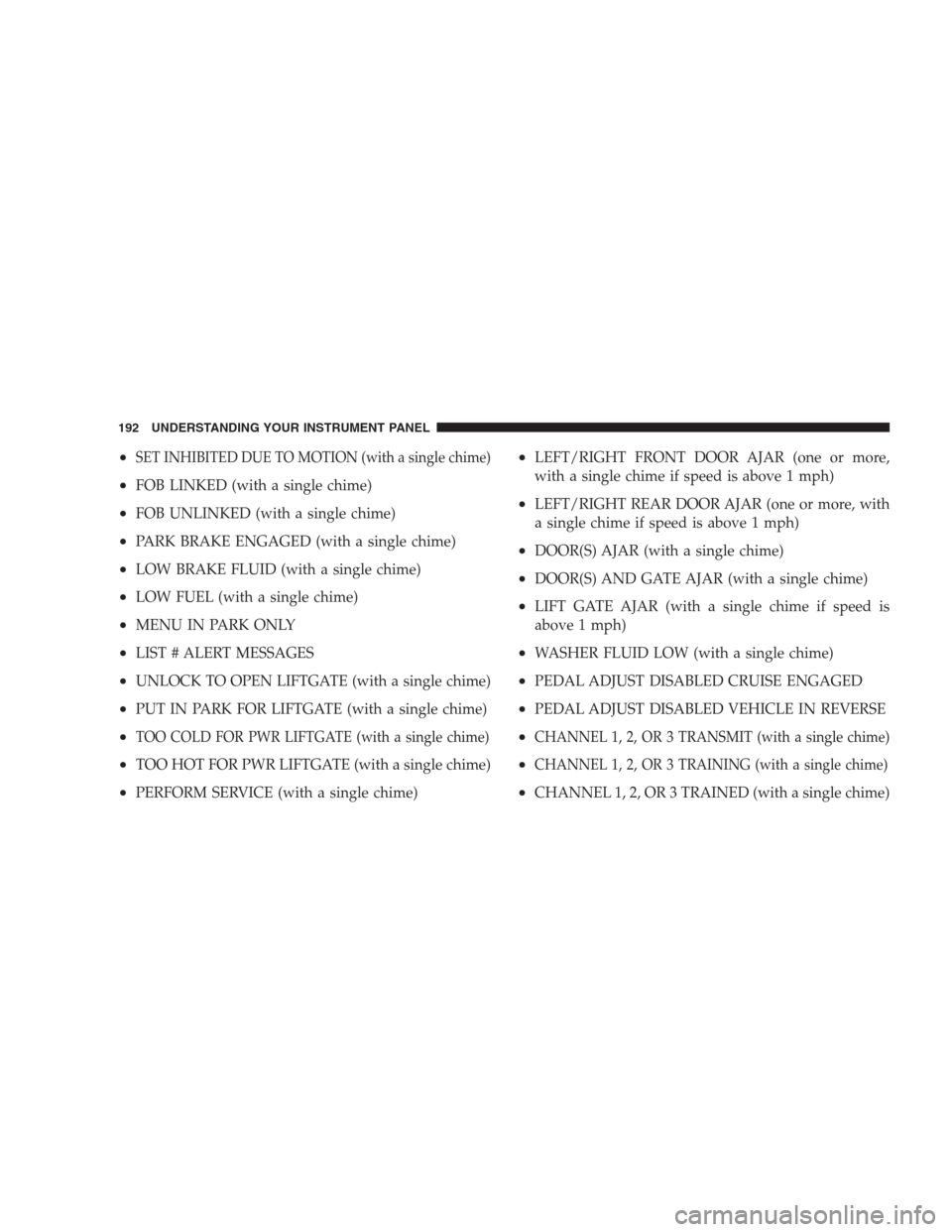
•SET INHIBITED DUE TO MOTION (with a single chime)
•FOB LINKED (with a single chime)
•FOB UNLINKED (with a single chime)
•PARK BRAKE ENGAGED (with a single chime)
•LOW BRAKE FLUID (with a single chime)
•LOW FUEL (with a single chime)
•MENU IN PARK ONLY
•LIST # ALERT MESSAGES
•UNLOCK TO OPEN LIFTGATE (with a single chime)
•PUT IN PARK FOR LIFTGATE (with a single chime)
•TOO COLD FOR PWR LIFTGATE (with a single chime)
•TOO HOT FOR PWR LIFTGATE (with a single chime)
•PERFORM SERVICE (with a single chime)
•LEFT/RIGHT FRONT DOOR AJAR (one or more,
with a single chime if speed is above 1 mph)
•LEFT/RIGHT REAR DOOR AJAR (one or more, with
a single chime if speed is above 1 mph)
•DOOR(S) AJAR (with a single chime)
•DOOR(S) AND GATE AJAR (with a single chime)
•LIFT GATE AJAR (with a single chime if speed is
above 1 mph)
•WASHER FLUID LOW (with a single chime)
•PEDAL ADJUST DISABLED CRUISE ENGAGED
•PEDAL ADJUST DISABLED VEHICLE IN REVERSE
•CHANNEL 1, 2, OR 3 TRANSMIT (with a single chime)
•CHANNEL 1, 2, OR 3 TRAINING (with a single chime)
•CHANNEL 1, 2, OR 3 TRAINED (with a single chime)
192 UNDERSTANDING YOUR INSTRUMENT PANEL
Page 261 of 464
STARTING AND OPERATING
CONTENTS
�Starting Procedures.....................266
▫Automatic Transmission................267
▫Normal Starting (Above 32°F / 0°C)........267
▫Extremely Cold Weather Starting
(Below�20°F / –29°C).................267
▫High Altitude Starting
(Above 4,000 Ft. / 1 219 m)..............267
▫If Engine Fails To Start.................268
▫After Starting........................269
�Engine Block Heater — If Equipped.........270�Automatic Transmission..................270
▫Brake/Transmission Interlock System.......271
▫Automatic Transmission Ignition Interlock
System.............................271
▫Four Speed Automatic Transmission........271
�AutoStick............................274
▫AutoStick Operation...................274
▫AutoStick General Information............275
�All Wheel Drive — If Equipped............276
5
Page 262 of 464
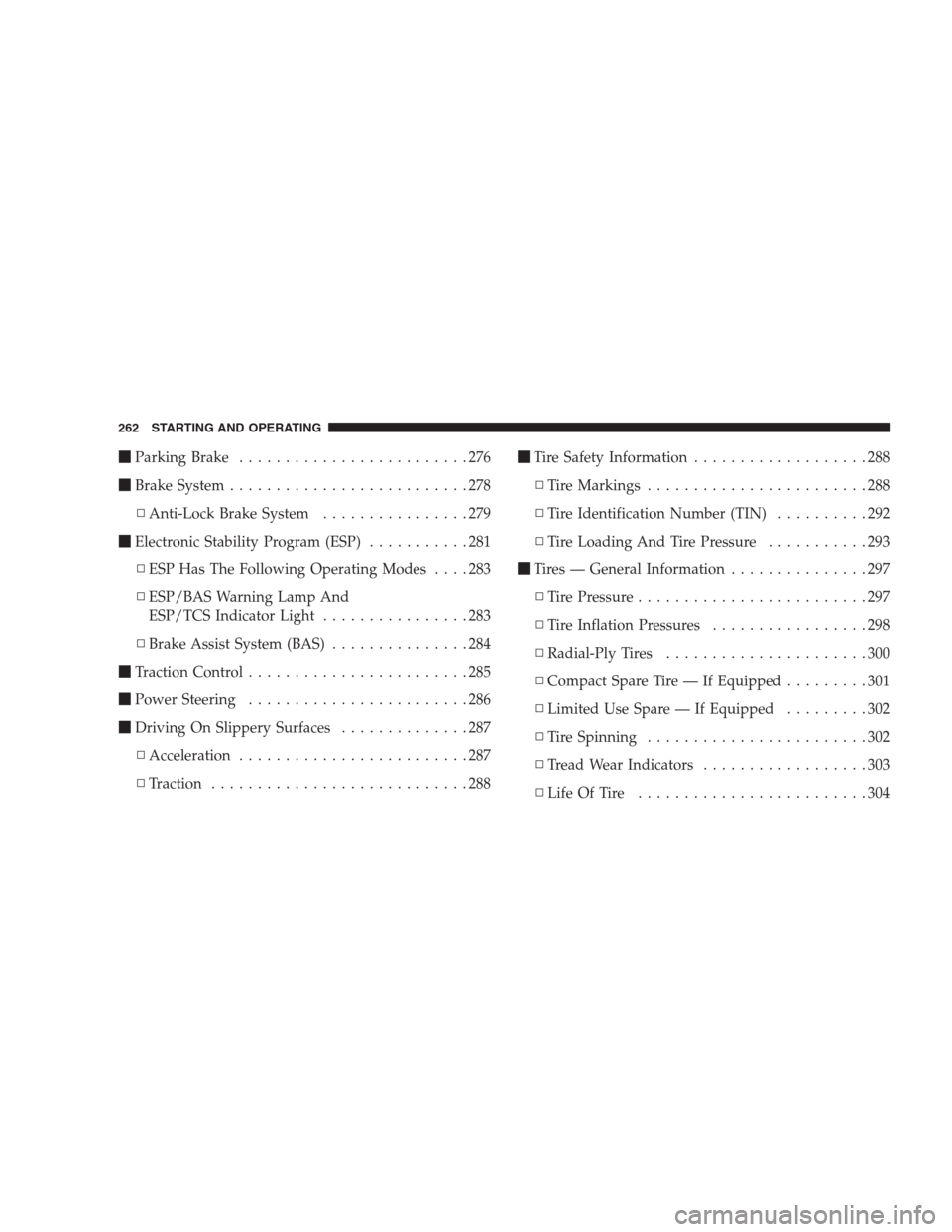
�Parking Brake.........................276
�Brake System..........................278
▫Anti-Lock Brake System................279
�Electronic Stability Program (ESP)...........281
▫ESP Has The Following Operating Modes....283
▫ESP/BAS Warning Lamp And
ESP/TCS Indicator Light................283
▫Brake Assist System (BAS)...............284
�Traction Control........................285
�Power Steering........................286
�Driving On Slippery Surfaces..............287
▫Acceleration.........................287
▫Traction............................288�Tire Safety Information...................288
▫Tire Markings........................288
▫Tire Identification Number (TIN)..........292
▫Tire Loading And Tire Pressure...........293
�Tires — General Information...............297
▫Tire Pressure.........................297
▫Tire Inflation Pressures.................298
▫Radial-Ply Tires......................300
▫Compact Spare Tire — If Equipped.........301
▫Limited Use Spare — If Equipped.........302
▫Tire Spinning........................302
▫Tread Wear Indicators..................303
▫Life Of Tire.........................304
262 STARTING AND OPERATING