Page 53 of 464
If your vehicle is equipped, the window bag on the crash
side of the vehicle is triggered in moderate to severe side
collisions. But even in collisions where the airbags inflate,
you need the seat belts to keep you in the right position
for the airbags to protect you properly.
Here are some simple steps you can take to minimize the
risk of harm from a deploying airbag.
1.Children 12 years old and under should always ride
buckled up in a rear seat.
Infants in rear facing child restraints shouldNEVERride
in the front seat of a vehicle with a passenger front airbag.
An airbag deployment can cause severe injury or death to
infants in that position.Children that are not big enough to properly wear the
vehicle seat belt (refer to section on Child Restraint)
should be secured in the rear seat, in a child restraint or
belt-positioning booster seat appropriate for the size and
age of the child. Older children who do not use a child
restraint or belt-positioning booster seat should ride
properly buckled up in the rear seat. Never allow chil-
dren to slide the shoulder belt behind them or under their
arm.
If a child from 1 to 12 years old must ride in the front
passenger seat because the vehicle is crowded, move the
seat as far back as possible, and use the proper child
restraint. Refer to the section on Child Restraint.
THINGS TO KNOW BEFORE STARTING YOUR VEHICLE 53
2
Page 67 of 464
Data Parameters that May Be Recorded:
•Diagnostic trouble code(s) and warning lamp status
for electronically-controlled safety systems, including
the airbag system
•Airbag disable lamp status (if equipped)
•�Time�of airbag deployment (in terms of ignition
cycles and vehicle mileage)
•Airbag deployment level (if applicable)
•Seat belt status
•Brake status (service and parking brakes)
•Accelerator status (including vehicle speed)
•Engine control status (including engine speed)
•Cruise control status
•Traction/stability control status
Child Restraint
Everyone in your vehicle needs to be buckled up at all
times — babies and children, too. Every state in the
United States and all Canadian provinces require that
small children ride in proper restraint systems. This is the
law, and you can be prosecuted for ignoring it.
Children 12 years and under should ride properly buck-
led up in a seat appropriate for their age and size.
According to crash statistics, children are safer when
properly restrained in the rear seats, rather than in the
front.
THINGS TO KNOW BEFORE STARTING YOUR VEHICLE 67
2
Page 71 of 464

shoulder portion of the lap/shoulder belt will tighten
the belt. The cinching latch plate will keep the belt
tight, however, any seat belt system will loosen with
time, so check the belt occasionally and pull it tight if
necessary.
•In the rear seat, you may have trouble tightening the
lap/shoulder belt on the child restraint because the
buckle or latch plate is too close to the belt path
opening on the restraint. Disconnect the latch plate
from the buckle and twist the short buckle end of the
belt several times to shorten it. Insert the latch plate
into the buckle with the release button facing out.
•If the belt still can’t be tightened, or if pulling and
pushing on the restraint loosens the belt, disconnect
the latch plate from the buckle, turn the buckle
around, and insert the latch plate into the buckle
again. If you still can’t make the child restraint secure,
try a different seating position.
•Buckle the child into the seat according to the child
restraint manufacturer’s directions.
•When your child restraint is not in use, secure it in the
vehicle with the seat belt or remove it from the vehicle.
Don’t leave it loose in the vehicle. In a sudden stop or
collision, it could strike the occupants or seatbacks and
cause serious personal injury.
Lower Anchors and Tether for CHildren (LATCH)
Each vehicle is equipped with two child restraint anchor-
age systems called LATCH, which stands for Lower
Anchors and Tether for CHildren. The LATCH child
restraint anchorage systems are installed on second-row
seats only. LATCH child restraint anchorage systems are
not provided on the six passenger third row seats.
THINGS TO KNOW BEFORE STARTING YOUR VEHICLE 71
2
Page 76 of 464
WARNING!
An incorrectly anchored tether strap could lead to
increased head motion and possible injury to the
child. Use only the anchor positions directly behind
the child seat to secure a child restraint top tether
strap.
Automatic-Locking Retractor (ALR)
The center seating position on vehicles equipped with a
second row bench seat is equipped with an Automatic-
Locking Retractor (ALR). Pull the belt from the retractor
until there is enough to allow you to pass through the
child restraint and slide the latch plate into the buckle.
Then pull on the belt until it is all removed from the
retractor. Allow the belt to return into the retractor,
pulling on the excess webbing to tighten the lap portion
about the child restraint. Follow the instructions of the
child restraint manufacturer.NOTE:To reset this feature you must let all of the belt
webbing return into the retractor. You will not be able to
pull out more webbing until all of the webbing has been
returned back into the retractor.
Installing A Child Restraint
We urge that you carefully follow the directions of the
manufacturer when installing your child restraint. Many,
but not all, restraint systems will be equipped with
separate straps on each side, with each having a hook or
connector and a means for adjusting the tension in the
strap. Forward-facing toddler restraints and some
rearward-facing infant restraints will also be equipped
with a tether strap, a hook and means for adjusting the
tension in the strap.
In general, you will first loosen the adjusters on the lower
straps and tether straps so that you can more easily attach
the hook or connector to the lower anchorages and tether
76 THINGS TO KNOW BEFORE STARTING YOUR VEHICLE
Page 78 of 464
WARNING!
Improper installation of a child restraint to the
LATCH anchorages can lead to failure of an infant or
child restraint. The child could be badly injured or
killed. Follow the manufacturer’s directions exactly
when installing an infant or child restraint.
Children Too Large For Booster Seats
Children who are large enough to wear the shoulder belt
comfortably, and whose legs are long enough to bend
over the front of the seat when their back is against the
seatback, should use the lap/shoulder belt in a rear seat.
•Make sure that the child is upright in the seat.
•The lap portion should be low on the hips and as snug
as possible.
•Check belt fit periodically. A child’s squirming or
slouching can move the belt out of position.
•If the shoulder belt contacts the face or neck, move the
child closer to the center of the vehicle. Never allow a
child to put the shoulder belt under an arm or behind
their back.
Transporting Pets
Airbags deploying in the front seat could harm your pet.
An unrestrained pet could be thrown about and possibly
injured, or injure a passenger during panic braking or in
a collision.
Pets should be restrained in the rear seat in pet harnesses
or pet carriers that are secured by seat belts.
78 THINGS TO KNOW BEFORE STARTING YOUR VEHICLE
Page 86 of 464
▫To Resume Speed.....................151
▫To Vary The Speed Setting...............151
▫To Accelerate For Passing...............152
�Overhead Console — If Equipped...........153
▫Courtesy/Reading Lights................153
▫Sunglasses Storage....................153
�Garage Door Opener — If Equipped.........154
▫Programming HomeLink................155
▫Canadian Programming/Gate Programming . . 158
▫Using HomeLink.....................159
▫Erasing HomeLink Buttons..............159
▫Reprogramming a Single HomeLink Button . . . 159▫Security............................160
�Power Sunroof — If Equipped.............160
▫Express Open Feature..................161
▫Wind Buffeting.......................163
▫Sunroof Maintenance...................163
�Electrical Power Outlets..................163
▫Electrical Outlet Use With Engine Off.......164
�Cupholders...........................165
▫Front Seat Cupholders..................165
▫Second Row Seat Cupholders.............165
▫Third Row Seat Cupholders — If Equipped . . . 166
86 UNDERSTANDING THE FEATURES OF YOUR VEHICLE
Page 126 of 464
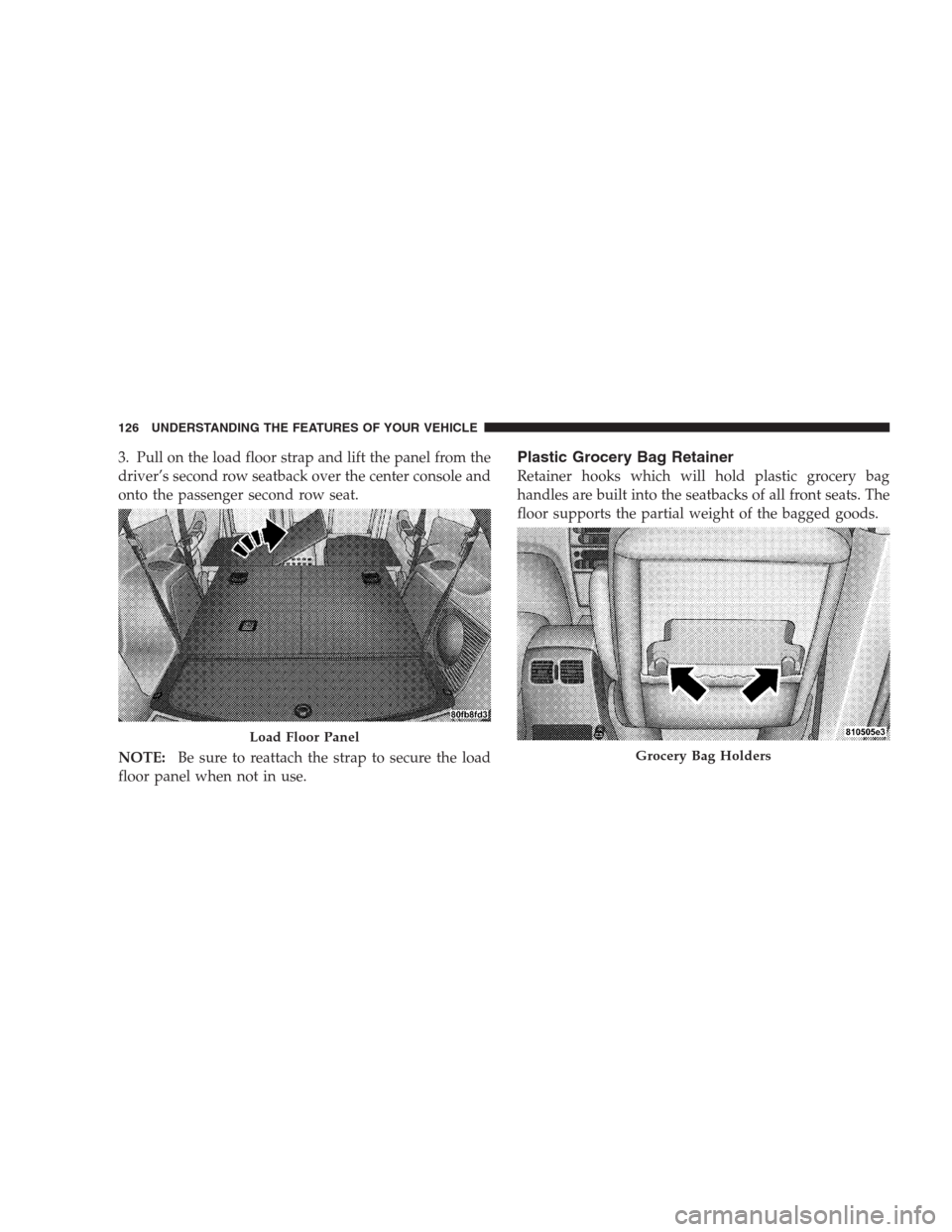
3. Pull on the load floor strap and lift the panel from the
driver’s second row seatback over the center console and
onto the passenger second row seat.
NOTE:Be sure to reattach the strap to secure the load
floor panel when not in use.Plastic Grocery Bag Retainer
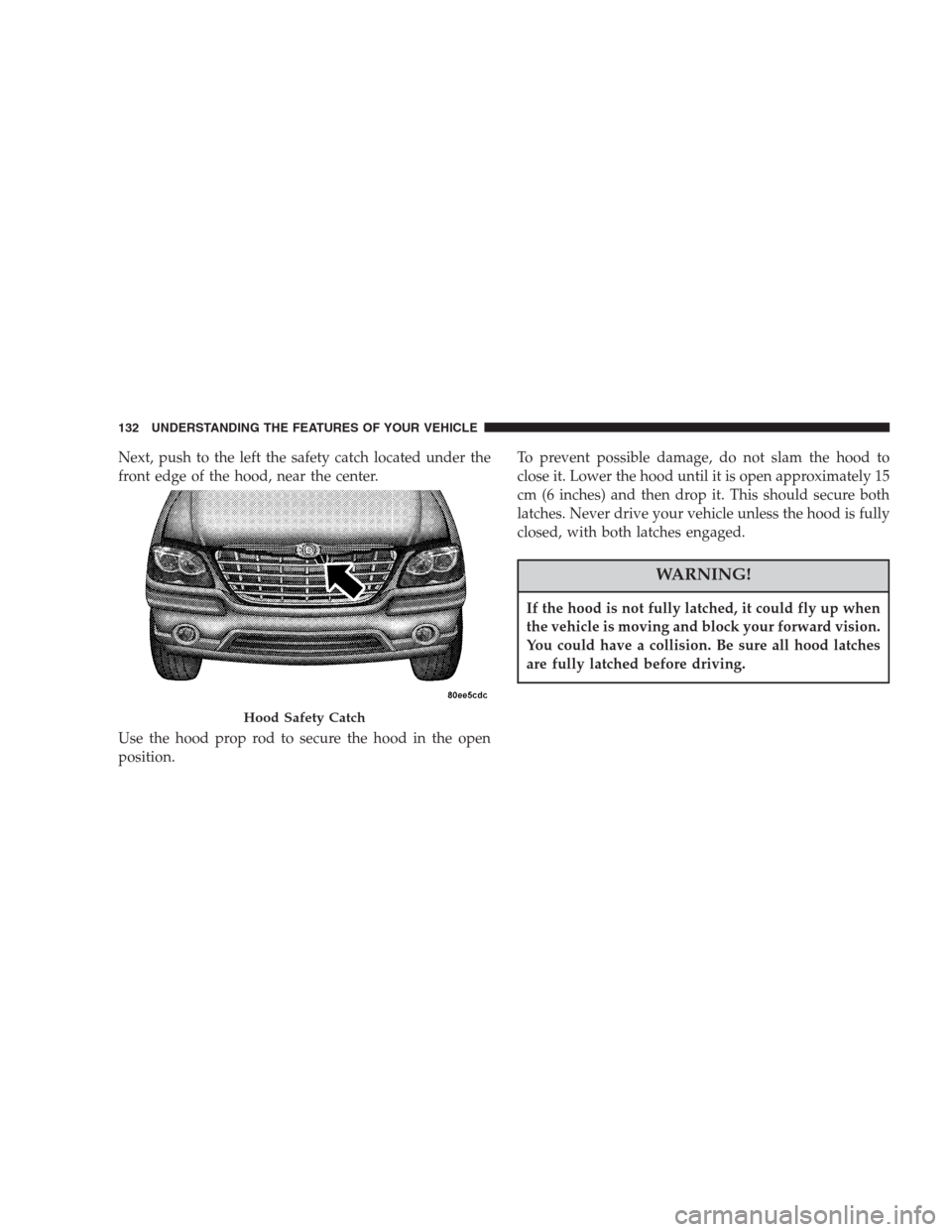
Retainer hooks which will hold plastic grocery bag
handles are built into the seatbacks of all front seats. The
floor supports the partial weight of the bagged goods.
Load Floor Panel
Grocery Bag Holders
126 UNDERSTANDING THE FEATURES OF YOUR VEHICLE
Page 132 of 464
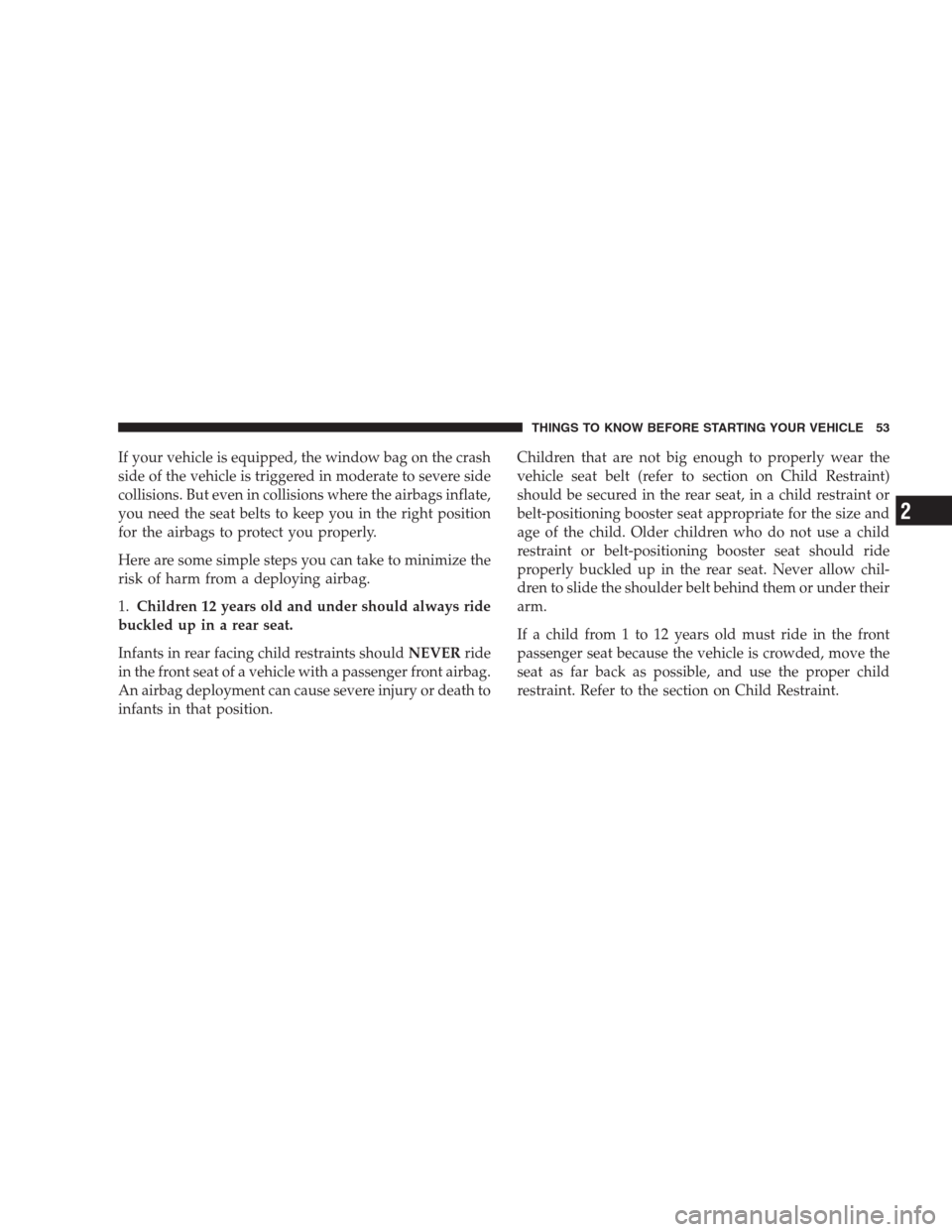
Next, push to the left the safety catch located under the
front edge of the hood, near the center.
Use the hood prop rod to secure the hood in the open
position.To prevent possible damage, do not slam the hood to
close it. Lower the hood until it is open approximately 15
cm (6 inches) and then drop it. This should secure both
latches. Never drive your vehicle unless the hood is fully
closed, with both latches engaged.
WARNING!
If the hood is not fully latched, it could fly up when
the vehicle is moving and block your forward vision.
You could have a collision. Be sure all hood latches
are fully latched before driving.
Hood Safety Catch
132 UNDERSTANDING THE FEATURES OF YOUR VEHICLE