Page 350 of 472

Preparations
Park the vehicle on a firm level surface, avoiding ice or
slippery areas. Set the parking brake and place the gear
selector in PARK (automatic transmission). On Four
Wheel Drive vehicles, shift the transfer case to the “4L”
position.
WARNING!
Do not attempt to change a tire on the side of the
vehicle close to moving traffic. Pull far enough off
the road to avoid the danger of being hit when
operating the jack or changing the wheel.
•Turn on the Hazard Warning Flasher.
•Block both the front and rear
of the wheel diagonally oppo-
site the jacking position. For
example, if the right front
wheel is being changed, block
the left rear wheel.
•Passengers should not remain in the vehicle when the
vehicle is being jacked.
Instructions
1. Remove the spare wheel, jack, and tools from storage.
2. Using the wheel wrench, loosen, but do not remove,
the wheel nuts by turning them counterclockwise one
turn while the wheel is still on the ground.
350 WHAT TO DO IN EMERGENCIES
Page 351 of 472
3. When changing a front wheel, place the jack under the
frame rail behind the wheel. Locate the jack as far
forward as possible on the straight part of the frame
(prior to inboard transition. Operate the jack using the
jack drive tube and the wheel wrench - the tube exten-
sion, may be used but is not required.When changing a rear wheel, assemble the jack drive
tube to the jack and connect the drive tube to the
extension tube. Place the jack under the axle as close to
the tire as posssible with the drive tubes extending to the
rear. Connect the jack tube extension and wheel wrench.
Front Jacking Location
Rear Left Jacking Location
WHAT TO DO IN EMERGENCIES 351
6
Page 352 of 472
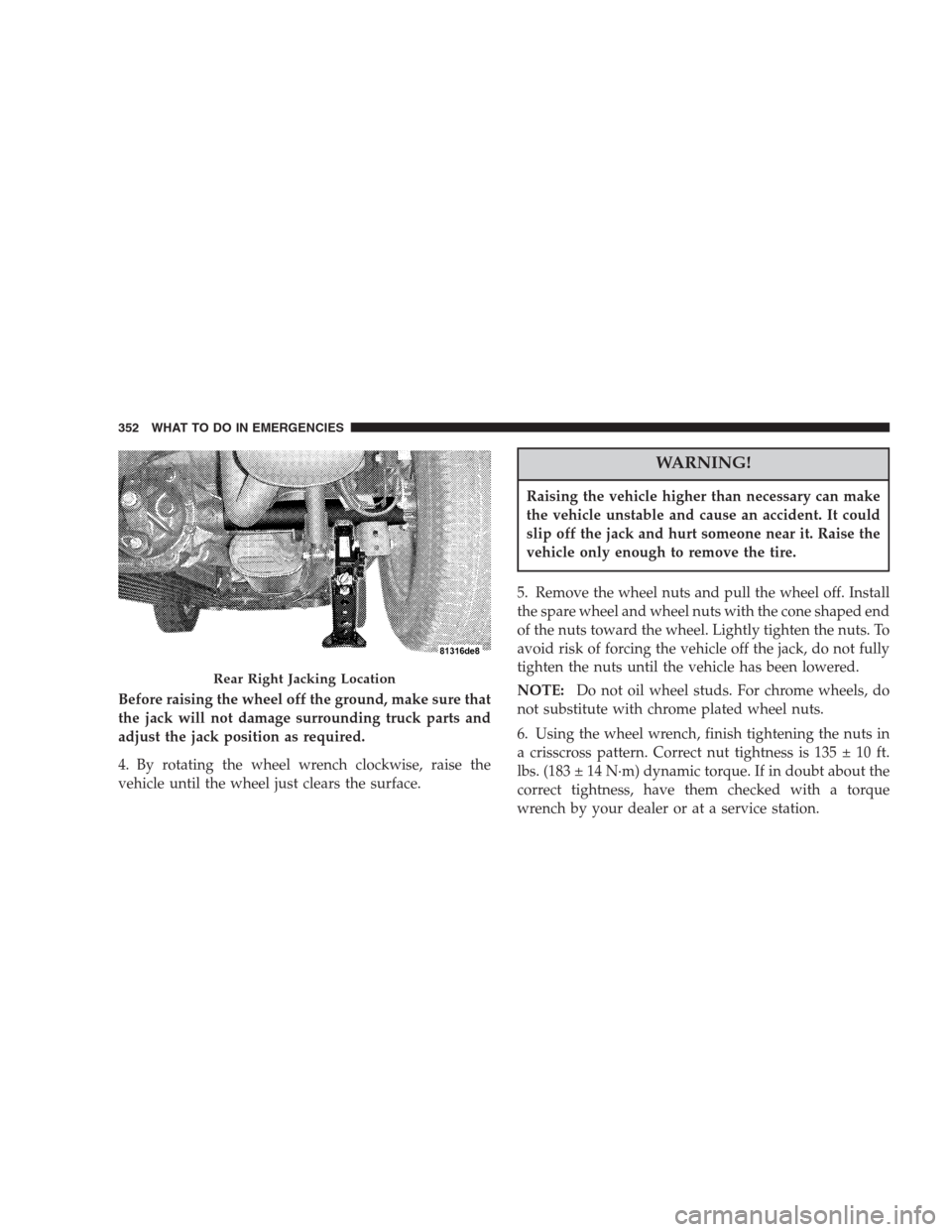
Before raising the wheel off the ground, make sure that
the jack will not damage surrounding truck parts and
adjust the jack position as required.
4. By rotating the wheel wrench clockwise, raise the
vehicle until the wheel just clears the surface.
WARNING!
Raising the vehicle higher than necessary can make
the vehicle unstable and cause an accident. It could
slip off the jack and hurt someone near it. Raise the
vehicle only enough to remove the tire.
5. Remove the wheel nuts and pull the wheel off. Install
the spare wheel and wheel nuts with the cone shaped end
of the nuts toward the wheel. Lightly tighten the nuts. To
avoid risk of forcing the vehicle off the jack, do not fully
tighten the nuts until the vehicle has been lowered.
NOTE:Do not oil wheel studs. For chrome wheels, do
not substitute with chrome plated wheel nuts.
6. Using the wheel wrench, finish tightening the nuts in
a crisscross pattern. Correct nut tightness is 135 ± 10 ft.
lbs. (183 ± 14 N·m) dynamic torque. If in doubt about the
correct tightness, have them checked with a torque
wrench by your dealer or at a service station.
Rear Right Jacking Location
352 WHAT TO DO IN EMERGENCIES
Page 353 of 472

WARNING!
A loose tire or jack thrown forward in a collision or
hard stop could injure someone in the vehicle.
Always stow the jack, tools and the extra tire and
wheel in the places provided.
7. Remove wheel blocks. Do not install chrome or alu-
minum wheel center caps on the spare wheel. This may
result in cap damage.
8. Lower the jack to its fully closed position. Stow the
replaced tire, jack, and tools as previously described.
9. Adjust the tire pressure when possible.
NOTE:Do not oil wheel studs. For chrome wheels, do
not substitute with chrome plated wheel nuts.
WARNING!
Carefully follow these tire changing warnings to help
prevent personal injury or damage to your vehicle:
•Always park on a firm, level surface as far from the
edge of the roadway as possible before raising the
vehicle.
•Block the wheel diagonally opposite the wheel to be
raised.
•Apply the parking brake firmly before jacking.
•Never start the engine with the vehicle on a jack.
•Do not let anyone sit in the vehicle when it is on a jack.
•Do not get under the vehicle when it is on a jack.
•Only use the jack in the positions indicated.
•If working on or near a roadway, be extremely careful
of motor traffic.
•To assure that spare tires, flat or inflated are securely
stowed, spares must be stowed with the value stem
facing the ground.
WHAT TO DO IN EMERGENCIES 353
6
Page 354 of 472

To Stow The Flat Or Spare
Turn the wheel so that the valve stem is down. Slide the
wheel retainer through the center of the wheel and
position it properly across the wheel opening.
For convenience in checking the spare tire inflation, stow
with the valve stem toward the rear of the vehicle.
Rotate the winch mechanism until the wheel is drawn
into place against the underside of the vehicle. Continue
to rotate until you feel the winch mechanism slip or click
2 times. It cannot be overtightened. Push against the tire
several times to be sure it is firmly in place.
JUMP STARTING PROCEDURES
WARNING!
•Battery fluid is a corrosive acid solution; do not
allow battery fluid to contact eyes, skin or cloth-
ing. Don’t lean over battery when attaching
clamps or allow the clamps to touch each other. If
acid splashes in eyes or on skin, flush the con-
taminated area immediately with large quantities
of water.
•A battery generates hydrogen gas which is flam-
mable and explosive. Keep flame or spark away
from the vent holes. Do not use a booster battery
or any other booster source with an output that
exceeds 12 volts.
354 WHAT TO DO IN EMERGENCIES
Page 358 of 472
Four-Wheel Drive Vehicles
The manufacturer recommends towing with all wheels
OFFthe ground. Acceptable methods are to tow the
vehicle on a flatbed or with one end of the vehicle raised
and the opposite end on a towing dolly.
Two-Wheel Drive Vehicles
Provided that the transmission is operable, tow with the
transmission in Neutral and the ignition key in the OFF
position along with the front wheels raised and the rear
wheels on the ground. The speed must not exceed 30
mph (50 km/h) and the distance must not exceed 15
miles (25 km).
If the vehicle is to be towed more than 15 miles (25 km )
or faster than 30 mph, it must be towed on a flatbed, or
with the rear wheels raised and the front wheels on the
ground, or with the front end raised and the rear wheels
on a towing dolly.NOTE:Towing the vehicle, with the rear wheels on the
ground, at more than 30 mph (50 km/h) or for more than
15 miles (25 km ) can cause severe transmission damage.
358 WHAT TO DO IN EMERGENCIES
Page 378 of 472

Drive Shaft Constant Velocity Joints
All four wheel drive models are equipped with four
constant velocity joints. Periodic lubrication of these
joints is not required. However, the joint boot should be
inspected for external leakage or damage periodically. If
external leakage or damage is evident, the joint boot and
grease should be replaced immediately. Continued op-
eration could result in failure of the joint due to water
and dirt contamination of the grease. This would require
complete replacement of the joint assembly. Refer to the
Service Manual for the detailed replacement procedure.
Body Lubrication
Locks and all body pivot points, including such items as
seat tracks, doors,liftgate and hood hinges, should be
lubricated periodically to assure quiet, easy operation
and to protect against rust and wear. Prior to the appli-
cation of any lubricant, the parts concerned should be
wiped clean to remove dust and grit; after lubricating
excess oil and grease should be removed. Particularattention should also be given to hood latching compo-
nents to insure proper function. When performing other
underhood services, the hood latch, release mechanism
and safety catch should be cleaned and lubricated.
The external lock cylinders should be lubricated twice a
year, preferably in the fall and spring. Apply a small
amount of a high quality lubricant such as Mopar�Lock
Cylinder Lubricant directly into the lock cylinder.
Windshield Wiper Blades
The rubber edges of the wiper blades and the windshield
should be cleaned periodically with a sponge or soft cloth
and a mild nonabrasive cleaner. This will remove accu-
mulations of salt or road film.
Operation of the wipers on dry glass for long periods
may cause deterioration of the wiper blades. Always use
washer fluid when using the wipers to remove salt or dirt
from a dry windshield.
378 MAINTAINING YOUR VEHICLE
Page 392 of 472

Axles
Refer to Fluids, Lubricants and Genuine Parts for correct
fluid type.
The manufacturer does not recommend regularly sched-
uled oil changes for axles in vehicles whose operation is
classified as normal truck service.
NOTE:The presence of water in the gear lubricant will
result in corrosion and possible failure of differential
components. Operation of the vehicle in water, as may be
encountered in some off-highway types of service, will
require draining and refilling the axle to avoid damage.
Rear Axle
Rear Axle fluid levels should be 1/4�(6.4 mm) +/- 1/4“
below the fill hole for 8 1/4�, and 9 1/4�axles.
Front Axle
Front Axle fluid level should be 1/4” (6.4 mm) below the
level of the fill hole.
Selection of Lubricating Grease
The National Lubricating Grease Institute (NLGI) has
developed a symbol (Certification Mark) to aid the
vehicle owner in the proper selection of grease for chassis
components. This symbol, an example shown below, is
located on the grease container and identifies the appli-
cation and quality of the grease.
There are two groups
identified, those for wheel
bearings (Letter “G”) and
those for chassis (Letter
“L”) lubrication. Perfor-
mance categories within
these groups result in dual
letter designations for
each group. The letter des-
ignations shown in the ex-
ample are the highest
quality level available and when combined as shown can
392 MAINTAINING YOUR VEHICLE

