Page 69 of 472
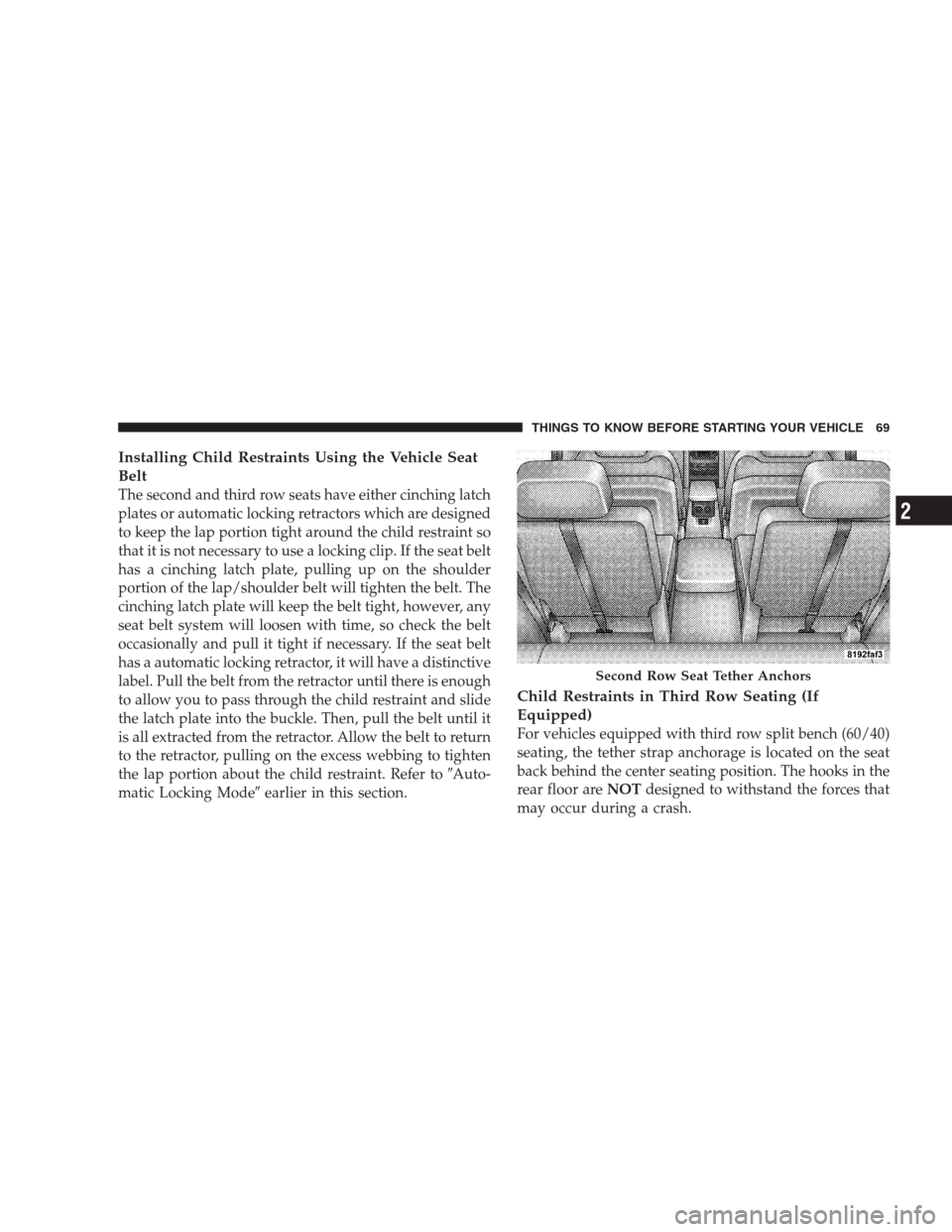
Installing Child Restraints Using the Vehicle Seat
Belt
The second and third row seats have either cinching latch
plates or automatic locking retractors which are designed
to keep the lap portion tight around the child restraint so
that it is not necessary to use a locking clip. If the seat belt
has a cinching latch plate, pulling up on the shoulder
portion of the lap/shoulder belt will tighten the belt. The
cinching latch plate will keep the belt tight, however, any
seat belt system will loosen with time, so check the belt
occasionally and pull it tight if necessary. If the seat belt
has a automatic locking retractor, it will have a distinctive
label. Pull the belt from the retractor until there is enough
to allow you to pass through the child restraint and slide
the latch plate into the buckle. Then, pull the belt until it
is all extracted from the retractor. Allow the belt to return
to the retractor, pulling on the excess webbing to tighten
the lap portion about the child restraint. Refer to�Auto-
matic Locking Mode�earlier in this section.
Child Restraints in Third Row Seating (If
Equipped)
For vehicles equipped with third row split bench (60/40)
seating, the tether strap anchorage is located on the seat
back behind the center seating position. The hooks in the
rear floor areNOTdesigned to withstand the forces that
may occur during a crash.
Second Row Seat Tether Anchors
THINGS TO KNOW BEFORE STARTING YOUR VEHICLE 69
2
Page 70 of 472

WARNING!
An incorrectly anchored tether strap could lead to
increased head motion and possible injury to the
child. Use only the anchor positions directly behind
the child seat to secure a child restraint top tether
strap. Children and infants are safer when properly
restrained in a child restraint system secured in a
rear seating position.
Child Restraint Tether Anchor
There are tether strap anchorages behind each seating
position in the second row and behind the center seating
position in the case of the third row seat (60/40) split
bench, if equipped. To install child restraint tether follow
these instructions.
1. Place the child restraint in the center seating position
of the third row of seats.2. Route the tether strap under the head restraint and
between the two headrest posts.
3. Attach the tether strap hook of the child restraint to
the tether anchor located on the seat back and remove the
slack in the tether strap according to the manufacturer ’s
instructions.Third Row Seat Tether Anchor
70 THINGS TO KNOW BEFORE STARTING YOUR VEHICLE
Page 76 of 472

�Seats................................108
▫Front Seat Manual Seat Adjustment........108
▫Front Seats Manual Seat Recliners..........109
▫Manual Lumbar Support Adjustment —
If Equipped.........................110
▫Adjustable Head Restraints — All Seating
Positions...........................110
▫8 - Way Driver’s Power Seat — If Equipped . . 111
▫4 - Way Passenger’s Power Seat —
If Equipped.........................112
▫Heated Seats — If Equipped.............112
▫Second Row Bucket Seats —
Fold And Tumble.....................115
▫Second Row 40/20/40 Seat —
Fold And Tumble.....................117▫Third Row Seat Bench — If Equipped.......120
▫Third Row 60/40 Folding — If Equipped....123
�Driver Memory System — If Equipped.......125
▫Setting Memory Positions And Linking Remote
Keyless Entry Transmitter To Memory.......126
▫Memory Position Recall.................127
▫To Disable A Transmitter Linked To Memory . . 127
▫Self-Limiting Control...................128
▫Driver Easy Exit And Easy Entry Control....128
�To Open And Close The Hood.............129
�Lights...............................131
▫Interior Lights.......................132
▫Battery Saver........................132
76 UNDERSTANDING THE FEATURES OF YOUR VEHICLE
Page 110 of 472
WARNING!
Do not ride with the seatback reclined so that the
shoulder belt is no longer resting against your chest.
In a collision you could slide under the seat belt and
be seriously or even fatally injured. Use the recliner
only when the vehicle is parked.
Manual Lumbar Support Adjustment — If
Equipped
The manual lumbar support adjustment lever is located
on the right side of the driver seat and on the left side of
the passenger’s seat. Moving the lumbar control lever
fore and aft increases or decreases the lumbar support.
Adjustable Head Restraints — All Seating
Positions
Head restraints can reduce the risk of whiplash injury in
the event of impact from the rear. Pull up or push down
on the restraints so that the upper edge is as high as
practical, at least to the level of the ears.
Lumbar Support Adjustment Lever
110 UNDERSTANDING THE FEATURES OF YOUR VEHICLE
Page 115 of 472
Second Row Bucket Seats — Fold and Tumble
Second row bucket seats have seatback recliners on both
seating positions. Raising the lever allows the seatback to
be reclined an additional 11 degrees.
The second row bucket seats can be folded and tumbled
forward for easy access to the third seat or rear cargo
area.
To fold and tumble the seat, follow these steps:
1. Remove any obstructions from the floor in front of the
seat.
2. Lower the head restraint to its full downward posi-
tion.3. Pull up on the seatback release lever located on the
outboard side of the seat and push the seatback forward.
Folding the Setaback
UNDERSTANDING THE FEATURES OF YOUR VEHICLE 115
3
Page 118 of 472
Second row leather seats have seatback recliners at the
40% seating positions. Raising the lever allows the seat-
back to be reclined an additional 11 degrees.
To Fold the 40% seatbacks fully raise the lever on the side
of the seat to release the seatback. The seatback can nowbe folded into the down position for use as a cargo floor,
or the seat can now be tumbled forward to allow access
to the rear of the vehicle.
To fold the 20% seatback, pull the strap forward to release
the seatback. Fold the seatback down for use as an
armrest or to carry cargo. When returning the seatback to
the upright position, push the seatback rearward to latch
the seatback. Pull the seatback forward to ensure that it is
locked in the upright position.
WARNING!
The 20% seatback contains the center shoulder belt.
A 20% seatback that is not fully latched in the
upright position will not protect you properly.
Fold, Tumble, and Recline Lever
118 UNDERSTANDING THE FEATURES OF YOUR VEHICLE
Page 295 of 472
5. Determine the combined weight of luggage and cargo
being loaded on the vehicle. That weight may not safely
exceed the available cargo and luggage load capacity
calculated in Step 4.
6. If your vehicle will be towing a trailer, load from your
trailer will be transferred to your vehicle. Consult this
manual to determine how this reduces the available
cargo and luggage load capacity of your vehicle.
NOTE:The following table shows examples on how to
calculate total load, cargo/luggage, and towing capaci-
ties of your vehicle with varying seating configurationsand number and size of occupants. This table is for
illustration purposes only and may not be accurate for
the seating and load carry capacity of your vehicle.
NOTE:For the following example, the combined weight
of occupants and cargo should never exceed 865 lbs. (392
Kg).
STARTING AND OPERATING 295
5


