2007 CHEVROLET TRAIL BLAZER wheel
[x] Cancel search: wheelPage 88 of 574
Restraint System Check
Checking the Restraint Systems
Now and then, make sure the safety belt reminder
light and all your belts, buckles, latch plates,
retractors and anchorages are working properly.
Look for any other loose or damaged safety
belt system parts. If you see anything that might
keep a safety belt system from doing its job, have
it repaired. Keep safety belts clean and dry.
SeeCare of Safety Belts on page 495for more
information.
Torn or frayed safety belts may not protect you in
a crash. They can rip apart under impact forces.
If a belt is torn or frayed, get a new one right away.Also look for any opened or broken airbag covers,
and have them repaired or replaced. The airbag
system does not need regular maintenance.
Notice:If you damage the covering for the
driver’s or the right front passenger’s airbag,
or the side impact airbag covering on the
ceiling near the side windows, the airbag may
not work properly. You may have to replace
the airbag module in the steering wheel, both
the airbag module and the instrument panel
for the right front passenger’s airbag, or
side impact airbag module and ceiling covering
for roof-mounted rollover airbags (if equipped).
Do not open or break the airbag coverings.
88
Page 91 of 574
Keys.............................................................. 93
Remote Keyless Entry (RKE) System.......... 95
Remote Keyless Entry (RKE) System
Operation................................................. 96
Doors and Locks.......................................... 98
Door Locks................................................. 98
Power Door Locks....................................... 99
Delayed Locking........................................ 100
Programmable Automatic Door Locks........ 100
Rear Door Security Locks......................... 103
Lockout Protection..................................... 103
Liftgate/Liftglass......................................... 104
Windows...................................................... 105
Power Windows........................................ 106
Sun Visors................................................ 108
Theft-Deterrent Systems............................. 108
Content Theft-Deterrent............................. 108
Passlock
®.................................................. 110Starting and Operating Your Vehicle......... 111
New Vehicle Break-In................................ 111
Ignition Positions....................................... 112
Retained Accessory Power (RAP)............. 113
Starting the Engine.................................... 113
Adjustable Throttle and Brake Pedal.......... 115
Engine Coolant Heater.............................. 116
Active Fuel Management™........................ 117
Automatic Transmission Operation............. 117
Four-Wheel Drive...................................... 121
Parking Brake........................................... 126
Shifting Into Park (P)................................. 127
Shifting Out of Park (P)............................. 129
Parking Over Things That Burn................. 129
Engine Exhaust......................................... 130
Running the Engine While Parked............. 131
Section 2 Features and Controls
91
Page 118 of 574
PARK (P):This position locks the rear wheels.
It is the best position to use when you start
the engine because your vehicle cannot move
easily.
{CAUTION:
It is dangerous to get out of your vehicle
if the shift lever is not fully in PARK (P)
with the parking brake rmly set. Your
vehicle can roll.
Do not leave your vehicle when the engine
is running unless you have to. If you have
left the engine running, the vehicle can
move suddenly. You or others could be
injured. To be sure your vehicle will not
move, even when you are on fairly level
ground, always set your parking brake
and move the shift lever to PARK (P). See
Shifting Into Park (P) on page 127.Ifyou
are pulling a trailer, seeTowing a Trailer
on page 368.
{CAUTION:
If you have four-wheel drive, your vehicle
will be free to roll — even if your shift
lever is in PARK (P) — if your transfer
case is in NEUTRAL. So, be sure the
transfer case is in a drive gear — not in
NEUTRAL. SeeFour-Wheel Drive on
page 121. SeeShifting Into Park (P) on
page 127.
Make sure the shift lever is fully in PARK (P)
before starting the engine. Your vehicle has an
automatic transmission shift lock control system.
You have to fully apply the regular brakes rst and
then press the shift lever button before you can
shift from PARK (P) when the ignition key is
in RUN. If you cannot shift out of PARK (P), ease
pressure on the shift lever and push the shift
lever all the way into PARK (P) as you maintain
brake application. Then press the shift lever button
and move the shift lever into another gear.
SeeShifting Out of Park (P) on page 129.
118
Page 119 of 574
REVERSE (R):Use this gear to back up.
Notice:Shifting to REVERSE (R) while your
vehicle is moving forward could damage
the transmission. The repairs would not be
covered by your warranty. Shift to
REVERSE (R) only after your vehicle is
stopped.
To rock your vehicle back and forth to get out of
snow, ice, or sand without damaging your
transmission, seeIf Your Vehicle is Stuck in Sand,
Mud, Ice, or Snow on page 354.
NEUTRAL (N):In this position, the engine does
not connect with the wheels. To restart when
you are already moving, use NEUTRAL (N) only.
{CAUTION:
Shifting into a drive gear while your
engine is running at high speed is
dangerous. Unless your foot is rmly on
the brake pedal, your vehicle could move
very rapidly. You could lose control and
hit people or objects. Do not shift into a
drive gear while your engine is running at
high speed.
Notice:Shifting out of PARK (P) or
NEUTRAL (N) with the engine running at
high speed may damage the transmission.
The repairs would not be covered by your
warranty. Be sure the engine is not running at
high speed when shifting your vehicle.
119
Page 121 of 574
To shift to the FIRST (1) position, you must rst
press the large button on the shift handle.
While the button is pressed, move the shifter in
the FIRST (1) position.
Notice:Spinning the tires or holding the
vehicle in one place on a hill using only
the accelerator pedal may damage the
transmission. The repair will not be covered by
your warranty. If you are stuck, do not spin
the tires. When stopping on a hill, use the
brakes to hold the vehicle in place.
Four-Wheel Drive
If your vehicle has four-wheel drive, the engine’s
driving power can be sent to all four wheels
for extra traction. To get the most satisfaction out
of four-wheel drive, you must be familiar with
its operation. Read the part that follows before
using four-wheel drive. You should use Two-Wheel
High for most normal driving conditions.Notice:Driving on clean, dry pavement in
Four-Wheel-Drive High or Four-Wheel-Drive
Low for an extended period of time may cause
premature wear on your vehicle’s powertrain.
Do not drive on clean, dry pavement in
Four-Wheel-Drive High or Four-Wheel-Drive
Low for extended periods of time.
Notice:If you continually drive your vehicle
with the transfer case in AUTO or Four-Wheel
Drive, you could shorten the life of the
transfer case or the Four-Wheel Drive system.
The selector switch should be left in
Two-Wheel Drive High mode. Only use AUTO
and Four-Wheel Drive when you need extra
traction such as in wet or slippery road
conditions.
121
Page 122 of 574
Automatic Transfer Case
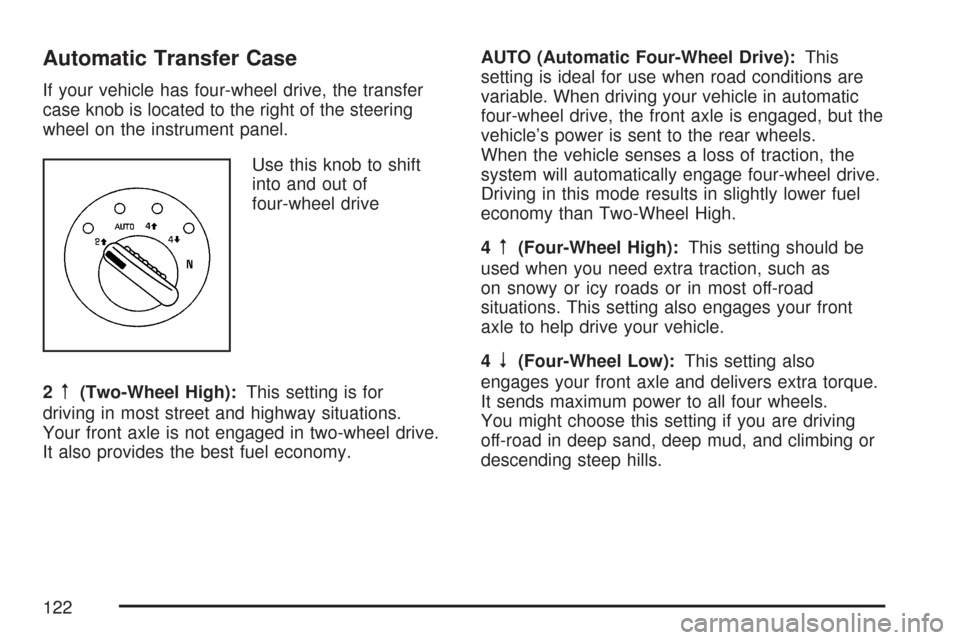
If your vehicle has four-wheel drive, the transfer
case knob is located to the right of the steering
wheel on the instrument panel.
Use this knob to shift
into and out of
four-wheel drive
2
m(Two-Wheel High):This setting is for
driving in most street and highway situations.
Your front axle is not engaged in two-wheel drive.
It also provides the best fuel economy.AUTO (Automatic Four-Wheel Drive):This
setting is ideal for use when road conditions are
variable. When driving your vehicle in automatic
four-wheel drive, the front axle is engaged, but the
vehicle’s power is sent to the rear wheels.
When the vehicle senses a loss of traction, the
system will automatically engage four-wheel drive.
Driving in this mode results in slightly lower fuel
economy than Two-Wheel High.
4
m(Four-Wheel High):This setting should be
used when you need extra traction, such as
on snowy or icy roads or in most off-road
situations. This setting also engages your front
axle to help drive your vehicle.
4
n(Four-Wheel Low):This setting also
engages your front axle and delivers extra torque.
It sends maximum power to all four wheels.
You might choose this setting if you are driving
off-road in deep sand, deep mud, and climbing or
descending steep hills.
122
Page 123 of 574
{CAUTION:
Shifting the transfer case to NEUTRAL can
cause your vehicle to roll even if the
transmission is in PARK (P). You or
someone else could be seriously injured.
Be sure to set the parking brake before
placing the transfer case in NEUTRAL.
SeeParking Brake on page 126.
NEUTRAL:Shift the vehicle’s transfer case to
NEUTRAL only when towing your vehicle.
SeeRecreational Vehicle Towing on page 362for
more information.
An indicator light in the knob will show you which
position the transfer case is in. The indicator lights
will come on briey when you turn on the ignition
and one will stay on. If the lights do not come on,
you should take your vehicle to your dealer for
service. An indicator light will ash while shiftingthe transfer case. It will stay on when the shift is
complete. If for some reason the transfer case
cannot make a requested shift, it will return to the
last chosen setting.
If the service Four-Wheel Drive Warning Light on
the instrument panel cluster stays on, you
should take your vehicle to your dealer for service.
SeeService Four-Wheel Drive Warning Light on
page 218for further information.
Shifting Into Four-Wheel High or Automatic
Four-Wheel Drive
Turn the knob to Four-Wheel High or Automatic
Four-Wheel Drive. This can be done at any speed
unless you are shifting out of Four-Wheel Low.
The indicator light will ash while shifting.
It will remain on when the shift is complete.
Shifting Into Two-Wheel High
Turn the knob to Two-Wheel High. This can be
done at any speed unless you are shifting
out of Four-Wheel Low.
123
Page 124 of 574
Shifting Into Four-Wheel Low
To shift to Four-Wheel Low, the vehicle’s engine
must be running and the vehicle must be stopped
or moving less than 2 mph (3.2 km/h) with the
transmission in NEUTRAL (N). The preferred
method for shifting into Four-Wheel Low is to have
your vehicle moving 1 or 2 mph (1.6 to 3.2 km/h).
Turn the knob to Four-Wheel Low. You must
wait for the Four-Wheel Low indicator light to stop
ashing and stay on before shifting the
transmission into gear.
If you turn the knob to Four-Wheel Low when your
vehicle is in gear and/or moving, the Four-Wheel
Low indicator light will ash for 30 seconds and not
complete the shift unless your vehicle is moving
less than 2 mph (3.2 km/h) and the transmission is
in NEUTRAL (N). After 30 seconds, the transfer
case will return to the setting last chosen.
Shifting Out of Four-Wheel Low
To shift from Four-Wheel Low to Four-Wheel High,
Auto Four-Wheel Drive, or Two-Wheel High,
your vehicle must be stopped or moving less than
2 mph (3.2 km/h) with the transmission in
NEUTRAL (N) and the engine running. The
preferred method for shifting out of Four-Wheel
Low is to have your vehicle moving 1 or 2 mph
(1.6 to 3.2 km/h). Turn the knob to Four-Wheel
High, Auto Four-Wheel Drive, or Two-Wheel High.
You must wait for the Four-Wheel High, Auto
Four-Wheel Drive, or Two-Wheel High indicator
light to stop ashing and stay off before shifting
your transmission into gear.
If the knob is turned to Four Wheel-High, Auto
Four-Wheel Drive, or Two-Wheel High when your
vehicle is in gear and/or moving, the Four-Wheel
High, Auto Four-Wheel Drive, or Two-Wheel
High indicator light will ash for 30 seconds. It will
not complete the shift unless your vehicle is
moving less than 2 mph (3.2 km/h) with the
transmission in NEUTRAL (N).
124