2007 CHEVROLET TRAIL BLAZER tires
[x] Cancel search: tiresPage 322 of 574
If other vehicles are lined up to pass a slow
vehicle, wait your turn. But take care that
someone is not trying to pass you as you
pull out to pass the slow vehicle. Remember
to glance over your shoulder and check the
blind spot.
Check your vehicle’s mirrors, glance over your
shoulder, and start your left lane change signal
before moving out of the right lane to pass.
When you are far enough ahead of the passed
vehicle to see its front in your vehicle’s inside
mirror, activate the right lane change signal
and move back into the right lane. Remember
that an outside convex mirror makes the vehicle
you just passed seem farther away from you
than it really is.
Try not to pass more than one vehicle at a time
on two-lane roads. Reconsider before passing
the next vehicle.
Do not overtake a slowly moving vehicle
too rapidly. Even though the brake lamps
are not ashing, it might be slowing down or
starting to turn.
If you are being passed, make it easy for the
following driver to get ahead of you. Perhaps
you can ease a little to the right.
Loss of Control
Let us review what driving experts say about what
happens when the three control systems — brakes,
steering, and acceleration — do not have enough
friction where the tires meet the road to do what the
driver has asked.
In any emergency, do not give up. Keep trying to
steer and constantly seek an escape route or
area of less danger.
Skidding
In a skid, a driver can lose control of the vehicle.
Defensive drivers avoid most skids by taking
reasonable care suited to existing conditions, and
by not overdriving those conditions. But skids
are always possible.
The three types of skids correspond to your
vehicle’s three control systems. In the braking skid,
the wheels are not rolling. In the steering or
cornering skid, too much speed or steering in a
curve causes tires to slip and lose cornering force.
And in the acceleration skid, too much throttle
causes the driving wheels to spin.
A cornering skid is best handled by easing your
foot off the accelerator pedal.
322
Page 323 of 574
If your vehicle starts to slide, ease your foot off
the accelerator pedal and quickly steer the
way you want the vehicle to go. If you start
steering quickly enough, your vehicle may
straighten out. Always be ready for a second
skid if it occurs.
Of course, traction is reduced when water, snow,
ice, gravel, or other material is on the road. For
safety, you want to slow down and adjust your
driving to these conditions. It is important to slow
down on slippery surfaces because stopping
distance is longer and vehicle control more limited.
While driving on a surface with reduced traction, try
your best to avoid sudden steering, acceleration, or
braking, including reducing vehicle speed by
shifting to a lower gear. Any sudden changes could
cause the tires to slide. You might not realize the
surface is slippery until your vehicle is skidding.
Learn to recognize warning clues — such as
enough water, ice, or packed snow on the road to
make a mirrored surface — and slow down when
you have any doubt.
Remember: Any Anti-Lock Brake System (ABS)
helps avoid only the braking skid.Competitive Driving
See your warranty book before using your vehicle
for competitive driving. After reviewing your
warranty book, please see the GM Performance
Parts website or catalog for parts and equipment
required for competitive driving.
Notice:If you use your vehicle for competitive
driving, the engine may use more oil than it
would with normal use. Low oil levels can
damage the engine. Be sure to check the oil
level often during competitive driving and keep
the level at or near the upper mark that
shows the proper operating range on the
engine oil dipstick. For information on how to
add oil, seeEngine Oil on page 402.
Off-Road Driving (Except SS)
This off-road guide is for vehicles that have
four-wheel drive. Also, seeBraking on page 310.
If your vehicle does not have four-wheel drive,
you should not drive off-road unless you are
on a level, solid surface.
323
Page 325 of 574
Loading Your Vehicle for
Off-Road Driving
{CAUTION:
Cargo on the load oor piled higher
than the seatbacks can be thrown
forward during a sudden stop. You or
your passengers could be injured.
Keep cargo below the top of the
seatbacks.
Unsecured cargo on the load oor can
be tossed about when driving over
rough terrain. You or your passengers
can be struck by ying objects.
Secure the cargo properly.
Heavy loads on the roof raise the
vehicle’s center of gravity, making it
more likely to roll over. You can be
seriously or fatally injured if the
vehicle rolls over. Put heavy loads
inside the cargo area, not on the roof.
Keep cargo in the cargo area as far
forward and low as possible.There are some important things to remember
about how to load your vehicle.
The heaviest things should be on the load
oor and forward of the rear axle. Put
heavier items as far forward as you can.
Be sure the load is secured properly, so
driving on the off-road terrain does not
toss things around.
You will nd other important information in this
manual. SeeLoading Your Vehicle on page 356,
Luggage Carrier on page 162, andTires on
page 448.
325
Page 335 of 574
Surface conditions can be a problem when you
drive across a hill. Loose gravel, muddy spots,
or even wet grass can cause the tires to slip
sideways, downhill. If the vehicle slips
sideways, it can hit something that will trip
it —a rock, a rut, etc. — and roll over.
Hidden obstacles can make the steepness of
the incline even worse. If you drive across a
rock with the uphill wheels, or if the downhill
wheels drop into a rut or depression, your
vehicle can tilt even more.
For reasons like these, you need to decide
carefully whether to try to drive across an incline.
Just because the trail goes across the incline
does not mean you have to drive it. The last
vehicle to try it might have rolled over.
Q:What if I am driving across an incline that
is not too steep, but I hit some loose
gravel and start to slide downhill. What
should I do?
A:If you feel your vehicle starting to slide
sideways, turn downhill. This should help
straighten out the vehicle and prevent the side
slipping. However, a much better way to
prevent this is to get out and “walk the course”
so you know what the surface is like before
you drive it.
335
Page 337 of 574
Driving in Mud, Sand, Snow, or Ice
When you drive in mud, snow, or sand, the wheels
will not get good traction. You cannot accelerate
as quickly, turning is more difficult, and you
will need longer braking distances.
It is best to use a low gear when you are in
mud —the deeper the mud, the lower the gear.
In really deep mud, the idea is to keep your vehicle
moving so you do not get stuck.
When you drive on sand, you will sense a change
in wheel traction. But it will depend upon how
loosely packed the sand is. On loosely packed
sand, such as on beaches or sand dunes, the tires
will tend to sink into the sand. This has an effect
on steering, accelerating, and braking. Drive
at a reduced speed and avoid sharp turns
or abrupt maneuvers.Hard packed snow and ice offer the worst tire
traction. On these surfaces, it is very easy to lose
control. On wet ice, for example, the traction is
so poor that you will have difficulty accelerating.
And if you do get moving, poor steering and
difficult braking can cause you to slide out of
control.
{CAUTION:
Driving on frozen lakes, ponds, or rivers
can be dangerous. Underwater springs,
currents under the ice, or sudden thaws
can weaken the ice. Your vehicle could
fall through the ice and you and your
passengers could drown. Drive your
vehicle on safe surfaces only.
337
Page 338 of 574
Driving in Water
{CAUTION:
Driving through rushing water can be
dangerous. Deep water can sweep your
vehicle downstream and you and your
passengers could drown. If it is only
shallow water, it can still wash away the
ground from under your tires, and you
could lose traction and roll the vehicle
over. Do not drive through rushing water.
Heavy rain can mean ash ooding, and ood
waters demand extreme caution.
Find out how deep the water is before you drive
through it. If it is deep enough to cover the
wheel hubs, axles, or exhaust pipe, do not try
it — you probably will not get through. Also, water
that deep can damage the axle and other
vehicle parts.If the water is not too deep, drive slowly through it.
At faster speeds, water splashes on the ignition
system and your vehicle can stall. Stalling can also
occur if you get the tailpipe under water. And,
as long as the tailpipe is under water, you
will never be able to start the engine. When you
go through water, remember that when the brakes
get wet, it may take you longer to stop.
SeeDriving in Rain and on Wet Roads on page 340
for more information on driving through water.
After Off-Road Driving
Remove any brush or debris that has collected on
the underbody, chassis, or under the hood.
These accumulations can be a re hazard.
After operation in mud or sand, have the brake
linings cleaned and checked. These substances
can cause glazing and uneven braking. Check the
body structure, steering, suspension, wheels,
tires, and exhaust system for damage. Also, check
the fuel lines and cooling system for any leakage.
Your vehicle will require more frequent service
due to off-road use. Refer to the Maintenance
Schedule for additional information.
338
Page 340 of 574
Keep the windshield and all the glass on your
vehicle clean — inside and out. Glare at night is
made much worse by dirt on the glass. Even
the inside of the glass can build up a lm caused
by dust. Dirty glass makes lights dazzle and
ash more than clean glass would, making the
pupils of your eyes contract repeatedly.
Remember that the headlamps light up far less of a
roadway when you are in a turn or curve. Keep your
eyes moving; that way, it is easier to pick out dimly
lighted objects. Just as the headlamps should be
checked regularly for proper aim, so should your
eyes be examined regularly. Some drivers suffer
from night blindness — the inability to see in dim
light — and are not even aware of it.Driving in Rain and on Wet Roads
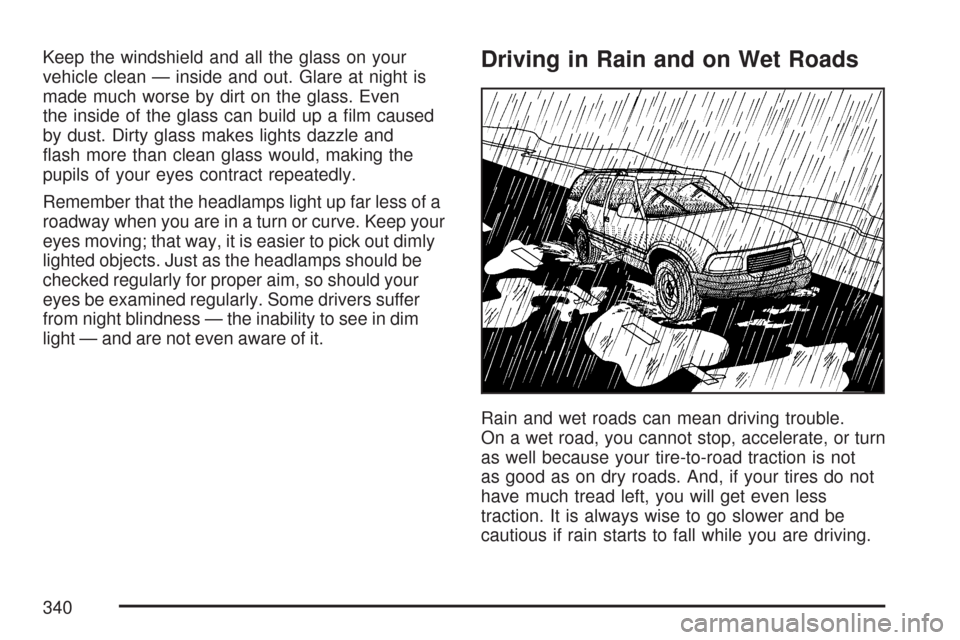
Rain and wet roads can mean driving trouble.
On a wet road, you cannot stop, accelerate, or turn
as well because your tire-to-road traction is not
as good as on dry roads. And, if your tires do not
have much tread left, you will get even less
traction. It is always wise to go slower and be
cautious if rain starts to fall while you are driving.
340
Page 342 of 574
Hydroplaning
Hydroplaning is dangerous. So much water can
build up under your tires that they can actually ride
on the water. This can happen if the road is wet
enough and you are going fast enough. When your
vehicle is hydroplaning, it has little or no contact
with the road.
Hydroplaning does not happen often. But it can
if your tires do not have much tread or if the
pressure in one or more is low. It can happen if
a lot of water is standing on the road. If you
can see reections from trees, telephone poles,
or other vehicles, and raindrops dimple the water’s
surface, there could be hydroplaning.
Hydroplaning usually happens at higher speeds.
There just is not a hard and fast rule about
hydroplaning. The best advice is to slow down
when it is raining.
Driving Through Deep Standing Water
Notice:If you drive too quickly through
deep puddles or standing water, water can
come in through the engine’s air intake
and badly damage the engine. Never drive
through water that is slightly lower than the
underbody of your vehicle. If you cannot avoid
deep puddles or standing water, drive
through them very slowly.
342