2007 CHEVROLET SUBURBAN wheel
[x] Cancel search: wheelPage 108 of 634
Restraint System Check
Checking the Restraint Systems
Now and then, make sure the safety belt reminder
light and all your belts, buckles, latch plates,
retractors and anchorages are working properly.
Look for any other loose or damaged safety
belt system parts. If you see anything that might
keep a safety belt system from doing its job, have
it repaired. Keep safety belts clean and dry.
SeeCare of Safety Belts on page 556for more
information.
Torn or frayed safety belts may not protect you in
a crash. They can rip apart under impact forces.
If a belt is torn or frayed, get a new one right away.
Also look for any opened or broken airbag
covers, and have them repaired or replaced. The
airbag system does not need regular maintenance.Notice:If you damage the covering for the
driver’s or the right front passenger’s airbag,
or the side impact airbag covering on the
ceiling near the side windows, the airbag may
not work properly. You may have to replace
the airbag module in the steering wheel, both
the airbag module and the instrument panel
for the right front passenger’s airbag, or
side impact airbag module and ceiling covering
for roof-mounted rollover airbags (if equipped).
Do not open or break the airbag coverings.
108
Page 111 of 634
Keys............................................................ 113
Remote Keyless Entry (RKE) System........ 114
Remote Keyless Entry (RKE) System
Operation............................................... 115
Doors and Locks........................................ 122
Door Locks................................................ 122
Power Door Locks..................................... 123
Delayed Locking........................................ 123
Programmable Automatic Door Locks........ 123
Rear Door Security Locks......................... 124
Lockout Protection..................................... 124
Liftgate/Liftglass......................................... 125
Power Liftgate........................................... 127
Power Running Boards.............................. 131
Windows...................................................... 132
Power Windows........................................ 133
Sun Visors................................................ 134
Theft-Deterrent Systems............................. 135
Content Theft-Deterrent............................. 135
PASS-Key
®III+......................................... 137
PASS-Key®III+ Operation......................... 137Starting and Operating Your Vehicle......... 139
New Vehicle Break-In................................ 139
Ignition Positions....................................... 140
Retained Accessory Power (RAP)............. 141
Starting the Engine.................................... 141
Adjustable Throttle and Brake Pedal.......... 143
Engine Coolant Heater.............................. 143
Active Fuel Management™........................ 145
Automatic Transmission Operation............. 145
Tow/Haul Mode......................................... 149
Four-Wheel Drive...................................... 150
Parking Brake........................................... 156
Shifting Into Park (P) ................................. 157
Shifting Out of Park (P)............................. 159
Parking Over Things That Burn................. 159
Engine Exhaust......................................... 160
Running the Engine While Parked............. 161
Section 2 Features and Controls
111
Page 140 of 634
Ignition Positions
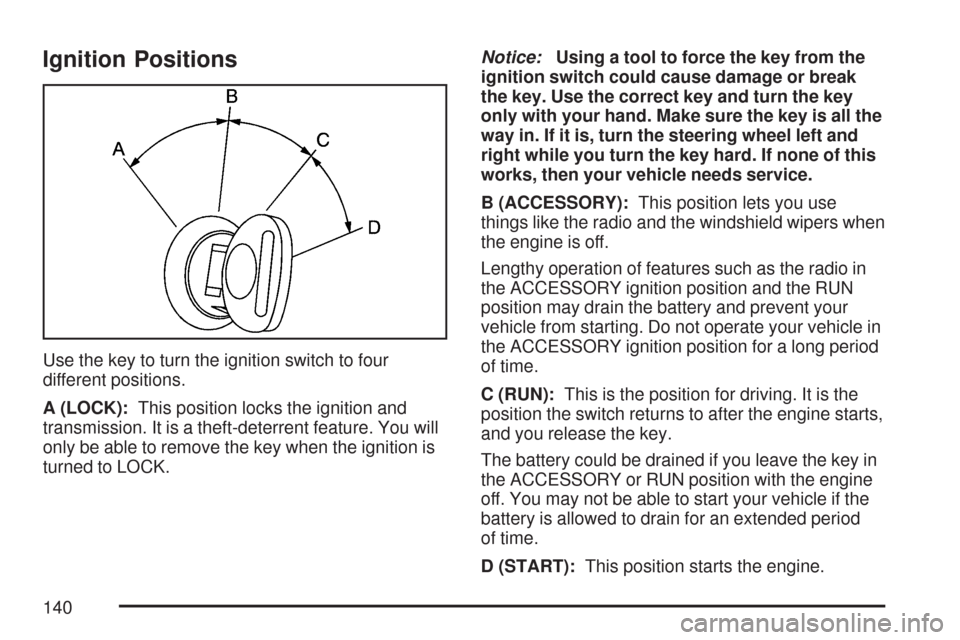
Use the key to turn the ignition switch to four
different positions.
A (LOCK):This position locks the ignition and
transmission. It is a theft-deterrent feature. You will
only be able to remove the key when the ignition is
turned to LOCK.Notice:Using a tool to force the key from the
ignition switch could cause damage or break
the key. Use the correct key and turn the key
only with your hand. Make sure the key is all the
way in. If it is, turn the steering wheel left and
right while you turn the key hard. If none of this
works, then your vehicle needs service.
B (ACCESSORY):This position lets you use
things like the radio and the windshield wipers when
the engine is off.
Lengthy operation of features such as the radio in
the ACCESSORY ignition position and the RUN
position may drain the battery and prevent your
vehicle from starting. Do not operate your vehicle in
the ACCESSORY ignition position for a long period
of time.
C (RUN):This is the position for driving. It is the
position the switch returns to after the engine starts,
and you release the key.
The battery could be drained if you leave the key in
the ACCESSORY or RUN position with the engine
off. You may not be able to start your vehicle if the
battery is allowed to drain for an extended period
of time.
D (START):This position starts the engine.
140
Page 146 of 634
PARK (P):This position locks your rear wheels. It
is the best position to use when you start your
engine because your vehicle cannot move easily.
{CAUTION:
It is dangerous to get out of your vehicle
if the shift lever is not fully in PARK (P)
with the parking brake rmly set. Your
vehicle can roll.
Do not leave your vehicle when the engine
is running unless you have to. If you have
left the engine running, the vehicle can
move suddenly. You or others could be
injured. To be sure your vehicle will not
move, even when you are on fairly level
ground, always set your parking brake
and move the shift lever to PARK (P). See
Shifting Into Park (P) on page 157.Ifyou
are pulling a trailer, seeTowing a Trailer
on page 422.
{CAUTION:
If you have four-wheel drive, your vehicle
will be free to roll — even if your shift
lever is in PARK (P) — if your transfer
case is in NEUTRAL. So, be sure the
transfer case is in a drive gear, two-wheel
high, four-wheel high or four-wheel
low — not in NEUTRAL. SeeShifting Into
Park (P) on page 157.
REVERSE (R):Use this gear to back up.
Notice:Shifting to REVERSE (R) while your
vehicle is moving forward could damage the
transmission. The repairs would not be covered
by your warranty. Shift to REVERSE (R) only
after your vehicle is stopped.
To rock your vehicle back and forth to get out of
snow, ice, or sand without damaging your
transmission, seeIf Your Vehicle is Stuck in Sand,
Mud, Ice, or Snow on page 404.
146
Page 147 of 634

NEUTRAL (N):In this position, your engine does
not connect with the wheels. To restart when
you are already moving, use NEUTRAL (N) only.
Also, use NEUTRAL (N) when your two-wheel
drive vehicle is being towed.
{CAUTION:
Shifting into a drive gear while your
engine is running at high speed is
dangerous. Unless your foot is rmly on
the brake pedal, your vehicle could move
very rapidly. You could lose control and
hit people or objects. Do not shift into a
drive gear while your engine is running at
high speed.
Notice:Shifting out of PARK (P) or
NEUTRAL (N) with the engine running at high
speed may damage the transmission. The
repairs would not be covered by your warranty.
Be sure the engine is not running at high
speed when shifting your vehicle.DRIVE (D):This position is for normal driving. It
provides the best fuel economy for your vehicle. If
you need more power for passing, and you are:
Going less than about 35 mph (56 km/h), push
your accelerator pedal about halfway down.
Going about 35 mph (56 km/h) or more, push
the accelerator all the way down.
DRIVE (D) can be used when towing a trailer,
carrying a heavy load, driving on steep hills or for
off-road driving. You may want to shift the
transmission to THIRD (3) or, if necessary, a lower
gear selection if the transmission shifts too often.
Downshifting the transmission in slippery road
conditions could result in skidding, see “Skidding”
underLoss of Control on page 371
THIRD (3):This position is also used for normal
driving. However, it reduces vehicle speed
more than DRIVE (D) without using your brakes.
You can use THIRD (3) on hills. It can help control
your speed as you go down steep mountain
roads, but then you would also want to use your
brakes off and on.
147
Page 148 of 634
SECOND (2):This position reduces vehicle speed
even more than THIRD (3) without using your
brakes. You can use SECOND (2) on hills. It can
help control your speed as you go down steep
mountain roads, but then you would also want to
use your brakes off and on.
If you select SECOND (2) and the Tow/Haul has
not been selected, the transmission will drive
in SECOND (2) gear. You may use this feature for
reducing the speed of the rear wheels when
you are trying to start your vehicle from a stop on
slippery road surfaces.
If you select SECOND (2) and the Tow/Haul has
also been selected, the transmission operation will
be limited to FIRST (1) and SECOND (2) gears.
You may use this feature for reducing the speed of
the rear wheels when you are trying to start
your vehicle from a stop on slippery road surfaces.
FIRST (1):This position reduces vehicle speed
even more than SECOND (2) without using
your brakes. You can use it on very steep hills, or
in deep snow or mud. If the shift lever is put in
FIRST (1) while the vehicle is moving forward, the
transmission will not shift into rst gear until the
vehicle is going slowly enough.Notice:Spinning the tires or holding the
vehicle in one place on a hill using only the
accelerator pedal may damage the
transmission. The repair will not be covered by
your warranty. If you are stuck, do not spin
the tires. When stopping on a hill, use the
brakes to hold the vehicle in place.
When temperatures are very cold, the
Hydra-Matic
®Automatic Transmission’s gear
shifting may be delayed providing more stable
shifts until the engine warms up. Shifts may
be more noticeable with a cold transmission. This
difference in shifting is normal.
The transmission torque converter clutch operation
is restricted during cold operation. When the
startup transmission temperature is approximately
64°F (18°C) your torque converter clutch will
temporarily not operate. Once the transmission
temperature rises above 68°F (20°C), normal
operation will resume.
148
Page 150 of 634
Four-Wheel Drive
If your vehicle has four-wheel drive, you can send
your engine’s driving power to all four wheels
for extra traction. Read the part that follows before
using four-wheel drive.
Notice:Driving on clean, dry pavement in
Four-Wheel-Drive High or Four-Wheel-Drive
Low for an extended period of time may cause
premature wear on your vehicle’s powertrain.
Do not drive on clean, dry pavement in
Four-Wheel-Drive High or Four-Wheel-Drive
Low for extended periods of time.
While driving on clean dry pavement and during
tight turns, you may experience a vibration in
the steering system.
Front Axle Locking Feature
The front axle locks and unlocks automatically
when you shift the transfer case. Some delay for
the axle to lock or unlock is normal.
Automatic Transfer Case
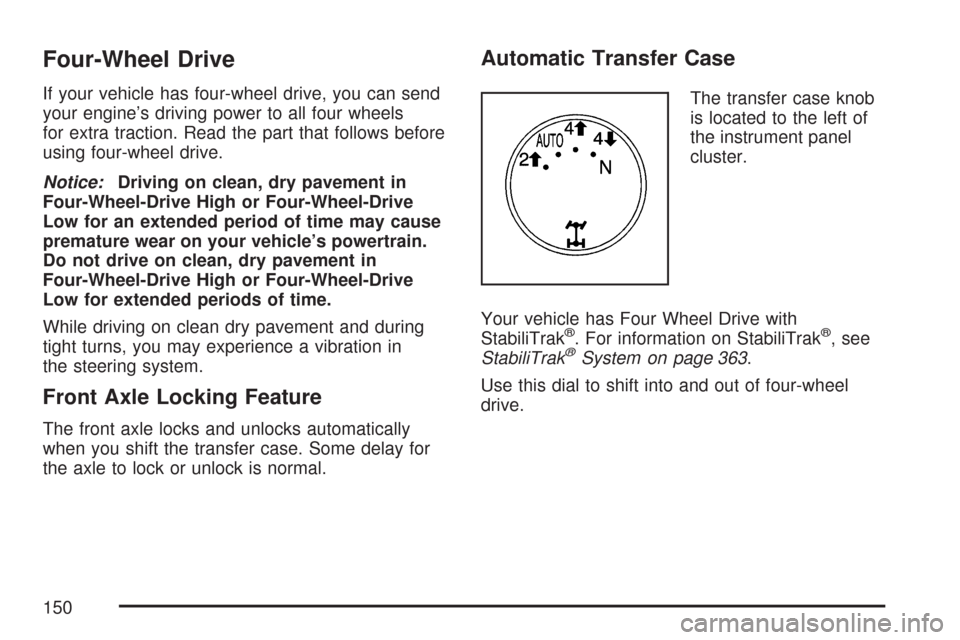
The transfer case knob
is located to the left of
the instrument panel
cluster.
Your vehicle has Four Wheel Drive with
StabiliTrak
®. For information on StabiliTrak®, see
StabiliTrak®System on page 363.
Use this dial to shift into and out of four-wheel
drive.
150
Page 151 of 634
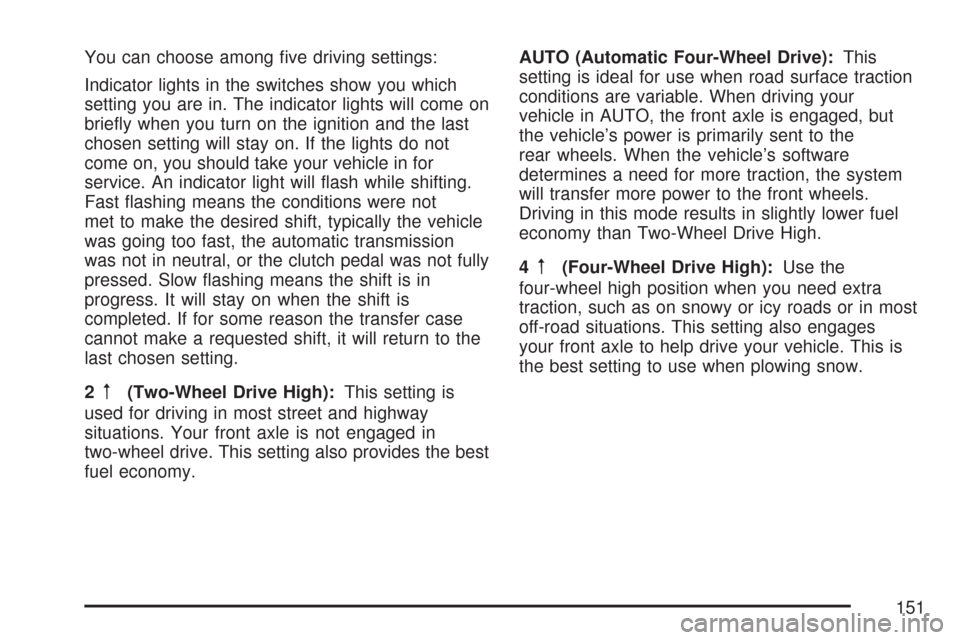
You can choose among ve driving settings:
Indicator lights in the switches show you which
setting you are in. The indicator lights will come on
briey when you turn on the ignition and the last
chosen setting will stay on. If the lights do not
come on, you should take your vehicle in for
service. An indicator light will ash while shifting.
Fast ashing means the conditions were not
met to make the desired shift, typically the vehicle
was going too fast, the automatic transmission
was not in neutral, or the clutch pedal was not fully
pressed. Slow ashing means the shift is in
progress. It will stay on when the shift is
completed. If for some reason the transfer case
cannot make a requested shift, it will return to the
last chosen setting.
2
m(Two-Wheel Drive High):This setting is
used for driving in most street and highway
situations. Your front axle is not engaged in
two-wheel drive. This setting also provides the best
fuel economy.AUTO (Automatic Four-Wheel Drive):This
setting is ideal for use when road surface traction
conditions are variable. When driving your
vehicle in AUTO, the front axle is engaged, but
the vehicle’s power is primarily sent to the
rear wheels. When the vehicle’s software
determines a need for more traction, the system
will transfer more power to the front wheels.
Driving in this mode results in slightly lower fuel
economy than Two-Wheel Drive High.
4
m(Four-Wheel Drive High):Use the
four-wheel high position when you need extra
traction, such as on snowy or icy roads or in most
off-road situations. This setting also engages
your front axle to help drive your vehicle. This is
the best setting to use when plowing snow.
151