2007 CHEVROLET SILVERADO towing
[x] Cancel search: towingPage 526 of 684
Engine Fan Noise
If your vehicle has a clutched engine cooling fan,
when the clutch is engaged, the fan spins
faster to provide more air to cool the engine. In
most everyday driving conditions, the fan is
spinning slower and the clutch is not fully engaged.
This improves fuel economy and reduces fan
noise. Under heavy vehicle loading, trailer towing,
and/or high outside temperatures, the fan speed
increases as the clutch more fully engages, so you
may hear an increase in fan noise. This is
normal and should not be mistaken as the
transmission slipping or making extra shifts. It is
merely the cooling system functioning properly.
The fan will slow down when additional cooling is
not required and the clutch disengages.
You may also hear this fan noise when you start
the engine. It will go away as the fan clutch
partially disengages.If your vehicle has electric cooling fans, you may
hear the fans spinning at low speed during most
everyday driving. The fans may turn off if no cooling
is required. Under heavy vehicle loading, trailer
towing, and/or high outside temperatures, or if you
are operating your air conditioning system, the fans
may change to high speed and you may hear an
increase in fan noise. This is normal and indicates
that the cooling system is functioning properly. The
fans will change to low speed when additional
cooling is no longer required.
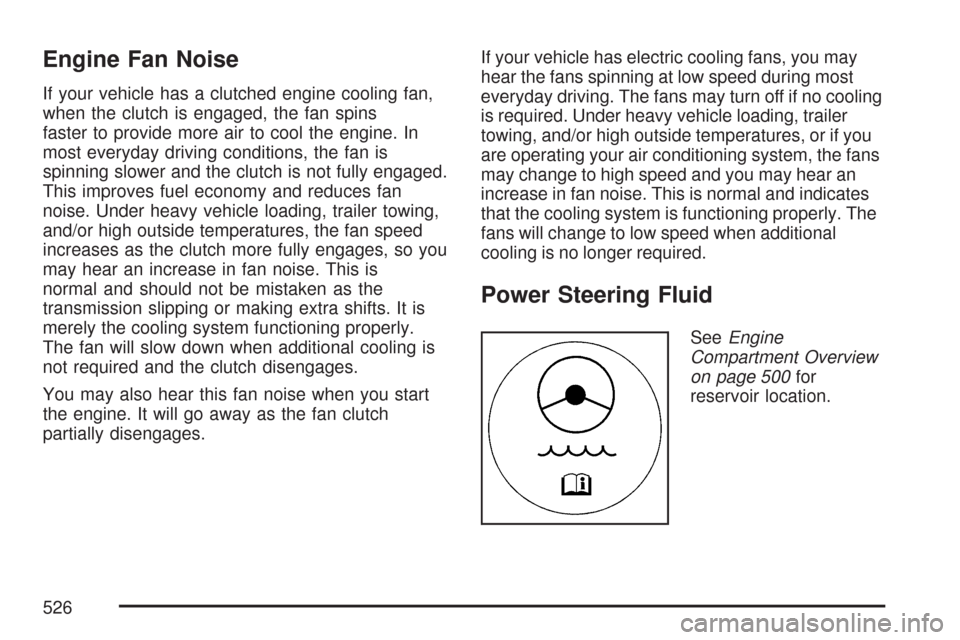
Power Steering Fluid
SeeEngine
Compartment Overview
on page 500for
reservoir location.
526
Page 634 of 684

(e)Make sure the safety belt reminder light and all
your belts, buckles, latch plates, retractors, and
anchorages are working properly. Look for
any other loose or damaged safety belt system
parts. If you see anything that might keep a safety
belt system from doing its job, have it repaired.
Have any torn or frayed safety belts replaced. Also
look for any opened or broken airbag coverings,
and have them repaired or replaced. The
airbag system does not need regular maintenance.
(f)Lubricate all key lock cylinders, body door
hinges, hood latch assembly, secondary latch,
pivots, spring anchor, release pawl, tailgate hinges,
tailgate linkage, tailgate handle pivot points,
latch bolt, fuel door hinge, locks, and folding seat
hardware. More frequent lubrication may be
required when exposed to a corrosive
environment. Applying silicone grease on
weatherstrips with a clean cloth will make them
last longer, seal better, and not stick or squeak.
(g)Check vent hose at transfer case for kinks and
proper installation. Check to be sure vent hose
is unobstructed, clear, and free of debris.(h)Change automatic transmission uid and lter
if the vehicle Gross Vehicle Weight Rating
(GVWR) is over 8600 lbs or if the vehicle is mainly
driven under one or more of these conditions:
In heavy city traffic where the outside
temperature regularly reaches 90°F (32°C) or
higher.
In hilly or mountainous terrain.
When doing frequent trailer towing.
Uses such as found in taxi, police or delivery
service.
(i)Drain, ush, and rell cooling system. This
service can be complex; you should have
your dealer perform this service. See Engine
Coolant on page 514 for what to use. Inspect
hoses. Clean radiator, condenser, pressure cap,
and ller neck. Pressure test the cooling
system and pressure cap.
(j)A uid loss in any vehicle system could indicate
a problem. Have the system inspected and
repaired and the uid level checked. Add uid
if needed.
634
Page 635 of 684
(k)Inspect system. Check all fuel and vapor lines
and hoses for proper hook-up, routing, and
condition. Check that the purge valve, if the vehicle
has one, works properly. Replace as needed.
(l)Extreme Duty Service: Change transfer case
uid if the vehicle is mainly driven off-road in
four-wheel drive, or is used for heavy trailer towing.
Farming, mining, forestry, and Department of
Natural Resources (DNR) vehicles meet this
denition.
(m)During any maintenance, if a power washer is
used to clean mud and dirt from the underbody,
care should be taken to not directly spray the
transfer case output seals. High pressure water can
overcome the seals and contaminate the transfer
case uid. Contaminated uid will decrease the life
of the transfer case and should be replaced.
(n)Vehicles with diesel engine or with GVWR
above 10,000 lbs (4 536 kg) only: Inspect shields
for damage or looseness. Adjust or replace as
required. This is a Noise Emission Control Service.
Applicable to vehicles sold in the United States
and recommended for vehicles sold in Canada.
(p)If you drive regularly under dusty conditions,
inspect the lter or change indicator (if equipped)
at each engine oil change.(q)Visually inspect belt for fraying, excessive
cracks, or obvious damage. Replace belt if
necessary.
Owner Checks and Services
These owner checks and services should be
performed at the intervals specied to help
ensure the safety, dependability, and emission
control performance of your vehicle. Your
GM Goodwrench
®dealer can assist you with
these checks and services.
Be sure any necessary repairs are completed at
once. Whenever any uids or lubricants are added
to your vehicle, make sure they are the proper
ones, as shown inRecommended Fluids and
Lubricants on page 639.
At the First 100, 1,000 and
6,000 Miles (160, 1 600 and
10 000 km)
Check dual wheel nut torque. For proper torque,
seeCapacities and Specications on page 620.
635
Page 657 of 684

Towing and Road Service Exclusions
Specically excluded from Roadside Assistance
coverage are towing or services for vehicles
operated on a non-public roadway or highway,
nes, impound towing caused by a violation
of local, Municipal, State, Provincial, or Federal
law, and mounting, dismounting or changing
of snow tires, chains, or other traction devices.
Courtesy Transportation
To enhance your ownership experience, we and
our participating dealers/retailers are proud to offer
Courtesy Transportation, a customer support
program for new vehicles.
For warranty repairs during the Bumper-to-Bumper
(U.S.) or Base Warranty Coverage period
(Canada), provided by the New Vehicle Limited
Warranty, interim transportation may be available
under the Courtesy Transportation program.
Several courtesy transportation options are
available to assist in reducing your inconvenience
when warranty repairs are required.Courtesy Transportation is not a part of the New
Vehicle Limited Warranty and is available only
at participating dealers/retailers. A separate
booklet entitled “Warranty and Owner Assistance
Information” furnished with each new vehicle
provides detailed warranty coverage information.
Scheduling Service Appointments
When your vehicle requires warranty service,
contact your dealer/retailer and request an
appointment. By scheduling a service appointment
and advising your service consultant of your
transportation needs, your dealer/retailer can help
minimize your inconvenience.
If your vehicle cannot be scheduled into the
service department immediately, keep driving it
until it can be scheduled for service, unless,
of course, the problem is safety-related. If it is,
please call your dealership/retailer, let them know
this, and ask for instructions.
If the dealer/retailer requests that you simply drop
the vehicle off for service, you are urged to do
so as early in the work day as possible to allow for
the same day repair.
657
Page 663 of 684
If your vehicle cannot be driven, know where
the towing service will be taking it. Get a
card from the tow truck operator or write down
the driver’s name, the service’s name, and
the phone number.
Remove any valuables from your vehicle
before it is towed away. Make sure this
includes your insurance information and
registration if you keep these items in your
vehicle.
Gather the important information you will need
from the other driver. Things like name,
address, phone number, driver’s license
number, vehicle license plate, vehicle make,
model and model year, Vehicle Identication
Number (VIN), insurance company and
policy number, and a general description of
the damage to the other vehicle.
If possible, call your insurance company from
the scene of the accident. They will walk you
through the information they will need. If
they ask for a police report, phone or go to
the police department headquarters the
next day and you can get a copy of the report
for a nominal fee. In some states/provinces
with “no fault” insurance laws, a report may not
be necessary. This is especially true if there
are no injuries and both vehicles are driveable.
Choose a reputable collision repair facility
for your vehicle. Whether you select a
GM dealer/retailer or a private collision repair
facility to x the damage, make sure you
are comfortable with them. Remember, you
will have to feel comfortable with their work for
a long time.
Once you have an estimate, read it carefully
and make sure you understand what work
will be performed on your vehicle. If you have
a question, ask for an explanation. Reputable
shops welcome this opportunity.
663
Page 680 of 684
Rearview Mirrors......................................... 171
Reclining Seatbacks...................................... 15
Recommended Fluids and Lubricants.......... 639
Recovery Hooks.......................................... 426
Recreational Vehicle Towing........................ 442
Remote Keyless Entry (RKE) System.......... 112
Remote Keyless Entry (RKE) System,
Operation................................................. 113
Removing the Flat Tire and Installing the
Spare Tire................................................ 586
Removing the Spare Tire and Tools............ 582
Replacement Bulbs..................................... 551
Reporting Safety Defects
Canadian Government............................. 665
General Motors........................................ 665
United States Government....................... 664
Restraint System Check
Checking the Restraint Systems............... 106
Replacing Restraint System Parts After
a Crash................................................ 107
Retained Accessory Power (RAP)................ 136
Right Front Passenger Position, Safety
Belts.......................................................... 37
Roadside
Assistance Program................................. 654Rocking Your Vehicle to Get it Out.............. 425
Routing, Engine Drive Belt.......................... 643
Running the Engine While Parked............... 170
S
Safety Belt
Passenger Reminder Light....................... 251
Pretensioners............................................. 45
Reminder Light........................................ 251
Safety Belts
Care of.................................................... 604
Center Front Passenger Position......... 37, 38
Driver Position........................................... 28
How to Wear Safety Belts Properly............ 27
Questions and Answers About Safety
Belts....................................................... 26
Rear Safety Belt Comfort Guides............... 42
Rear Seat Passengers............................... 39
Right Front Passenger Position.................. 37
Safety Belt Extender.................................. 45
Safety Belt Use During Pregnancy............. 36
Safety Belts Are for Everyone.................... 22
Shoulder Belt Height Adjuster.................... 35
680
Page 683 of 684
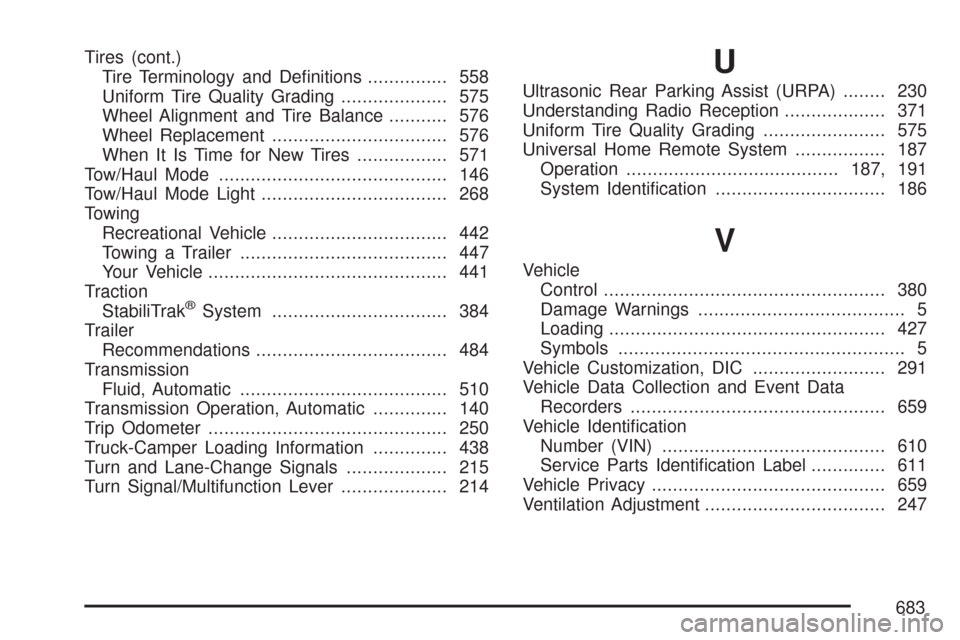
Tires (cont.)
Tire Terminology and Denitions............... 558
Uniform Tire Quality Grading.................... 575
Wheel Alignment and Tire Balance........... 576
Wheel Replacement................................. 576
When It Is Time for New Tires................. 571
Tow/Haul Mode........................................... 146
Tow/Haul Mode Light................................... 268
Towing
Recreational Vehicle................................. 442
Towing a Trailer....................................... 447
Your Vehicle............................................. 441
Traction
StabiliTrak
®System................................. 384
Trailer
Recommendations.................................... 484
Transmission
Fluid, Automatic....................................... 510
Transmission Operation, Automatic.............. 140
Trip Odometer............................................. 250
Truck-Camper Loading Information.............. 438
Turn and Lane-Change Signals................... 215
Turn Signal/Multifunction Lever.................... 214
U
Ultrasonic Rear Parking Assist (URPA)........ 230
Understanding Radio Reception................... 371
Uniform Tire Quality Grading....................... 575
Universal Home Remote System................. 187
Operation........................................187, 191
System Identication................................ 186
V
Vehicle
Control..................................................... 380
Damage Warnings....................................... 5
Loading.................................................... 427
Symbols...................................................... 5
Vehicle Customization, DIC......................... 291
Vehicle Data Collection and Event Data
Recorders................................................ 659
Vehicle Identication
Number (VIN).......................................... 610
Service Parts Identication Label.............. 611
Vehicle Privacy............................................ 659
Ventilation Adjustment.................................. 247
683