2007 CHEVROLET SILVERADO fuel
[x] Cancel search: fuelPage 436 of 684
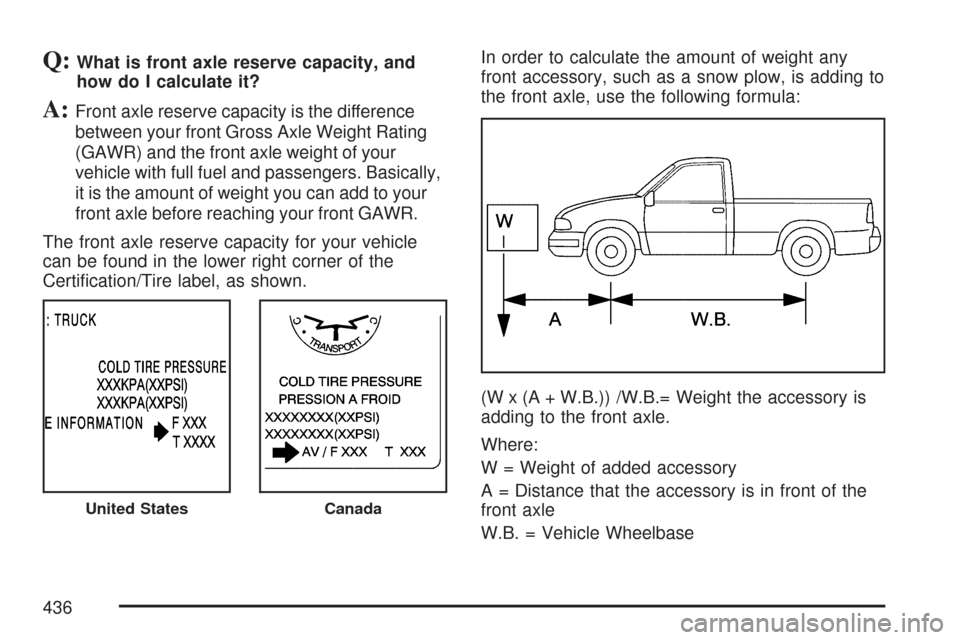
Q:What is front axle reserve capacity, and
how do I calculate it?
A:Front axle reserve capacity is the difference
between your front Gross Axle Weight Rating
(GAWR) and the front axle weight of your
vehicle with full fuel and passengers. Basically,
it is the amount of weight you can add to your
front axle before reaching your front GAWR.
The front axle reserve capacity for your vehicle
can be found in the lower right corner of the
Certication/Tire label, as shown.In order to calculate the amount of weight any
front accessory, such as a snow plow, is adding to
the front axle, use the following formula:
(W x (A + W.B.)) /W.B.= Weight the accessory is
adding to the front axle.
Where:
W = Weight of added accessory
A = Distance that the accessory is in front of the
front axle
W.B. = Vehicle Wheelbase
United StatesCanada
436
Page 438 of 684
Q:What is total vehicle reserve capacity?
A:This is the difference between your GVWR and
the weight of your truck with full fuel and
passengers. It is the amount of weight you can
add to your vehicle before reaching your
GVWR. Keep in mind that reserve capacity
numbers are intended as a guide when
selecting the amount of equipment or cargo
your truck can carry. If you are unsure of your
vehicle’s front, rear, or total weight, go to a
weigh station and weigh your vehicle.
Your dealer can also help you with this.
The total vehicle reserve capacity for your
vehicle can be found in the lower right corner
of the Certication/Tire label as shown
previously.
See your dealer for additional advice and
information about using a snow plow on your
vehicle. Also, seeLoading Your Vehicle on
page 427.
Emergency Roof Lamp Provisions
Vehicles with the RPO VYU snow plow prep
package also have an emergency roof lamp
provision package, RPO TRW. Wiring for the
emergency roof lamp is provided above the
overhead console. SeeAuxiliary Roof Mounted
Lamp on page 227for switch location.
Truck-Camper Loading Information
Notice:Installing a truck-camper to a
vehicle that is equipped with the SS trim
package could damage the vehicle. Do not
install a truck-camper on a vehicle equipped
with the SS trim package.
A vehicle specic Truck-Camper Loading
information label is attached to the inside of your
vehicle’s glove box. This label will tell you if
your vehicle can carry a slide-in camper, how
much of a load your vehicle can carry, and how to
correctly spread out the load. Also, it will help
you match the right slide-in camper to your vehicle.
438
Page 447 of 684
Towing a Trailer
If your vehicle has a diesel engine, see the
DURAMAX®Diesel manual for more information.
Do not tow a trailer during break-in. SeeNew
Vehicle Break-In on page 134for more information.
{CAUTION:
If you do not use the correct equipment
and drive properly, you can lose control
when you pull a trailer. For example, if the
trailer is too heavy, the brakes may not
work well — or even at all. You and your
passengers could be seriously injured.
Pull a trailer only if you have followed all
the steps in this section. Ask your dealer
for advice and information about towing a
trailer with your vehicle.Notice:Pulling a trailer improperly can
damage your vehicle and result in costly
repairs not covered by your warranty. To pull
a trailer correctly, follow the advice in this
part, and see your dealer for important
information about towing a trailer with your
vehicle.
To identify the trailering capacity of your vehicle,
you should read the information in “Weight of
the Trailer” that appears later in this section.
Trailering is different than just driving your vehicle
by itself. Trailering means changes in acceleration,
braking, handling, durability and fuel economy.
Successful, safe trailering takes correct equipment,
and it has to be used properly.
That’s the reason for this part. In it are many
time-tested, important trailering tips and safety
rules. Many of these are important for your safety
and that of your passengers. So please read
this section carefully before you pull a trailer.
447
Page 449 of 684
Tow/Haul Mode
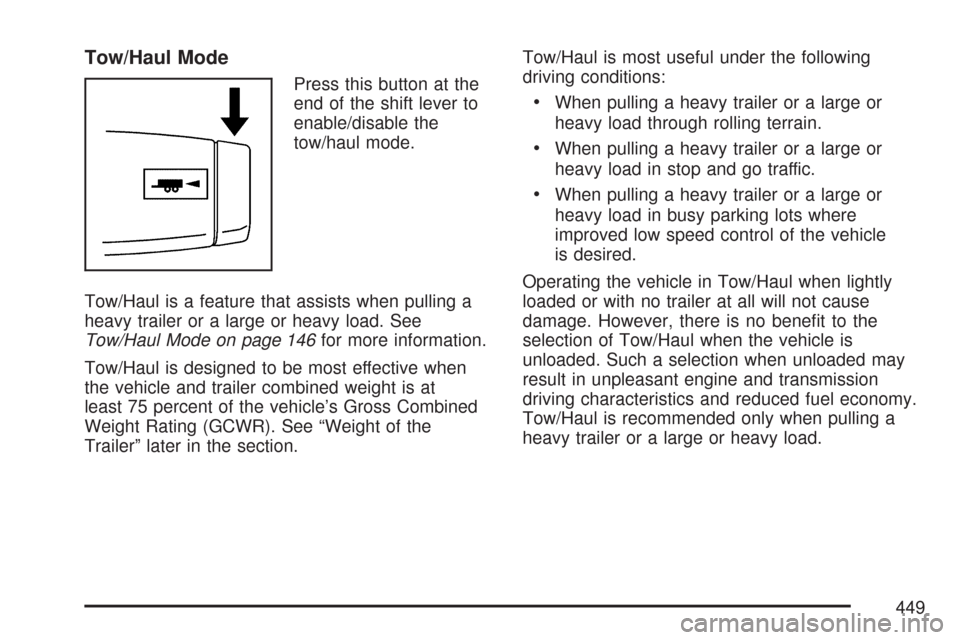
Press this button at the
end of the shift lever to
enable/disable the
tow/haul mode.
Tow/Haul is a feature that assists when pulling a
heavy trailer or a large or heavy load. See
Tow/Haul Mode on page 146for more information.
Tow/Haul is designed to be most effective when
the vehicle and trailer combined weight is at
least 75 percent of the vehicle’s Gross Combined
Weight Rating (GCWR). See “Weight of the
Trailer” later in the section.Tow/Haul is most useful under the following
driving conditions:
When pulling a heavy trailer or a large or
heavy load through rolling terrain.
When pulling a heavy trailer or a large or
heavy load in stop and go traffic.
When pulling a heavy trailer or a large or
heavy load in busy parking lots where
improved low speed control of the vehicle
is desired.
Operating the vehicle in Tow/Haul when lightly
loaded or with no trailer at all will not cause
damage. However, there is no benet to the
selection of Tow/Haul when the vehicle is
unloaded. Such a selection when unloaded may
result in unpleasant engine and transmission
driving characteristics and reduced fuel economy.
Tow/Haul is recommended only when pulling a
heavy trailer or a large or heavy load.
449
Page 485 of 684
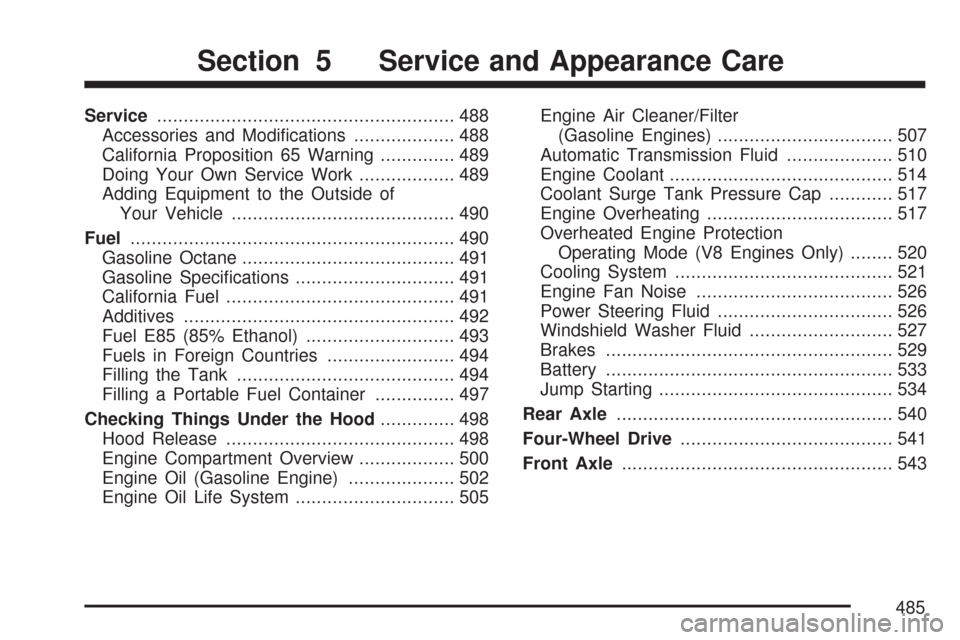
Service........................................................ 488
Accessories and Modications................... 488
California Proposition 65 Warning.............. 489
Doing Your Own Service Work.................. 489
Adding Equipment to the Outside of
Your Vehicle.......................................... 490
Fuel............................................................. 490
Gasoline Octane........................................ 491
Gasoline Specications.............................. 491
California Fuel........................................... 491
Additives................................................... 492
Fuel E85 (85% Ethanol)............................ 493
Fuels in Foreign Countries........................ 494
Filling the Tank......................................... 494
Filling a Portable Fuel Container............... 497
Checking Things Under the Hood.............. 498
Hood Release........................................... 498
Engine Compartment Overview.................. 500
Engine Oil (Gasoline Engine).................... 502
Engine Oil Life System.............................. 505Engine Air Cleaner/Filter
(Gasoline Engines)................................. 507
Automatic Transmission Fluid.................... 510
Engine Coolant.......................................... 514
Coolant Surge Tank Pressure Cap............ 517
Engine Overheating................................... 517
Overheated Engine Protection
Operating Mode (V8 Engines Only)........ 520
Cooling System......................................... 521
Engine Fan Noise..................................... 526
Power Steering Fluid................................. 526
Windshield Washer Fluid........................... 527
Brakes...................................................... 529
Battery...................................................... 533
Jump Starting............................................ 534
Rear Axle.................................................... 540
Four-Wheel Drive........................................ 541
Front Axle................................................... 543
Section 5 Service and Appearance Care
485
Page 490 of 684

Adding Equipment to the Outside of
Your Vehicle
Things you might add to the outside of your
vehicle can affect the airow around it. This may
cause wind noise and affect windshield washer
performance. Check with your dealer before
adding equipment to the outside of your vehicle.
Fuel
If your vehicle has a diesel engine, see “Diesel
Fuel Requirements and Fuel System” in the
DURAMAX
®Diesel Supplement.
For vehicles with gasoline engines, please
read this.
Gasoline
Use of the recommended fuel is an important part
of the proper maintenance of your vehicle. To
help keep the engine clean and maintain optimum
vehicle performance, GM recommends the use
of gasoline advertised as TOP TIER Detergent
Gasoline.
The 8th digit of the Vehicle Identication Number
(VIN) shows the code letter or number that
identies your vehicle’s engine. The VIN is at the
top left of the instrument panel. SeeVehicle
Identication Number (VIN) on page 610.
If your vehicle has the 5.3L V8 engine (VIN
Code 0) or the 5.3L V8 engine (VIN Code 3), you
can use either regular unleaded gasoline or
ethanol fuel containing up to 85% ethanol (E85);
also seeFuel E85 (85% Ethanol) on page 493.
In all other gasoline engines, use only regular
unleaded gasoline.
490
Page 491 of 684

Gasoline Octane
Use regular unleaded gasoline with a posted
octane rating of 87 or higher. If the octane rating
is less than 87, you might notice an audible
knocking noise when you drive, commonly referred
to as spark knock. If this occurs, use a gasoline
rated at 87 octane or higher as soon as possible. If
you are using gasoline rated at 87 octane or
higher and you hear heavy knocking, the engine
needs service.
Gasoline Specications
At a minimum, gasoline should meet ASTM
specication D 4814 in the United States or
CAN/CGSB-3.5 in Canada. Some gasolines may
contain an octane-enhancing additive called
methylcyclopentadienyl manganese tricarbonyl
(MMT). General Motors recommends against the
use of gasolines containing MMT. SeeAdditives
on page 492for additional information.
California Fuel
If your vehicle is certied to meet California
Emissions Standards, it is designed to operate on
fuels that meet California specications. See
the underhood emission control label. If this fuel is
not available in states adopting California
emissions standards, your vehicle will operate
satisfactorily on fuels meeting federal
specications, but emission control system
performance may be affected. The malfunction
indicator lamp may turn on and your vehicle may
fail a smog-check test. SeeMalfunction Indicator
Lamp on page 262. If this occurs, return to
your authorized GM dealer for diagnosis. If it is
determined that the condition is caused by the type
of fuel used, repairs may not be covered by
your warranty.
491
Page 492 of 684

Additives
To provide cleaner air, all gasolines in the United
States are now required to contain additives
that will help prevent engine and fuel system
deposits from forming, allowing your emission
control system to work properly. In most cases,
you should not have to add anything to your fuel.
However, some gasolines contain only the
minimum amount of additive required to meet U.S.
Environmental Protection Agency regulations.
To help keep fuel injectors and intake valves clean,
or if your vehicle experiences problems due to
dirty injectors or valves, look for gasoline that is
advertised as TOP TIER Detergent Gasoline. Also,
your dealer has additives that will help correct
and prevent most deposit-related problems.
Gasolines containing oxygenates, such as
ethers and ethanol, and reformulated gasolines
may be available in your area. General Motors
recommends that you use these gasolines if they
comply with the specications described earlier.
However, E85 (85% ethanol) and other fuels
containing more than 10% ethanol must not be
used in vehicles that were not designed for
those fuels.Notice:Your vehicle was not designed for
fuel that contains methanol. Do not use
fuel containing methanol. It can corrode metal
parts in the fuel system and also damage
plastic and rubber parts. That damage would
not be covered under your warranty.
Some gasolines that are not reformulated for low
emissions may contain an octane-enhancing
additive called methylcyclopentadienyl manganese
tricarbonyl (MMT); ask the attendant where you
buy gasoline whether the fuel contains MMT.
General Motors recommends against the use of
such gasolines. Fuels containing MMT can reduce
the life of spark plugs and the performance of
the emission control system may be affected. The
malfunction indicator lamp may turn on. If this
occurs, return to your dealer for service.
492