2007 CHEVROLET SILVERADO automatic transmission
[x] Cancel search: automatic transmissionPage 386 of 684
Traction Control Operation
The traction control system is part of the
StabiliTrak®system. Traction control limits wheel
spin by reducing engine power to the wheels
(engine speed management) and by applying
brakes to each individual wheel (brake-traction
control) as necessary.
The traction control system is enabled
automatically when you start your vehicle. It will
activate and the StabiliTrak
®light will ash if
it senses that any of the wheels are spinning or
beginning to lose traction while driving. If you
turn off traction control, only the brake-traction
control portion of traction control will work.
The engine speed management will be disabled.
In this mode, engine power is not reduced
automatically and the driven wheels can spin more
freely. This can cause the brake-traction control
to activate constantly.
Notice:If you allow the wheel(s) of one axle
to spin excessively while the StabiliTrak
®, ABS
and brake warning lights and the SERVICE
STABILITRAK message are displayed,
you could damage the transfer case.The repairs would not be covered by your
warranty. Reduce engine power and do
not spin the wheel(s) excessively while these
lights and this message are displayed.
The traction control system may activate on
dry or rough roads or under conditions such as
heavy acceleration while turning or abrupt
upshifts/downshifts of the transmission. When this
happens, you may notice a reduction in
acceleration, or may hear a noise or vibration.
This is normal.
If your vehicle is in cruise control when the system
activates, the StabiliTrak
®light will ash and the
cruise control will automatically disengage.
When road conditions allow you to use cruise
again, you may re-engage the cruise control.
SeeCruise Control on page 220.
StabiliTrak
®may also turn off automatically if it
determines that a problem exists with the system.
If the problem does not clear itself after restarting
the vehicle, you should see your dealer for service.
386
Page 480 of 684
Maintenance When Trailer Towing
Your vehicle will need service more often when
you’re pulling a trailer. SeeScheduled
Maintenance (Gasoline Engine) on page 627for
more information. Things that are especially
important in trailer operation are automatic
transmission uid (don’t overll), engine oil, axle
lubricant, belt, cooling system and brake system.
Each of these is covered in this manual, and
the Index will help you nd them quickly. If you’re
trailering, it’s a good idea to review these
sections before you start your trip.
Check periodically to see that all hitch nuts and
bolts are tight.
Trailer Wiring Harness
Your vehicle is equipped with one of the following
wiring harnesses for towing a trailer or hauling
a slide-in camper.
Basic Trailer Wiring
All regular, extended cab and crew cab pickups
have a seven-wire trailer towing harness.
For vehicles not equipped with heavy duty
trailering, the harness is clipped to the vehicle’s
frame behind the spare tire mount. The harness
requires the installation of a trailer connector,
which is available through your dealer.
If you need to tow a light-duty trailer with a
standard four-way round pin connector, you can
also get an adapter from your dealer.
480
Page 485 of 684
Service........................................................ 488
Accessories and Modications................... 488
California Proposition 65 Warning.............. 489
Doing Your Own Service Work.................. 489
Adding Equipment to the Outside of
Your Vehicle.......................................... 490
Fuel............................................................. 490
Gasoline Octane........................................ 491
Gasoline Specications.............................. 491
California Fuel........................................... 491
Additives................................................... 492
Fuel E85 (85% Ethanol)............................ 493
Fuels in Foreign Countries........................ 494
Filling the Tank......................................... 494
Filling a Portable Fuel Container............... 497
Checking Things Under the Hood.............. 498
Hood Release........................................... 498
Engine Compartment Overview.................. 500
Engine Oil (Gasoline Engine).................... 502
Engine Oil Life System.............................. 505Engine Air Cleaner/Filter
(Gasoline Engines)................................. 507
Automatic Transmission Fluid.................... 510
Engine Coolant.......................................... 514
Coolant Surge Tank Pressure Cap............ 517
Engine Overheating................................... 517
Overheated Engine Protection
Operating Mode (V8 Engines Only)........ 520
Cooling System......................................... 521
Engine Fan Noise..................................... 526
Power Steering Fluid................................. 526
Windshield Washer Fluid........................... 527
Brakes...................................................... 529
Battery...................................................... 533
Jump Starting............................................ 534
Rear Axle.................................................... 540
Four-Wheel Drive........................................ 541
Front Axle................................................... 543
Section 5 Service and Appearance Care
485
Page 501 of 684

A. Engine Air Cleaner/Filter. SeeEngine Air
Cleaner/Filter (Gasoline Engines) on page 507.
B. Air Filter Restriction Indicator (If Equipped).
SeeEngine Air Cleaner/Filter (Gasoline
Engines) on page 507.
C. Coolant Surge Tank and Pressure Cap. See
Cooling System on page 521andCoolant
Surge Tank Pressure Cap on page 517.
D. Positive (+) Terminal. SeeJump Starting on
page 534.
E. Battery. SeeBattery on page 533.
F. Engine Oil Fill Cap. See “When to Add Engine
Oil” underEngine Oil (Gasoline Engine) on
page 502.
G. Automatic Transmission Dipstick. See
“Checking the Fluid Level” underAutomatic
Transmission Fluid on page 510.H. Remote Negative (−) Terminal (Out of View).
SeeJump Starting on page 534.
I. Engine Oil Dipstick (Out of View). See
“Checking Engine Oil” underEngine Oil
(Gasoline Engine) on page 502.
J. Engine Cooling Fan. SeeCooling System on
page 521.
K. Power Steering Fluid Reservoir. SeePower
Steering Fluid on page 526.
L. Brake Master Cylinder Reservoir. See “Brake
Fluid” underBrakes on page 529.
M. Underhood Fuse Block. SeeUnderhood Fuse
Block on page 615.
N. Windshield Washer Fluid Reservoir. See
“Adding Washer Fluid” underWindshield
Washer Fluid on page 527.
501
Page 510 of 684

Automatic Transmission Fluid
When to Check and Change Automatic
Transmission Fluid
It is usually not necessary to check the
transmission uid level. The only reason for uid
loss is a transmission leak or overheating the
transmission. If you suspect a small leak, then use
the following checking procedures to check the
uid level. However, if there is a large leak, then it
may be necessary to have the vehicle towed to
a dealership service department and have it
repaired before driving the vehicle further.
Notice:Use of the incorrect automatic
transmission uid may damage your vehicle,
and the damages may not be covered by
your warranty. Always use the automatic
transmission uid listed inRecommended
Fluids and Lubricants on page 639.
Change the uid and lter at the intervals listed in
the Maintenance Schedule. SeeScheduled
Maintenance (Gasoline Engine) on page 627.Be
sure to use the transmission uid listed in
Recommended Fluids and Lubricants on page 639.
How to Check Automatic Transmission
Fluid
Notice:Too much or too little uid can
damage your transmission. Too much can
mean that some of the uid could come out
and fall on hot engine parts or exhaust system
parts, starting a re. Too little uid could
cause the transmission to overheat. Be sure to
get an accurate reading if you check your
transmission uid.
Before checking the uid level, prepare your
vehicle as follows:
1. Start the engine and park your vehicle on a
level surface. Keep the engine running.
2. Apply the parking brake and place the shift
lever in PARK (P).
510
Page 535 of 684
3. Get the vehicles close enough so the jumper
cables can reach, but be sure the vehicles are
not touching each other. If they are, it could
cause an unwanted ground connection.
You would not be able to start your vehicle,
and the bad grounding could damage the
electrical systems.
To avoid the possibility of the vehicles rolling,
set the parking brake rmly on both vehicles
involved in the jump start procedure. Put
the automatic transmission in PARK (P) or a
manual transmission in NEUTRAL before
setting the parking brake. If you have a
four-wheel-drive vehicle, be sure the transfer
case is in a drive gear, not in NEUTRAL.
Notice:If you leave your radio or other
accessories on during the jump starting
procedure, they could be damaged. The repairs
would not be covered by your warranty.
Always turn off your radio and other
accessories when jump starting your vehicle.4. Turn off the ignition on both vehicles. Unplug
unnecessary accessories plugged into the
cigarette lighter or the accessory power
outlets. Turn off the radio and all the lamps
that are not needed. This will avoid sparks and
help save both batteries. And it could save
the radio!
5. Open the hood on the other vehicle and
locate the positive (+) and negative (−)
terminal locations on that vehicle.
The positive (+) terminal, is located under a
red plastic cover at the positive battery
post. To uncover the positive (+) terminal,
open the red plastic cover.
535
Page 558 of 684
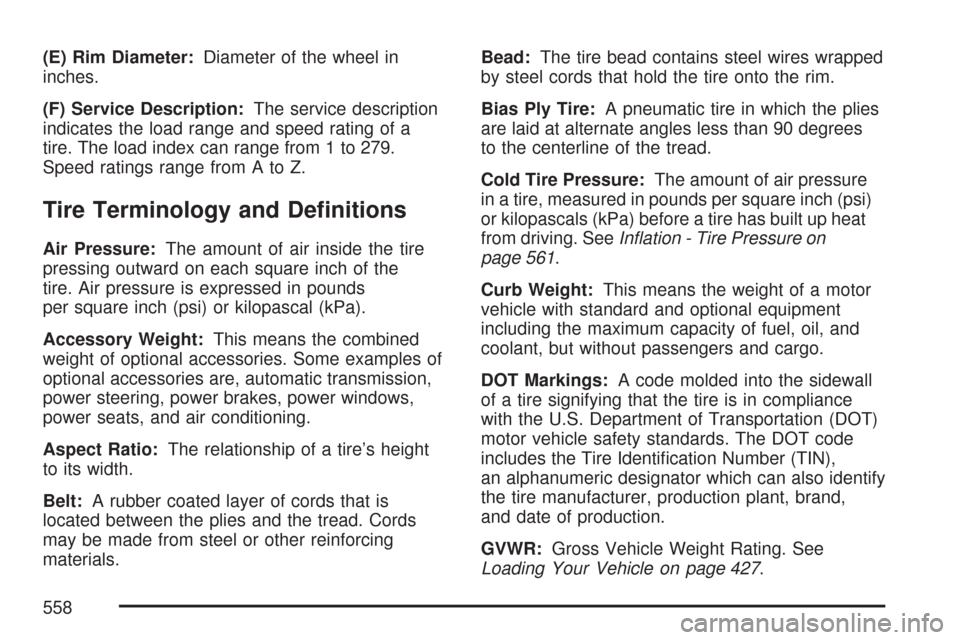
(E) Rim Diameter:Diameter of the wheel in
inches.
(F) Service Description:The service description
indicates the load range and speed rating of a
tire. The load index can range from 1 to 279.
Speed ratings range from A to Z.
Tire Terminology and Denitions
Air Pressure:The amount of air inside the tire
pressing outward on each square inch of the
tire. Air pressure is expressed in pounds
per square inch (psi) or kilopascal (kPa).
Accessory Weight:This means the combined
weight of optional accessories. Some examples of
optional accessories are, automatic transmission,
power steering, power brakes, power windows,
power seats, and air conditioning.
Aspect Ratio:The relationship of a tire’s height
to its width.
Belt:A rubber coated layer of cords that is
located between the plies and the tread. Cords
may be made from steel or other reinforcing
materials.Bead:The tire bead contains steel wires wrapped
by steel cords that hold the tire onto the rim.
Bias Ply Tire:A pneumatic tire in which the plies
are laid at alternate angles less than 90 degrees
to the centerline of the tread.
Cold Tire Pressure:The amount of air pressure
in a tire, measured in pounds per square inch (psi)
or kilopascals (kPa) before a tire has built up heat
from driving. SeeInation - Tire Pressure on
page 561.
Curb Weight:This means the weight of a motor
vehicle with standard and optional equipment
including the maximum capacity of fuel, oil, and
coolant, but without passengers and cargo.
DOT Markings:A code molded into the sidewall
of a tire signifying that the tire is in compliance
with the U.S. Department of Transportation (DOT)
motor vehicle safety standards. The DOT code
includes the Tire Identication Number (TIN),
an alphanumeric designator which can also identify
the tire manufacturer, production plant, brand,
and date of production.
GVWR:Gross Vehicle Weight Rating. See
Loading Your Vehicle on page 427.
558
Page 622 of 684
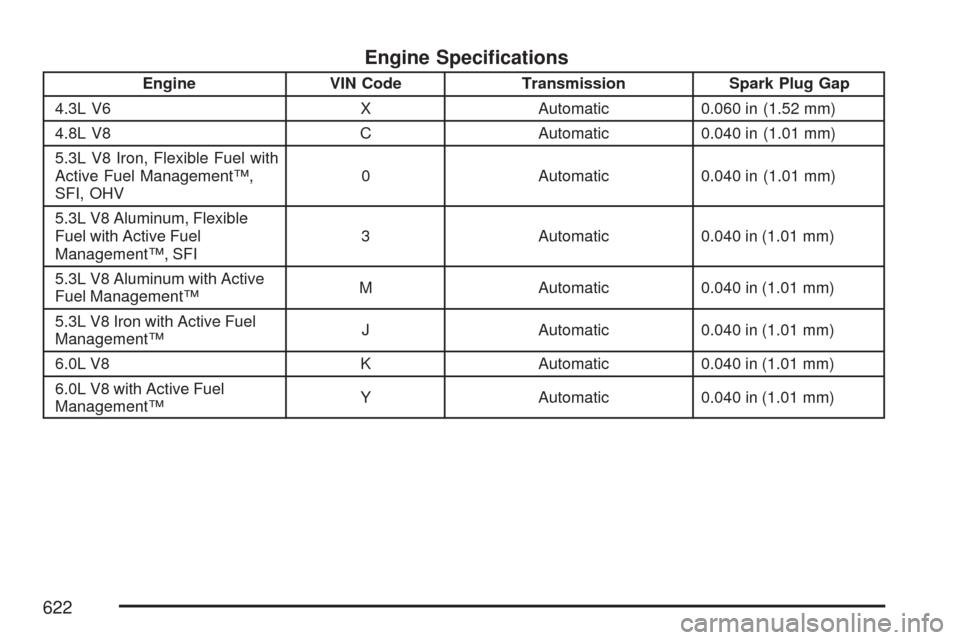
Engine Specications
Engine VIN Code Transmission Spark Plug Gap
4.3L V6 X Automatic 0.060 in (1.52 mm)
4.8L V8 C Automatic 0.040 in (1.01 mm)
5.3L V8 Iron, Flexible Fuel with
Active Fuel Management™,
SFI, OHV0 Automatic 0.040 in (1.01 mm)
5.3L V8 Aluminum, Flexible
Fuel with Active Fuel
Management™, SFI3 Automatic 0.040 in (1.01 mm)
5.3L V8 Aluminum with Active
Fuel Management™M Automatic 0.040 in (1.01 mm)
5.3L V8 Iron with Active Fuel
Management™J Automatic 0.040 in (1.01 mm)
6.0L V8 K Automatic 0.040 in (1.01 mm)
6.0L V8 with Active Fuel
Management™Y Automatic 0.040 in (1.01 mm)
622