2007 CHEVROLET SILVERADO brake
[x] Cancel search: brakePage 466 of 684
Safety Chains
You should always attach chains between your
vehicle and your trailer. Cross the safety
chains under the tongue of the trailer to help
prevent the tongue from contacting the road if it
becomes separated from the hitch. Instructions
about safety chains may be provided by the hitch
manufacturer or by the trailer manufacturer.
If you are towing a trailer up to 5,000 lbs (2 271 kg)
with a factory-installed step bumper, you may
attach the safety chains to the attaching points on
the bumper. If you are towing a trailer up to
your vehicle’s trailer rating limit you may attach
the safety chains to the attaching point on the hitch
platform. If you are towing with an aftermarket
hitch follow the trailer or hitch manufacturer’s
recommendation for attaching safety chains.
Always leave just enough slack so you can turn
with your rig. Never allow safety chains to drag on
the ground.
Trailer Brakes
If your trailer weighs more than 2,000 lbs (900 kg)
loaded, then it needs its own brakes – and they
must be adequate. Be sure to read and follow the
instructions for the trailer brakes so you’ll be
able to install, adjust and maintain them properly.
If your vehicle is equipped with StabiliTrak
®,
your trailer cannot tap into the vehicle’s hydraulic
brake system.
Your trailer brake system can tap into the vehicle’s
hydraulic brake system only if:
The trailer parts can withstand 3,000 psi
(20 650 kPa) of pressure.
The trailer’s brake system will use less than
0.02 cubic inch (0.3 cc) of uid from your
vehicle’s master cylinder. Otherwise,
both braking systems won’t work well.
You could even lose your brakes.
If everything checks out this far, make the brake
tap at the port on the master cylinder that
sends the uid to the rear brakes. But don’t use
copper tubing for this. If you do, it will bend
and nally break off. Use steel brake tubing.
466
Page 467 of 684
Integrated Trailer Brake Control System
Your vehicle may have
an Integrated Trailer
Brake Control (ITBC)
system for electric trailer
brakes.
This symbol is located on the Trailer Brake
Control Panel on vehicles with an Integrated
Trailer Brake Control System. The power output to
the trailer brakes is based on the amount of
brake pressure being applied by your vehicle’s
brake system. This available power output to the
trailer brakes can be adjusted to a wide range
of trailering situations.The ITBC system is integrated with your
vehicle’s brake, anti-lock brake and StabiliTrak
®
(if equipped) systems. In trailering conditions
that cause your vehicle’s anti-lock brake or
StabiliTrak
®systems to activate, power sent to the
trailer’s brakes will be automatically adjusted to
minimize trailer wheel lock-up. This does not imply
that your trailer has the StabiliTrak
®system.
If your vehicle’s brake, anti-lock brake or
StabiliTrak
®systems are not functioning properly,
your ITBC system may not be fully functional
or may not function at all. Make sure all of these
systems are fully operational to ensure full
functionality of the ITBC system.
The ITBC system is powered through your
vehicle’s electrical system. Turning the ignition off
will also turn off the ITBC system. The ITBC
system is fully functional only when the ignition is
in ON or in RUN.
467
Page 468 of 684
The ITBC system can only be used with trailers
with electric brakes.
{CAUTION:
Connecting a trailer that is not compatible
with the ITBC system may result in
reduced or complete loss of trailer
braking. There may be an increase in
stopping distance or trailer instability
which could result in personal injury or
damage to your vehicle, trailer, or other
property. An aftermarket controller may be
available for use with trailers with surge,
air or electric-over-hydraulic trailer brake
systems. To determine the type of brakes
on your trailer and the availability of
controllers, check with your trailer
manufacturer or dealer.When trailering, make sure of the following:
The ITBC system is used only with trailers that
are equipped with electric brakes.
All applicable local and federal laws and
regulations are followed.
All electrical and mechanical connections to
the trailer are made correctly.
The trailer’s brakes are in proper working
condition.
The trailer and vehicle are properly loaded for
the towing condition.
The ITBC system is a factory installed item.
Out-of-factory installation of this system should not
be attempted. GM is not responsible for warranty
or performance of the system resulting from
out-of-factory installation.
468
Page 469 of 684
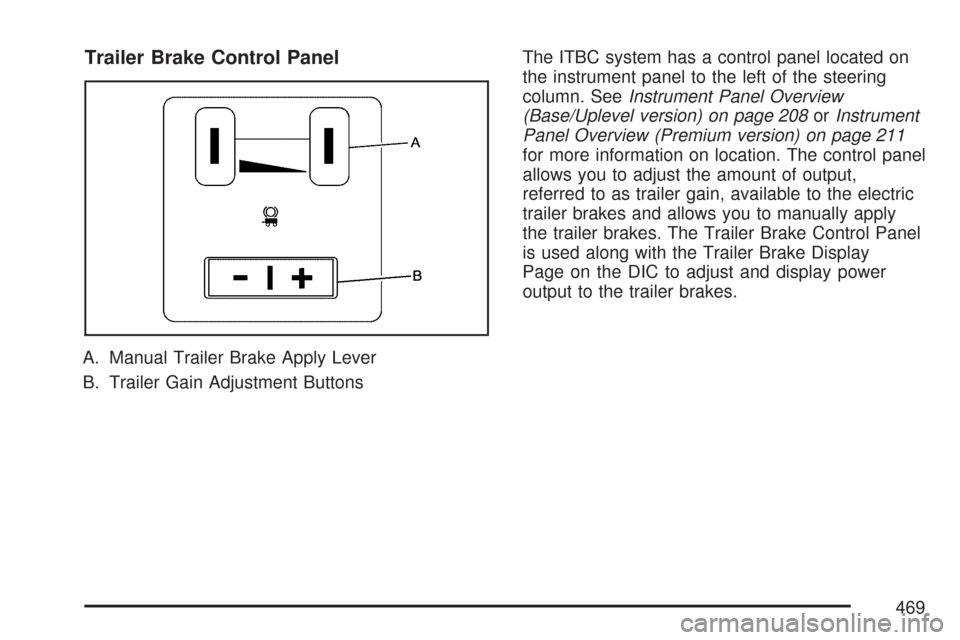
Trailer Brake Control Panel
A. Manual Trailer Brake Apply Lever
B. Trailer Gain Adjustment ButtonsThe ITBC system has a control panel located on
the instrument panel to the left of the steering
column. SeeInstrument Panel Overview
(Base/Uplevel version) on page 208orInstrument
Panel Overview (Premium version) on page 211
for more information on location. The control panel
allows you to adjust the amount of output,
referred to as trailer gain, available to the electric
trailer brakes and allows you to manually apply
the trailer brakes. The Trailer Brake Control Panel
is used along with the Trailer Brake Display
Page on the DIC to adjust and display power
output to the trailer brakes.
469
Page 470 of 684
Trailer Brake DIC Display Page
The ITBC system displays messages into the
vehicle’s Driver Information Center (DIC). SeeDIC
Warnings and Messages on page 281for more
information.
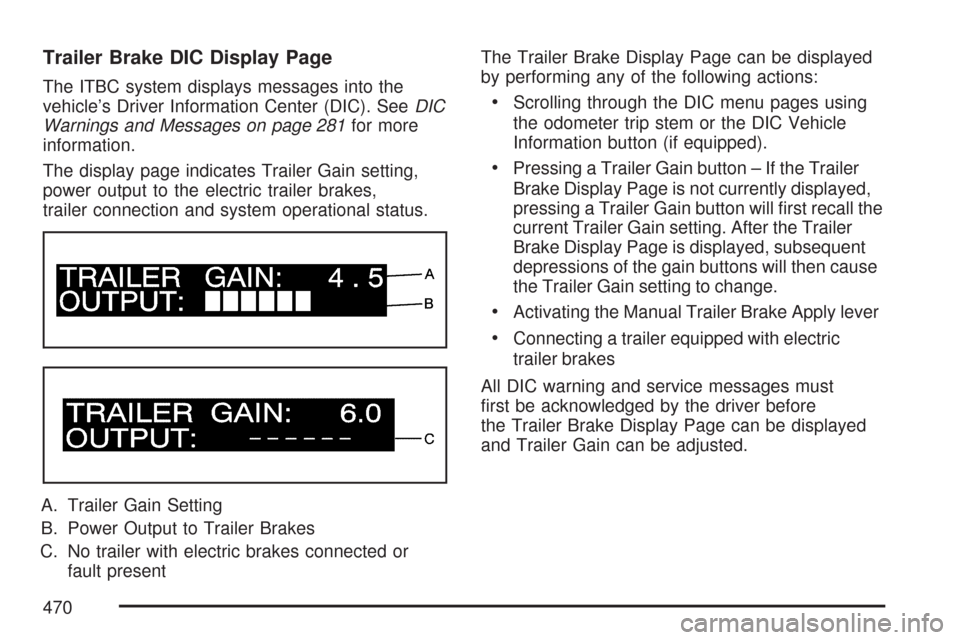
The display page indicates Trailer Gain setting,
power output to the electric trailer brakes,
trailer connection and system operational status.
A. Trailer Gain Setting
B. Power Output to Trailer Brakes
C. No trailer with electric brakes connected or
fault presentThe Trailer Brake Display Page can be displayed
by performing any of the following actions:Scrolling through the DIC menu pages using
the odometer trip stem or the DIC Vehicle
Information button (if equipped).
Pressing a Trailer Gain button – If the Trailer
Brake Display Page is not currently displayed,
pressing a Trailer Gain button will rst recall the
current Trailer Gain setting. After the Trailer
Brake Display Page is displayed, subsequent
depressions of the gain buttons will then cause
the Trailer Gain setting to change.
Activating the Manual Trailer Brake Apply lever
Connecting a trailer equipped with electric
trailer brakes
All DIC warning and service messages must
rst be acknowledged by the driver before
the Trailer Brake Display Page can be displayed
and Trailer Gain can be adjusted.
470
Page 471 of 684
TRAILER GAIN – This setting is displayed
anytime the Trailer Brake Display Page is active.
This setting can be adjusted from 0.0 to 10.0
with either a trailer connected or disconnected.
To adjust the Trailer Gain, press one of the Trailer
Gain adjustment buttons located on the Trailer
Brake Control Panel. Pressg and hold a gain
button to cause the Trailer Gain to continuously
adjust. To turn the output to the trailer off,
adjust the Trailer Gain setting to 0.0 (zero).
0.0 (zero) gain is the factory default setting.
To properly adjust trailer gain, see the Trailer Gain
Adjustment Procedure later in this section.
TRAILER OUTPUT – This is displayed any time a
trailer with electric brakes is connected. Output
to the electric brakes is based on the amount
of vehicle braking present and relative to the
Trailer Gain setting. Output is displayed
from 0 to 10 bars for each gain setting.The Trailer Output will indicate “------“onthe
Trailer Brake Display Page whenever the
following occur:
No trailer is connected.
A trailer without electric brakes is connected
(no DIC message is displayed).
A trailer with electric brakes has become
disconnected (a CHECK TRAILER WIRING
message will also be displayed on the DIC).
There is a fault present in the wiring to
the electric trailer brakes (a CHECK TRAILER
WIRING message will also be displayed on
the DIC).
There is a fault in the ITBC system (a
SERVICE TRAILER BRAKE SYSTEM
message will also be displayed in the DIC).
471
Page 472 of 684
Manual Trailer Brake Apply
The Manual Trailer Brake Apply Lever is located on
the Trailer Brake Control Panel and is used to apply
the trailer’s electric brakes independent of your
vehicle’s brakes. This lever is used in the Trailer
Gain Adjustment Procedure to properly adjust the
power output to the trailer brakes. Sliding the lever
to the left will apply only the trailer brakes. The
power output to the trailer is indicated in the Trailer
Brake Display Page in the DIC. If your vehicle’s
service brakes are applied while using the Manual
Trailer Brake Apply Lever, the trailer output power
will be the greater of the two.
The trailer and the vehicle’s brake lamps will come
on when either vehicle braking or manual trailer
brakes are applied.
Trailer Gain Adjustment Procedure
Trailer Gain should be set for a specic trailering
condition and must be adjusted any time
vehicle loading, trailer loading or road surface
conditions change.
Setting the Trailer Gain properly is needed for the
best trailer stopping performance. A trailer that
is over-gained may result in locked trailer brakes.
A trailer that is under-gained may result in notenough trailer braking. Both of these conditions
may result in poorer stopping and stability of
the vehicle and trailer.
Use the following procedure to correctly adjust
Trailer Gain for each towing condition:
1. Make sure the trailer brakes are in proper
working condition.
2. Connect a properly loaded trailer to the
vehicle and make all necessary mechanical
and electrical connections. SeeLoading Your
Vehicle on page 427for more information.
3. After the electrical connection is made to a
trailer equipped with electric brakes:
A TRAILER CONNECTED message will be
briey displayed on the DIC display.
The Trailer Brake Display Page will appear
on the DIC showing TRAILER GAIN and
TRAILER OUTPUT.
In the Trailer Output display on the
DIC, “------“will disappear if there is no
error present. Connecting a trailer without
electric brakes will not clear the six dashed
lines.
472
Page 473 of 684
4. Adjust the Trailer Gain by using the gain
adjustment (+ / -) buttons on the Trailer
Brake Control Panel.
5. Drive the vehicle with the trailer attached on a
level road surface representative of the towing
condition and free of traffic at about 20 to
25 mph (32 to 40 km/h) and fully apply
the Manual Trailer Brake Apply lever.
Adjusting trailer gain at speeds lower than
20 to 25 mph (32 to 40 km/h) may result in an
incorrect gain setting.
6. Adjust the Trailer Gain to just below the point
of trailer wheel lock-up, indicated by trailer
wheel squeal or puffs of tire smoke when
a trailer wheel locks.
Trailer wheel lock-up may not occur if towing
a heavily loaded trailer. In this case, adjust
the Trailer Gain to the highest allowable
setting for the towing condition.
7. Re-adjust Trailer Gain any time vehicle
loading, trailer loading or road surface
conditions change or if you notice trailer wheel
lock-up at any time while you are towing.Other ITBC Related DIC Messages
In addition to displaying TRAILER GAIN and
TRAILER OUTPUT through the DIC, trailer
connection and ITBC system status is displayed in
the DIC.
TRAILER CONNECTED – This message will be
briey displayed when a trailer with electric brakes
is rst connected to the vehicle. This message
will automatically turn off in about ten seconds.
The driver can also acknowledge this message
before it automatically turns off.
CHECK TRAILER WIRING – This message will be
displayed if:
1. The ITBC system rst determines connection
to a trailer with electric brakes and then the
trailer harness becomes disconnected
from the vehicle.
If the disconnect occurs while the vehicle is
stationary, this message will automatically turn
off in about thirty seconds. This message
will also turn off if the driver acknowledges this
message off or if the trailer harness is
re-connected.
473