Page 444 of 684
Dolly Towing
Front Towing
(Front Wheels Off the Ground)
Two-Wheel-Drive Vehicles
Notice:If you tow a two-wheel-drive vehicle
with the rear wheels on the ground, the
transmission could be damaged. The repairs
would not be covered by your warranty.
Never tow your vehicle with the rear wheels on
the ground.
Two-wheel-drive vehicles should not be towed
with the rear wheels on the ground.
Two-wheel-drive transmissions have no provisions
for internal lubrication while being towed.
To dolly tow a two-wheel-drive vehicle, you must
tow the vehicle with the rear wheels on the
dolly. See “Rear Towing (Rear Wheels Off the
Ground)” later in this section for more information.
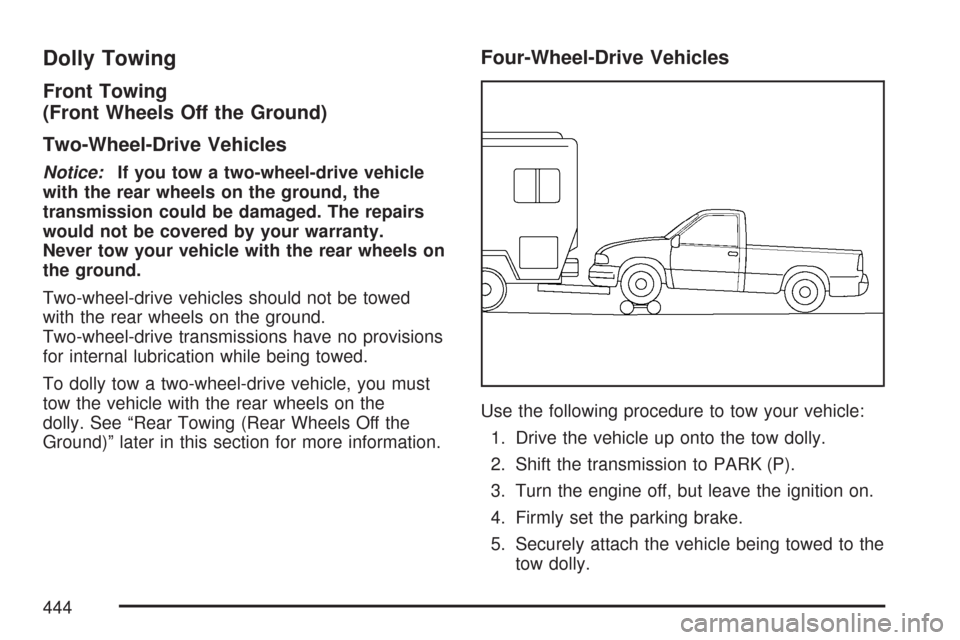
Four-Wheel-Drive Vehicles
Use the following procedure to tow your vehicle:
1. Drive the vehicle up onto the tow dolly.
2. Shift the transmission to PARK (P).
3. Turn the engine off, but leave the ignition on.
4. Firmly set the parking brake.
5. Securely attach the vehicle being towed to the
tow dolly.
444
Page 445 of 684
{CAUTION:
Shifting a four-wheel-drive vehicle’s
transfer case into NEUTRAL can cause
your vehicle to roll even if the
transmission is in PARK (P). You or
others could be injured. Make sure the
parking brake is rmly set before you shift
the transfer case to NEUTRAL.
6. Shift the transfer case to NEUTRAL.
SeeFour-Wheel Drive on page 149for the
proper procedure to select the neutral position
for your vehicle.
7. Release the parking brake only after the
vehicle being towed is rmly attached to
the towing vehicle.
8. Turn the ignition off and lock the steering
column.
Rear Towing
(Rear Wheels Off the Ground)
Two-Wheel-Drive Vehicles
Use the following procedure to tow your vehicle
from the rear:
1. Drive the vehicle onto the dolly.
2. Firmly set the parking brake. SeeParking
Brake on page 164.
3. Put the transmission in PARK (P).
4. Follow the dolly manufacturer’s instructions to
attach and secure the vehicle being towed to
the dolly and then the loaded dolly to the
tow vehicle. Make sure the wheels are straight
before towing.
Use an adequate clamping device to ensure
that the front wheels are locked into the
straight position.
5. Release the parking brake only after the
vehicle being towed is rmly attached to
the tow vehicle.
6. Turn the ignition to LOCK.
445
Page 446 of 684
Four-Wheel-Drive Vehicles
Use the following procedure to tow your vehicle
from the rear:
1. Drive the vehicle onto the dolly.
2. Firmly set the parking brake. SeeParking
Brake on page 164.
3. Put the transmission in PARK (P).
4. Follow the dolly manufacturer’s instructions to
attach and secure the vehicle being towed to
the dolly and then the loaded dolly to the
tow vehicle.
Use an adequate clamping device to ensure
that the front wheels are locked into the
straight position.{CAUTION:
Shifting a four-wheel-drive vehicle’s
transfer case into NEUTRAL can cause
your vehicle to roll even if the transmission
is in PARK (P). You or others could be
injured. Make sure the parking brake is
rmly set before you shift the transfer case
to NEUTRAL.
5. Shift the transfer case to NEUTRAL.
SeeFour-Wheel Drive on page 149.
6. Release the parking brake only after the
vehicle being towed is rmly attached to
the tow vehicle.
7. Turn the ignition to LOCK.
446
Page 460 of 684
K-3500 Extended
Cab (4WD)*Axle Ratio Maximum Trailer Weight GCWR
6.0L V8 3.73 12,000 lbs (5 443 kg) 18,500 lbs (8 391 kg)
6.0L V8
(Dual Rear Wheels)3.73 11,700 lbs (5 307 kg) 18,500 lbs (8 391 kg)
*Fifth-wheel or gooseneck kingpin weight should be 15 percent to 25 percent of trailer weight up to 3,500 lbs
(1 587 kg) maximum.
*Trailer rating limited to 13,000 lbs (5 897 kg) with weight distributing hitch.
K-3500 Crew
Cab (4WD)*Axle Ratio Maximum Trailer Weight GCWR
6.0L V8 3.73 11,800 lbs (5 352 kg) 18,500 lbs (8 391 kg)
6.0L V8
(Dual Rear Wheels)3.73 11,600 lbs (5 262 kg) 18,500 lbs (8 391 kg)
*Fifth-wheel or gooseneck kingpin weight should be 15 percent to 25 percent of trailer weight up to 3,500 lbs
(1 587 kg) maximum.
*Trailer rating limited to 13,000 lbs (5 897 kg) with weight distributing hitch.
The Gross Combination Weight Rating (GCWR) is
the total allowable weight of the completely loaded
vehicle and trailer including any passengers, cargo,
equipment and conversions. The GCWR for your
vehicle should not be exceeded.You can ask your dealer for our trailering
information or advice, or you can write us at our
Customer Assistance Offices. SeeCustomer
Assistance Offices on page 652for more
information.
460
Page 476 of 684
Before you start, check all trailer hitch parts and
attachments, safety chains, electrical connector,
lamps, tires and mirror adjustment. If the trailer has
electric brakes, start your vehicle and trailer
moving and then apply the trailer brake controller
by hand to be sure the brakes are working.
This lets you check your electrical connection at
the same time.
During your trip, check occasionally to be sure
that the load is secure, and that the lamps and any
trailer brakes are still working.
While towing a trailer or when exposed to long
periods of sunshine, the oor of the truck bed may
become very warm. Avoid putting items in the
truck bed that might be affected by high ambient
temperatures.
Following Distance
Stay at least twice as far behind the vehicle ahead
as you would when driving your vehicle without a
trailer. This can help you avoid situations that
require heavy braking and sudden turns.
Passing
You’ll need more passing distance up ahead when
you’re towing a trailer. And, because you’re a good
deal longer, you’ll need to go much farther beyond
the passed vehicle before you can return to your
lane.
Backing Up
Hold the bottom of the steering wheel with one
hand. Then, to move the trailer to the left, just move
that hand to the left. To move the trailer to the right,
move your hand to the right. Always back up slowly
and, if possible, have someone guide you.
Making Turns
Notice:Making very sharp turns while
trailering could cause the trailer to come in
contact with the vehicle. Your vehicle could be
damaged. Avoid making very sharp turns while
trailering.
When you’re turning with a trailer, make wider
turns than normal. Do this so your trailer
won’t strike soft shoulders, curbs, road signs,
trees or other objects. Avoid jerky or sudden
maneuvers. Signal well in advance.
476
Page 517 of 684
Coolant Surge Tank Pressure Cap
Notice:If the pressure cap is not tightly
installed, coolant loss and possible engine
damage may occur. Be sure the cap is properly
and tightly secured.
The coolant surge tank pressure cap must be fully
installed on the coolant surge tank. SeeEngine
Compartment Overview on page 500for more
information on location.
Engine Overheating
If your vehicle has the DURAMAX®Diesel engine,
see the DURAMAX®Diesel manual for more
information.
You will nd a coolant temperature gage on your
vehicle’s instrument panel. SeeEngine Coolant
Temperature Gage on page 260.
In addition, you will nd ENGINE OVERHEATED
STOP ENGINE, ENGINE OVERHEATED IDLE
ENGINE, and ENGINE POWER IS REDUCED
messages in the Driver Information Center (DIC)
on the instrument panel. SeeDIC Warnings
and Messages on page 281.
517
Page 546 of 684
Headlamps
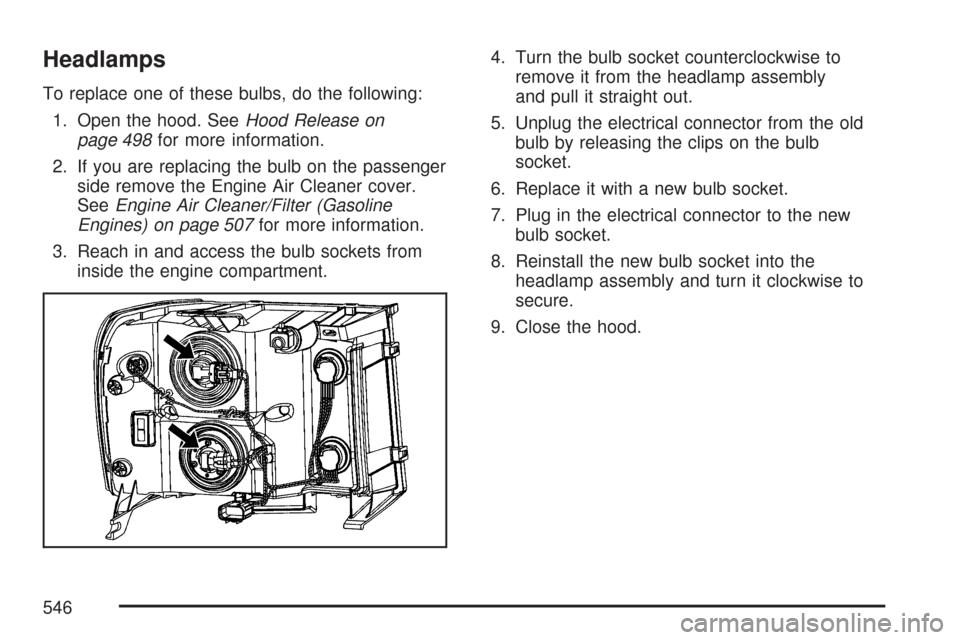
To replace one of these bulbs, do the following:
1. Open the hood. SeeHood Release on
page 498for more information.
2. If you are replacing the bulb on the passenger
side remove the Engine Air Cleaner cover.
SeeEngine Air Cleaner/Filter (Gasoline
Engines) on page 507for more information.
3. Reach in and access the bulb sockets from
inside the engine compartment.4. Turn the bulb socket counterclockwise to
remove it from the headlamp assembly
and pull it straight out.
5. Unplug the electrical connector from the old
bulb by releasing the clips on the bulb
socket.
6. Replace it with a new bulb socket.
7. Plug in the electrical connector to the new
bulb socket.
8. Reinstall the new bulb socket into the
headlamp assembly and turn it clockwise to
secure.
9. Close the hood.
546
Page 568 of 684

Federal Communications Commission
(FCC) and Industry and Science
Canada
The Tire Pressure Monitor System (TPMS)
operates on a radio frequency and complies with
Part 15 of the FCC Rules. Operation is subject
to the following two conditions:
1. This device may not cause harmful
interference.
2. This device must accept any interference
received, including interference that may
cause undesired operation.
The Tire Pressure Monitor System (TPMS)
operates on a radio frequency and complies with
RSS-210 of Industry and Science Canada.
Operation is subject to the following two
conditions:
1. This device may not cause interference.
2. This device must accept any interference
received, including interference that may
cause undesired operation of the device.
Changes or modications to this system by other
than an authorized service facility could void
authorization to use this equipment.
Tire Inspection and Rotation
Tires should be rotated every 5,000 to 8,000 miles
(8 000 to 13 000 km).
Any time you notice unusual wear, rotate your
tires as soon as possible and check wheel
alignment. Also check for damaged tires or wheels.
SeeWhen It Is Time for New Tires on page 571
andWheel Replacement on page 576for
more information.
Make sure the spare tire is stored securely. Push,
pull, and then try to rotate or turn the tire. If it
moves, use the wheel wrench/hoist shaft to tighten
the cable. SeeChanging a Flat Tire on page 580.
If your vehicle has dual rear wheels, also see
Dual Tire Operation on page 562.
The purpose of regular rotation is to achieve more
uniform wear for all tires on the vehicle. The
rst rotation is the most important. SeeScheduled
Maintenance (Gasoline Engine) on page 627.
568