2007 CHEVROLET OPTRA 5 tire size
[x] Cancel search: tire sizePage 317 of 422

Make certain that all wheel nuts are properly
tightened. See “Wheel Nut Torque” under
Capacities and Specifications on page 352.
{CAUTION:
Rust or dirt on a wheel, or on the parts to
which it is fastened, can make wheel nuts
become loose after time. The wheel could
come off and cause an accident. When
you change a wheel, remove any rust or
dirt from places where the wheel attaches
to the vehicle. In an emergency, you can
use a cloth or a paper towel to do this;
but be sure to use a scraper or wire brush
later, if needed, to get all the rust or dirt
off. SeeChanging a Flat Tire on page 324.
When It Is Time for New Tires
One way to tell when it
is time for new tires is
to check the treadwear
indicators, which will
appear when your tires
have only 1/16 inch
(1.6 mm) or less of tread
remaining.
You need a new tire if any of the following
statements are true:
•You can see the indicators at three or more
places around the tire.
•You can see cord or fabric showing through
the tire’s rubber.
•The tread or sidewall is cracked, cut, or
snagged deep enough to show cord or fabric.
•The tire has a bump, bulge, or split.
•The tire has a puncture, cut, or other damage
that cannot be repaired well because of the
size or location of the damage.
317
Page 318 of 422

Buying New Tires
To find out what kind and size of tires you need,
look at the tire and loading information label
attached to your vehicle. SeeLoading Your
Vehicle on page 236for a label example and
where it is attached to your vehicle.
Make sure the replacements are the same size,
load range, speed rating and construction type
(bias, bias-belted or radial) as your original tires.
{CAUTION:
Mixing tires could cause you to lose
control while driving. If you mix tires of
different sizes, brands, or types (radial
and bias-belted tires), the vehicle may not
handle properly, and you could have a
crash. Using tires of different sizes,
brands, or types may also cause damage
to your vehicle. Be sure to use the correct
CAUTION: (Continued)
CAUTION: (Continued)
size, brand, and type of tires on all
wheels. It is all right to drive with your
compact spare temporarily, as it was
developed for use on your vehicle.
SeeCompact Spare Tire on page 334.
{CAUTION:
If you use bias-ply tires on your vehicle,
the wheel rim anges could develop
cracks after many miles of driving. A tire
and/or wheel could fail suddenly, causing
a crash. Use only radial-ply tires with the
wheels on your vehicle.
318
Page 319 of 422

Different Size Tires and Wheels
If you add wheels or tires that are a different size
than your original equipment wheels and tires,
this may affect the way your vehicle performs,
including its braking, ride and handling
characteristics, stability, and resistance to rollover.
Additionally, if your vehicle has electronic
systems such as, anti-lock brakes, traction control,
and electronic stability control, the performance
of these systems can be affected.{CAUTION:
If you add different sized wheels, your
vehicle may not provide an acceptable
level of performance and safety if tires
not recommended for those wheels are
selected. You may increase the chance
that you will crash and suffer serious
injury. Only use GM specic wheel and
tire systems developed for your vehicle,
and have them properly installed by a
GM certied technician.
SeeBuying New Tires on page 318and
Accessories and Modifications on page 249for
additional information.
319
Page 323 of 422

Used Replacement Wheels
{CAUTION:
Putting a used wheel on your vehicle is
dangerous. You cannot know how it has
been used or how far it has been driven.
It could fail suddenly and cause a crash.
If you have to replace a wheel, use a new
GM original equipment wheel.
Tire Chains
Notice:Use tire chains only where legal and
only when you must. Use only SAE Class
“S” type chains that are the proper size for
your tires. Install them on the front tires
and tighten them as tightly as possible with
the ends securely fastened. Drive slowly
and follow the chain manufacturer’s
instructions. If you can hear the chains
contacting your vehicle, stop and retighten
them. If the contact continues, slow down
until it stops. Driving too fast or spinning
the wheels with chains on will damage your
vehicle.
323
Page 333 of 422

Storing a Flat or Spare Tire
and Tools
{CAUTION:
Storing a jack, a tire, or other equipment
in the passenger compartment of the
vehicle could cause injury. In a sudden
stop or collision, loose equipment could
strike someone. Store all these in the
proper place.To store a flat or spare tire, do the following:
1. Put the flat or spare tire in the compact spare
tire compartment, then secure the retainer.
2. Store the jack in its housing in the cargo area.
Secure the jack by turning the retainer
clockwise.
3. Store the tools securely in the foam tray and
place the tray on top of the tire.
4. Replace the trim cover.
The compact spare tire is for temporary use only.
Replace the compact spare tire with a full-size
tire as soon as you can. SeeCompact Spare Tire
on page 334.
333
Page 334 of 422

Compact Spare Tire
Although the compact spare tire was fully inflated
when your vehicle was new, it can lose air
after a time. Check the inflation pressure regularly.
It should be 60 psi (420 kPa).
After installing the compact spare on your vehicle,
you should stop as soon as possible and make
sure your spare tire is correctly inflated. The
compact spare is made to perform well at speeds
up to 50 mph (80 km/h), so you can finish your
trip and have your full-size tire repaired or replaced
where you want. Of course, it is best to replace
your spare with a full-size tire as soon as you can.
Your spare will last longer and be in good shape
in case you need it again.Notice:When the compact spare is installed,
do not take your vehicle through an automatic
car wash with guide rails. The compact
spare can get caught on the rails. That can
damage the tire and wheel, and maybe
other parts of your vehicle.
Do not use your compact spare on other vehicles.
And do not mix your compact spare tire or
wheel with other wheels or tires. They will not fit.
Keep your spare tire and its wheel together.
Notice:Tire chains will not t your compact
spare. Using them can damage your vehicle
and can damage the chains too. Do not use tire
chains on your compact spare.
334
Page 421 of 422
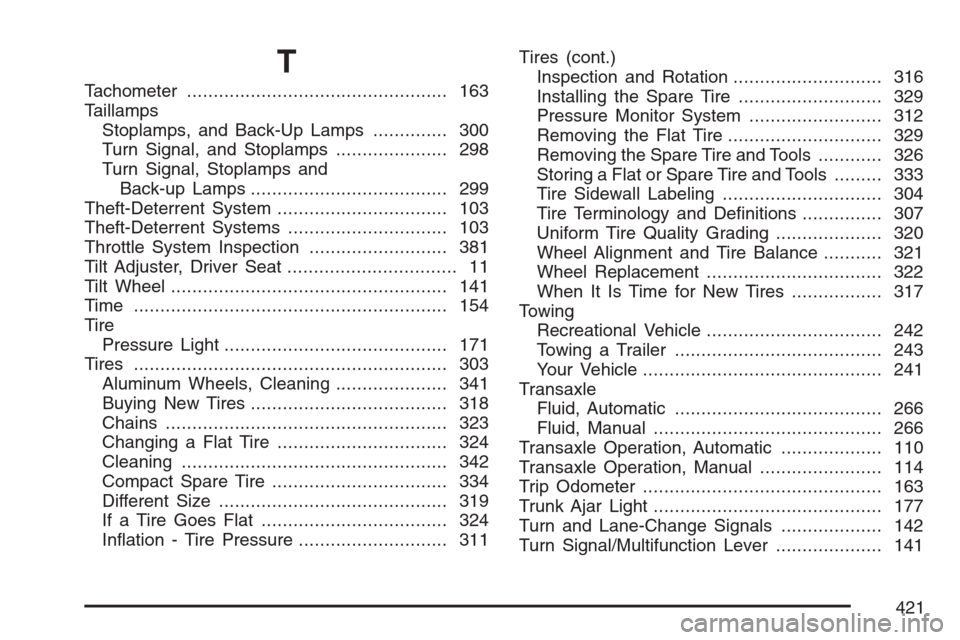
T
Tachometer................................................. 163
Taillamps
Stoplamps, and Back-Up Lamps.............. 300
Turn Signal, and Stoplamps..................... 298
Turn Signal, Stoplamps and
Back-up Lamps..................................... 299
Theft-Deterrent System................................ 103
Theft-Deterrent Systems.............................. 103
Throttle System Inspection.......................... 381
Tilt Adjuster, Driver Seat................................ 11
Tilt Wheel.................................................... 141
Time ........................................................... 154
Tire
Pressure Light.......................................... 171
Tires........................................................... 303
Aluminum Wheels, Cleaning..................... 341
Buying New Tires..................................... 318
Chains..................................................... 323
Changing a Flat Tire................................ 324
Cleaning.................................................. 342
Compact Spare Tire................................. 334
Different Size........................................... 319
If a Tire Goes Flat................................... 324
Inflation - Tire Pressure............................ 311Tires (cont.)
Inspection and Rotation............................ 316
Installing the Spare Tire........................... 329
Pressure Monitor System......................... 312
Removing the Flat Tire............................. 329
Removing the Spare Tire and Tools............ 326
Storing a Flat or Spare Tire and Tools......... 333
Tire Sidewall Labeling .............................. 304
Tire Terminology and Definitions............... 307
Uniform Tire Quality Grading.................... 320
Wheel Alignment and Tire Balance........... 321
Wheel Replacement................................. 322
When It Is Time for New Tires................. 317
Towing
Recreational Vehicle................................. 242
Towing a Trailer....................................... 243
Your Vehicle............................................. 241
Transaxle
Fluid, Automatic....................................... 266
Fluid, Manual........................................... 266
Transaxle Operation, Automatic................... 110
Transaxle Operation, Manual....................... 114
Trip Odometer............................................. 163
Trunk Ajar Light........................................... 177
Turn and Lane-Change Signals................... 142
Turn Signal/Multifunction Lever.................... 141
421
Page 422 of 422

U
Understanding Radio Reception................... 203
Uniform Tire Quality Grading....................... 320
V
Vehicle
Control..................................................... 210
Damage Warnings....................................... 5
Loading.................................................... 236
Parking Your............................................ 119
Symbols...................................................... 5
Vehicle Data Collection and Event
Data Recorders........................................ 400
Vehicle Identification
Number (VIN).......................................... 344
Service Parts Identification Label.............. 345
Ventilation Adjustment.................................. 159
Visors.......................................................... 102
W
Warning Lights, Gages and Indicators......... 161
Warnings
Hazard Warning Flashers......................... 140
Other Warning Devices............................ 140Warnings (cont.)
Safety and Symbols..................................... 4
Vehicle Damage.......................................... 5
Wheels
Alignment and Tire Balance..................... 321
Different Size........................................... 319
Replacement............................................ 322
Where to Put the Restraint............................ 50
Windows..................................................... 100
Manual..................................................... 100
Power...................................................... 101
Windshield
Washer.................................................... 144
Washer Fluid........................................... 280
Wiper Blade Replacement........................ 302
Wiper Blades, Cleaning............................ 340
Wiper Fuses............................................ 346
Wipers..................................................... 143
Windshield, Rear Washer/Wiper................... 145
Winter Driving............................................. 231Y
Your Vehicle and the Environment............... 356
422