2007 CHEVROLET MONTE CARLO change wheel
[x] Cancel search: change wheelPage 83 of 456

Adding Equipment to Your
Airbag-Equipped Vehicle
Q:Is there anything I might add to the front
or sides of the vehicle that could keep the
airbags from working properly?
A:Yes. If you add things that change your
vehicle’s frame, bumper system, height,
front end or side sheet metal, they may keep
the airbag system from working properly.
Also, the airbag system may not work properly
if you relocate any of the airbag sensors. If
you have any questions about this, you should
contact Customer Service before you modify
your vehicle. The phone numbers and
addresses for Customer Assistance are in
Step Two of the Customer Satisfaction
Procedure in this manual. SeeCustomer
Satisfaction Procedure on page 422.
Q:Because I have a disability, I have to get
my vehicle modied. How can I nd out
whether this will affect my airbag system?
A:Changing or moving any parts of the
front seats, safety belts, the airbag sensing
and diagnostic module, steering wheel,
instrument panel, the overhead console, or
airbag wiring can affect the operation of
the airbag system. If you have questions, call
Customer Assistance. The phone numbers
and addresses for Customer Assistance are
in Step Two of the Customer Satisfaction
Procedure in this manual. SeeCustomer
Satisfaction Procedure on page 422.
83
Page 143 of 456

Instrument Panel Overview........................ 146
Hazard Warning Flashers.......................... 148
Other Warning Devices............................. 148
Horn.......................................................... 148
Tilt Wheel.................................................. 148
Turn Signal/Multifunction Lever.................. 149
Turn and Lane-Change Signals................. 150
Headlamp High/Low-Beam Changer.......... 151
Flash-to-Pass............................................ 151
Windshield Wipers..................................... 151
Windshield Washer.................................... 152
Cruise Control........................................... 153
Exterior Lamps.......................................... 156
Delayed Headlamps.................................. 157
Daytime Running Lamps (DRL)/
Automatic Headlamp System.................. 158
Fog Lamps................................................ 158
Instrument Panel Brightness...................... 159
Courtesy Lamps........................................ 159
Dome Lamp.............................................. 159
Entry Lighting............................................ 160
Delayed Entry Lighting.............................. 160
Delayed Exit Lighting................................. 160
Parade Dimming........................................ 161Reading Lamps......................................... 161
Electric Power Management...................... 161
Battery Run-Down Protection..................... 162
Accessory Power Outlet(s)........................ 162
Ashtray(s) and Cigarette Lighter................ 164
Climate Controls......................................... 164
Climate Control System............................. 164
Outlet Adjustment...................................... 168
Passenger Compartment Air Filter............. 169
Warning Lights, Gages, and Indicators..... 170
Instrument Panel Cluster........................... 171
Speedometer and Odometer...................... 172
Tachometer............................................... 172
Safety Belt Reminder Light........................ 173
Passenger Safety Belt Reminder Light....... 173
Airbag Readiness Light............................. 174
Passenger Airbag Status Indicator............. 175
Charging System Light.............................. 177
Brake System Warning Light..................... 177
Anti-Lock Brake System Warning Light...... 178
Traction Control System (TCS)
Warning Light........................................ 179
Engine Coolant Temperature
Warning Light........................................ 179
Section 3 Instrument Panel
143
Page 149 of 456

To tilt the wheel, hold the wheel and pull the lever.
Then move the wheel to a comfortable position
and release the lever to lock the wheel in place.
Turn Signal/Multifunction Lever
The lever on the left side of the steering column
includes the following:
GTurn and Lane Change Signals. See
Turn and Lane-Change Signals on page 150.
2Headlamp High/Low-Beam Changer. See
Headlamp High/Low-Beam Changer on
page 151.
Flash-to-Pass. SeeFlash-to-Pass on page 151.
NWindshield Wipers. SeeWindshield Wipers
on page 151.
LQWindshield Washer. SeeWindshield
Washer on page 152.
For information on the headlamps, seeExterior
Lamps on page 156.
149
Page 153 of 456
Cruise Control
With cruise control, you can maintain a speed of
about 25 mph (40 km/h) or more without
keeping your foot on the accelerator. This can
really help on long trips. Cruise control does not
work at speeds below about 25 mph (40 km/h).
{CAUTION:
Cruise control can be dangerous where
you cannot drive safely at a steady speed.
So, do not use your cruise control on
winding roads or in heavy traffic.
Cruise control can be dangerous on
slippery roads. On such roads, fast
changes in tire traction can cause
excessive wheel slip, and you could lose
control. Do not use cruise control on
slippery roads.
If your vehicle is in cruise control when the
traction control system, if your vehicle has this
feature, begins to limit wheel spin, the cruise
control will automatically disengage. SeeTractionControl System (TCS) on page 254. When road
conditions allow you to safely use it again,
the cruise control can be turned back on.
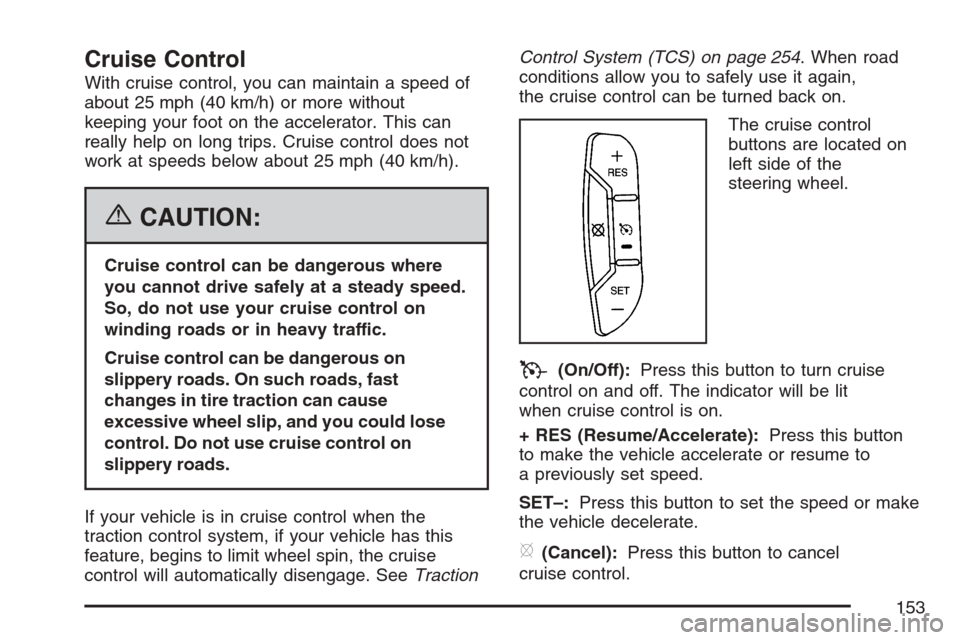
The cruise control
buttons are located on
left side of the
steering wheel.
T(On/Off):Press this button to turn cruise
control on and off. The indicator will be lit
when cruise control is on.
+ RES (Resume/Accelerate):Press this button
to make the vehicle accelerate or resume to
a previously set speed.
SET–:Press this button to set the speed or make
the vehicle decelerate.
[(Cancel):Press this button to cancel
cruise control.
153
Page 252 of 456

Let us say the road is wet and you are driving
safely. Suddenly, an animal jumps out in front of
you. You slam on the brakes and continue braking.
Here is what happens with ABS:
A computer senses that wheels are slowing down.
If one of the wheels is about to stop rolling, the
computer will separately work the brakes at each
front wheel and at both rear wheels.ABS can change the brake pressure faster than
any driver could. The computer is programmed
to make the most of available tire and road
conditions. This can help you steer around the
obstacle while braking hard.
As you brake, your computer keeps receiving
updates on wheel speed and controls braking
pressure accordingly.
252
Page 253 of 456

Remember: ABS does not change the time you
need to get your foot up to the brake pedal or
always decrease stopping distance. If you get too
close to the vehicle in front of you, you will not have
time to apply your brakes if that vehicle suddenly
slows or stops. Always leave enough room up
ahead to stop, even though you have ABS.
Using ABS
Do not pump the brakes. Just hold the brake
pedal down rmly and let anti-lock work for you.
You may feel a slight brake pedal pulsation
or notice some noise, but this is normal.
Braking in Emergencies
At some time, nearly every driver gets into a
situation that requires hard braking.
If you have ABS, you can steer and brake at the
same time. However, if you do not have ABS, your
rst reaction — to hit the brake pedal hard and
hold it down — may be the wrong thing to do. Your
wheels can stop rolling. Once they do, the
vehicle cannot respond to your steering.Momentum will carry it in whatever direction it was
headed when the wheels stopped rolling. That
could be off the road, into the very thing you were
trying to avoid, or into traffic.
If you do not have ABS, use a “squeeze” braking
technique. This will give you maximum braking
while maintaining steering control. You can do this
by pushing on the brake pedal with steadily
increasing pressure.
In an emergency, you will probably want to squeeze
the brakes hard without locking the wheels. If you
hear or feel the wheels sliding, ease off the brake
pedal. This will help you retain steering control. If
you do have ABS, it is different. SeeAnti-Lock
Brake System (ABS) on page 251.
In many emergencies, steering can help you more
than even the very best braking.
253
Page 255 of 456
To turn the system off
or on, press the traction
control button located
near the exterior
lamp control.
When you turn the system off, a chime will sound
and a TRACTION CONTROL OFF message will
appear in the DIC. SeeDIC Warnings and
Messages on page 195for more information. If the
Traction Control System is limiting wheel spin when
you press the button to turn the system off, the
traction control system warning light will come on
and the system will turn off right away.
You can turn the system back on at any time by
pressing the button again. The Traction Control
System warning light should go off.
Adding non-GM accessories can affect your
vehicle’s performance. SeeAccessories and
Modications on page 296for more information.Steering
Power Steering
If you lose power steering assist because the
engine stops or the system is not functioning, you
can steer but it will take much more effort.
Steering Tips
It is important to take curves at a reasonable speed.
A lot of the “driver lost control” accidents
mentioned on the news happen on curves.
Here is why:
Experienced driver or beginner, each of us is
subject to the same laws of physics when driving on
curves. The traction of the tires against the road
surface makes it possible for the vehicle to change
its path when you turn the front wheels. If there is
no traction, inertia will keep the vehicle going in the
same direction. If you have ever tried to steer a
vehicle on wet ice, you will understand this.
255
Page 260 of 456

Loss of Control
Let us review what driving experts say about what
happens when the three control systems — brakes,
steering, and acceleration — do not have enough
friction where the tires meet the road to do what the
driver has asked.
In any emergency, do not give up. Keep trying to
steer and constantly seek an escape route or
area of less danger.
Skidding
In a skid, a driver can lose control of the vehicle.
Defensive drivers avoid most skids by taking
reasonable care suited to existing conditions, and
by not overdriving those conditions. But skids
are always possible.
The three types of skids correspond to your
vehicle’s three control systems. In the braking skid,
your wheels are not rolling. In the steering or
cornering skid, too much speed or steering in a
curve causes tires to slip and lose cornering force.
And in the acceleration skid, too much throttle
causes the driving wheels to spin.A cornering skid and an acceleration skid are
best handled by easing your foot off the
accelerator pedal.
If your vehicle starts to slide, ease your foot off
the accelerator pedal and quickly steer the
way you want the vehicle to go. If you start
steering quickly enough, your vehicle may
straighten out. Always be ready for a second skid
if it occurs.
Of course, traction is reduced when water, snow,
ice, gravel, or other material is on the road.
For safety, you will want to slow down and adjust
your driving to these conditions. It is important
to slow down on slippery surfaces because
stopping distance will be longer and vehicle control
more limited.
While driving on a surface with reduced traction, try
your best to avoid sudden steering, acceleration, or
braking, including reducing vehicle speed by
shifting to a lower gear. Any sudden changes could
cause the tires to slide. You may not realize the
surface is slippery until your vehicle is skidding.
Learn to recognize warning clues — such as
enough water, ice, or packed snow on the road to
make a mirrored surface — and slow down when
you have any doubt.
260