2007 CHEVROLET MALIBU engine overheat
[x] Cancel search: engine overheatPage 120 of 510
Starting the Engine
Place the transaxle in the proper gear.
Move your shift lever to PARK (P) or
NEUTRAL (N). Your engine will not start in
any other position — this is a safety feature.
To restart when you are already moving,
use NEUTRAL (N) only.
Notice:Shifting into PARK (P) with the vehicle
moving could damage the transaxle. Shift
into PARK (P) only when your vehicle is
stopped.
Starting Procedure
1. With your foot off the accelerator pedal,
turn the ignition key to START. When the
engine starts, let go of the key. The idle
speed will go down as your engine gets warm.
Do not race the engine immediately after
starting it. Operate the engine and transaxle
gently to allow the oil to warm up and lubricate
all moving parts.Your vehicle has a Computer-Controlled
Cranking System. This feature assists in
starting the engine and protects components. If
the ignition key is turned to the START position,
and then released when the engine begins
cranking, the engine will continue cranking for a
few seconds or until the vehicle starts. If the
engine does not start and the key is held in
START for many seconds, cranking will be
stopped after 15 seconds to prevent cranking
motor damage. To prevent gear damage, this
system also prevents cranking if the engine is
already running. Engine cranking can be
stopped by turning the ignition switch to the
ACC or OFF position.
Notice:Cranking the engine for long periods
of time, by returning the key to the START
position immediately after cranking has ended,
can overheat and damage the cranking
motor, and drain the battery. Wait at least
15 seconds between each try, to allow
the cranking motor to cool down.
120
Page 123 of 510
To Use the Engine Coolant Heater
1. Turn off the engine.
2. Open the hood and unwrap the electrical
cord. On the 2.2L engine, the engine
coolant heater cord is located near the air
cleaner box on the passenger’s side of
the engine compartment. On the 3.5L and
3.9L V6 engines, the engine coolant heater
cord is located on the driver’s side around the
battery box. SeeEngine Compartment
Overview on page 354for more information
on location.
{CAUTION:
Plugging the cord into an ungrounded
outlet could cause an electrical shock.
Also, the wrong kind of extension cord
could overheat and cause a re.
CAUTION: (Continued)
CAUTION: (Continued)
You could be seriously injured. Plug the
cord into a properly grounded three-prong
110-volt AC outlet. If the cord will not
reach, use a heavy-duty three-prong
extension cord rated for at least 15 amps.
3. Plug the cord into a normal, grounded
110-volt AC outlet.
4. Before starting the engine, be sure to unplug
and store the cord as it was before to keep it
away from moving engine parts. If you do
not, it could be damaged.
How long should you keep the coolant heater
plugged in? The answer depends on the outside
temperature, the kind of oil you have, and
some other things. Instead of trying to list
everything here, we ask that you contact your
dealer/retailer in the area where you will be parking
your vehicle. The dealer can give you the best
advice for that particular area.
123
Page 132 of 510
Parking Brake
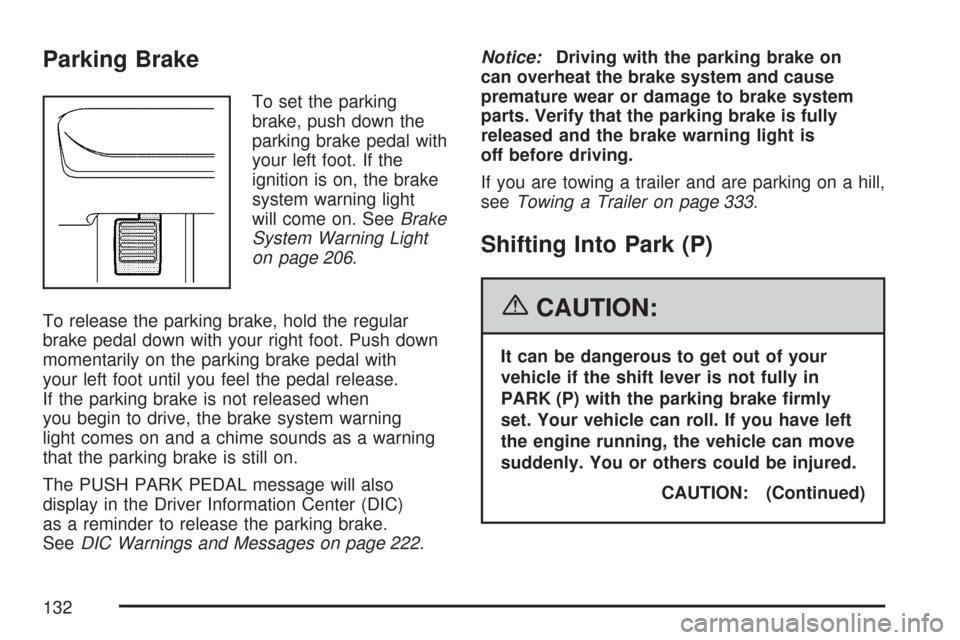
To set the parking
brake, push down the
parking brake pedal with
your left foot. If the
ignition is on, the brake
system warning light
will come on. SeeBrake
System Warning Light
on page 206.
To release the parking brake, hold the regular
brake pedal down with your right foot. Push down
momentarily on the parking brake pedal with
your left foot until you feel the pedal release.
If the parking brake is not released when
you begin to drive, the brake system warning
light comes on and a chime sounds as a warning
that the parking brake is still on.
The PUSH PARK PEDAL message will also
display in the Driver Information Center (DIC)
as a reminder to release the parking brake.
SeeDIC Warnings and Messages on page 222.Notice:Driving with the parking brake on
can overheat the brake system and cause
premature wear or damage to brake system
parts. Verify that the parking brake is fully
released and the brake warning light is
off before driving.
If you are towing a trailer and are parking on a hill,
seeTowing a Trailer on page 333.
Shifting Into Park (P)
{CAUTION:
It can be dangerous to get out of your
vehicle if the shift lever is not fully in
PARK (P) with the parking brake rmly
set. Your vehicle can roll. If you have left
the engine running, the vehicle can move
suddenly. You or others could be injured.
CAUTION: (Continued)
132
Page 133 of 510
CAUTION: (Continued)
To be sure your vehicle will not move,
even when you are on fairly level ground,
use the steps that follow. If you are
pulling a trailer, seeTowing a Trailer
on page 333.
1. Hold the brake pedal down with your right foot
and set the parking brake.
2. Move the shift lever into PARK (P) by pressing
the button on the shift lever while pushing the
shift lever all the way toward the front of
the vehicle.
3. Turn the ignition key to OFF.
4. Remove the key and take it with you. If you
can leave your vehicle with the ignition key in
your hand, your vehicle is in PARK (P).
Leaving Your Vehicle With the
Engine Running
{CAUTION:
It can be dangerous to leave your vehicle
with the engine running. Your vehicle
could move suddenly if the shift lever is
not fully in PARK (P) with the parking
brake rmly set. And, if you leave the
vehicle with the engine running, it could
overheat and even catch re. You or
others could be injured. Do not leave
your vehicle with the engine running.
If you have to leave your vehicle with the engine
running, be sure your vehicle is in PARK (P)
and the parking brake is rmly set before leaving
it. After moving the shift lever into PARK (P),
hold the regular brake pedal down. Then, see if
you can move the shift lever away from PARK (P)
without rst pushing the shift lever button.
If you can, it means that the shift lever was not
fully locked in PARK (P).
133
Page 211 of 510
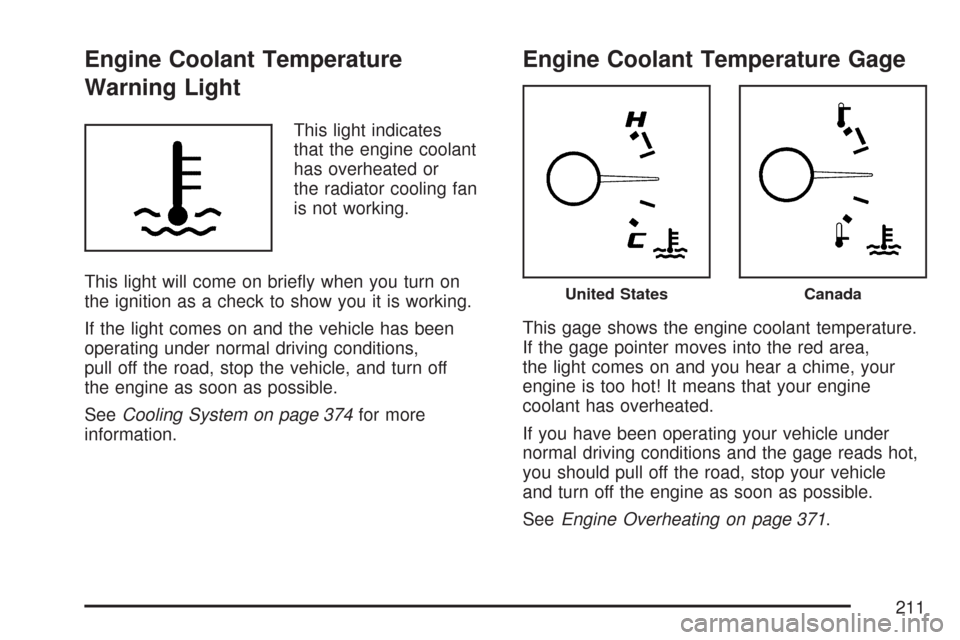
Engine Coolant Temperature
Warning Light
This light indicates
that the engine coolant
has overheated or
the radiator cooling fan
is not working.
This light will come on briey when you turn on
the ignition as a check to show you it is working.
If the light comes on and the vehicle has been
operating under normal driving conditions,
pull off the road, stop the vehicle, and turn off
the engine as soon as possible.
SeeCooling System on page 374for more
information.
Engine Coolant Temperature Gage
This gage shows the engine coolant temperature.
If the gage pointer moves into the red area,
the light comes on and you hear a chime, your
engine is too hot! It means that your engine
coolant has overheated.
If you have been operating your vehicle under
normal driving conditions and the gage reads hot,
you should pull off the road, stop your vehicle
and turn off the engine as soon as possible.
SeeEngine Overheating on page 371.
United StatesCanada
211
Page 323 of 510
{CAUTION:
If you let your vehicle’s tires spin at
high speed, they can explode, and you
or others could be injured. And, the
transaxle or other parts of the vehicle
can overheat. That could cause an
engine compartment re or other damage.
When you are stuck, spin the wheels
as little as possible. Do not spin the
wheels above 35 mph (55 km/h) as
shown on the speedometer.
Notice:Spinning the wheels can destroy
parts of your vehicle as well as the tires.
If you spin the wheels too fast while shifting
the transaxle back and forth, you can destroy
the transaxle. SeeRocking Your Vehicle to
Get It Out on page 323.
For information about using tire chains on your
vehicle, seeTire Chains on page 416.
Rocking Your Vehicle to Get It Out
First, turn the steering wheel left and right.
That will clear the area around the front wheels.
If your vehicle has a traction system, you
should turn the traction system off. SeeTraction
Control System (TCS) on page 295orEnhanced
Traction System (ETS) on page 297. Then
shift back and forth between REVERSE (R) and
a forward gear, spinning the wheels as little
as possible. Release the accelerator pedal while
you shift, and press lightly on the accelerator pedal
when the transaxle is in gear. By slowly spinning
the wheels in the forward and reverse directions,
you will cause a rocking motion that may free
your vehicle. If that does not get your vehicle
out after a few tries, it may need to be towed out.
If your vehicle does need to be towed out, see
Towing Your Vehicle on page 330.
323
Page 335 of 510
When towing a trailer on long uphill grades while
the outside temperature is above 85°F (29°C),
reduce your vehicle speed to 45 mph (72 km/h)
to avoid overheating the engine cooling system.
You can ask your dealer/retailer for our trailering
information or advice, or you can write us at
our Customer Assistance Offices. SeeCustomer
Assistance Offices on page 479for more
information.
Weight of the Trailer Tongue
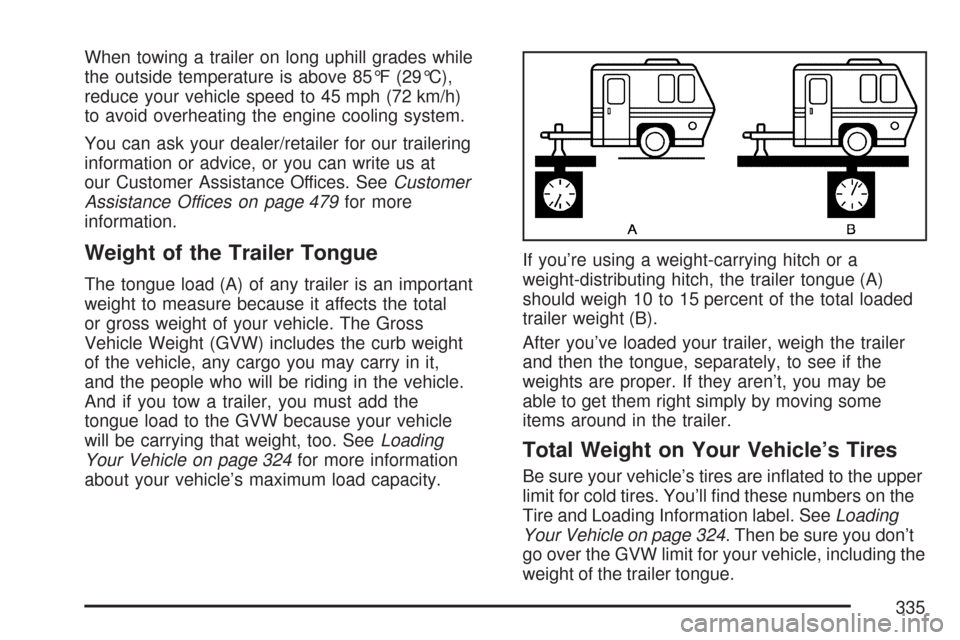
The tongue load (A) of any trailer is an important
weight to measure because it affects the total
or gross weight of your vehicle. The Gross
Vehicle Weight (GVW) includes the curb weight
of the vehicle, any cargo you may carry in it,
and the people who will be riding in the vehicle.
And if you tow a trailer, you must add the
tongue load to the GVW because your vehicle
will be carrying that weight, too. SeeLoading
Your Vehicle on page 324for more information
about your vehicle’s maximum load capacity.If you’re using a weight-carrying hitch or a
weight-distributing hitch, the trailer tongue (A)
should weigh 10 to 15 percent of the total loaded
trailer weight (B).
After you’ve loaded your trailer, weigh the trailer
and then the tongue, separately, to see if the
weights are proper. If they aren’t, you may be
able to get them right simply by moving some
items around in the trailer.
Total Weight on Your Vehicle’s Tires
Be sure your vehicle’s tires are inated to the upper
limit for cold tires. You’ll nd these numbers on the
Tire and Loading Information label. SeeLoading
Your Vehicle on page 324. Then be sure you don’t
go over the GVW limit for your vehicle, including the
weight of the trailer tongue.
335
Page 338 of 510
Making Turns
Notice:Making very sharp turns while
trailering could cause the trailer to come in
contact with the vehicle. Your vehicle could
be damaged. Avoid making very sharp
turns while trailering.
When you’re turning with a trailer, make wider
turns than normal. Do this so your trailer
won’t strike soft shoulders, curbs, road signs,
trees or other objects. Avoid jerky or sudden
maneuvers. Signal well in advance.
Turn Signals When Towing a Trailer
When you tow a trailer, your vehicle may
need additional wiring. Check with your
dealer/retailer. The arrows on your instrument
panel will ash whenever you signal a turn or
lane change. Properly hooked up, the trailer
lamps will also ash, telling other drivers you’re
about to turn, change lanes or stop.When towing a trailer, the arrows on your
instrument panel will ash for turns even if the
bulbs on the trailer are burned out. Thus, you
may think drivers behind you are seeing
your signal when they are not. It’s important to
check occasionally to be sure the trailer bulbs
are still working.
Driving On Grades
When towing a trailer on long uphill grades while
the outside temperature is above 85°F (29°C),
reduce your vehicle speed to 45 mph (72 km/h)
to avoid overheating the engine cooling system.
Reduce speed and shift to a lower gearbefore
you start down a long or steep downgrade.
If you don’t shift down, you might have to use
your brakes so much that they would get hot
and no longer work well.
Pay attention to the engine coolant gage.
If the indicator is in the red area, turn off the
air conditioning to reduce engine load. See
Engine Overheating on page 371.
338