2007 CHEVROLET MALIBU MAXX service
[x] Cancel search: servicePage 284 of 510
Radio Reception
Frequency interference and static during normal
radio reception can occur if items such as
cellphone chargers, vehicle convenience
accessories, and external electronic devices
are plugged into the accessory power outlet.
If there is interference or static, unplug the
item from the accessory power outlet.
AM
The range for most AM stations is greater than
for FM, especially at night. The longer range
can cause station frequencies to interfere with
each other. For better radio reception, most
AM radio stations boost the power levels during
the day, and then reduce these levels during
the night. Static can also occur when things
like storms and power lines interfere with radio
reception. When this happens, try reducing
the treble on your radio.
FM Stereo
FM stereo gives the best sound, but FM signals
reach about 10 to 40 miles (16 to 65 km). Tall
buildings or hills can interfere with FM signals,
causing the sound to fade in and out.
XM™ Satellite Radio Service
XM™ Satellite Radio Service gives digital radio
reception from coast-to-coast in the 48 contiguous
United States, and in Canada. Just as with FM,
tall buildings or hills can interfere with satellite
radio signals, causing the sound to fade in and out.
In addition, traveling or standing under heavy
foliage, bridges, garages, or tunnels can cause
loss of the XM™ signal for a period of time.
The radio could display NO XM SIGNAL to
indicate interference.
284
Page 299 of 510
Steering
Electric Power Steering
If your vehicle has the electric power steering
system and the engine stalls while you are driving,
the power steering assist system will continue to
operate until you are able to stop your vehicle. If
you lose power steering assist because the electric
power steering system is not functioning, you can
steer, but it will take more effort.
If you turn the steering wheel in either direction
several times until it stops, or hold the steering
wheel in the stopped position for an extended
amount of time, you may notice a reduced amount
of power steering assist. The normal amount of
power steering assist should return shortly after
a few normal steering movements.
The electric power steering system does not
require regular maintenance. If you suspect
steering system problems, contact your
dealer/retailer for service repairs. SeeDIC
Warnings and Messages on page 222.
Hydraulic Power Steering
If your vehicle has the hydraulic power steering
system and you lose power steering assist
because the engine stops or the power steering
system is not functioning, you can steer, but it will
take much more effort.
Steering Tips
It is important to take curves at a reasonable
speed.
A lot of the “driver lost control” accidents
mentioned on the news happen on curves.
Here is why:
Experienced driver or beginner, each of us is
subject to the same laws of physics when driving
on curves. The traction of the tires against the
road surface makes it possible for the vehicle to
change its path when you turn the front wheels.
If there is no traction, inertia will keep the
vehicle going in the same direction. If you have
ever tried to steer a vehicle on wet ice, you
will understand this.
299
Page 313 of 510
Once you are on the freeway, adjust your
speed to the posted limit or to the prevailing rate
if it is slower. Stay in the right lane unless you
want to pass.
Before changing lanes, check your mirrors.
Then use your turn signal.
Just before you leave the lane, glance quickly
over your shoulder to make sure there is not
another vehicle in your blind spot.
Once you are moving on the freeway, make
certain you allow a reasonable following distance.
Expect to move slightly slower at night.
When you want to leave the freeway, move to
the proper lane well in advance. If you miss
your exit, do not, under any circumstances,
stop and back up. Drive on to the next exit.
The exit ramp can be curved, sometimes quite
sharply. The exit speed is usually posted. Reduce
your speed according to your speedometer, not
to your sense of motion. After driving for any
distance at higher speeds, you may tend to think
you are going slower than you actually are.Before Leaving on a Long Trip
Make sure you are ready. Try to be well rested.
If you must start when you are not fresh — such
as after a day’s work — do not plan to make
too many miles that rst part of the journey.
Wear comfortable clothing and shoes you can
easily drive in.
Is your vehicle ready for a long trip? If you keep
it serviced and maintained, it is ready to go. If
it needs service, have it done before starting out.
Of course, you will nd experienced and able
service experts in GM dealerships all across
North America. They will be ready and willing to
help if you need it.
313
Page 315 of 510
What can you do about highway hypnosis?
First, be aware that it can happen.
Then here are some tips:
Make sure your vehicle is well ventilated,
with a comfortably cool interior.
Keep your eyes moving. Scan the road
ahead and to the sides. Check your rearview
mirrors and your instruments frequently.
If you get sleepy, pull off the road into a rest,
service, or parking area and take a nap,
get some exercise, or both. For safety, treat
drowsiness on the highway as an emergency.
Hill and Mountain Roads
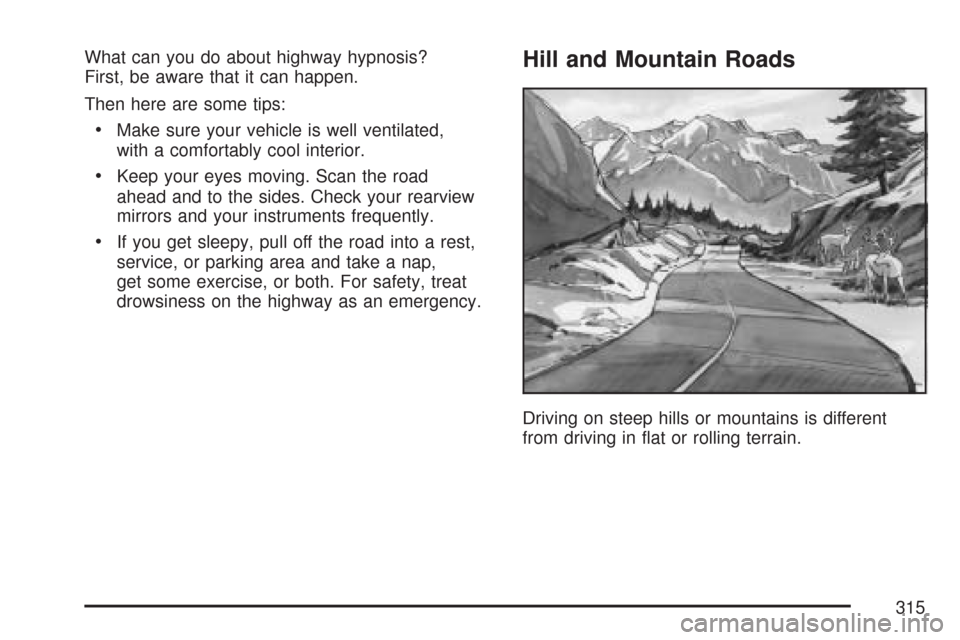
Driving on steep hills or mountains is different
from driving in at or rolling terrain.
315
Page 330 of 510
Towing
Towing Your Vehicle
Consult your dealer or a professional towing
service if you need to have your disabled vehicle
towed. SeeRoadside Assistance Program
on page 481.
If you want to tow your vehicle behind another
vehicle for recreational purposes (such as
behind a motorhome), see “Recreational
Vehicle Towing” following.
Recreational Vehicle Towing
Recreational vehicle towing means towing your
vehicle behind another vehicle — such as behind
a motorhome. The two most common types
of recreational vehicle towing are known as
“dinghy towing” (towing your vehicle with all
four wheels on the ground) and “dolly towing”
(towing your vehicle with two wheels on the
ground and two wheels up on a device known
as a “dolly”).With the proper preparation and equipment,
many vehicle can be towed in these ways. See
“Dinghy Towing” and “Dolly Towing”, following.
Here are some important things to consider before
you do recreational vehicle towing:
What’s the towing capacity of the towing
vehicle? Be sure you read the tow vehicle
manufacturer’s recommendations.
How far will you tow? Some vehicles have
restrictions on how far and how long they
can tow.
Do you have the proper towing equipment?
See your dealer/retailer or trailering
professional for additional advice and
equipment recommendations.
Is your vehicle ready to be towed? Just as
you would prepare your vehicle for a long
trip, you’ll want to make sure your vehicle is
prepared to be towed. SeeBefore Leaving
on a Long Trip on page 313.
330
Page 340 of 510
When You Are Ready to Leave After
Parking on a Hill
1. Apply your regular brakes and hold the
pedal down while you:
start your engine,
shift into a gear, and
release the parking brake.
2. Let up on the brake pedal.
3. Drive slowly until the trailer is clear
of the chocks.
4. Stop and have someone pick up and
store the chocks.
Maintenance When Trailer Towing
Your vehicle will need service more often when
you’re pulling a trailer. Things that are especially
important in trailer operation are automatic
transmission uid (don’t overll), engine oil,
drive belt, cooling system and brake system.
Each of these is covered in this manual, and
the Index will help you nd them quickly.
If you’re trailering, it’s a good idea to review
this information before you start your trip.
Check periodically to see that all hitch nuts
and bolts are tight.
Engine Cooling When Trailer Towing
Your cooling system may temporarily overheat
during severe operating conditions. See
Engine Overheating on page 371.
340
Page 341 of 510
Service........................................................ 344
Accessories and Modications................... 344
California Proposition 65 Warning.............. 345
Doing Your Own Service Work.................. 345
Adding Equipment to the Outside of
Your Vehicle.......................................... 346
Fuel............................................................. 346
Gasoline Octane........................................ 346
Gasoline Specications.............................. 347
California Fuel........................................... 347
Additives................................................... 347
Fuels in Foreign Countries........................ 348
Filling the Tank......................................... 349
Filling a Portable Fuel Container............... 351
Checking Things Under the Hood.............. 352
Hood Release........................................... 352
Engine Compartment Overview.................. 354
Engine Oil................................................. 359
Engine Oil Life System.............................. 362
Engine Air Cleaner/Filter............................ 364
Automatic Transaxle Fluid
(2.2L L4 and 3.5L V6 Engines).............. 365Automatic Transaxle Fluid
(3.9L V6 Engine).................................... 366
Engine Coolant.......................................... 368
Coolant Surge Tank Pressure Cap............ 371
Engine Overheating................................... 371
Overheated Engine Protection Operating
Mode (3.5L V6 and 3.9L V6 Engines).... 373
Cooling System......................................... 374
Power Steering Fluid................................. 379
Windshield Washer Fluid........................... 380
Brakes...................................................... 381
Battery...................................................... 384
Jump Starting............................................ 385
Bulb Replacement....................................... 389
Halogen Bulbs........................................... 389
Headlamps, Front Turn Signal, and
Parking Lamps....................................... 390
Taillamps, Turn Signal, Stoplamps
and Back-up Lamps............................... 392
License Plate Lamp................................... 393
Replacement Bulbs................................... 394
Windshield Wiper Blade Replacement....... 394
Section 5 Service and Appearance Care
341
Page 342 of 510
Tires............................................................ 397
Winter Tires.............................................. 398
Tire Sidewall Labeling............................... 399
Tire Terminology and Denitions............... 403
Ination - Tire Pressure............................. 406
High-Speed Operation............................... 407
Tire Inspection and Rotation...................... 408
When It Is Time for New Tires.................. 409
Buying New Tires...................................... 410
Different Size Tires and Wheels................ 412
Uniform Tire Quality Grading..................... 412
Wheel Alignment and Tire Balance............ 414
Wheel Replacement.................................. 414
Tire Chains............................................... 416
If a Tire Goes Flat.................................... 417
Changing a Flat Tire................................. 418
Removing the Spare Tire and Tools.......... 419
Removing the Flat Tire and Installing
the Spare Tire....................................... 422
Storing a Flat or Spare Tire and Tools
(Sedan).................................................. 428
Storing a Flat or Spare Tire and Tools
(Sedan SS)............................................ 430Storing a Flat or Spare Tire and Tools
(All MAXX Models)................................. 432
Compact Spare Tire.................................. 434
Appearance Care........................................ 435
Cleaning the Inside of Your Vehicle.......... 435
Fabric/Carpet............................................. 436
Leather...................................................... 437
Ultra Lux Suede........................................ 438
Instrument Panel, Vinyl, and Other
Plastic Surfaces..................................... 438
Care of Safety Belts.................................. 439
Weatherstrips............................................ 439
Washing Your Vehicle............................... 439
Cleaning Exterior Lamps/Lenses................ 440
Finish Care............................................... 440
Windshield and Wiper Blades.................... 440
Aluminum Wheels...................................... 441
Tires......................................................... 441
Sheet Metal Damage................................. 442
Finish Damage.......................................... 442
Underbody Maintenance............................ 442
Chemical Paint Spotting............................ 442
Section 5 Service and Appearance Care
342