Page 222 of 510
DIC Warnings and Messages
These messages appear if there is a problem
detected in one of your vehicle’s systems.
A message will clear when that condition is no
longer present on the vehicle. To acknowledge a
message and clear it from the display, press
any of the three DIC buttons. If the condition is
still present, the warning message will come back
on the next time the vehicle is turned off and
back on. With most messages, a warning chime
sounds when the message displays. Your
vehicle may have other warning messages.
AUTO (Automatic) LIGHTS OFF:This message
displays if the automatic headlamp system is
disabled with the headlamp switch.
AUTO (Automatic) LIGHTS ON:This message
displays if the automatic headlamp system is
enabled with the headlamp switch.BRAKE FLUID:This message displays to
inform the driver that the brake uid level is low
while the ignition is in ON. The brake system
warning light on the instrument panel cluster
also comes on. SeeBrake System Warning Light
on page 206for more information. Have the
brake system serviced by your dealer/retailer
as soon as possible.
CHANGE OIL SOON:This message displays
when the life of the engine oil has expired and it
should be changed.
When you acknowledge the CHANGE OIL SOON
message by clearing it from the display, you still
must reset the engine oil life system separately.
SeeEngine Oil Life System on page 362,Engine
Oil on page 359, andScheduled Maintenance
on page 460for more information.
222
Page 225 of 510

DIC Vehicle Personalization
The following personalization options may appear
on your vehicle’s audio display by pressing the
MENU button:
OIL LIFE RESET:When this option is displayed,
you can reset the engine oil life system.
To reset the system, seeEngine Oil Life
System on page 362.
UNITS:When UNITS appears on the display,
press the enter button to move between METRIC
or ENGLISH. When you have made your choice,
press the MENU button to record your selection.
The initial setting from the factory is English for
the United States and metric for Canada.
If you choose English, all information will be
displayed in English units.
If you choose metric, all information will be
displayed in metric units.The unit measurement will also change the trip
odometer, temperature, and average fuel
economy displays.
REMOTE START:If your vehicle has this
feature, the remote start option can be enabled
or disabled. When REMOTE START appears
on the display, press the enter button to move
between OFF and ON. When you have made
your choice, press the MENU button to record
your selection. The initial setting from the
factory is ON.
LOCK HORN:If your vehicle has Remote
Keyless Entry (RKE), this option which allows
the vehicle’s horn to chirp every time the
lock button on the RKE transmitter is pressed,
can be enabled or disabled. When LOCK HORN
appears on the display, press the enter button
to move between ON and OFF. When you have
made your choice, press the MENU button to
record your selection. The initial setting from
the factory is OFF.
225
Page 305 of 510
A cornering skid and an acceleration skid are best
handled by easing your foot off the accelerator
pedal.
If your vehicle starts to slide, ease your foot off
the accelerator pedal and quickly steer the way
you want the vehicle to go. If you start steering
quickly enough, your vehicle may straighten out.
Always be ready for a second skid if it occurs.
Of course, traction is reduced when water, snow,
ice, gravel, or other material is on the road.
For safety, you will want to slow down and adjust
your driving to these conditions. It is important
to slow down on slippery surfaces because
stopping distance will be longer and vehicle
control more limited.
While driving on a surface with reduced traction,
try your best to avoid sudden steering, acceleration,
or braking, including reducing vehicle speed by
shifting to a lower gear. Any sudden changes could
cause the tires to slide. You may not realize the
surface is slippery until your vehicle is skidding.
Learn to recognize warning clues — such as
enough water, ice, or packed snow on the road to
make a mirrored surface — and slow down when
you have any doubt.If you have the Anti-Lock Brake System (ABS),
remember: It helps avoid only the braking skid.
If you do not have ABS, then in a braking
skid, where the wheels are no longer rolling,
release enough pressure on the brakes to get
the wheels rolling again. This restores steering
control. Push the brake pedal down steadily
when you have to stop suddenly. As long as the
wheels are rolling, you will have steering control.
Competitive Driving
See your warranty book before using your vehicle
for competitive driving. After reviewing your
warranty book, please see the GM Performance
Parts website or catalog for parts and equipment
required for competitive driving.
Notice:If you use your vehicle for competitive
driving, the engine may use more oil than it
would with normal use. Low oil levels can
damage the engine. Be sure to check the oil
level often during competitive driving and
keep the level at or near the upper mark that
shows the proper operating range on the
engine oil dipstick. For information on how
to add oil, seeEngine Oil on page 359.
305
Page 314 of 510
Here are some things you can check before a trip:
Windshield Washer Fluid:Is the reservoir
full? Are all windows clean inside and outside?
Wiper Blades:Are they in good shape?
Fuel, Engine Oil, Other Fluids:Have you
checked all levels?
Lamps:Are they all working? Are the
lenses clean?
Tires:They are vitally important to a safe,
trouble-free trip. Is the tread good enough
for long-distance driving? Are the tires
all inated to the recommended pressure?
Weather Forecasts:What is the weather
outlook along your route? Should you
delay your trip a short time to avoid a major
storm system?
Maps:Do you have up-to-date maps?
Highway Hypnosis
Is there actually such a condition as highway
hypnosis? Or is it just plain falling asleep
at the wheel? Call it highway hypnosis, lack of
awareness, or whatever.
There is something about an easy stretch of
road with the same scenery, along with the
hum of the tires on the road, the drone of the
engine, and the rush of the wind against the
vehicle that can make you sleepy. Do not let it
happen to you! If it does, your vehicle can leave
the road in less than a second, and you could
crash and be injured.
314
Page 340 of 510
When You Are Ready to Leave After
Parking on a Hill
1. Apply your regular brakes and hold the
pedal down while you:
start your engine,
shift into a gear, and
release the parking brake.
2. Let up on the brake pedal.
3. Drive slowly until the trailer is clear
of the chocks.
4. Stop and have someone pick up and
store the chocks.
Maintenance When Trailer Towing
Your vehicle will need service more often when
you’re pulling a trailer. Things that are especially
important in trailer operation are automatic
transmission uid (don’t overll), engine oil,
drive belt, cooling system and brake system.
Each of these is covered in this manual, and
the Index will help you nd them quickly.
If you’re trailering, it’s a good idea to review
this information before you start your trip.
Check periodically to see that all hitch nuts
and bolts are tight.
Engine Cooling When Trailer Towing
Your cooling system may temporarily overheat
during severe operating conditions. See
Engine Overheating on page 371.
340
Page 341 of 510
Service........................................................ 344
Accessories and Modications................... 344
California Proposition 65 Warning.............. 345
Doing Your Own Service Work.................. 345
Adding Equipment to the Outside of
Your Vehicle.......................................... 346
Fuel............................................................. 346
Gasoline Octane........................................ 346
Gasoline Specications.............................. 347
California Fuel........................................... 347
Additives................................................... 347
Fuels in Foreign Countries........................ 348
Filling the Tank......................................... 349
Filling a Portable Fuel Container............... 351
Checking Things Under the Hood.............. 352
Hood Release........................................... 352
Engine Compartment Overview.................. 354
Engine Oil................................................. 359
Engine Oil Life System.............................. 362
Engine Air Cleaner/Filter............................ 364
Automatic Transaxle Fluid
(2.2L L4 and 3.5L V6 Engines).............. 365Automatic Transaxle Fluid
(3.9L V6 Engine).................................... 366
Engine Coolant.......................................... 368
Coolant Surge Tank Pressure Cap............ 371
Engine Overheating................................... 371
Overheated Engine Protection Operating
Mode (3.5L V6 and 3.9L V6 Engines).... 373
Cooling System......................................... 374
Power Steering Fluid................................. 379
Windshield Washer Fluid........................... 380
Brakes...................................................... 381
Battery...................................................... 384
Jump Starting............................................ 385
Bulb Replacement....................................... 389
Halogen Bulbs........................................... 389
Headlamps, Front Turn Signal, and
Parking Lamps....................................... 390
Taillamps, Turn Signal, Stoplamps
and Back-up Lamps............................... 392
License Plate Lamp................................... 393
Replacement Bulbs................................... 394
Windshield Wiper Blade Replacement....... 394
Section 5 Service and Appearance Care
341
Page 352 of 510
Checking Things Under
the Hood
{CAUTION:
An electric fan under the hood can start up
and injure you even when the engine is not
running. Keep hands, clothing, and tools
away from any underhood electric fan.
{CAUTION:
Things that burn can get on hot engine
parts and start a re. These include
liquids like fuel, oil, coolant, brake uid,
windshield washer and other uids, and
plastic or rubber. You or others could be
burned. Be careful not to drop or spill
things that will burn onto a hot engine.
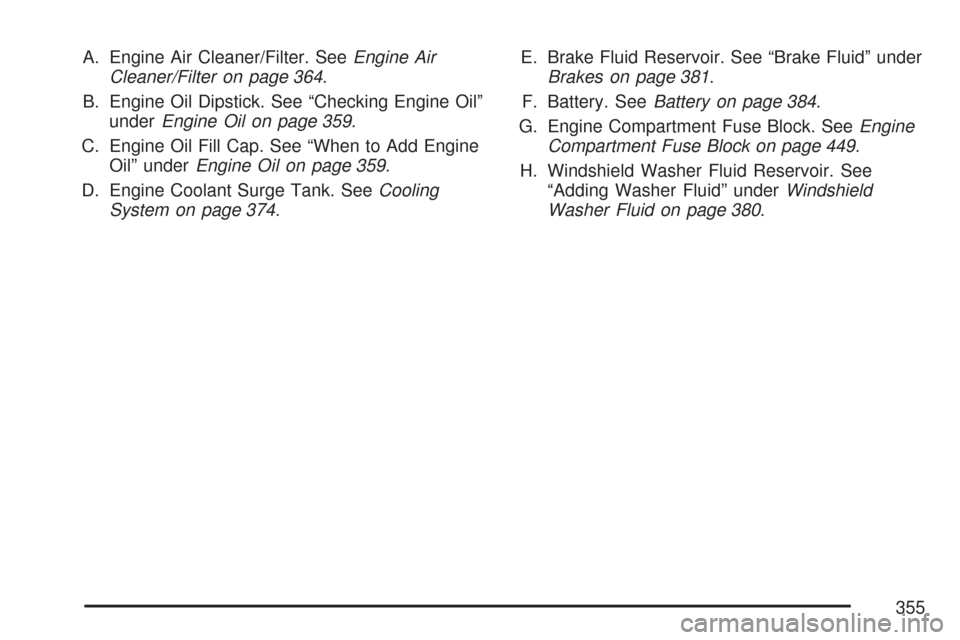
Hood Release
To open the hood, do the following:
1. Pull the hood
release handle with
this symbol on it.
It is located
inside the vehicle to
the left of the
steering column.
352
Page 355 of 510
A. Engine Air Cleaner/Filter. SeeEngine Air
Cleaner/Filter on page 364.
B. Engine Oil Dipstick. See “Checking Engine Oil”
underEngine Oil on page 359.
C. Engine Oil Fill Cap. See “When to Add Engine
Oil” underEngine Oil on page 359.
D. Engine Coolant Surge Tank. SeeCooling
System on page 374.E. Brake Fluid Reservoir. See “Brake Fluid” under
Brakes on page 381.
F. Battery. SeeBattery on page 384.
G. Engine Compartment Fuse Block. SeeEngine
Compartment Fuse Block on page 449.
H. Windshield Washer Fluid Reservoir. See
“Adding Washer Fluid” underWindshield
Washer Fluid on page 380.
355