Page 362 of 460

Your vehicle has also been equipped with a TPMS
malfunction indicator to indicate when the system is
not operating properly. The TPMS malfunction
indicator is combined with the low tire pressure
telltale. When the system detects a malfunction,
the telltale will ash for approximately one minute
and then remain continuously illuminated. This
sequence will continue upon subsequent vehicle
start-ups as long as the malfunction exists.
When the malfunction indicator is illuminated, the
system may not be able to detect or signal low
tire pressure as intended. TPMS malfunctions may
occur for a variety of reasons, including the
installation of replacement or alternate tires or
wheels on the vehicle that prevent the TPMS from
functioning properly. Always check the TPMS
malfunction telltale after replacing one or more
tires or wheels on your vehicle to ensure that the
replacement or alternate tires and wheels allow
the TPMS to continue to function properly.
A Tire and Loading Information label, attached to
your vehicle, shows the size of your vehicle’s
original equipment tires and the correct ination
pressure for your vehicle’s tires when theyare cold. SeeLoading Your Vehicle on page 277,
for an example of the Tire and Loading
Information label and its location on your vehicle.
Also seeInation - Tire Pressure on page 359.
Your vehicle’s TPMS system can warn you about
a low tire pressure condition but it does not
replace normal tire maintenance. SeeTire
Inspection and Rotation on page 364andTires on
page 351.
Notice:Do not use a tire sealant if your vehicle
has Tire Pressure Monitors. The liquid sealant
can damage the tire pressure monitor sensors.
The TPMS will not function properly if one or more
of the TPMS sensors are missing or inoperable.
If the system detects a missing or inoperable
sensor, an error message SERVICE TIRE
MONITOR SYSTEM will be shown on the DIC
display. If you have replaced a tire/wheel assembly
without transferring the TPMS sensors, the error
message will be displayed. Once you re-install the
TPMS sensors, the error message should go
off. See your GM dealer for service if all TPMS
sensors are installed and the error message
comes on and stays on.
362
Page 366 of 460
When It Is Time for New Tires
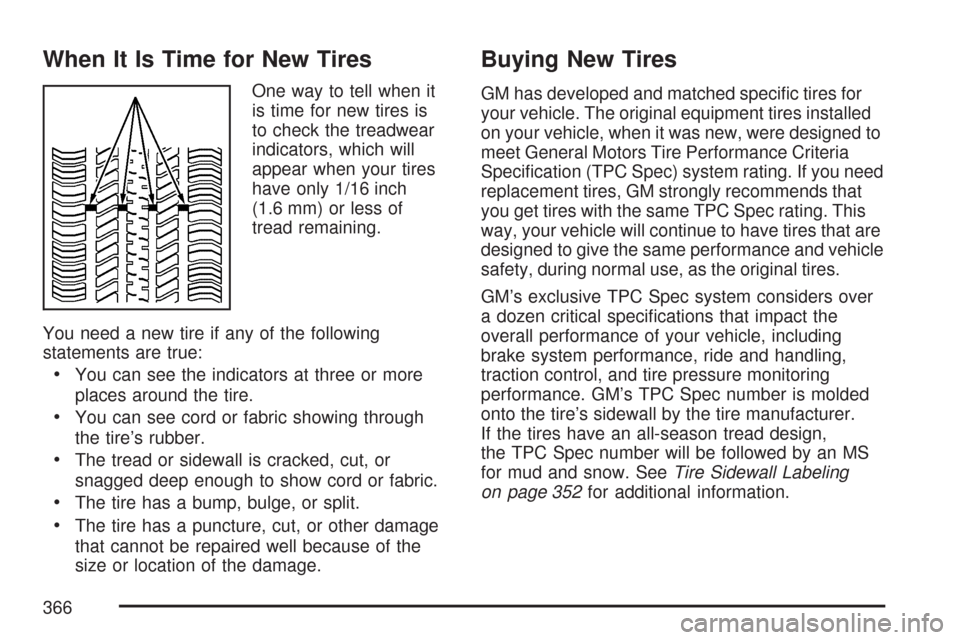
One way to tell when it
is time for new tires is
to check the treadwear
indicators, which will
appear when your tires
have only 1/16 inch
(1.6 mm) or less of
tread remaining.
You need a new tire if any of the following
statements are true:
You can see the indicators at three or more
places around the tire.
You can see cord or fabric showing through
the tire’s rubber.
The tread or sidewall is cracked, cut, or
snagged deep enough to show cord or fabric.
The tire has a bump, bulge, or split.
The tire has a puncture, cut, or other damage
that cannot be repaired well because of the
size or location of the damage.
Buying New Tires
GM has developed and matched specic tires for
your vehicle. The original equipment tires installed
on your vehicle, when it was new, were designed to
meet General Motors Tire Performance Criteria
Specication (TPC Spec) system rating. If you need
replacement tires, GM strongly recommends that
you get tires with the same TPC Spec rating. This
way, your vehicle will continue to have tires that are
designed to give the same performance and vehicle
safety, during normal use, as the original tires.
GM’s exclusive TPC Spec system considers over
a dozen critical specications that impact the
overall performance of your vehicle, including
brake system performance, ride and handling,
traction control, and tire pressure monitoring
performance. GM’s TPC Spec number is molded
onto the tire’s sidewall by the tire manufacturer.
If the tires have an all-season tread design,
the TPC Spec number will be followed by an MS
for mud and snow. SeeTire Sidewall Labeling
on page 352for additional information.
366
Page 367 of 460
{CAUTION:
Mixing tires could cause you to lose
control while driving. If you mix tires of
different sizes, brands, or types (radial
and bias-belted tires), the vehicle may not
handle properly, and you could have a
crash. Using tires of different sizes,
brands, or types may also cause damage
to your vehicle. Be sure to use the correct
size, brand, and type of tires on all
wheels. It is all right to drive with your
compact spare temporarily, as it was
developed for use on your vehicle.
SeeCompact Spare Tire on page 385.
{CAUTION:
If you use bias-ply tires on your vehicle,
the wheel rim anges could develop
cracks after many miles of driving. A tire
and/or wheel could fail suddenly, causing
a crash. Use only radial-ply tires with the
wheels on your vehicle.
If you must replace your vehicle’s tires with those
that do not have a TPC Spec number, make
sure they are the same size, load range, speed
rating, and construction type (radial and
bias-belted tires) as your vehicle’s original tires.
367
Page 368 of 460
Vehicles that have a tire pressure monitoring
system may give an inaccurate low-pressure
warning if non-TPC Spec rated tires are installed
on your vehicle. Non-TPC Spec rated tires
may give a low-pressure warning that is higher or
lower than the proper warning level you would
get with TPC Spec rated tires. SeeTire Pressure
Monitor System on page 360.
Your vehicle’s original equipment tires are listed
on the Tire and Loading Information Label.
This label is attached to the vehicle’s center pillar
(B-pillar). SeeLoading Your Vehicle on page 277,
for more information about the Tire and Loading
Information Label and its location on your vehicle.
Different Size Tires and Wheels
If you add wheels or tires that are a different size
than your original equipment wheels and tires, this
may affect the way your vehicle performs, including
its braking, ride and handling characteristics,
stability, and resistance to rollover. Additionally,
if your vehicle has electronic systems such as,
anti-lock brakes, traction control, and electronic
stability control, the performance of these systems
can be affected.
{CAUTION:
If you add different sized wheels, your
vehicle may not provide an acceptable
level of performance and safety if tires
not recommended for those wheels are
selected. You may increase the chance
that you will crash and suffer serious
injury. Only use GM specic wheel and
tire systems developed for your vehicle,
and have them properly installed by a GM
certied technician.
SeeBuying New Tires on page 366and
Accessories and Modications on page 296for
additional information.
368
Page 372 of 460
Used Replacement Wheels
{CAUTION:
Putting a used wheel on your vehicle is
dangerous. You cannot know how it has
been used or how far it has been driven.
It could fail suddenly and cause a crash.
If you have to replace a wheel, use a new
GM original equipment wheel.
Tire Chains
{CAUTION:
If your vehicle has P225/55R17 or
P235/50R18 size tires, do not use tire
chains, there is not enough clearance.
CAUTION: (Continued)
CAUTION: (Continued)
Tire chains used on a vehicle without the
proper amount of clearance can cause
damage to the brakes, suspension, or
other vehicle parts. The area damaged by
the tire chains could cause you to lose
control of your vehicle and you or others
may be injured in a crash.
Use another type of traction device only if
its manufacturer recommends it for use
on your vehicle and tire size combination
and road conditions. Follow that
manufacturer’s instructions. To help
avoid damage to your vehicle, drive slowly,
readjust, or remove the device if it is
contacting your vehicle, and do not
spin your wheels.
If you do nd traction devices that will t,
install them on the front tires.
372
Page 373 of 460
Notice:If your vehicle has a tire size other
than P225/55R17 or P235/50R18 size tires, use
tire chains only where legal and only when
you must. Use only SAE Class S-type chains
that are the proper size for your tires. Install
them on the front tires and tighten them
as tightly as possible with the ends securely
fastened. Drive slowly and follow the chain
manufacturer’s instructions. If you can hear
the chains contacting your vehicle, stop
and retighten them. If the contact continues,
slow down until it stops. Driving too fast
or spinning the wheels with chains on will
damage your vehicle.
If a Tire Goes Flat
It is unusual for a tire to blowout while you are
driving, especially if you maintain your vehicle’s
tires properly. If air goes out of a tire, it is much
more likely to leak out slowly. But if you should ever
have a blowout, here are a few tips about what to
expect and what to do:
If a front tire fails, the at tire will create a drag that
pulls the vehicle toward that side. Take your foot off
the accelerator pedal and grip the steering wheel
rmly. Steer to maintain lane position, and then
gently brake to a stop well out of the traffic lane.A rear blowout, particularly on a curve, acts much
like a skid and may require the same correction
you would use in a skid. In any rear blowout
remove your foot from the accelerator pedal.
Get the vehicle under control by steering the
way you want the vehicle to go. It may be very
bumpy and noisy, but you can still steer. Gently
brake to a stop, well off the road if possible.
{CAUTION:
Lifting a vehicle and getting under it to do
maintenance or repairs is dangerous
without the appropriate safety equipment
and training. The jack provided with your
vehicle is designed only for changing a
at tire. If it is used for anything else, you
or others could be badly injured or killed
if the vehicle slips off the jack. Use the
jack provided with your vehicle only for
changing a at tire.
If a tire goes at, the next part shows how to use the
jacking equipment to change a at tire safely.
373
Page 383 of 460
Storing a Flat or Spare Tire
and Tools
{CAUTION:
Storing a jack, a tire, or other equipment
in the passenger compartment of the
vehicle could cause injury. In a sudden
stop or collision, loose equipment could
strike someone. Store all these in the
proper place.
After the compact spare tire has been installed on
the vehicle, store the at tire in the trunk.When storing a full-size tire, use the extension
with the protector, located in the foam holder,
to help avoid wheel surface damage.
To store a full-size tire:
1. Install the tools in their original location in the
trunk area and secure.
2. Place the tire valve stem facing down and
the protector/guide placed through a wheel
bolt hole.
3. Remove the protector and attach the retainer
securely.
4. Store the cover as far forward as possible.
When storing a compact spare tire in the trunk, put
the protector back in the foam holder.
383
Page 384 of 460
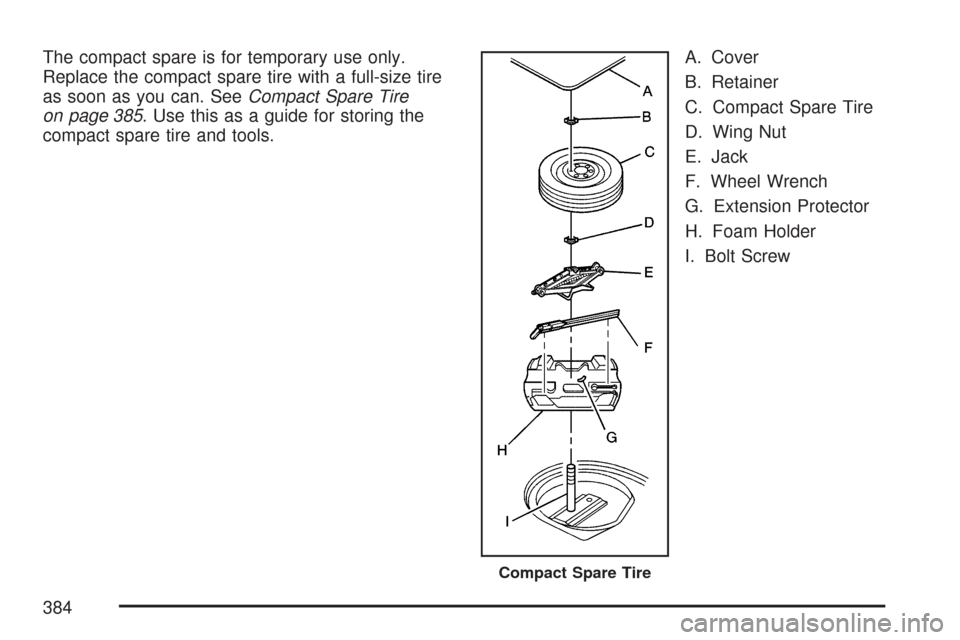
The compact spare is for temporary use only.
Replace the compact spare tire with a full-size tire
as soon as you can. SeeCompact Spare Tire
on page 385. Use this as a guide for storing the
compact spare tire and tools.A. Cover
B. Retainer
C. Compact Spare Tire
D. Wing Nut
E. Jack
F. Wheel Wrench
G. Extension Protector
H. Foam Holder
I. Bolt Screw
Compact Spare Tire
384