Page 74 of 446
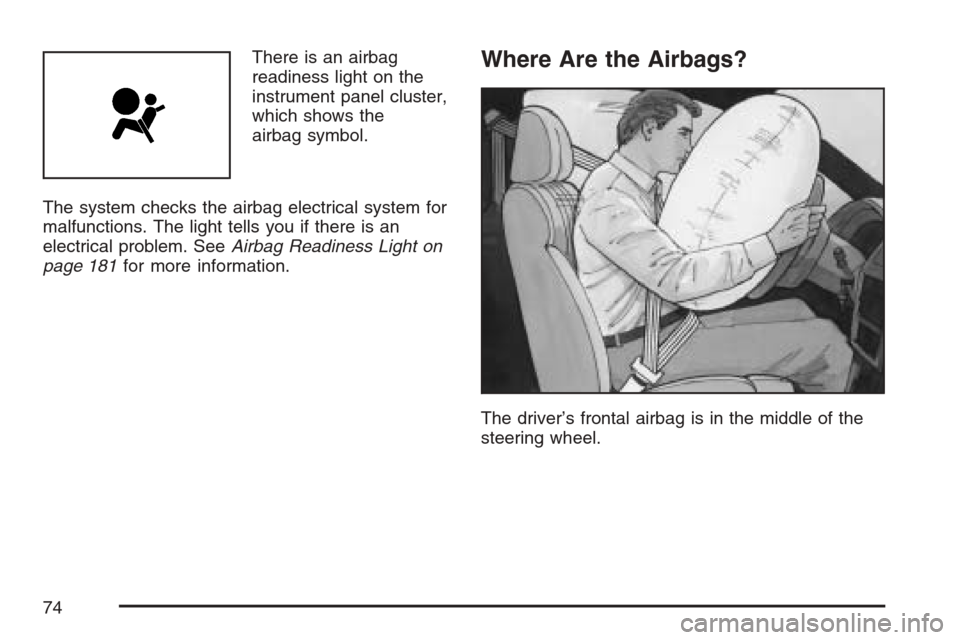
There is an airbag
readiness light on the
instrument panel cluster,
which shows the
airbag symbol.
The system checks the airbag electrical system for
malfunctions. The light tells you if there is an
electrical problem. SeeAirbag Readiness Light on
page 181for more information.Where Are the Airbags?
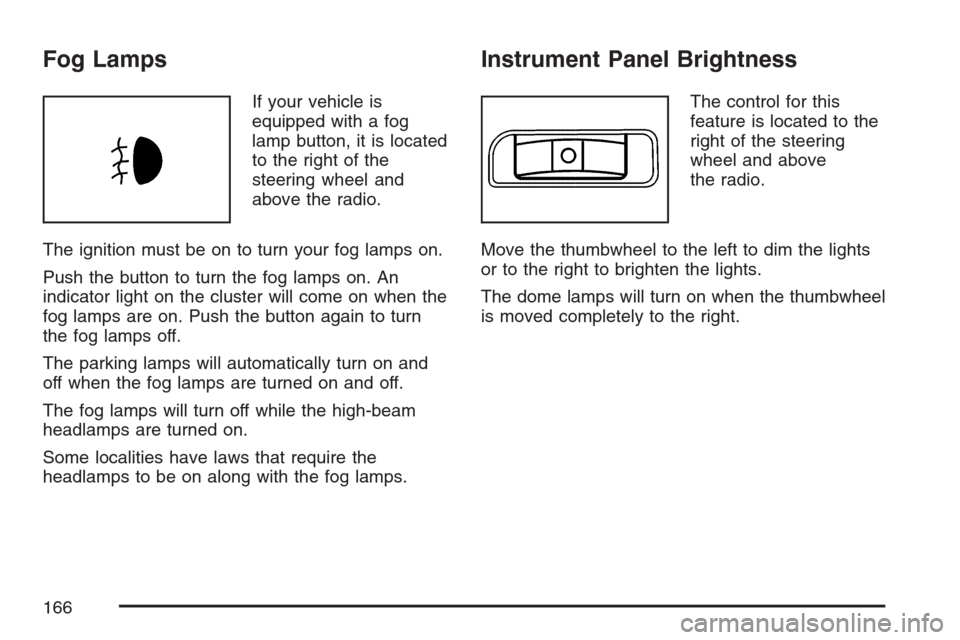
The driver’s frontal airbag is in the middle of the
steering wheel.
74
Page 87 of 446
{CAUTION:
If the airbag readiness light in the
instrument panel cluster ever comes on
and stays on, it means that something
may be wrong with the airbag system. If
this ever happens, have the vehicle
serviced promptly, because an adult-size
person sitting in the right front
passenger’s seat may not have the
protection of the frontal airbag. See
Airbag Readiness Light on page 181for
more on this, including important safety
information.Aftermarket equipment, such as seat covers, can
affect how well the passenger sensing system
operates. You may want to consider not using seat
covers or other aftermarket equipment if your
vehicle has the passenger sensing system. See
Adding Equipment to Your Airbag-Equipped
Vehicle on page 89for more information about
modications that can affect how the system
operates.
{CAUTION:
Stowing of articles under the passenger’s
seat or between the passenger’s seat
cushion and seatback may interfere with
the proper operation of the passenger
sensing system.
87
Page 149 of 446
Instrument Panel Overview........................ 152
Hazard Warning Flashers.......................... 154
Other Warning Devices............................. 154
Horn.......................................................... 154
Tilt Wheel.................................................. 155
Turn Signal/Multifunction Lever.................. 155
Turn and Lane-Change Signals................. 156
Headlamp High/Low-Beam Changer.......... 156
Flash-to-Pass............................................ 156
Windshield Wipers..................................... 157
Windshield Washer.................................... 158
Rear Window Wiper/Washer...................... 159
Cruise Control........................................... 160
Headlamps................................................ 163
Wiper Activated Headlamps....................... 164
Headlamps on Reminder........................... 164
Daytime Running Lamps (DRL)................. 164
Automatic Headlamp System..................... 165
Fog Lamps................................................ 166
Instrument Panel Brightness...................... 166
Dome Lamp.............................................. 167Entry/Exit Lighting...................................... 167
Mirror Reading Lamps............................... 168
Rear Reading Lamps................................ 168
Electric Power Management...................... 168
Battery Run-Down Protection..................... 168
Accessory Power Outlet(s)........................ 169
Ashtray(s) and Cigarette Lighter................ 170
Climate Controls......................................... 170
Climate Control System............................. 170
Outlet Adjustment...................................... 174
Passenger Compartment Air Filter............. 175
Warning Lights, Gages, and Indicators..... 177
Instrument Panel Cluster........................... 178
Speedometer and Odometer...................... 179
Tachometer............................................... 179
Safety Belt Reminder Light........................ 180
Passenger Safety Belt Reminder Light....... 180
Airbag Readiness Light............................. 181
Passenger Airbag Status Indicator............. 182
Charging System Light.............................. 184
Section 3 Instrument Panel
149
Page 153 of 446
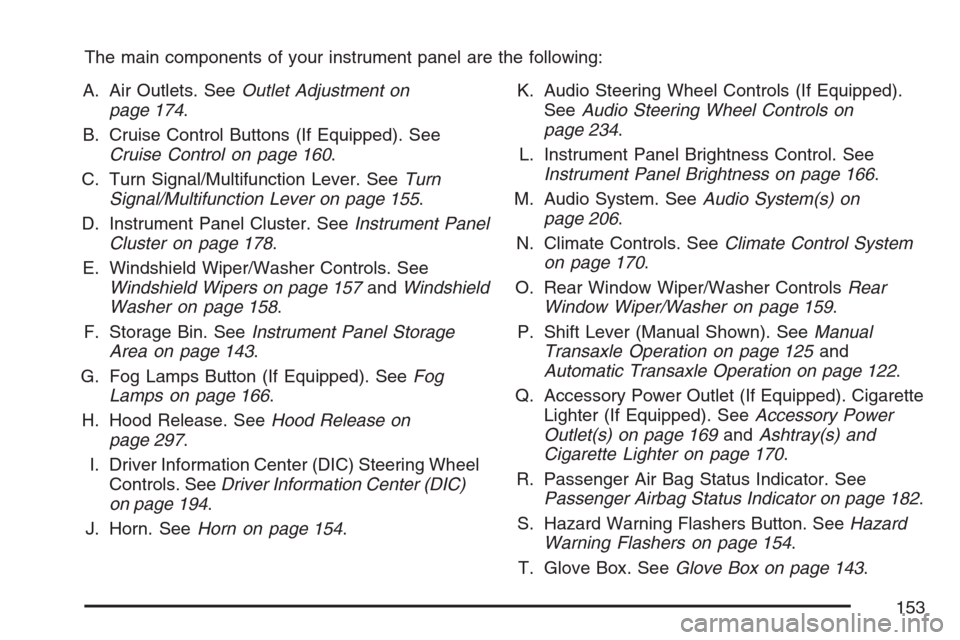
The main components of your instrument panel are the following:
A. Air Outlets. SeeOutlet Adjustment on
page 174.
B. Cruise Control Buttons (If Equipped). See
Cruise Control on page 160.
C. Turn Signal/Multifunction Lever. SeeTurn
Signal/Multifunction Lever on page 155.
D. Instrument Panel Cluster. SeeInstrument Panel
Cluster on page 178.
E. Windshield Wiper/Washer Controls. See
Windshield Wipers on page 157andWindshield
Washer on page 158.
F. Storage Bin. SeeInstrument Panel Storage
Area on page 143.
G. Fog Lamps Button (If Equipped). SeeFog
Lamps on page 166.
H. Hood Release. SeeHood Release on
page 297.
I. Driver Information Center (DIC) Steering Wheel
Controls. SeeDriver Information Center (DIC)
on page 194.
J. Horn. SeeHorn on page 154.K. Audio Steering Wheel Controls (If Equipped).
SeeAudio Steering Wheel Controls on
page 234.
L. Instrument Panel Brightness Control. See
Instrument Panel Brightness on page 166.
M. Audio System. SeeAudio System(s) on
page 206.
N. Climate Controls. SeeClimate Control System
on page 170.
O. Rear Window Wiper/Washer ControlsRear
Window Wiper/Washer on page 159.
P. Shift Lever (Manual Shown). SeeManual
Transaxle Operation on page 125and
Automatic Transaxle Operation on page 122.
Q. Accessory Power Outlet (If Equipped). Cigarette
Lighter (If Equipped). SeeAccessory Power
Outlet(s) on page 169andAshtray(s) and
Cigarette Lighter on page 170.
R. Passenger Air Bag Status Indicator. See
Passenger Airbag Status Indicator on page 182.
S. Hazard Warning Flashers Button. SeeHazard
Warning Flashers on page 154.
T. Glove Box. SeeGlove Box on page 143.
153
Page 156 of 446
Turn and Lane-Change Signals
The turn signal has two upward (for right) and
two downward (for left) positions. These positions
allow you to signal a turn or a lane change.
To signal a turn, move the lever all the way up or
down. When the turn is nished, the lever will
return automatically.
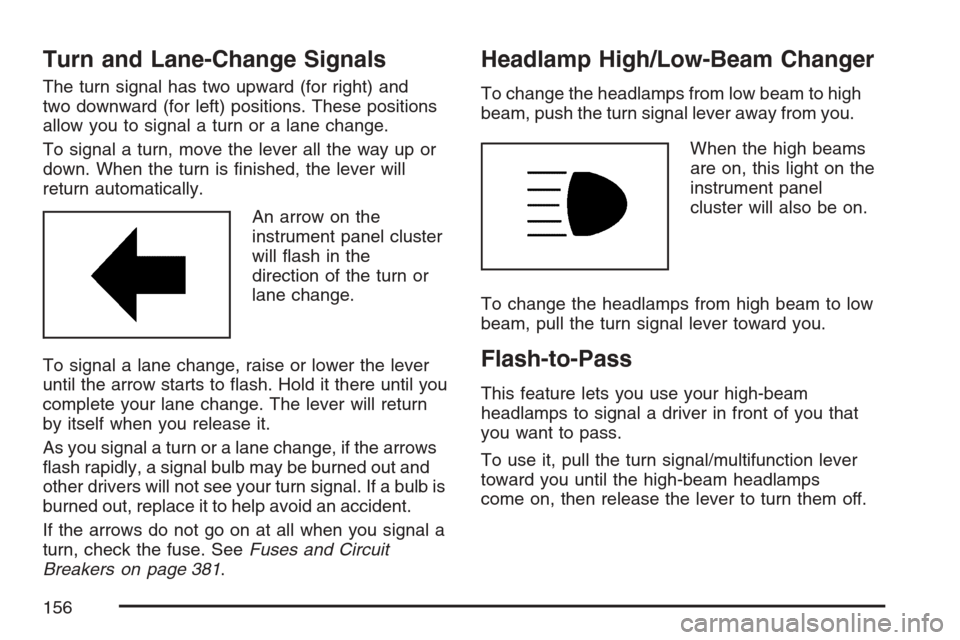
An arrow on the
instrument panel cluster
will ash in the
direction of the turn or
lane change.
To signal a lane change, raise or lower the lever
until the arrow starts to ash. Hold it there until you
complete your lane change. The lever will return
by itself when you release it.
As you signal a turn or a lane change, if the arrows
ash rapidly, a signal bulb may be burned out and
other drivers will not see your turn signal. If a bulb is
burned out, replace it to help avoid an accident.
If the arrows do not go on at all when you signal a
turn, check the fuse. SeeFuses and Circuit
Breakers on page 381.
Headlamp High/Low-Beam Changer
To change the headlamps from low beam to high
beam, push the turn signal lever away from you.
When the high beams
are on, this light on the
instrument panel
cluster will also be on.
To change the headlamps from high beam to low
beam, pull the turn signal lever toward you.
Flash-to-Pass
This feature lets you use your high-beam
headlamps to signal a driver in front of you that
you want to pass.
To use it, pull the turn signal/multifunction lever
toward you until the high-beam headlamps
come on, then release the lever to turn them off.
156
Page 165 of 446
Automatic Headlamp System
When it is dark enough outside, your automatic
system will turn on your headlamps at the normal
brightness along with other lamps such as the
taillamps, sidemarker, parking lamps, instrument
panel lights, and interior switch backlighting.
Your vehicle has a light sensor on top of the
instrument panel. Make sure it is not covered, or
the headlamps may remain on when you do
not need them.
The system may also be on when driving through
a parking garage, heavy overcast weather or a
tunnel. This is normal.
There is a delay in the transition between the
daytime and nighttime operation of the automatic
lamp control system so that driving under
bridges or bright overhead street lights does not
affect the system. The automatic lamp control
system will only be affected when the light sensor
sees a change in lighting lasting longer than
this delay.If you start your vehicle in a dark garage, the
automatic lamp system will come on immediately.
Once you leave the garage, it will take about
20 seconds for the automatic lamp system
to change to DRL if it is light outside. During that
delay, the instrument panel cluster may not be
as bright as usual. Make sure the instrument panel
brightness control is in the full bright position.
SeeInstrument Panel Brightness on page 166.
To idle your vehicle with the system off, turn
the ignition on and turn the exterior light switch to
the off/on position. For Canadian vehicles, the
transaxle must stay in PARK (P) for this function
or the parking brake must be set for vehicles
with manual transaxles.
As with any vehicle, you should turn on the
regular headlamps when you need them.
165
Page 166 of 446
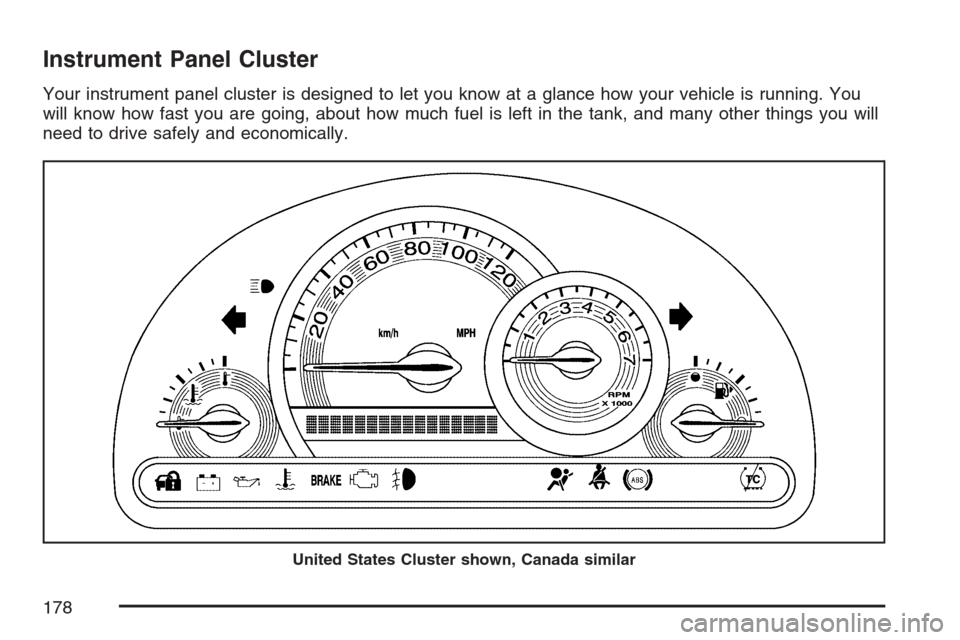
Fog Lamps
If your vehicle is
equipped with a fog
lamp button, it is located
to the right of the
steering wheel and
above the radio.
The ignition must be on to turn your fog lamps on.
Push the button to turn the fog lamps on. An
indicator light on the cluster will come on when the
fog lamps are on. Push the button again to turn
the fog lamps off.
The parking lamps will automatically turn on and
off when the fog lamps are turned on and off.
The fog lamps will turn off while the high-beam
headlamps are turned on.
Some localities have laws that require the
headlamps to be on along with the fog lamps.
Instrument Panel Brightness
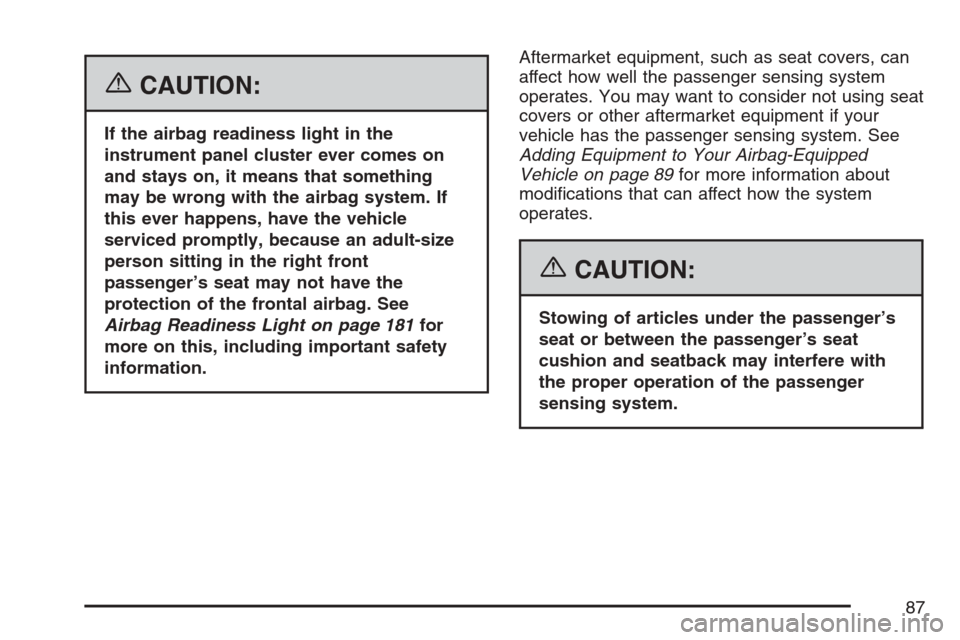
The control for this
feature is located to the
right of the steering
wheel and above
the radio.
Move the thumbwheel to the left to dim the lights
or to the right to brighten the lights.
The dome lamps will turn on when the thumbwheel
is moved completely to the right.
166
Page 178 of 446
Instrument Panel Cluster
Your instrument panel cluster is designed to let you know at a glance how your vehicle is running. You
will know how fast you are going, about how much fuel is left in the tank, and many other things you will
need to drive safely and economically.
United States Cluster shown, Canada similar
178