2007 CHEVROLET HHR parking brake
[x] Cancel search: parking brakePage 275 of 446
With the proper preparation and equipment, many
vehicles can be towed in these ways. See
“Dinghy Towing” and “Dolly Towing,” following.
Here are some important things to consider before
you do recreational vehicle towing:
What is the towing capacity of the towing
vehicle? Be sure you read the tow vehicle
manufacturer’s recommendations.
How far will you tow? Some vehicles have
restrictions on how far and how long they
can tow.
Do you have the proper towing equipment?
See your dealer or trailering professional
for additional advice and equipment
recommendations.
Is your vehicle ready to be towed? Just as
you would prepare your vehicle for a long
trip, you will want to make sure your vehicle is
prepared to be towed. SeeBefore Leaving
on a Long Trip on page 260.
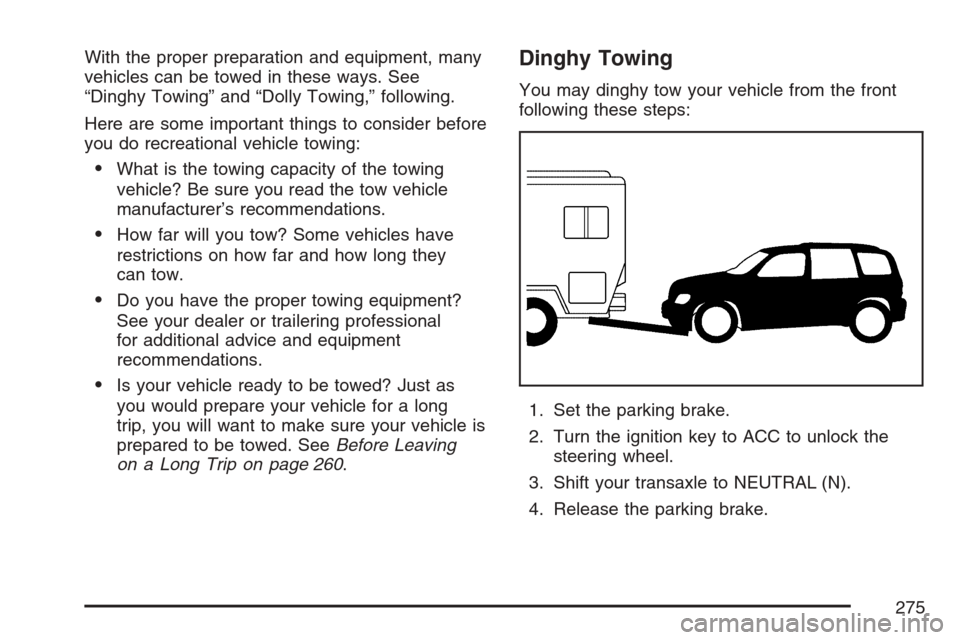
Dinghy Towing
You may dinghy tow your vehicle from the front
following these steps:
1. Set the parking brake.
2. Turn the ignition key to ACC to unlock the
steering wheel.
3. Shift your transaxle to NEUTRAL (N).
4. Release the parking brake.
275
Page 285 of 446
Reduce speed and shift to a lower gearbefore
you start down a long or steep downgrade. If you
do not shift down, you might have to use your
brakes so much that they would get hot and
no longer work well.
Pay attention to the engine coolant gage. If the
indicator is in the red area, turn off the air
conditioning to reduce engine load. SeeEngine
Overheating on page 309.
Parking on Hills
{CAUTION:
You really should not park your vehicle,
with a trailer attached, on a hill. If
something goes wrong, your rig could
start to move. People can be injured, and
both your vehicle and the trailer can be
damaged.But if you ever have to park your rig on a hill, here
is how to do it:
1. Apply your regular brakes, but do not shift into
PARK (P) for an automatic transaxle, or into
gear for a manual transaxle. When parking
uphill, turn your wheels away from the
curb. When parking downhill, turn your wheels
into the curb.
2. Have someone place chocks under the trailer
wheels.
3. When the wheel chocks are in place, release
the regular brakes until the chocks absorb
the load.
4. Reapply the regular brakes. Then apply your
parking brake, and then shift into PARK (P) for
an automatic transaxle or REVERSE (R) for a
manual transaxle.
5. Release the regular brakes.
285
Page 286 of 446
When You Are Ready to Leave After
Parking on a Hill
1. Apply your regular brakes and hold the pedal
down while you:
Start your engine.
Shift into a gear.
Release the parking brake.
2. Let up on the brake pedal.
3. Drive slowly until the trailer is clear of
the chocks.
4. Stop and have someone pick up and store
the chocks.
Maintenance When Trailer Towing
Your vehicle will need service more often when
you are pulling a trailer. SeeScheduled
Maintenance on page 393for more on this.
Things that are especially important in trailer
operation are automatic transaxle uid
(do not overll), engine oil, drive belt, cooling
system and brake system.
Each of these is covered in this manual, and the
Index will help you nd them quickly. If you
are trailering, it is a good idea to review this
information before you start your trip.
Check periodically to see that all hitch nuts and
bolts are tight.
Engine Cooling When Trailer Towing
Your cooling system may temporarily overheat
during severe operating conditions. SeeEngine
Overheating on page 309.
286
Page 287 of 446
Service........................................................ 289
Accessories and Modications................... 289
California Proposition 65 Warning.............. 290
Doing Your Own Service Work.................. 290
Adding Equipment to the Outside of
Your Vehicle.......................................... 291
Fuel............................................................. 291
Gasoline Octane........................................ 291
Gasoline Specications.............................. 292
California Fuel........................................... 292
Additives................................................... 292
Fuels in Foreign Countries........................ 293
Filling the Tank......................................... 294
Filling a Portable Fuel Container............... 296
Checking Things Under the Hood.............. 296
Hood Release........................................... 297
Engine Compartment Overview.................. 298
Engine Oil................................................. 299
Engine Oil Life System.............................. 302
Engine Air Cleaner/Filter............................ 304
Automatic Transaxle Fluid......................... 305
Manual Transaxle Fluid............................. 305
Hydraulic Clutch........................................ 306
Engine Coolant.......................................... 306Pressure Cap............................................ 309
Engine Overheating................................... 309
Cooling System......................................... 312
Windshield Washer Fluid........................... 316
Brakes...................................................... 317
Battery...................................................... 320
Jump Starting............................................ 320
Headlamp Aiming........................................ 327
Bulb Replacement....................................... 330
Halogen Bulbs........................................... 330
Headlamps, Front Turn Signal, and
Parking Lamps....................................... 330
Center High-Mounted Stoplamp (CHMSL) ... 331
Taillamps, Turn Signal, Stoplamps and
Back-up Lamps...................................... 332
License Plate Lamp................................... 334
Replacement Bulbs................................... 334
Windshield Wiper Blade Replacement....... 335
Tires............................................................ 336
Tire Sidewall Labeling............................... 337
Tire Terminology and Denitions............... 340
Ination - Tire Pressure............................. 344
Tire Inspection and Rotation...................... 345
Section 5 Service and Appearance Care
287
Page 321 of 446
{CAUTION:
Batteries can hurt you. They can be
dangerous because:
They contain acid that can burn you.
They contain gas that can explode or
ignite.
They contain enough electricity to
burn you.
If you do not follow these steps exactly,
some or all of these things can hurt you.
Notice:Ignoring these steps could result in
costly damage to your vehicle that would
not be covered by your warranty.
Trying to start your vehicle by pushing or
pulling it will not work, and it could damage
your vehicle.
1. Check the other vehicle. It must have a
12-volt battery with a negative ground system.Notice:If the other vehicle’s system is not a
12-volt system with a negative ground,
both vehicles can be damaged. Only use
vehicles with 12-volt systems with negative
grounds to jump start your vehicle.
2. Get the vehicles close enough so the jumper
cables can reach, but be sure the vehicles are
not touching each other. If they are, it could
cause a ground connection you do not
want. You would not be able to start your
vehicle, and the bad grounding could damage
the electrical systems.
To avoid the possibility of the vehicles rolling,
set the parking brake rmly on both vehicles
involved in the jump start procedure. Put
an automatic transaxle in PARK (P) or
a manual transaxle in NEUTRAL before setting
the parking brake.
321
Page 355 of 446
Changing a Flat Tire
If a tire goes at, avoid further tire and wheel
damage by driving slowly to a level place. Turn on
your hazard warning ashers.
{CAUTION:
Changing a tire can be dangerous. The
vehicle can slip off the jack and roll over or
fall on you or other people. You and they
could be badly injured or even killed.
Find a level place to change your tire.
CAUTION: (Continued)
CAUTION: (Continued)
To help prevent the vehicle from moving:
1. Set the parking brake rmly.
2. Put an automatic transaxle shift lever
in PARK (P), or shift a manual
transaxle to FIRST (1) or REVERSE (R).
3. Turn off the engine and do not restart
while the vehicle is raised.
4. Do not allow passengers to remain in
the vehicle.
To be even more certain the vehicle will not
move, you should put blocks at the front
and rear of the tire farthest away from the
one being changed. That would be the tire
on the other side, at the opposite end of the
vehicle.
355
Page 385 of 446
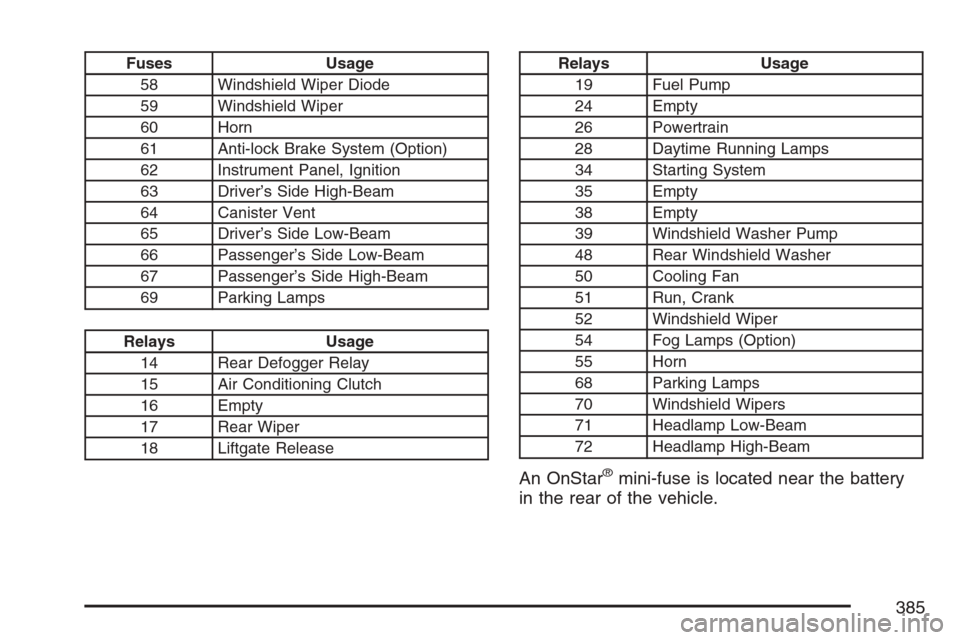
Fuses Usage
58 Windshield Wiper Diode
59 Windshield Wiper
60 Horn
61 Anti-lock Brake System (Option)
62 Instrument Panel, Ignition
63 Driver’s Side High-Beam
64 Canister Vent
65 Driver’s Side Low-Beam
66 Passenger’s Side Low-Beam
67 Passenger’s Side High-Beam
69 Parking Lamps
Relays Usage
14 Rear Defogger Relay
15 Air Conditioning Clutch
16 Empty
17 Rear Wiper
18 Liftgate Release
Relays Usage
19 Fuel Pump
24 Empty
26 Powertrain
28 Daytime Running Lamps
34 Starting System
35 Empty
38 Empty
39 Windshield Washer Pump
48 Rear Windshield Washer
50 Cooling Fan
51 Run, Crank
52 Windshield Wiper
54 Fog Lamps (Option)
55 Horn
68 Parking Lamps
70 Windshield Wipers
71 Headlamp Low-Beam
72 Headlamp High-Beam
An OnStar®mini-fuse is located near the battery
in the rear of the vehicle.
385
Page 397 of 446
Maintenance Footnotes
(a)Visually inspect brake lines and hoses for
proper hook-up, binding, leaks, cracks, chafing,
etc. Inspect disc brake pads for wear and rotors for
surface condition. Inspect drum brake
linings/shoes for wear or cracks. Inspect other
brake parts, including drums, wheel cylinders,
calipers, parking brake, etc.
(b)Visually inspect front and rear suspension and
steering system for damaged, loose, or missing
parts or signs of wear. Inspect power steering
cables for proper hook-up, binding, cracks,
chafing, etc.
(c)Visually inspect hoses and have them replaced
if they are cracked, swollen, or deteriorated.
Inspect all pipes, fittings, and clamps; replace with
genuine GM parts as needed. To help ensure
proper operation, a pressure test of the cooling
system and pressure cap and cleaning the outside
of the radiator and air conditioning condenser is
recommended at least once a year.
(d)Visually inspect wiper blades for wear or
cracking. Replace wiper blades that appear worn
or damaged or that streak or miss areas of
the windshield.(e)Make sure the safety belt reminder light and all
belts, buckles, latch plates, retractors, and
anchorages are working properly. Look for any
other loose or damaged safety belt system parts.
If you see anything that might keep a safety
belt system from doing its job, have it repaired.
Have any torn or frayed safety belts replaced. Also
look for any opened or broken airbag coverings,
and have them repaired or replaced. The
airbag system does not need regular maintenance.
(f)Lubricate all key lock cylinders, door hinges
and latches, hood hinges and latches, and trunk lid
hinges and latches. More frequent lubrication
may be required when exposed to a corrosive
environment. Applying silicone grease on
weatherstrips with a clean cloth will make them
last longer, seal better, and not stick or squeak.
(g)Check system for interference or binding
and for damaged or missing parts. Replace parts
as needed. Replace any components that
have high effort or excessive wear. Do not
lubricate accelerator or cruise control cables.
397