2007 CHEVROLET HHR ABS
[x] Cancel search: ABSPage 266 of 446
Remember, unless your vehicle has ABS, if you
brake so hard that your wheels stop rolling,
you will just slide. Brake so the wheels always
keep rolling and you can still steer.
Whatever your vehicle’s braking system, allow
greater following distance on any slippery road.
Watch for slippery spots. The road might be
ne until you hit a spot that is covered with ice.
On an otherwise clear road, ice patches may
appear in shaded areas where the sun cannot
reach, such as around clumps of trees, behind
buildings, or under bridges. Sometimes the
surface of a curve or an overpass may remain
icy when the surrounding roads are clear. If you
see a patch of ice ahead of you, brake before
you are on it. Try not to brake while you are
actually on the ice, and avoid sudden steering
maneuvers.
If You Are Caught in a Blizzard
If you are stopped by heavy snow, you could be in
a serious situation. You should probably stay
with your vehicle unless you know for sure that you
are near help and you can hike through the
snow. Here are some things to do to summon
help and keep yourself and your passengers safe:
Turn on the hazard ashers.
Tie a red cloth to your vehicle to alert police
that you have been stopped by the snow.
Put on extra clothing or wrap a blanket around
you. If you do not have blankets or extra
clothing, make body insulators from
newspapers, burlap bags, rags, oor
mats — anything you can wrap around
yourself or tuck under your clothing to
keep warm.
266
Page 285 of 446
Reduce speed and shift to a lower gearbefore
you start down a long or steep downgrade. If you
do not shift down, you might have to use your
brakes so much that they would get hot and
no longer work well.
Pay attention to the engine coolant gage. If the
indicator is in the red area, turn off the air
conditioning to reduce engine load. SeeEngine
Overheating on page 309.
Parking on Hills
{CAUTION:
You really should not park your vehicle,
with a trailer attached, on a hill. If
something goes wrong, your rig could
start to move. People can be injured, and
both your vehicle and the trailer can be
damaged.But if you ever have to park your rig on a hill, here
is how to do it:
1. Apply your regular brakes, but do not shift into
PARK (P) for an automatic transaxle, or into
gear for a manual transaxle. When parking
uphill, turn your wheels away from the
curb. When parking downhill, turn your wheels
into the curb.
2. Have someone place chocks under the trailer
wheels.
3. When the wheel chocks are in place, release
the regular brakes until the chocks absorb
the load.
4. Reapply the regular brakes. Then apply your
parking brake, and then shift into PARK (P) for
an automatic transaxle or REVERSE (R) for a
manual transaxle.
5. Release the regular brakes.
285
Page 333 of 446
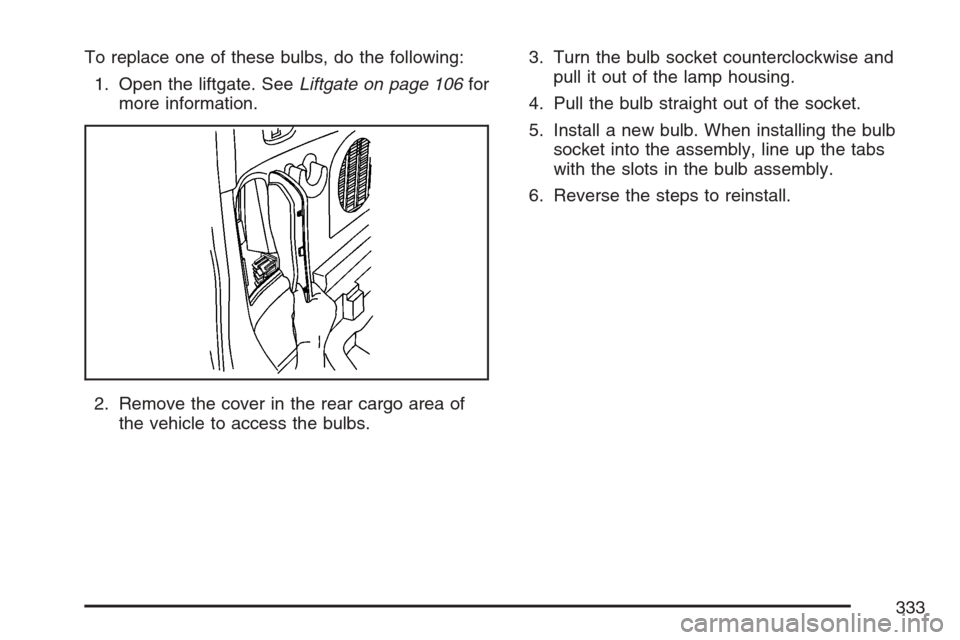
To replace one of these bulbs, do the following:
1. Open the liftgate. SeeLiftgate on page 106for
more information.
2. Remove the cover in the rear cargo area of
the vehicle to access the bulbs.3. Turn the bulb socket counterclockwise and
pull it out of the lamp housing.
4. Pull the bulb straight out of the socket.
5. Install a new bulb. When installing the bulb
socket into the assembly, line up the tabs
with the slots in the bulb assembly.
6. Reverse the steps to reinstall.
333
Page 371 of 446
Do not clean your vehicle using the following
cleaners or techniques:
Never use a knife or any other sharp object to
remove a soil from any interior surface.
Never use a stiff brush. It can cause damage
to your vehicle’s interior surfaces.
Never apply heavy pressure or rub
aggressively with a cleaning cloth. Use of
heavy pressure can damage your interior and
does not improve the effectiveness of soil
removal.
Use only mild, neutral-pH soaps. Avoid
laundry detergents or dishwashing soaps with
degreasers. Using too much soap will leave
a residue that leaves streaks and attracts dirt.
For liquid cleaners, about 20 drops per
gallon (3.78 L) of water is a good guide.
Do not heavily saturate your upholstery while
cleaning.
Damage to your vehicle’s interior may result
from the use of many organic solvents such
as naptha, alcohol, etc.
Fabric/Carpet
Use a vacuum cleaner with a soft brush
attachment frequently to remove dust and loose
dirt. A canister vacuum with a beater bar in
the nozzle may only be used on oor carpet and
carpeted oor mats. For soils, always try to remove
them rst with plain water or club soda. Before
cleaning, gently remove as much of the soil
as possible using one of the following techniques:
For liquids: gently blot the remaining soil
with a paper towel. Allow the soil to absorb into
the paper towel until no more can be
removed.
For solid dry soils: remove as much as
possible and then vacuum.
To clean, use the following instructions:
1. Saturate a lint-free, clean white cloth with
water or club soda.
2. Wring the cloth to remove excess moisture.
3. Start on the outside edge of the soil and gently
rub toward the center. Continue cleaning,
using a clean area of the cloth each time it
becomes soiled.
371
Page 423 of 446
Additional Program Information
All program options, such as shuttle service, may
not be available at every dealer. Please contact
your dealer for specic information about
availability. All Courtesy Transportation
arrangements will be administered by appropriate
dealer personnel.
General Motors reserves the right to unilaterally
modify, change or discontinue Courtesy
Transportation at any time and to resolve all
questions of claim eligibility pursuant to the terms
and conditions described herein at its sole
discretion.
Vehicle Data Collection and
Event Data Recorders
Your vehicle, like other modern motor vehicles, has
a number of sophisticated computer systems that
monitor and control several aspects of the vehicle’s
performance. Your vehicle uses on-board vehicle
computers to monitor emission control components
to optimize fuel economy, to monitor conditions forairbag deployment and, if the vehicle has the
Anti-lock Brake System (ABS), to provide anti-lock
braking and to help the driver control the vehicle in
difficult driving situations. Some information may be
stored during regular operations to facilitate repair
of detected malfunctions; other information is
stored only in a crash event by computer systems,
such as those commonly called Event Data
Recorders (EDR).
In a crash event, computer systems, such as the
airbag Sensing and Diagnostic Module (SDM) in
your vehicle may record information about the
condition of the vehicle and how it was operated,
such as data related to engine speed, brake
application, throttle position, vehicle speed, safety
belt usage, airbag readiness, airbag performance,
and the severity of a collision.This information has
been used to improve vehicle crash performance
and may be used to improve crash performance of
future vehicles and driving safety. Unlike the data
recorders on many airplanes, these on-board
systems do not record sounds, such as
conversation of vehicle occupants.
423
Page 433 of 446
A
Accessories and Modications..................... 289
Accessory Power Outlet(s).......................... 169
Adding Equipment to Your Airbag-Equipped
Vehicle....................................................... 89
Additives, Fuel............................................ 292
Add-On Electrical Equipment....................... 380
Air Cleaner/Filter, Engine............................. 304
Air Conditioning........................................... 170
Airbag
Passenger Status Indicator....................... 182
Readiness Light....................................... 181
Airbag Sensing and Diagnostic
Module (SDM).......................................... 423
Airbag System............................................... 71
Adding Equipment to Your
Airbag-Equipped Vehicle......................... 89
How Does an Airbag Restrain?.................. 79
Passenger Sensing System....................... 82
Servicing Your Airbag-Equipped Vehicle..... 88
What Makes an Airbag Inate?.................. 79
What Will You See After an Airbag
Inates?................................................. 80
When Should an Airbag Inate?................. 77
Where Are the Airbags?............................. 74
Antenna, Fixed Mast................................... 236Antenna, XM™ Satellite Radio Antenna
System.................................................... 236
Anti-Lock Brake System (ABS).................... 243
Anti-Lock Brake, System Warning Light....... 186
Appearance Care
Aluminum or Chrome-Plated Wheels........ 375
Care of Safety Belts................................ 373
Chemical Paint Spotting........................... 377
Cleaning Exterior Lamps/Lenses.............. 374
Cleaning the Inside of Your Vehicle.......... 370
Fabric/Carpet........................................... 371
Finish Care.............................................. 374
Finish Damage......................................... 377
Instrument Panel, Vinyl, and Other
Plastic Surfaces.................................... 372
Sheet Metal Damage............................... 376
Tires........................................................ 376
Underbody Maintenance........................... 377
Vehicle Care/Appearance Materials.......... 378
Washing Your Vehicle .............................. 373
Weatherstrips........................................... 373
Windshield and Wiper Blades................... 375
Ashtray(s).................................................... 170
Audio System(s).......................................... 206
Audio Steering Wheel Controls................. 234
Care of Your CD Player........................... 235
Care of Your CDs.................................... 235
433
Page 434 of 446
Audio System(s) (cont.)
Fixed Mast Antenna................................. 236
Radio with CD................................210, 215
Setting the Time..............................207, 208
Theft-Deterrent Feature............................ 233
Understanding Radio Reception............... 234
XM™ Satellite Radio Antenna System...... 236
Automatic Door Lock................................... 105
Automatic Headlamp System....................... 165
Automatic Transaxle
Fluid........................................................ 305
Operation................................................. 122
B
Battery........................................................ 320
Electric Power Management..................... 168
Run-Down Protection............................... 168
Before Leaving on a Long Trip.................... 260
Brake
Anti-Lock Brake System (ABS)................. 243
Emergencies............................................ 245
Parking.................................................... 127
System Warning Light.............................. 185
Brakes........................................................ 317
Braking....................................................... 242
Braking in Emergencies............................... 245Break-In, New Vehicle................................. 115
Bulb Replacement....................................... 330
Center High-Mounted
Stoplamp (CHMSL)............................... 331
Halogen Bulbs......................................... 330
Headlamp Aiming..................................... 327
Headlamps, Front Turn Signal, and
Parking Lamps..................................... 330
License Plate Lamps................................ 334
Replacement Bulbs.................................. 334
Taillamps, Turn Signal, Stoplamps
and Back-up Lamps.............................. 332
Buying New Tires........................................ 347C
Calibration..........................................134, 136
California Fuel............................................. 292
California Proposition 65 Warning................ 290
Canadian Owners........................................... 3
Capacities and Specications...................... 386
Carbon Monoxide......................106, 132, 264,
276, 277
Care of
Safety Belts............................................. 373
Your CD Player........................................ 235
Your CDs ................................................. 235
CD, MP3 ..................................................... 226
434