2007 CHEVROLET EXPRESS PASSANGER lights
[x] Cancel search: lightsPage 245 of 458

No one can see as well at night as in the daytime.
But as we get older these differences increase.
A 50-year-old driver might require at least twice as
much light to see the same thing at night as a
20-year-old.
What you do in the daytime can also affect your
night vision. For example, if you spend the
day in bright sunshine you are wise to wear
sunglasses. Your eyes will have less trouble
adjusting to night. But if you are driving, do not
wear sunglasses at night. They might cut down on
glare from headlamps, but they also make a lot
of things invisible.
You can be temporarily blinded by approaching
headlamps. It can take a second or two, or
even several seconds, for your eyes to re-adjust
to the dark. When you are faced with severe glare,
as from a driver who does not lower the high
beams, or a vehicle with misaimed headlamps,
slow down a little. Avoid staring directly into
the approaching headlamps.Keep the windshield and all the glass on your
vehicle clean — inside and out. Glare at night is
made much worse by dirt on the glass. Even
the inside of the glass can build up a film caused
by dust. Dirty glass makes lights dazzle and
flash more than clean glass would, making the
pupils of your eyes contract repeatedly.
Remember that the headlamps light up far less of a
roadway when you are in a turn or curve. Keep your
eyes moving; that way, it is easier to pick out dimly
lighted objects. Just as the headlamps should be
checked regularly for proper aim, so should your
eyes be examined regularly. Some drivers suffer
from night blindness — the inability to see in dim
light — and are not even aware of it.
245
Page 312 of 458

How to Add Automatic
Transmission Fluid
Refer to the Maintenance Schedule to determine
what kind of transmission fluid to use. See
Recommended Fluids and Lubricants on page 415.
Using a funnel, add fluid down the transmission
dipstick tube only after checking the transmission
fluid while it is hot. A cold check is used only
as a reference. If the fluid level is low, add only
enough of the proper fluid to bring the level up to
the HOT area for a hot check. It does not take
much fluid, generally less than one pint (0.5 L).
Do not overfill.
Notice:Use of the incorrect automatic
transmission uid may damage your vehicle,
and the damages may not be covered by
your warranty. Always use the automatic
transmission uid listed inRecommended
Fluids and Lubricants on page 415.
•After adding fluid, recheck the fluid level as
described under “How to Check Automatic
Transmission Fluid,” earlier in this section.
•When the correct fluid level is obtained, push
the dipstick back in all the way; then flip the
handle down to lock the dipstick in place.
Engine Coolant
If your vehicle has the DURAMAX®Diesel engine,
see the DURAMAX®Diesel manual for more
information.
The cooling system in your vehicle is filled with
DEX-COOL
®engine coolant. This coolant is
designed to remain in your vehicle for five years
or 150,000 miles (240 000 km), whichever
occurs first, if you add only DEX-COOL
®
extended life coolant.
The following explains your cooling system and
how to add coolant when it is low. If you have
a problem with engine overheating, seeEngine
Overheating on page 315.
A 50/50 mixture of clean, drinkable water and
DEX-COOL
®coolant will:
•Give freezing protection down to−34°F (−37°C).
•Give boiling protection up to 265°F (129°C).
•Protect against rust and corrosion.
•Help keep the proper engine temperature.
•Let the warning lights and gages work as
they should.
312
Page 452 of 458

Light (cont.)
Daytime Running Lamps Indicator............ 185
Highbeam On.......................................... 185
Malfunction Indicator................................ 178
Passenger Airbag Status Indicator............ 172
Passenger Safety Belt Reminder.............. 169
Reduced Engine Power............................ 184
Safety Belt Reminder............................... 168
Security................................................... 183
StabiliTrak
®Indicator................................ 177
StabiliTrak®Not Ready............................. 177
Tow/Haul Mode........................................ 185
Lighting
Entry........................................................ 158
Exit.......................................................... 158
Lights
Exterior Lamps......................................... 155
Flash-to-Pass........................................... 149
High/Low Beam Changer......................... 149
On Reminder........................................... 156
Loading Your Vehicle................................... 261
Locking Rear Axle....................................... 235
Lockout Protection....................................... 110
Locks
Cargo Door Relocking.............................. 109
Door........................................................ 108
Lockout Protection................................... 110Locks (cont.)
Power Door............................................. 109
Rear Door Security Locks........................ 110
Loss of Control........................................... 243
M
Maintenance Schedule
Additional Required Services.................... 408
At Each Fuel Fill...................................... 412
At Least Once a Month............................ 412
At Least Once a Year.............................. 413
At the First 100, 1,000 and 6,000 Miles
(160, 1 600 and 10 000 km)................ 411
Introduction.............................................. 402
Maintenance Footnotes............................ 409
Maintenance Record................................ 419
Maintenance Requirements...................... 402
Normal Maintenance Replacement
Parts.................................................... 417
Owner Checks and Services.................... 411
Recommended Fluids and Lubricants....... 415
Scheduled Maintenance........................... 405
Using....................................................... 403
Your Vehicle and the Environment............ 402
Malfunction Indicator Light........................... 178
Manual Seats.................................................. 9
452
Page 458 of 458
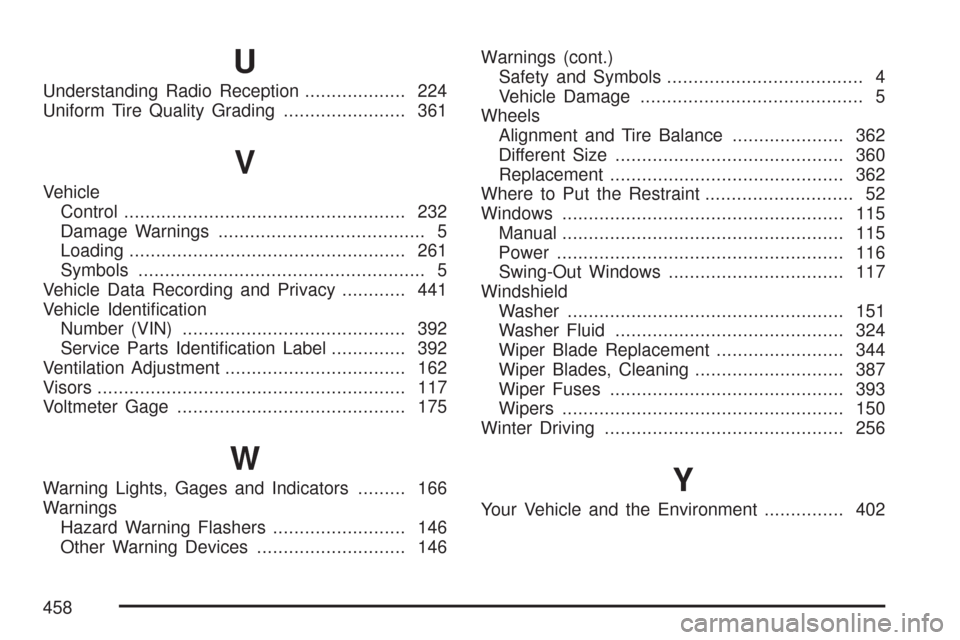
U
Understanding Radio Reception................... 224
Uniform Tire Quality Grading....................... 361
V
Vehicle
Control..................................................... 232
Damage Warnings....................................... 5
Loading.................................................... 261
Symbols...................................................... 5
Vehicle Data Recording and Privacy............ 441
Vehicle Identification
Number (VIN).......................................... 392
Service Parts Identification Label.............. 392
Ventilation Adjustment.................................. 162
Visors.......................................................... 117
Voltmeter Gage........................................... 175
W
Warning Lights, Gages and Indicators......... 166
Warnings
Hazard Warning Flashers......................... 146
Other Warning Devices............................ 146Warnings (cont.)
Safety and Symbols..................................... 4
Vehicle Damage.......................................... 5
Wheels
Alignment and Tire Balance..................... 362
Different Size........................................... 360
Replacement............................................ 362
Where to Put the Restraint............................ 52
Windows..................................................... 115
Manual..................................................... 115
Power...................................................... 116
Swing-Out Windows................................. 117
Windshield
Washer.................................................... 151
Washer Fluid........................................... 324
Wiper Blade Replacement........................ 344
Wiper Blades, Cleaning............................ 387
Wiper Fuses............................................ 393
Wipers..................................................... 150
Winter Driving............................................. 256Y
Your Vehicle and the Environment............... 402
458