Page 313 of 458
Notice:Using coolant other than
DEX-COOL®may cause premature engine,
heater core, radiator and fuel operated heater
(FOH) corrosion. In addition, the engine coolant
may require changing sooner, at 30,000 miles
(50 000 km) or 24 months, whichever occurs
rst. Any repairs would not be covered by your
warranty. Always use DEX-COOL
®(silicate-free)
coolant in your vehicle.
What to Use
Use a mixture of one-half clean, drinkable water
and one-half DEX-COOL®coolant which will
not damage aluminum parts. If you use this coolant
mixture, you do not need to add anything else.
{CAUTION:
Adding only plain water to your cooling
system can be dangerous. Plain water, or
some other liquid such as alcohol, can
boil before the proper coolant mixture will.
Your vehicle’s coolant warning system is
set for the proper coolant mixture.
CAUTION: (Continued)
CAUTION: (Continued)
With plain water or the wrong mixture, your
engine could get too hot but you would
not get the overheat warning. Your engine
could catch re and you or others could
be burned. Use a 50/50 mixture of clean,
drinkable water and the proper coolant.
Notice:If you use an improper coolant
mixture, your engine could overheat and be
badly damaged. The repair cost would not be
covered by your warranty. Too much water
in the mixture can freeze and crack the engine,
radiator, heater core, and other parts.
If you have to add coolant more than four times
a year, have your dealer/retailer check your
cooling system.
Notice:If you use extra inhibitors and/or
additives in your vehicle’s cooling system,
you could damage your vehicle. Use only the
proper mixture of the engine coolant listed
in this manual for the cooling system.
SeeRecommended Fluids and Lubricants
on page 415for more information.
313
Page 323 of 458
Engine Fan Noise
Your vehicle has a clutched engine cooling fan.
When the clutch is engaged, the fan spins faster
to provide more air to cool the engine. In most
everyday driving conditions, the fan is spinning
slower and the clutch is not fully engaged.
This improves fuel economy and reduces fan
noise. Under heavy vehicle loading, trailer towing,
and/or high outside temperatures, the fan speed
increases as the clutch more fully engages,
so you may hear an increase in fan noise.
This is normal and should not be mistaken as the
transmission slipping or making extra shifts. It
is merely the cooling system functioning properly.
The fan will slow down when additional cooling
is not required and the clutch partially disengages.
You may also hear this fan noise when you
start the engine. It will go away as the fan
clutch partially disengages.
Power Steering Fluid
The power steering fluid
reservoir is located in
the engine compartment
on the driver’s side of
the vehicle. SeeEngine
Compartment Overview
on page 302for
reservoir location.
When to Check Power Steering Fluid
It is not necessary to regularly check power
steering fluid unless you suspect there is a leak
in the system or you hear an unusual noise.
A fluid loss in this system could indicate a problem.
Have the system inspected and repaired.
323
Page 324 of 458
How to Check Power Steering Fluid
To check the power steering fluid, do the following:
1. Turn the key off and let the engine
compartment cool down.
2. Wipe the cap and the top of the
reservoir clean.
3. Unscrew the cap and wipe the dipstick
with a clean rag.
4. Replace the cap and completely tighten it.
5. Then remove the cap again and look at
the fluid level on the dipstick.
The level should be at the COLD FILL mark.
If necessary, add only enough fluid to bring
the level up to the mark.
To prevent contamination of brake fluid, never
check or fill the power steering reservoir with
the brake master cylinder cover off.
What to Use
To determine what kind of fluid to use, see
Recommended Fluids and Lubricants on page 415.
Always use the proper fluid. Failure to use the
proper fluid can cause leaks and damage hoses
and seals.
Windshield Washer Fluid
What to Use
When you need windshield washer fluid, be sure
to read the manufacturer’s instructions before
use. If you will be operating your vehicle in an area
where the temperature may fall below freezing,
use a fluid that has sufficient protection against
freezing.
Adding Washer Fluid
Open the cap with the
washer symbol on it.
Add washer fluid
until the tank is full. See
Engine Compartment
Overview on page 302
for reservoir location.
324
Page 325 of 458
Notice:
When using concentrated washer uid,
follow the manufacturer’s instructions
for adding water.
Do not mix water with ready-to-use washer
uid. Water can cause the solution to
freeze and damage your washer uid tank
and other parts of the washer system.
Also, water does not clean as well
as washer uid.
Fill the washer uid tank only
three-quarters full when it is very cold.
This allows for uid expansion if freezing
occurs, which could damage the tank if
it is completely full.
Do not use engine coolant (antifreeze) in
your windshield washer. It can damage
the vehicle’s windshield washer system
and paint.
Brakes
Brake Fluid
The brake master
cylinder reservoir is
filled with DOT-3 brake
fluid. SeeEngine
Compartment Overview
on page 302for the
location of the reservoir.
There are only two reasons why the brake fluid
level in the reservoir might go down. The first
is that the brake fluid goes down to an acceptable
level during normal brake lining wear. When
new linings are put in, the fluid level goes back
up. The other reason is that fluid is leaking out of
the brake system. If it is, you should have the
brake system fixed, since a leak means that
sooner or later the brakes will not work well.
So, it is not a good idea to top off the brake fluid.
Adding brake fluid will not correct a leak.
325
Page 326 of 458
If you add fluid when the linings are worn, then
you will have too much fluid when you get
new brake linings. You should add or remove
brake fluid, as necessary, only when work is
done on the brake hydraulic system.
{CAUTION:
If you have too much brake uid, it can
spill on the engine and/or fuel operated
heater parts, if equipped. If your vehicle
has a diesel engine and a fuel operated
heater, see “Fuel Operated Heater (FOH)”
in the diesel engine supplement. The uid
will burn if the engine is hot enough.
You or others could be burned, and your
vehicle could be damaged. Add brake
uid only when work is done on the brake
hydraulic system. See “Checking Brake
Fluid” in this section.
Refer to the Maintenance Schedule to determine
when to check the brake fluid. SeeScheduled
Maintenance (Gasoline Engine) on page 405.
Checking Brake Fluid
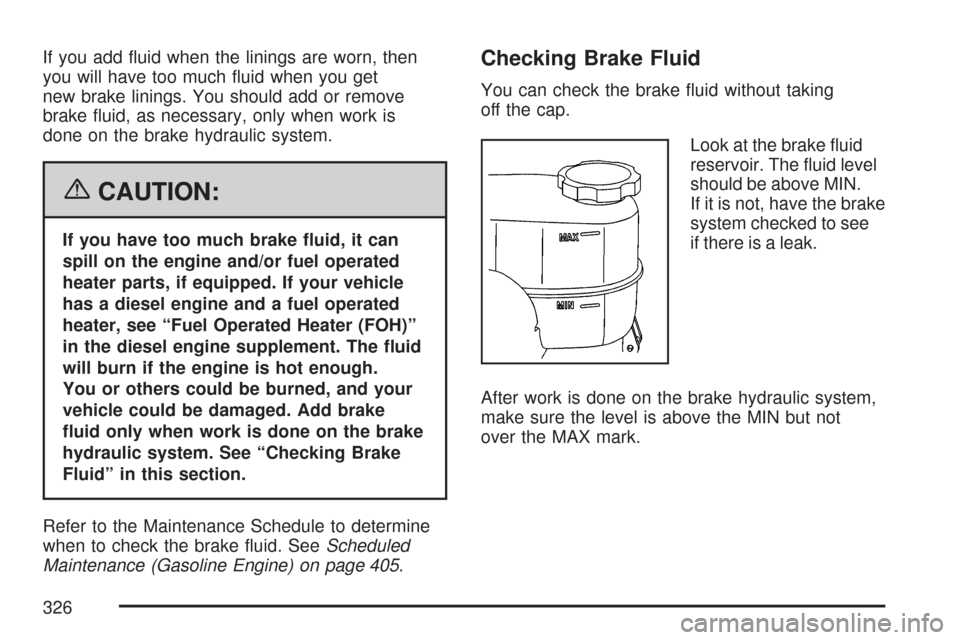
You can check the brake fluid without taking
off the cap.
Look at the brake fluid
reservoir. The fluid level
should be above MIN.
If it is not, have the brake
system checked to see
if there is a leak.
After work is done on the brake hydraulic system,
make sure the level is above the MIN but not
over the MAX mark.
326
Page 327 of 458
What to Add
When you do need brake fluid, use only DOT-3
brake fluid. Use new brake fluid from a sealed
container only. SeeRecommended Fluids
and Lubricants on page 415.
Always clean the brake fluid reservoir cap and the
area around the cap before removing it. This
will help keep dirt from entering the reservoir.
{CAUTION:
With the wrong kind of uid in the brake
system, the brakes may not work well.
This could cause a crash. Always use
the proper brake uid.Notice:
Using the wrong uid can badly damage
brake system parts. For example, just a
few drops of mineral-based oil, such
as engine oil, in the brake system can
damage brake system parts so badly that
they will have to be replaced. Do not
let someone put in the wrong kind of uid.
If you spill brake uid on your vehicle’s
painted surfaces, the paint nish can
be damaged. Be careful not to spill brake
uid on your vehicle. If you do, wash it
off immediately. SeeWashing Your Vehicle
on page 386.
327
Page 336 of 458
All-Wheel Drive
Lubricant checks in this section also apply to
these vehicles. However, there are two additional
systems that need lubrication.
Transfer Case
When to Check Lubricant
Refer to the Maintenance Schedule to determine
how often to check the lubricant. SeeScheduled
Maintenance (Gasoline Engine) on page 405.
How to Check Lubricant
To get an accurate reading, the vehicle should be
on a level surface.If the level is below the bottom of the filler plug
hole, you’ll need to add some lubricant. Add
enough lubricant to raise the level to the bottom of
the filler plug hole. Use care not to overtighten
the plug.
What to Use
Refer to the Maintenance Schedule to determine
what kind of lubricant to use. SeeRecommended
Fluids and Lubricants on page 415.
336
Page 337 of 458
Rear Axle
When to Check Lubricant
Refer to the Maintenance Schedule to determine
how often to check the lubricant. SeeScheduled
Maintenance (Gasoline Engine) on page 405.
How to Check Lubricant
To get an accurate reading, the vehicle should be
on a level surface.If you have the 1500 Series, the proper level
is from 5/8 inch (15 mm) to 1 5/8 inch (40 mm)
below the bottom of the filler plug hole. The
proper level for the 2500 and 3500 Series is
from 0 to 1/4 (6 mm) below the bottom of the
filler plug hole. Add only enough fluid to reach
the proper level.
What to Use
Refer to the Maintenance Schedule to determine
what kind of lubricant to use. SeeRecommended
Fluids and Lubricants on page 415.
337