Page 370 of 492
3. Turn off the ignition on both vehicles. Unplug
unnecessary accessories plugged into the
cigarette lighter or the accessory power outlet.
Turn off the radio and all lamps that are not
needed. This will avoid sparks and help save
both batteries. And it could save your radio!
4. Open the hoods and locate the positive (+)
and negative (−) terminal locations on each
vehicle.
You will not need to access your battery for
jump starting. Your vehicle has a remote
positive (+) and a remote negative (−) jump
starting terminal for that purpose.
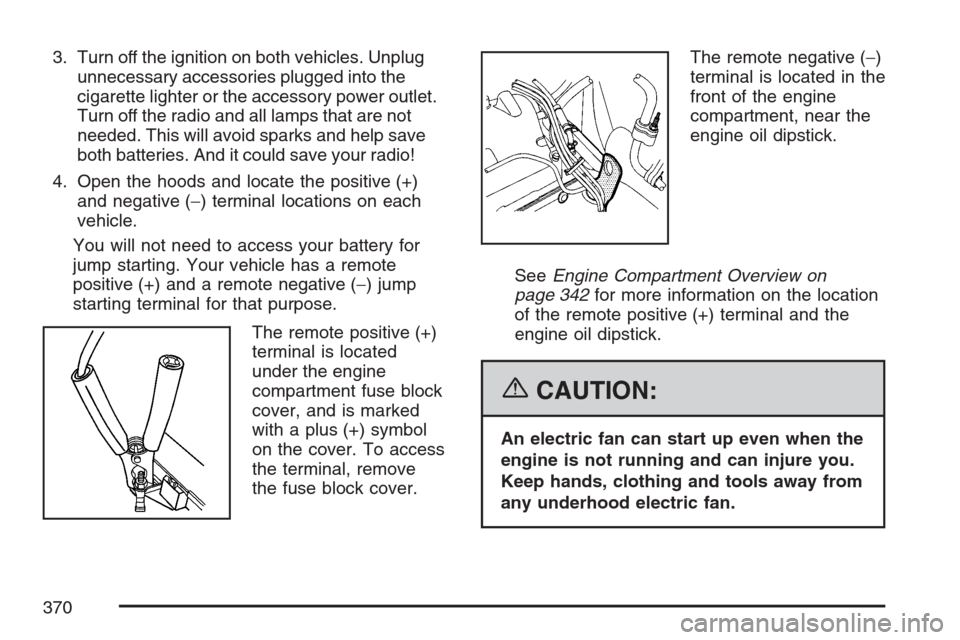
The remote positive (+)
terminal is located
under the engine
compartment fuse block
cover, and is marked
with a plus (+) symbol
on the cover. To access
the terminal, remove
the fuse block cover.The remote negative (−)
terminal is located in the
front of the engine
compartment, near the
engine oil dipstick.
SeeEngine Compartment Overview on
page 342for more information on the location
of the remote positive (+) terminal and the
engine oil dipstick.
{CAUTION:
An electric fan can start up even when the
engine is not running and can injure you.
Keep hands, clothing and tools away from
any underhood electric fan.
370
Page 393 of 492
When a low tire pressure condition is detected,
the TPMS will illuminate the low tire pressure
warning symbol on the instrument panel cluster,
and at the same time a message to check
the pressure in a specic tire will appear on the
Driver Information Center (DIC) display. The
low tire pressure warning symbol on the instrument
panel cluster and the check tire pressure
message will appear at each ignition cycle until
the tires are inated to the correct ination
pressure. Using the DIC, tire pressure levels can
be viewed by the driver. For additional information
and details about the DIC operation and displays
seeDIC Operation and Displays on page 193
andDIC Warnings and Messages on page 198.
The low tire pressure warning light may come on
in cool weather when the vehicle is rst started,
and then turn off as you start to drive. This may be
an early indicator that the air pressure in the
tire(s) are getting low and need to be inated to
the proper pressure.
A Tire and Loading Information Label, attached to
your vehicle, shows the size of your vehicle’s
original equipment tires and the correct inationpressure for your vehicle’s tires when they are cold.
SeeLoading Your Vehicle on page 315, for an
example of the Tire and Loading Information
Label and its location on your vehicle. Also see
Ination - Tire Pressure on page 390.
Your vehicle’s TPMS system can warn you about a
low tire pressure condition but it does not replace
normal tire maintenance. SeeTire Inspection and
Rotation on page 396andTires on page 382.
Notice:Do not use a tire sealant if your vehicle
has Tire Pressure Monitors. The liquid sealant
can damage the tire pressure monitor sensors.
The TPMS will not function properly if one or more
of the TPMS sensors are missing or inoperable. If
the system detects a missing or inoperable sensor,
an error message SERVICE TIRE MONITOR
SYSTEM will be shown on the DIC display. If you
have replaced a tire/wheel assembly without
transferring the TPMS sensors, the error message
will be displayed. Once you re-install the TPMS
sensors, the error message should go off. See your
dealer for service if all TPMS sensors are installed
and the error message comes on and stays on.
393
Page 394 of 492
TPMS Sensor Matching Process
Each TPMS sensor has a unique identication
code. Any time you replace one or more of
the TPMS sensors or rotate the vehicle’s tires, the
identication codes will need to be matched to
the new tire/wheel position. The sensors are
matched, to the tire/wheel positions, in the
following order: driver side front tire, passenger
side front tire, passenger side rear tire, and driver
side rear tire using a TPMS diagnostic tool.
See your dealer for service.
The TPMS sensors may also be matched to each
tire/wheel position by increasing or decreasing
the tire’s air pressure. When increasing the tire’s
pressure, do not exceed the maximum ination
pressure indicated on the tire’s sidewall.
You will have two minutes to match each tire
and wheel position. If it takes longer than
two minutes to match any tire and wheel position,
the matching process stops and you will need
to start over.The TPMS matching process is outlined below:
1. Set the parking brake.
2. Turn the ignition switch to RUN with the
engine off.
3. Using the DIC, press the vehicle
information button until the TIRE LOCATIONS
PRESS
VTO LEARN message displays.
4. Press the set/reset button to allow the system
to learn the tire positions. The horn will sound
twice to indicate the receiver is ready, and
the TIRE LEARNING ACTIVE message
displays. The TPMS system is ready for the
sensor matching process to begin.
5. Start with the driver side front tire.
394
Page 395 of 492
6. Remove the valve cap from the tire’s valve
stem. Activate the TPMS sensor by increasing
or decreasing the tire’s air pressure for
ve seconds, or until a horn chirp sounds. The
horn chirp, which may take up to 30 seconds to
sound, conrms that the sensor identication
code has been matched to the tire/wheel
position. To decrease the tire’s air-pressure
use the pointed end of the valve cap, a
pencil-style air pressure gage, or a key.
7. Proceed to the passenger side front tire,
and repeat the procedure in Step 6.
8. Proceed to the passenger side rear tire,
and repeat the procedure in Step 6.
9. Proceed to the driver side rear tire, and
repeat the procedure in Step 6.
10. After hearing the conrming horn chirp for the
driver side rear tire, the tire learning process
ends. Turn the ignition switch to LOCK.
11. Set all four tires to the recommended air
pressure level as indicated on the tire and
loading information label.
12. Put the valve caps back on the valve stems.Federal Communications Commission
(FCC) and Industry and Science Canada
The Tire Pressure Monitor System (TPMS)
operates on a radio frequency and complies with
Part 15 of the FCC Rules. Operation is subject
to the following two conditions:
1. This device may not cause harmful
interference.
2. This device must accept any interference
received, including interference that may
cause undesired operation.
The Tire Pressure Monitor System (TPMS)
operates on a radio frequency and complies with
RSS-210 of Industry and Science Canada.
Operation is subject to the following
two conditions:
1. This device may not cause interference.
2. This device must accept any interference
received, including interference that may
cause undesired operation of the device.
Changes or modications to this system by other
than an authorized service facility could void
authorization to use this equipment.
395
Page 430 of 492
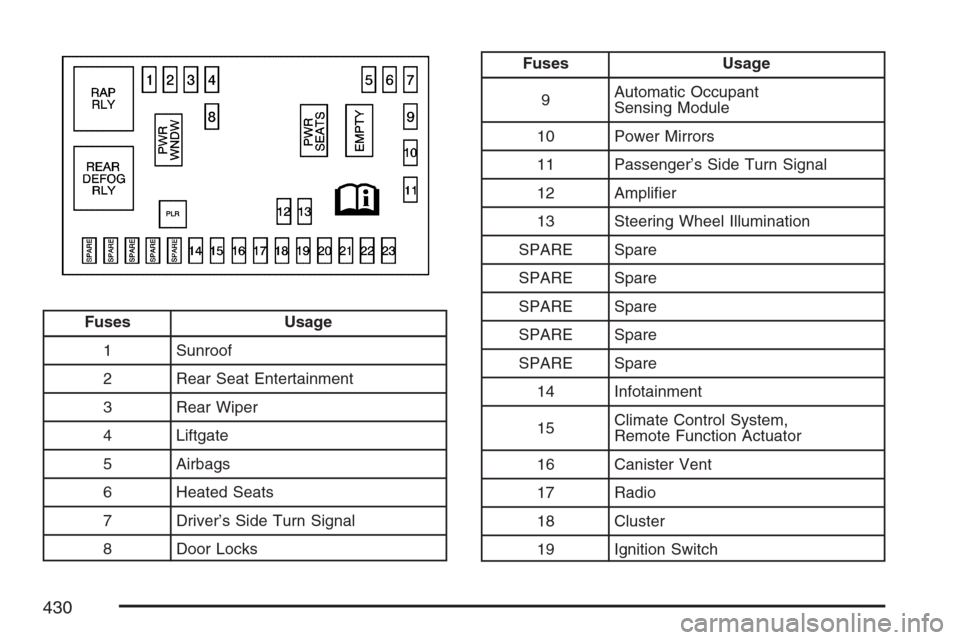
Fuses Usage
1 Sunroof
2 Rear Seat Entertainment
3 Rear Wiper
4 Liftgate
5 Airbags
6 Heated Seats
7 Driver’s Side Turn Signal
8 Door Locks
Fuses Usage
9Automatic Occupant
Sensing Module
10 Power Mirrors
11 Passenger’s Side Turn Signal
12 Amplier
13 Steering Wheel Illumination
SPARE Spare
SPARE Spare
SPARE Spare
SPARE Spare
SPARE Spare
14 Infotainment
15Climate Control System,
Remote Function Actuator
16 Canister Vent
17 Radio
18 Cluster
19 Ignition Switch
430
Page 432 of 492
Fuses Usage
1 Cooling Fan 2
2 Cooling Fan 1
3 Auxiliary Power
4 Not Used
5 Spare
6 Spare
7 Anti-lock Brake System
8 Air Conditioning Clutch
9 Driver’s Side Low-Beam
10 Daytime Running Lamp 2
11 Passenger’s Side High-Beam
12 Passenger’s Side Park Lamp
13 Horn
14 Driver’s Side Park Lamp
15 Starter
16Electronic Throttle Control,
Engine Control Module
17 Emission Device 1Fuses Usage
18 Even Coils, Injectors
19 Odd Coils, Injectors
20 Emission Device 2
21 Spare
22 Powertrain Control Module, Ignition
23 Transmission
24 Mass Airow Sensor
25 Airbag Display
26 Spare
27 Stoplamp
28 Passenger’s Side Low-Beam
29 Driver’s Side High-Beam
30 Battery Main 3
32 Spare
33 Engine Control Module, Battery
34Transmission Control Module,
Battery
35 Trailer Park Lamp
432
Page 433 of 492
Fuses Usage
36 Front Wiper
37Driver’s Side Trailer Stoplamp,
Turn Signal
38 Spare
39 Fuel Pump
40 Not Used
41 All-Wheel Drive
42 Regulated Voltage Control
43Passenger’s Side Trailer Stoplamp,
Turn Signal
44 Spare
45 Front, Rear Washer
48 Rear Defogger
49 Anti-lock Brake System Motor
50 Battery Main 2
52 Daytime Running Lamps
53 Fog LampsFuses Usage
54 Climate Control System Blower
57 Battery Main 1
63 Megafuse
Relays Usage
31 Ignition Main
46 Air Conditioning Compressor Clutch
47 Powertrain
51 Spare
55 Crank
56 Fan 1
58Passenger’s Side Trailer Stoplamp,
Turn Signal
59Driver’s Side Trailer Stoplamp,
Turn Signal
60 Fan 3
61 Fan 2
62 Fuel Pump
433
Page 446 of 492
At Least Once a Year
Starter Switch Check
{CAUTION:
When you are doing this inspection, the
vehicle could move suddenly. If the vehicle
moves, you or others could be injured.
1. Before you start, be sure you have enough
room around the vehicle.
2. Firmly apply both the parking brake and the
regular brake. SeeParking Brake on page 122.
Do not use the accelerator pedal, and be ready
to turn off the engine immediately if it starts.
3. Try to start the engine in each gear. The
vehicle should start only in PARK (P) or
NEUTRAL (N). If the vehicle starts in any
other position, contact your GM Goodwrench
®
dealer for service.
Automatic Transaxle Shift Lock Control
System Check
{CAUTION:
When you are doing this inspection, the
vehicle could move suddenly. If the vehicle
moves, you or others could be injured.
1. Before you start, be sure you have enough
room around the vehicle. It should be parked
on a level surface.
2. Firmly apply the parking brake. SeeParking
Brake on page 122.
Be ready to apply the regular brake
immediately if the vehicle begins to move.
3. With the engine off, turn the ignition to RUN,
but do not start the engine. Without applying
the regular brake, try to move the shift
lever out of PARK (P) with normal effort. If the
shift lever moves out of PARK (P), contact
your GM Goodwrench
®dealer for service.
446