2007 CHEVROLET CORVETTE service
[x] Cancel search: servicePage 322 of 488

If this occurs, use a gasoline rated at 87 octane or
higher as soon as possible. Otherwise, you might
damage your engine. If you are using gasoline
rated at 87 octane or higher and you hear heavy
knocking, your engine needs service.
If your vehicle has the 7.0L V8 engine
(VIN Code E), use premium unleaded gasoline
with a posted octane rating of 91 or higher.
For best performance, use premium unleaded
gasoline with a posted octane rating of 93.
In an emergency, you can use regular unleaded
gasoline with an octane rating of 87 or higher.
If 87 octane fuel is used, do not perform any
aggressive driving maneuvers such as wide open
throttle applications. You may also hear audible
spark knock during acceleration. Rell your
tank with premium fuel as soon as possible to
avoid damaging your engine. If you are using
gasoline rated at 91 octane or higher and you
hear heavy knocking, your engine needs service.Gasoline Specications
At a minimum, gasoline should meet ASTM
specication D 4814 in the United States or
CAN/CGSB-3.5 in Canada. Some gasolines may
contain an octane-enhancing additive called
methylcyclopentadienyl manganese tricarbonyl
(MMT). General Motors recommends against the
use of gasolines containing MMT. SeeAdditives
on page 323for additional information.
California Fuel
If your vehicle is certied to meet California
Emissions Standards, it is designed to operate on
fuels that meet California specications. See the
underhood emission control label. If this fuel is not
available in states adopting California emissions
standards, your vehicle will operate satisfactorily
on fuels meeting federal specications, but
emission control system performance may be
affected. The malfunction indicator lamp may turn
on and your vehicle may fail a smog-check test.
SeeMalfunction Indicator Lamp on page 200.
322
Page 323 of 488

If this occurs, return to your authorized GM dealer
for diagnosis. If it is determined that the condition is
caused by the type of fuel used, repairs may not be
covered by your warranty.
Additives
To provide cleaner air, all gasolines in the
United States are now required to contain additives
that will help prevent engine and fuel system
deposits from forming, allowing your emission
control system to work properly. In most cases,
you should not have to add anything to your
fuel. However, some gasolines contain only the
minimum amount of additive required to meet U.S.
Environmental Protection Agency regulations.
To help keep fuel injectors and intake valves clean,
or if your vehicle experiences problems due to
dirty injectors or valves, look for gasoline that is
advertised as TOP TIER Detergent Gasoline.
Also, your dealer has additives that will help
correct and prevent most deposit-related problems.
Gasolines containing oxygenates, such as
ethers and ethanol, and reformulated gasolines
may be available in your area. General Motors
recommends that you use these gasolines if they
comply with the specications described earlier.However, E85 (85% ethanol) and other fuels
containing more than 10% ethanol must no
be used in vehicles that were not designed for
those fuels.
Notice:Your vehicle was not designed for
fuel that contains methanol. Do not use
fuel containing methanol. It can corrode metal
parts in the fuel system and also damage
plastic and rubber parts. That damage would
not be covered under your warranty.
Some gasolines that are not reformulated for
low emissions may contain an octane-enhancing
additive called methylcyclopentadienyl manganese
tricarbonyl (MMT); ask the attendant where you
buy gasoline whether the fuel contains MMT.
General Motors recommends against the use of
such gasolines. Fuels containing MMT can reduce
the life of spark plugs and the performance of
the emission control system may be affected.
The malfunction indicator lamp may turn on.
If this occurs, return to your dealer for service.
323
Page 341 of 488
When the system has calculated that oil life has
been diminished, it will indicate that an oil change
is necessary. A CHANGE ENGINE OIL message
will come on. Change your oil as soon as possible
within the next 600 miles (1 000 km). It is
possible that, if you are driving under the best
conditions, the oil life system may not indicate
that an oil change is necessary for over a
year. However, your engine oil and lter must
be changed at least once a year and at this
time the system must be reset. Your dealer
has GM-trained service people who will perform
this work using genuine GM parts and reset
the system. It is also important to check your
oil regularly and keep it at the proper level.
If the system is ever reset accidentally, you
must change your oil at 3,000 miles (5 000 km)
since your last oil change. Remember to reset
the oil life system whenever the oil is changed.How to Reset the Engine Oil Life
System
The Engine Oil Life System calculates when to
change your engine oil and lter based on vehicle
use. Anytime your oil is changed, reset the
system so it can calculate when the next oil
change is required. If a situation occurs where
you change your oil prior to a CHANGE ENGINE
OIL message being turned on, reset the system.
To reset the CHANGE ENGINE OIL message
after an oil change, do the following:
1. Press the TRIP button so the OIL LIFE
percentage is displayed.
2. Press RESET and hold for two seconds.
OIL LIFE REMAINING 100% will appear.
If the CHANGE ENGINE OIL message comes
back on when you start your vehicle, the engine
oil life system has not reset. Repeat the procedure.
341
Page 342 of 488
What to Do with Used Oil
Used engine oil contains certain elements that may
be unhealthy for your skin and could even cause
cancer. Do not let used oil stay on your skin for
very long. Clean your skin and nails with soap and
water, or a good hand cleaner. Wash or properly
dispose of clothing or rags containing used engine
oil. See the manufacturer’s warnings about the
use and disposal of oil products.
Used oil can be a threat to the environment. If you
change your own oil, be sure to drain all the oil from
the lter before disposal. Never dispose of oil by
putting it in the trash, pouring it on the ground, into
sewers, or into streams or bodies of water. Instead,
recycle it by taking it to a place that collects used
oil. If you have a problem properly disposing of
your used oil, ask your dealer, a service station,
or a local recycling center for help.
Engine Air Cleaner/Filter
SeeEngine Compartment Overview on page 330
for the location of the engine air cleaner/lters.Notice:If you spray water into the engine
air cleaner/lter intake and water enters
the engine air cleaner/lter housing, you
could damage your vehicle’s engine.
The repairs would not be covered by your
warranty. Do not spray water into the engine
air cleaner/lter intake and/or housing.
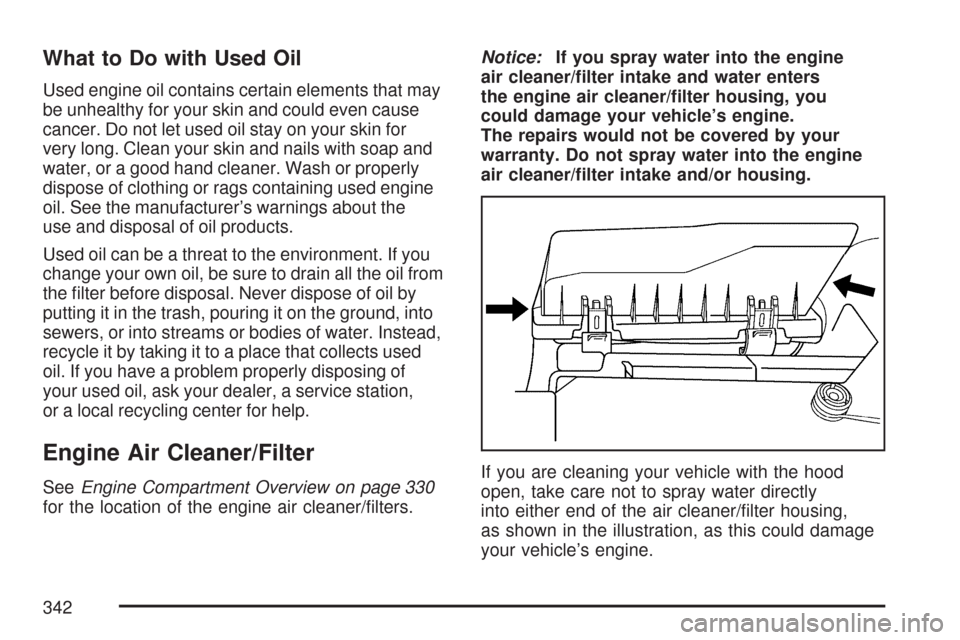
If you are cleaning your vehicle with the hood
open, take care not to spray water directly
into either end of the air cleaner/lter housing,
as shown in the illustration, as this could damage
your vehicle’s engine.
342
Page 345 of 488

Automatic Transmission Fluid
How to Check Automatic
Transmission Fluid
It is not necessary to check the transmission
uid level. A transmission uid leak is the only
reason for uid loss. If a leak occurs, take
the vehicle to the dealership service department
and have it repaired as soon as possible.
There is a special procedure for checking and
changing the transmission uid. Because
this procedure is difficult, you should have this
done at the dealership service department.
Contact your dealer for additional information or
the procedure can be found in the service manual.
To purchase a service manual, seeService
Publications Ordering Information on page 468.Notice:Use of the incorrect automatic
transmission uid may damage your vehicle,
and the damages may not be covered by
your warranty. Always use the automatic
transmission uid listed inRecommended
Fluids and Lubricants on page 443.
Change the uid and lter at the intervals listed in
Additional Required Services on page 436, and
be sure to use the uid listed inRecommended
Fluids and Lubricants on page 443.
Manual Transmission Fluid
It is not necessary to check the manual
transmission uid level. A transmission uid leak
is the only reason for uid loss. If a leak occurs,
take the vehicle to the dealership service
department and have it repaired as soon as
possible. SeeRecommended Fluids and
Lubricants on page 443for the proper uid to use.
345
Page 346 of 488
Hydraulic Clutch
It is not necessary to regularly check clutch uid
unless you suspect there is a leak in the system.
Adding uid will not correct a leak.
A uid loss in this system could indicate a
problem. Have the system inspected and repaired.
When to Check and What to Use
The hydraulic clutch
uid reservoir cap
has this symbol
on it. SeeEngine
Compartment Overview
on page 330for
reservoir location.Refer to the Maintenance Schedule to determine
how often you should check the uid level in
your clutch master cylinder reservoir and for
the proper uid to use. SeeOwner Checks
and Services on page 438andRecommended
Fluids and Lubricants on page 443.
How to Check and Add Fluid
Make sure the uid level is at the MIN (Minimum)
line on the side of the reservoir. If it is not,
remove the cap and add the proper uid until
the level reaches the MIN line.
346
Page 347 of 488
Engine Coolant
The cooling system in your vehicle is lled with
DEX-COOL®engine coolant. This coolant is
designed to remain in your vehicle for ve years
or 150,000 miles (240 000 km), whichever
occurs rst, if you add only DEX-COOL
®
extended life coolant.
The following explains your cooling system
and how to add coolant when it is low. If you
have a problem with engine overheating,
seeEngine Overheating on page 350.A 50/50 mixture of clean, drinkable water and
DEX-COOL
®coolant will:
Give freezing protection down to−34°F (−37°C).
Give boiling protection up to 265°F (129°C).
Protect against rust and corrosion.
Help keep the proper engine temperature.
Let the warning lights and gages work as
they should.
Notice:Using coolant other than DEX-COOL
®
may cause premature engine, heater core,
or radiator corrosion. In addition, the engine
coolant may require changing sooner, at
the rst maintenance service after each
30,000 miles (50 000 km) or 24 months,
whichever occurs rst. Any repairs would
not be covered by your warranty. Always
use DEX-COOL
®(silicate-free) coolant in
your vehicle.
347
Page 352 of 488
If you no longer have the overheat warning,
you can drive. Just to be safe, drive slower for
about 10 minutes. If the warning does not
come back on, you can drive normally.
If the warning continues and you are not
stopped, pull over, stop, and park your vehicle
right away.
If there is still no sign of steam, you can idle the
engine for three minutes while you are parked.
If you still have the warning, turn off the engine
and get everyone out of the vehicle until it
cools down. Also, see “Overheated Engine
Protection Operating Mode” later in this section.
You may decide not to lift the hood but to get
service help right away.Overheated Engine Protection
Operating Mode
If an overheated engine condition exists and the
messages COOLANT OVER TEMPERATURE
and REDUCED ENGINE POWER are displayed,
along with the Check Engine light, an overheat
protection mode which alternates ring groups of
cylinders helps prevent engine damage. In
this mode, you will notice a loss in power and
engine performance. This operating mode allows
your vehicle to be driven to a safe place in an
emergency; you may drive up to 50 miles (80 km).
Notice:After driving in the overheated
engine protection operating mode, to avoid
engine damage, allow the engine to cool before
attempting any repair. The engine oil will be
severely degraded. Repair the cause of coolant
loss, change the oil and reset the oil life
system. SeeEngine Oil on page 333.
352