2007 CHEVROLET CORVETTE oil
[x] Cancel search: oilPage 264 of 488
Playing an MP3
Insert a CD partway into the slot, label side up.
The player pulls it in, and READING displays.
The CD should begin playing and the CD symbol
displays.
If the ignition or radio is turned off with a CD-R
in the player, it stays in the player. When the
ignition or radio is turned on, the CD-R starts to
play where it stopped, if it was the last selected
audio source.
As each new track starts to play, the track number
displays.
The CD player can play the smaller 3 inch (8 cm)
single CDs with an adapter ring. Full-size CDs
and the smaller CDs are loaded in the same
manner.
If playing a CD-R, the sound quality (and playback
performance) can be reduced due to the CD-R
quality, method of recording, the quality of
the music that has been recorded, and the way
the CD-R has been handled. For better playback
performance when home burning audio discs,
use brand named CD media with the [“Compact
Disc” trade mark logo], and a burn rate no
faster than 12X.There could be an increase in skipping, difficulty
in nding tracks, and/or difficulty in loading
and ejecting. If these problems occur, check the
bottom surface of the CD. If the surface of the
CD is damaged, such as cracked, broken,
or scratched, the CD does not play properly.
If the surface of the CD is soiled, seeCare of
Your CDs on page 271for more information.
If there is no apparent damage, try a known
good CD.
Do not add any label to a CD, it could get caught
in the CD player. If a CD is recorded on a
personal computer and a description label is
needed, try labeling the top of the recorded CD
with a marking pen.
Notice:If a label is added to a CD, or more
than one CD is inserted into the slot at a
time, or an attempt is made to play scratched
or damaged CDs, the CD player could be
damaged. While using the CD player, use
only CDs in good condition without any label,
load one CD at a time, and keep the CD
player and the loading slot free of foreign
materials, liquids, and debris.
264
Page 271 of 488
FM Stereo
FM stereo will give the best sound, but FM signals
will reach only about 10 to 40 miles (16 to 65 km).
Tall buildings or hills can interfere with FM
signals, causing the sound to fade in and out.
XM™ Satellite Radio Service
If your vehicle as the XM™ Satellite Radio
Service, this type of radio service gives
digital radio reception from coast-to-coast in the
48 contiguous United States, and in Canada.
Just as with FM, tall buildings or hills can interfere
with satellite radio signals, causing the sound
to fade in and out. In addition, traveling or standing
under heavy foliage, bridges, garages, or tunnels
may cause loss of the XM™ signal for a period
of time. The radio may display NO SIGNAL
to indicate interference.
Care of Your CDs
Handle CDs carefully. Store them in their original
cases or other protective cases and away from
direct sunlight and dust. The CD player scans
the bottom surface of the disc. If the surface of
a CD is damaged, such as cracked, broken,
or scratched, the CD does not play properly or
not at all. If the surface of a CD is soiled, take
a soft, lint free cloth or dampen a clean, soft cloth
in a mild, neutral detergent solution mixed with
water, and clean it. Make sure the wiping process
starts from the center to the edge.
Do not touch the bottom side of a CD while
handling it; this could damage the surface.
Pick up CDs by grasping the outer edges or
the edge of the hole and the outer edge.
271
Page 292 of 488
If your vehicle starts to slide, ease your foot off the
accelerator pedal and quickly steer the way you
want the vehicle to go. If you start steering quickly
enough, your vehicle may straighten out. Always
be ready for a second skid if it occurs.
Of course, traction is reduced when water, snow,
ice, gravel, or other material is on the road.
For safety, you will want to slow down and adjust
your driving to these conditions. It is important
to slow down on slippery surfaces because
stopping distance will be longer and vehicle
control more limited.
While driving on a surface with reduced traction, try
your best to avoid sudden steering, acceleration,
or braking, including reducing vehicle speed by
shifting to a lower gear. Any sudden changes could
cause the tires to slide. You may not realize the
surface is slippery until your vehicle is skidding.
Learn to recognize warning clues — such as
enough water, ice, or packed snow on the road
to make a mirrored surface — and slow down
when you have any doubt.
Remember: Any Anti-Lock Brake System (ABS)
helps avoid only the braking skid.Racing or Other Competitive Driving
See your warranty book before using your
vehicle for racing or other competitive driving.
Notice:If you use your vehicle for racing or
other competitive driving, the engine may
use more oil than it would with normal
use. Low oil levels can damage the engine.
For information on how to add oil, see
Engine Oil on page 333.
Z06 Only: Be sure to check the oil level often
during racing or other competitive driving
and keep the level at or near the upper mark
that shows the proper operating range on
the engine oil dipstick.
Except Z06: Be sure to check the oil level
often during racing or other competitive driving
and keep the level at or near 1 quart (1 L)
above the upper mark that shows the proper
operating range on the engine oil dipstick.
After the competitive driving, remove excess
oil so that the level on the dipstick is not
above the upper mark that shows the proper
operating range.
292
Page 300 of 488
Before Leaving on a Long Trip
Make sure you are ready. Try to be well rested.
If you must start when you are not fresh — such
as after a day’s work — do not plan to make
too many miles that rst part of the journey.
Wear comfortable clothing and shoes you can
easily drive in.
Is your vehicle ready for a long trip? If you keep it
serviced and maintained, it is ready to go. If it
needs service, have it done before starting out.
Of course, you will nd experienced and able
service experts in GM dealerships all across
North America. They will be ready and willing to
help if you need it.Here are some things you can check before a trip:Windshield Washer Fluid:Is the reservoir
full? Are all windows clean inside and outside?
Wiper Blades:Are they in good shape?
Fuel, Engine Oil, Other Fluids:Have you
checked all levels?
Lamps:Are they all working? Are the
lenses clean?
Tires:They are vitally important to a safe,
trouble-free trip. Is the tread good enough
for long-distance driving? Are the tires
all inated to the recommended pressure?
Weather Forecasts:What is the weather
outlook along your route? Should you
delay your trip a short time to avoid a major
storm system?
Maps:Do you have up-to-date maps?
300
Page 317 of 488

Service........................................................ 319
Accessories and Modications................... 319
California Proposition 65 Warning.............. 320
Doing Your Own Service Work.................. 320
Adding Equipment to the Outside
of Your Vehicle...................................... 321
Fuel............................................................. 321
Gasoline Octane........................................ 321
Gasoline Specications.............................. 322
California Fuel........................................... 322
Additives................................................... 323
Fuels in Foreign Countries........................ 324
Filling the Tank......................................... 324
Filling a Portable Fuel Container............... 327
Checking Things Under the Hood.............. 328
Hood Release........................................... 329
Engine Compartment Overview.................. 330
Engine Oil................................................. 333
Engine Oil Life System.............................. 340
Engine Air Cleaner/Filter............................ 342
Automatic Transmission Fluid.................... 345
Manual Transmission Fluid........................ 345
Hydraulic Clutch........................................ 346
Engine Coolant.......................................... 347
Coolant Surge Tank Pressure Cap............ 350Engine Overheating................................... 350
Overheated Engine Protection
Operating Mode..................................... 352
Cooling System......................................... 353
Power Steering Fluid................................. 358
Windshield Washer Fluid........................... 360
Brakes...................................................... 361
Battery...................................................... 364
Jump Starting............................................ 365
Rear Axle.................................................... 370
Bulb Replacement....................................... 371
High Intensity Discharge (HID) Lighting..... 371
Halogen Bulbs........................................... 372
Headlamps, Front Turn Signal, and
Parking Lamps....................................... 372
Taillamps, Turn Signal, and Stoplamps...... 374
Replacement Bulbs................................... 374
Windshield Replacement............................ 375
Windshield Wiper Blade Replacement....... 375
Tires............................................................ 378
Winter Tires.............................................. 379
Tire Sidewall Labeling............................... 380
Tire Terminology and Denitions............... 382
Extended Mobility Tires............................. 384
Ination - Tire Pressure............................. 386
Section 5 Service and Appearance Care
317
Page 324 of 488
Fuels in Foreign Countries
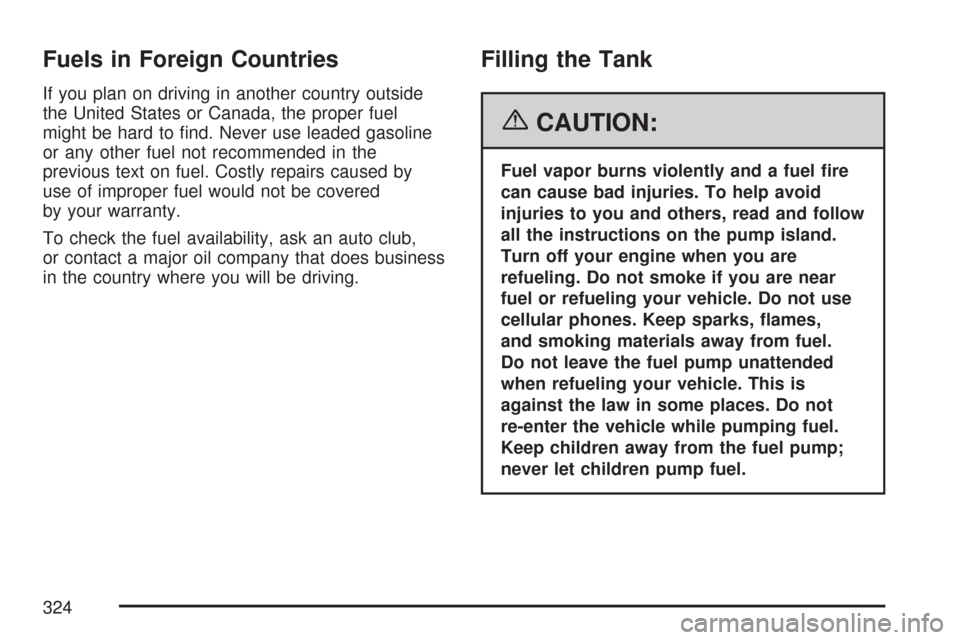
If you plan on driving in another country outside
the United States or Canada, the proper fuel
might be hard to nd. Never use leaded gasoline
or any other fuel not recommended in the
previous text on fuel. Costly repairs caused by
use of improper fuel would not be covered
by your warranty.
To check the fuel availability, ask an auto club,
or contact a major oil company that does business
in the country where you will be driving.
Filling the Tank
{CAUTION:
Fuel vapor burns violently and a fuel re
can cause bad injuries. To help avoid
injuries to you and others, read and follow
all the instructions on the pump island.
Turn off your engine when you are
refueling. Do not smoke if you are near
fuel or refueling your vehicle. Do not use
cellular phones. Keep sparks, ames,
and smoking materials away from fuel.
Do not leave the fuel pump unattended
when refueling your vehicle. This is
against the law in some places. Do not
re-enter the vehicle while pumping fuel.
Keep children away from the fuel pump;
never let children pump fuel.
324
Page 328 of 488
Checking Things Under
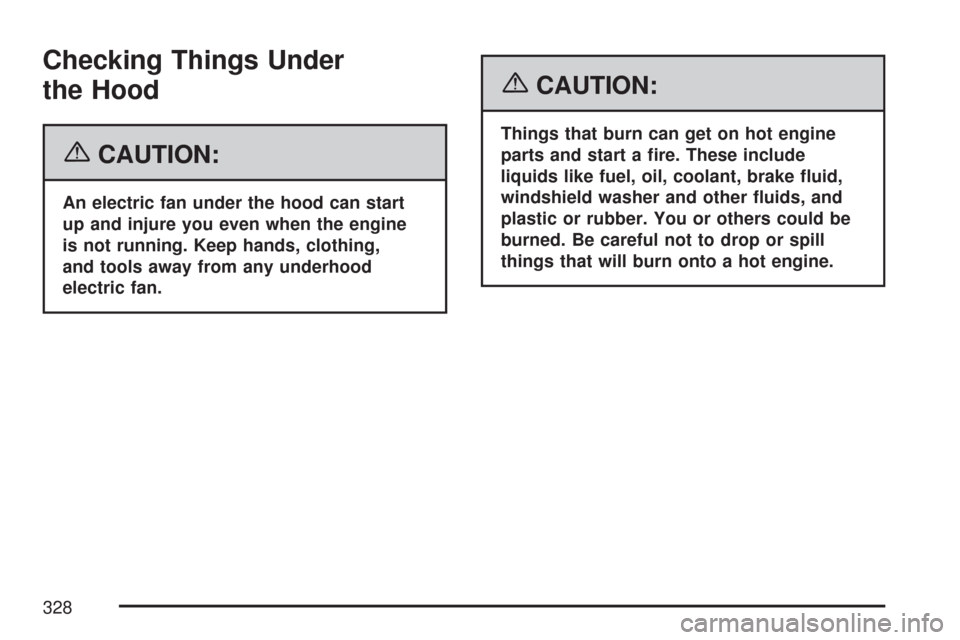
the Hood
{CAUTION:
An electric fan under the hood can start
up and injure you even when the engine
is not running. Keep hands, clothing,
and tools away from any underhood
electric fan.
{CAUTION:
Things that burn can get on hot engine
parts and start a re. These include
liquids like fuel, oil, coolant, brake uid,
windshield washer and other uids, and
plastic or rubber. You or others could be
burned. Be careful not to drop or spill
things that will burn onto a hot engine.
328
Page 331 of 488
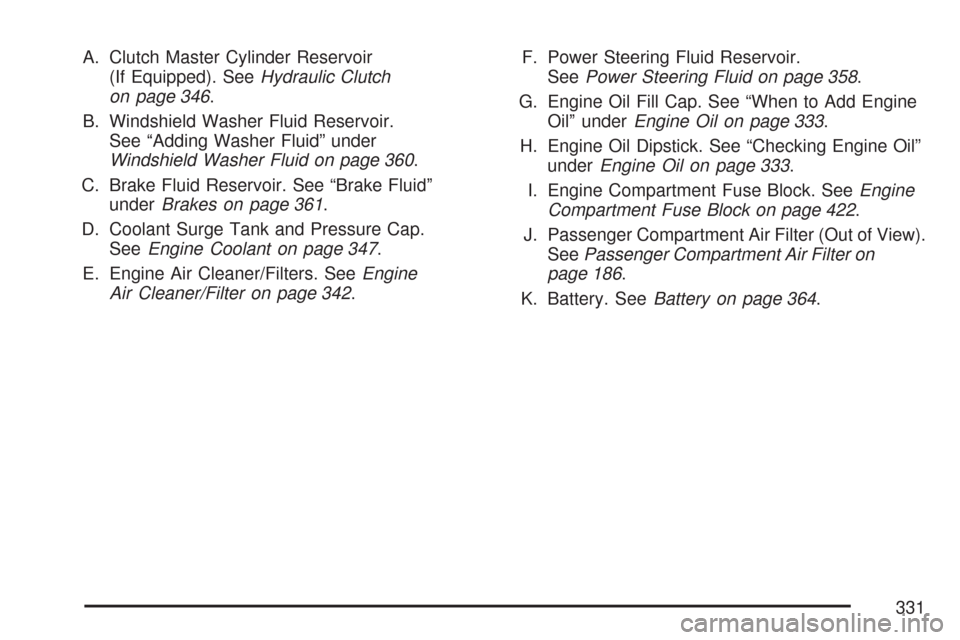
A. Clutch Master Cylinder Reservoir
(If Equipped). SeeHydraulic Clutch
on page 346.
B. Windshield Washer Fluid Reservoir.
See “Adding Washer Fluid” under
Windshield Washer Fluid on page 360.
C. Brake Fluid Reservoir. See “Brake Fluid”
underBrakes on page 361.
D. Coolant Surge Tank and Pressure Cap.
SeeEngine Coolant on page 347.
E. Engine Air Cleaner/Filters. SeeEngine
Air Cleaner/Filter on page 342.F. Power Steering Fluid Reservoir.
SeePower Steering Fluid on page 358.
G. Engine Oil Fill Cap. See “When to Add Engine
Oil” underEngine Oil on page 333.
H. Engine Oil Dipstick. See “Checking Engine Oil”
underEngine Oil on page 333.
I. Engine Compartment Fuse Block. SeeEngine
Compartment Fuse Block on page 422.
J. Passenger Compartment Air Filter (Out of View).
SeePassenger Compartment Air Filter on
page 186.
K. Battery. SeeBattery on page 364.
331