Page 320 of 488
California Proposition 65 Warning
Most motor vehicles, including this one, contain
and/or emit chemicals known to the State of
California to cause cancer and birth defects
or other reproductive harm. Engine exhaust,
many parts and systems (including some
inside the vehicle), many uids, and some
component wear by-products contain and/or
emit these chemicals.
Doing Your Own Service Work
{CAUTION:
You can be injured and your vehicle
could be damaged if you try to do
service work on a vehicle without
knowing enough about it.
Be sure you have sufficient
knowledge, experience, the proper
replacement parts, and tools
before you attempt any vehicle
maintenance task.
Be sure to use the proper nuts, bolts,
and other fasteners. English and
metric fasteners can be easily
confused. If you use the wrong
fasteners, parts can later break or
fall off. You could be hurt.
320
Page 331 of 488
A. Clutch Master Cylinder Reservoir
(If Equipped). SeeHydraulic Clutch
on page 346.
B. Windshield Washer Fluid Reservoir.
See “Adding Washer Fluid” under
Windshield Washer Fluid on page 360.
C. Brake Fluid Reservoir. See “Brake Fluid”
underBrakes on page 361.
D. Coolant Surge Tank and Pressure Cap.
SeeEngine Coolant on page 347.
E. Engine Air Cleaner/Filters. SeeEngine
Air Cleaner/Filter on page 342.F. Power Steering Fluid Reservoir.
SeePower Steering Fluid on page 358.
G. Engine Oil Fill Cap. See “When to Add Engine
Oil” underEngine Oil on page 333.
H. Engine Oil Dipstick. See “Checking Engine Oil”
underEngine Oil on page 333.
I. Engine Compartment Fuse Block. SeeEngine
Compartment Fuse Block on page 422.
J. Passenger Compartment Air Filter (Out of View).
SeePassenger Compartment Air Filter on
page 186.
K. Battery. SeeBattery on page 364.
331
Page 333 of 488
A. Engine Air Cleaner/Filter. SeeEngine
Air Cleaner/Filter on page 342.
B. Power Steering Fluid Reservoir.
SeePower Steering Fluid on page 358.
C. Engine Compartment Fuse Block. SeeEngine
Compartment Fuse Block on page 422.
D. Remote Positive Terminal (Out of View).
SeeBattery on page 364.
E. Engine Oil Dipstick. See “Checking Engine Oil”
underEngine Oil on page 333.
F. Dry Sump Engine Oil Tank. See “Changing
Engine Oil and Filter (Z06 Only)”Engine Oil
on page 333.
G. Engine Oil Fill Cap. See “When to Add
Engine Oil” underEngine Oil on page 333.
H. Coolant Surge Tank and Pressure Cap.
SeeEngine Coolant on page 347.
I. Windshield Washer Fluid Reservoir.
See “Adding Washer Fluid” under
Windshield Washer Fluid on page 360.
J. Brake Fluid Reservoir. See “Brake Fluid”
underBrakes on page 361.
K. Clutch Master Cylinder Reservoir.
SeeHydraulic Clutch on page 346.Engine Oil
Checking Engine Oil (Except Z06)
If the CHECK OIL LEVEL message on the Driver
Information Center (DIC) comes on, check the
engine oil level right away. For more information,
seeDriver Information Center (DIC) on page 207.
You should check the engine oil level regularly;
this is an added reminder.
It is a good idea to check the engine oil level
every time you get fuel. In order to get an accurate
reading, the oil must be warm and the vehicle
must be on level ground.
The engine oil dipstick handle is a yellow loop.
SeeEngine Compartment Overview on page 330
for the location of the engine oil dipstick.
1. Turn off the engine and give the oil a few
minutes to drain back into the oil pan. If
you do not do this, the oil dipstick might not
show the actual level.
2. Pull out the dipstick and clean it with a
lint-free paper towel or a cloth, then push
it back in all the way. Remove it again,
keeping the tip down.
333
Page 366 of 488
Notice:If you leave your radio or other
accessories on during the jump starting
procedure, they could be damaged. The
repairs would not be covered by your
warranty. Always turn off your radio and
other accessories when jump starting
your vehicle.
3. Turn off the ignition on both vehicles. Unplug
unnecessary accessories plugged into the
cigarette lighter or the accessory power outlet.
Turn off the radio and all lamps that are not
needed. This will avoid sparks and help save
both batteries. And it could save the radio!
4. Open the hoods and locate the positive (+) and
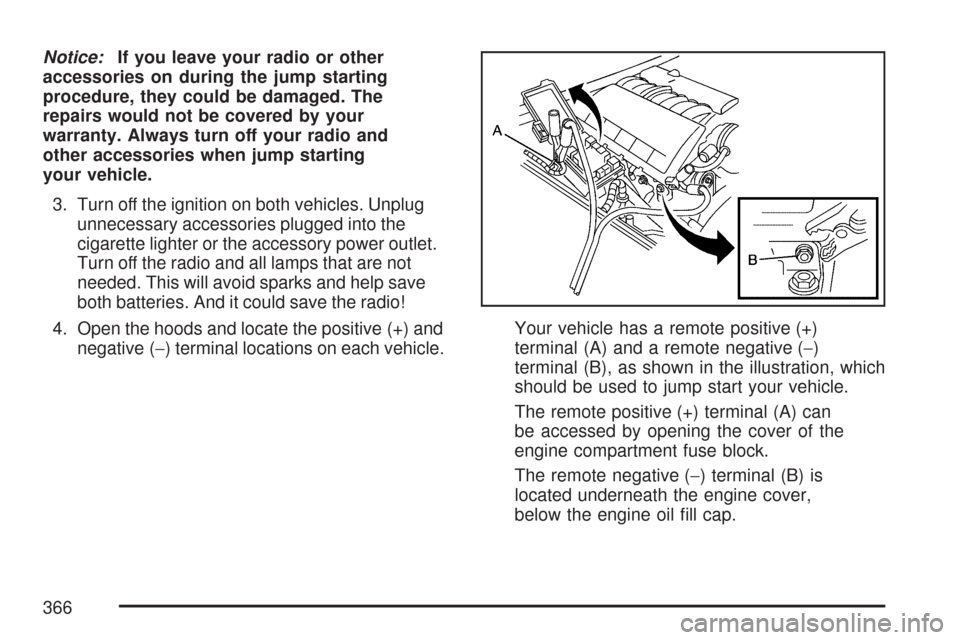
negative (−) terminal locations on each vehicle.Your vehicle has a remote positive (+)
terminal (A) and a remote negative (−)
terminal (B), as shown in the illustration, which
should be used to jump start your vehicle.
The remote positive (+) terminal (A) can
be accessed by opening the cover of the
engine compartment fuse block.
The remote negative (−) terminal (B) is
located underneath the engine cover,
below the engine oil ll cap.
366
Page 367 of 488
SeeEngine Compartment Overview on
page 330for the location of the engine
compartment fuse block and engine oil ll cap.
You will not need to access the battery for
jump starting. The remote terminals are
for that purpose.
{CAUTION:
An electric fan can start up even when the
engine is not running and can injure you.
Keep hands, clothing and tools away from
any underhood electric fan.
{CAUTION:
Using a match near a battery can cause
battery gas to explode. People have
been hurt doing this, and some have
been blinded. Use a ashlight if you
need more light.
CAUTION: (Continued)
CAUTION: (Continued)
Be sure the battery has enough water.
You do not need to add water to the
battery installed in your new vehicle.
But if a battery has ller caps, be sure the
right amount of uid is there. If it is low,
add water to take care of that rst. If you
do not, explosive gas could be present.
Battery uid contains acid that can
burn you. Do not get it on you. If you
accidentally get it in your eyes or on
your skin, ush the place with water
and get medical help immediately.
{CAUTION:
Fans or other moving engine parts can
injure you badly. Keep your hands away
from moving parts once the engine is
running.
367
Page 369 of 488
Notice:If the jumper cables are connected or
removed in the wrong order, electrical shorting
may occur and damage the vehicle. The repairs
would not be covered by your warranty. Always
connect and remove the jumper cables in the
correct order, making sure that the cables do
not touch each other or other metal.
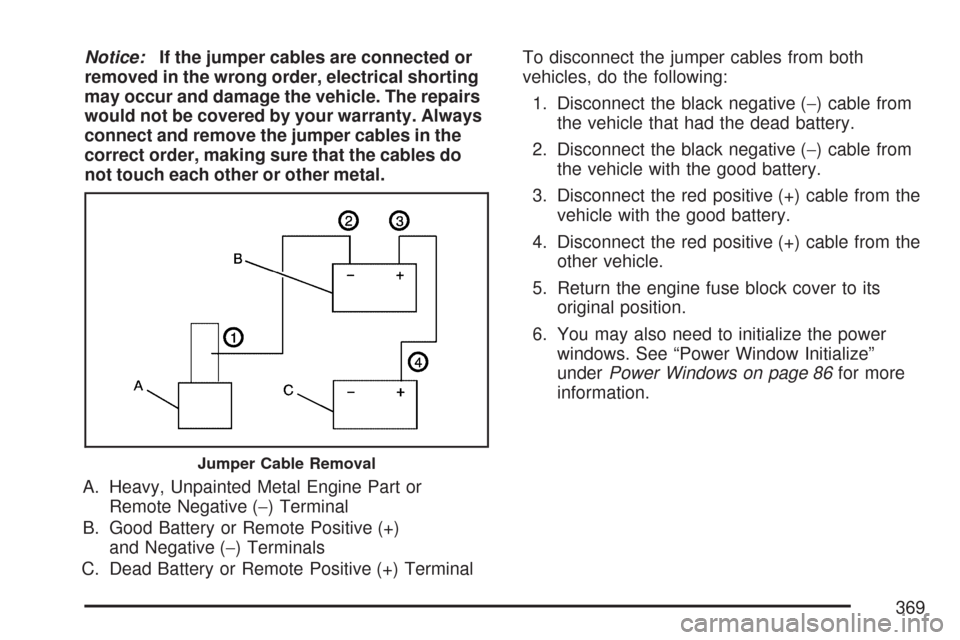
A. Heavy, Unpainted Metal Engine Part or
Remote Negative (−) Terminal
B. Good Battery or Remote Positive (+)
and Negative (−) Terminals
C. Dead Battery or Remote Positive (+) TerminalTo disconnect the jumper cables from both
vehicles, do the following:
1. Disconnect the black negative (−) cable from
the vehicle that had the dead battery.
2. Disconnect the black negative (−) cable from
the vehicle with the good battery.
3. Disconnect the red positive (+) cable from the
vehicle with the good battery.
4. Disconnect the red positive (+) cable from the
other vehicle.
5. Return the engine fuse block cover to its
original position.
6. You may also need to initialize the power
windows. See “Power Window Initialize”
underPower Windows on page 86for more
information.
Jumper Cable Removal
369
Page 419 of 488

Headlamp Wiring
The headlamp wiring is protected by fuses in the
fuse block. An electrical overload will cause
the lamps to turn off. If this happens, have your
headlamp wiring checked right away.
Windshield Wiper Fuses
The windshield wiper motor is protected by a
fuse and an internal circuit breaker. If the motor
overheats due to heavy snow, etc., the wiper will
stop until the motor cools. If the overload is caused
by some electrical problem and not snow, etc.,
be sure to get it xed.
Power Windows and Other
Power Options
Circuit breakers protect the power seats, power
windows, and other power accessories. When the
current load is too heavy, the circuit breaker opens
and closes, protecting the circuit until the problem
is xed or goes away.
Fuses and Circuit Breakers
The wiring circuits in your vehicle are protected from
short circuits by a combination of J-Case fuses,
mini-fuses and circuit breakers. This greatly reduces
the chance of res caused by electrical problems.
Look at the silver-colored band inside the fuse.
If the band is broken or melted, replace the
fuse. Be sure you replace a bad fuse with a
new one of the identical size and rating.
If you ever have a problem on the road and do not
have a spare fuse, you can borrow one that has the
same amperage. Just pick some feature of your
vehicle that you can get along without — like
the radio or cigarette lighter — and use its fuse,
if it is the correct amperage. Replace it as soon
as you can.
Instrument Panel Fuse Block
The instrument panel fuse block is located on
the passenger’s side of the vehicle, under
the instrument panel and under the toe-board.
419
Page 420 of 488
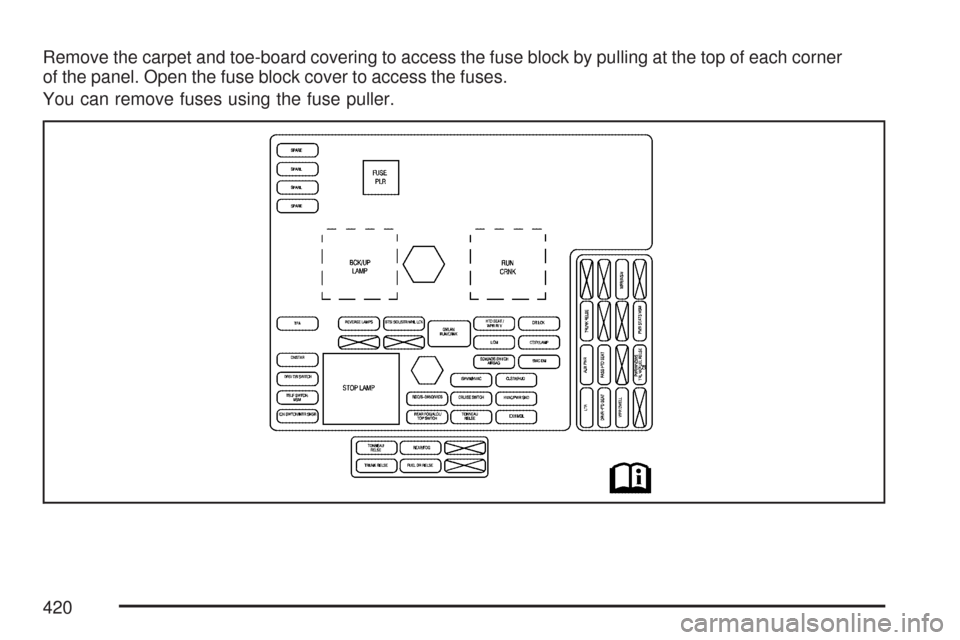
Remove the carpet and toe-board covering to access the fuse block by pulling at the top of each corner
of the panel. Open the fuse block cover to access the fuses.
You can remove fuses using the fuse puller.
420