Page 281 of 488
Remember: ABS does not change the time you
need to get your foot up to the brake pedal
or always decrease stopping distance. If you get
too close to the vehicle in front of you, you will
not have time to apply the brakes if that vehicle
suddenly slows or stops. Always leave enough
room up ahead to stop, even though you
have ABS.
Using ABS
Do not pump the brakes. Just hold the brake
pedal down rmly and let anti-lock work for you.
You might hear a motor or clicking noise and
feel the brake pedal move a little during a stop,
but this is normal.
Braking in Emergencies
With ABS, you can steer and brake at the same
time. In many emergencies, steering can help you
more than even the very best braking.
Traction Control System (TCS)
Your vehicle has a traction control system called
TCS that limits wheel spin. This is especially useful
in slippery road conditions. The system operates
only if it senses that the rear wheels are spinning
too much or are beginning to lose traction.
When this happens, the system works the rear
brakes and reduces engine power (by closing the
throttle and managing engine spark) to limit
wheel spin.
The TRACTION SYSTEM ACTIVE message
displays on the Driver Information Center (DIC)
when the TCS system is limiting wheel spin.
SeeDIC Warnings and Messages on page 214.
You may feel or hear the system working,
but this is normal.
If your vehicle is in cruise control when the
TCS system begins to limit wheel spin, the cruise
control will automatically disengage. When
road conditions allow you to safely use it again,
you may re-engage the cruise control. See
Turn Signal/Multifunction Lever on page 160.
281
Page 292 of 488
If your vehicle starts to slide, ease your foot off the
accelerator pedal and quickly steer the way you
want the vehicle to go. If you start steering quickly
enough, your vehicle may straighten out. Always
be ready for a second skid if it occurs.
Of course, traction is reduced when water, snow,
ice, gravel, or other material is on the road.
For safety, you will want to slow down and adjust
your driving to these conditions. It is important
to slow down on slippery surfaces because
stopping distance will be longer and vehicle
control more limited.
While driving on a surface with reduced traction, try
your best to avoid sudden steering, acceleration,
or braking, including reducing vehicle speed by
shifting to a lower gear. Any sudden changes could
cause the tires to slide. You may not realize the
surface is slippery until your vehicle is skidding.
Learn to recognize warning clues — such as
enough water, ice, or packed snow on the road
to make a mirrored surface — and slow down
when you have any doubt.
Remember: Any Anti-Lock Brake System (ABS)
helps avoid only the braking skid.Racing or Other Competitive Driving
See your warranty book before using your
vehicle for racing or other competitive driving.
Notice:If you use your vehicle for racing or
other competitive driving, the engine may
use more oil than it would with normal
use. Low oil levels can damage the engine.
For information on how to add oil, see
Engine Oil on page 333.
Z06 Only: Be sure to check the oil level often
during racing or other competitive driving
and keep the level at or near the upper mark
that shows the proper operating range on
the engine oil dipstick.
Except Z06: Be sure to check the oil level
often during racing or other competitive driving
and keep the level at or near 1 quart (1 L)
above the upper mark that shows the proper
operating range on the engine oil dipstick.
After the competitive driving, remove excess
oil so that the level on the dipstick is not
above the upper mark that shows the proper
operating range.
292
Page 306 of 488
The Anti-Lock Brake System (ABS) improves your
vehicle’s stability when you make a hard stop
on a slippery road. Even though you have ABS,
you will want to begin stopping sooner than
you would on dry pavement. SeeAnti-Lock Brake
System (ABS) on page 279.
Allow greater following distance on any
slippery road.
Watch for slippery spots. The road might be
ne until you hit a spot that is covered with
ice. On an otherwise clear road, ice patches
may appear in shaded areas where the
sun cannot reach, such as around clumps
of trees, behind buildings, or under bridges.
Sometimes the surface of a curve or an
overpass may remain icy when the
surrounding roads are clear. If you see a
patch of ice ahead of you, brake before
you are on it. Try not to brake while you
are actually on the ice, and avoid sudden
steering maneuvers.
If You Are Caught in a Blizzard
If you are stopped by heavy snow, you could be
in a serious situation. You should probably stay
with your vehicle unless you know for sure that you
are near help and you can hike through the snow.
Here are some things to do to summon help and
keep yourself and your passengers safe:
Turn on your hazard ashers.
Tie a red cloth to your vehicle to alert police
that you have been stopped by the snow.
Put on extra clothing or wrap a blanket
around you. If you do not have blankets or
extra clothing, make body insulators from
newspapers, burlap bags, rags, oor
mats — anything you can wrap around
yourself or tuck under your clothing to
keep warm.
306
Page 373 of 488
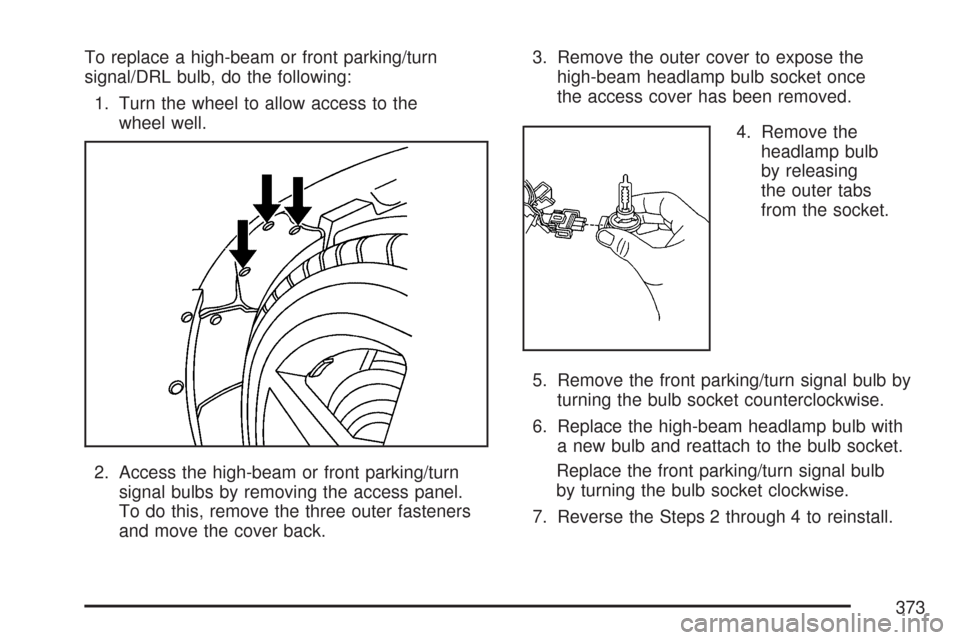
To replace a high-beam or front parking/turn
signal/DRL bulb, do the following:
1. Turn the wheel to allow access to the
wheel well.
2. Access the high-beam or front parking/turn
signal bulbs by removing the access panel.
To do this, remove the three outer fasteners
and move the cover back.3. Remove the outer cover to expose the
high-beam headlamp bulb socket once
the access cover has been removed.
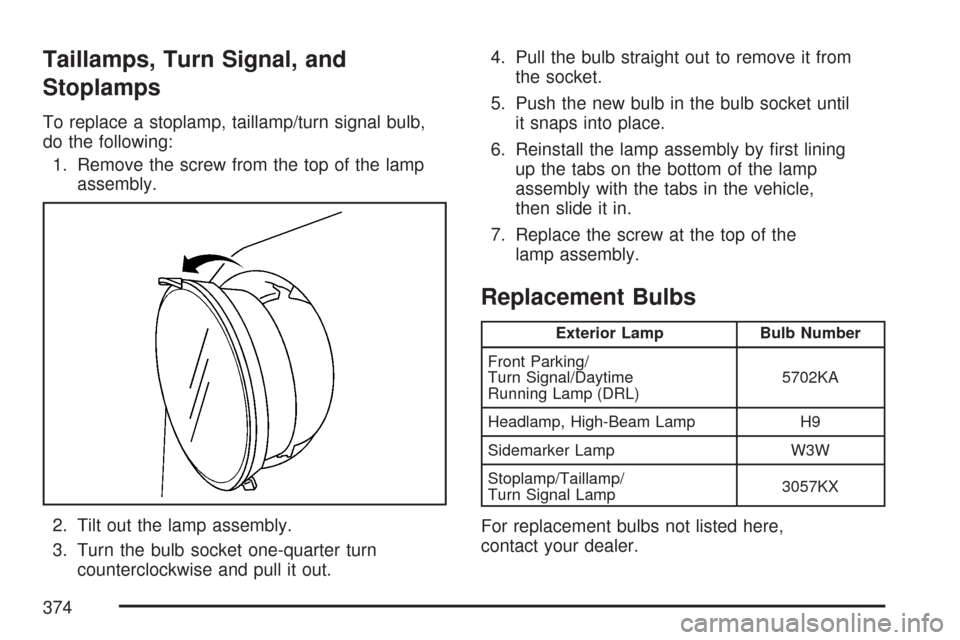
4. Remove the
headlamp bulb
by releasing
the outer tabs
from the socket.
5. Remove the front parking/turn signal bulb by
turning the bulb socket counterclockwise.
6. Replace the high-beam headlamp bulb with
a new bulb and reattach to the bulb socket.
Replace the front parking/turn signal bulb
by turning the bulb socket clockwise.
7. Reverse the Steps 2 through 4 to reinstall.
373
Page 374 of 488
Taillamps, Turn Signal, and
Stoplamps
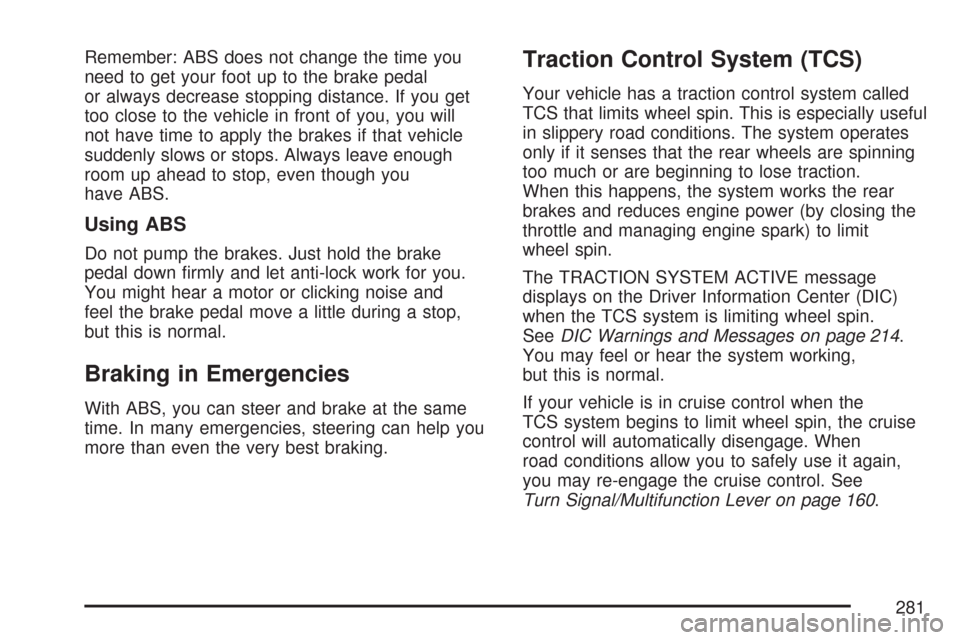
To replace a stoplamp, taillamp/turn signal bulb,
do the following:
1. Remove the screw from the top of the lamp
assembly.
2. Tilt out the lamp assembly.
3. Turn the bulb socket one-quarter turn
counterclockwise and pull it out.4. Pull the bulb straight out to remove it from
the socket.
5. Push the new bulb in the bulb socket until
it snaps into place.
6. Reinstall the lamp assembly by rst lining
up the tabs on the bottom of the lamp
assembly with the tabs in the vehicle,
then slide it in.
7. Replace the screw at the top of the
lamp assembly.
Replacement Bulbs
Exterior Lamp Bulb Number
Front Parking/
Turn Signal/Daytime
Running Lamp (DRL)5702KA
Headlamp, High-Beam Lamp H9
Sidemarker Lamp W3W
Stoplamp/Taillamp/
Turn Signal Lamp3057KX
For replacement bulbs not listed here,
contact your dealer.
374
Page 409 of 488
Fabric/Carpet
Use a vacuum cleaner with a soft brush
attachment frequently to remove dust and loose
dirt. A canister vacuum with a beater bar in
the nozzle may only be used on oor carpet and
carpeted oor mats. For soils, always try to remove
them rst with plain water or club soda. Before
cleaning, gently remove as much of the soil
as possible using one of the following techniques:
For liquids: gently blot the remaining soil
with a paper towel. Allow the soil to absorb
into the paper towel until no more can
be removed.
For solid dry soils: remove as much as
possible and then vacuum.
To clean, use the following instructions:
1. Saturate a lint-free, clean white cloth with
water or club soda.
2. Wring the cloth to remove excess moisture.
3. Start on the outside edge of the soil and gently
rub toward the center. Continue cleaning,
using a clean area of the cloth each time it
becomes soiled.4. Continue to gently rub the soiled area until
the cleaning cloth remains clean.
5. If the soil is not completely removed, use a
mild soap solution and repeat the cleaning
process that was used with plain water.
If any of the soil remains, a commercial fabric
cleaner or spot lifter may be necessary. When
a commercial upholstery cleaner or spot lifter
is to be used, test a small hidden area for
colorfastness rst. If the locally cleaned area
gives any impression that a ring formation may
result, clean the entire surface.
After the cleaning process has been completed,
a paper towel can be used to blot excess moisture
from the fabric or carpet.
Coated Moldings
These moldings are around the hatch opening
in the rear area.
When lightly soiled, wipe with a sponge or
soft lint-free cloth dampened with water.
When heavily soiled, use warm soapy water.
409