Page 186 of 496

Passenger Airbag Status Indicator
Your vehicle has the passenger sensing system.
Your instrument panel has a passenger airbag
status indicator.
When the ignition key is turned to ON or START,
the passenger airbag status indicator will light
ON and OFF, or the symbol for on and off,
for several seconds as a system check. Then,
after several more seconds, the status indicator
will light either ON or OFF, or either the on
or off symbol to let you know the status of the
right front passenger’s frontal airbag.There is a label on your sun visor that says,
“Never put a rear-facing child seat in the front.”
This is because the risk to the rear-facing child
is so great if the airbag deploys.
{CAUTION:
Even though the passenger sensing
system is designed to turn off the right
front passenger’s frontal airbag if the
system detects a rear-facing child restraint,
no system is fail-safe, and no one can
guarantee that an airbag will not deploy
under some unusual circumstance, even
though it is turned off. We recommend that
rear-facing child restraints be secured in
the rear seat, even if the airbag is off.
United StatesCanada
186
Page 189 of 496
Up-Shift Light
(Manual Transmission)
This light appears
when you need to
shift to the next higher
gear on a manual
transmission vehicle.
Shifting when the indicator light is on will help you
get the best fuel economy. See “Up-Shift Light”
underManual Transmission Operation on
page 126for more information.
Brake System Warning Light
Your vehicle’s hydraulic brake system is divided
into two parts. If one part is not working, the
other part can still work and stop you. For good
braking, though, you need both parts working well.
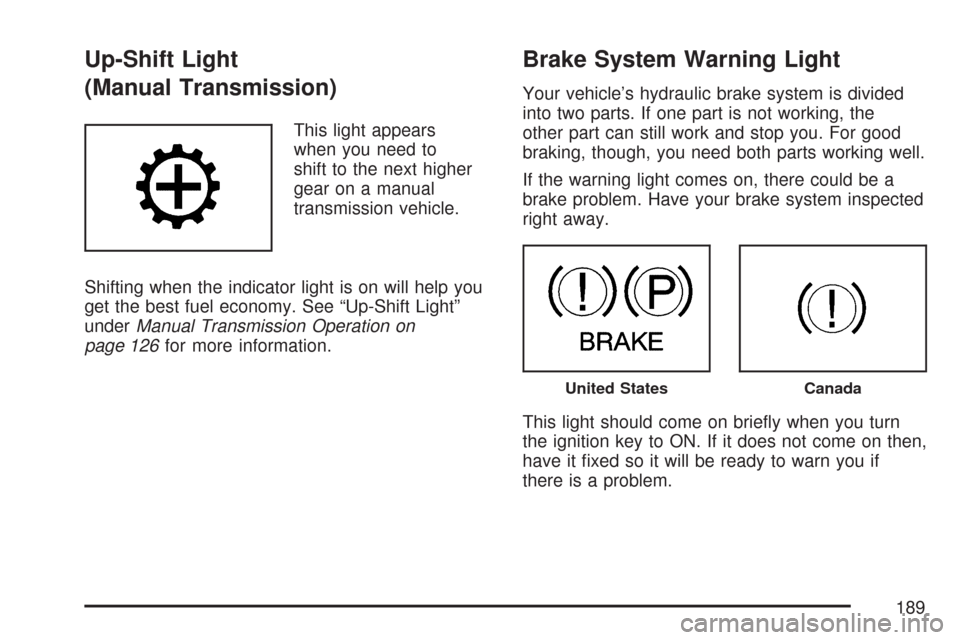
If the warning light comes on, there could be a
brake problem. Have your brake system inspected
right away.
This light should come on briey when you turn
the ignition key to ON. If it does not come on then,
have it xed so it will be ready to warn you if
there is a problem.
United StatesCanada
189
Page 190 of 496

When the ignition is on, the brake system warning
light will also come on when you set your parking
brake. SeeParking Brake on page 133for more
information. The light will stay on if your parking
brake does not release fully. If it stays on after your
parking brake is fully released, it means you have a
brake problem.
If the light comes on while you are driving, pull off
the road and stop carefully. You may notice that the
pedal is harder to push, or the pedal may go closer
to the oor. It may take longer to stop. If the light
is still on, have the vehicle towed for service.
SeeTowing Your Vehicle on page 299.
{CAUTION:
Your brake system may not be working
properly if the brake system warning light
is on. Driving with the brake system
warning light on can lead to an accident.
If the light is still on after you have pulled
off the road and stopped carefully, have
the vehicle towed for service.
Anti-Lock Brake System
Warning Light
With the Anti-Lock Brake
System (ABS), this light
will come on briey when
you start your engine
to show it is working.
Then it will turn off.
This is normal.
If the light stays on, or comes on when you are
driving, your vehicle needs service. If the regular
brake system warning light is not on, you still
have brakes, but you do not have anti-lock brakes.
If the regular brake system warning light is also
on, you do not have anti-lock brakes and there is
a problem with your regular brakes. SeeBrake
System Warning Light on page 189.
The ABS warning light should come on briey
when you turn the ignition key to ON. If the light
does not come on then, have it xed so it will
be ready to warn you if there is a problem.
190
Page 191 of 496

Engine Coolant Temperature Gage
This gage shows the
engine coolant
temperature.
If the gage pointer is near the top of the gage,
the engine is too hot. It means that your engine
coolant has overheated. If you have been
operating your vehicle under normal driving
conditions, you should pull off the road, stop
your vehicle and turn off the engine as soon
as possible.
SeeEngine Overheating on page 348for
more information.
Tire Pressure Light
This light should come
on briey when you turn
the ignition to ON.
This light will also come on when one or more
of your tires are signicantly underinated.
A LOW TIRE message will also appear in the
Driver Information Center (DIC), seeDIC Warnings
and Messages on page 202for more information.
Stop and check your tires as soon as it is safe to do
so. If underinated, inate to the proper pressure.
SeeTires on page 377for more information.
This light will ash for 60 seconds and then turn on
solid if a problem is detected with the Tire Pressure
Monitor system. SeeTire Pressure Monitor System
on page 385for more information.
191
Page 192 of 496

Malfunction Indicator Lamp
Check Engine Light
Your vehicle has
a computer which
monitors operation
of the fuel, ignition,
and emission
control systems.
This system is called OBD II (On-Board
Diagnostics-Second Generation) and is intended
to assure that emissions are at acceptable
levels for the life of the vehicle, helping to produce
a cleaner environment. The check engine light
comes on to indicate that there is a problem and
service is required. Malfunctions often will be
indicated by the system before any problem is
apparent. This may prevent more serious damage
to your vehicle. This system is also designed
to assist your service technician in correctly
diagnosing any malfunction.Notice:If you keep driving your vehicle with
this light on, after awhile, the emission controls
might not work as well, your vehicle’s fuel
economy might not be as good, and the engine
might not run as smoothly. This could lead
to costly repairs that might not be covered
by your warranty.
Notice:Modications made to the engine,
transmission, exhaust, intake, or fuel system
of your vehicle or the replacement of the
original tires with other than those of the same
Tire Performance Criteria (TPC) can affect
your vehicle’s emission controls and can cause
this light to come on. Modications to these
systems could lead to costly repairs not
covered by your warranty. This could also
result in a failure to pass a required Emission
Inspection/Maintenance test. SeeAccessories
and Modifications on page 324.
192
Page 193 of 496

This light should come on, as a check to show you
it is working, when the ignition is on and the engine
is not running. If the light does not come on, have
it repaired. This light will also come on during a
malfunction in one of two ways:
Light Flashing— A misre condition has been
detected. A misre increases vehicle emissions
and may damage the emission control system
on your vehicle. Diagnosis and service may
be required.
Light On Steady— An emission control
system malfunction has been detected on
your vehicle. Diagnosis and service may
be required.
If the Light is Flashing
The following may prevent more serious damage
to your vehicle:
Reducing vehicle speed
Avoiding hard accelerations
Avoiding steep uphill grades
If you are towing a trailer, reduce the
amount of cargo being hauled as soon
as it is possibleIf the light stops ashing and remains on steady,
see “If the Light Is On Steady” following.
If the light continues to ash, when it is safe to
do so, stop the vehicle. Find a safe place to park
your vehicle. Turn the key off, wait at least
10 seconds and restart the engine. If the light
remains on steady, see “If the Light Is On Steady”
following. If the light is still ashing, follow the
previous steps, and see your dealer for service
as soon as possible.
If the Light Is On Steady
You may be able to correct the emission system
malfunction by considering the following:
Did you recently put fuel into your vehicle?
If so, reinstall the fuel cap, making sure to fully
install the cap. SeeFilling the Tank on page 328.
The diagnostic system can determine if the
fuel cap has been left off or improperly installed.
A loose or missing fuel cap will allow fuel to
evaporate into the atmosphere. A few driving
trips with the cap properly installed should turn
the light off.
193
Page 196 of 496
Security Light
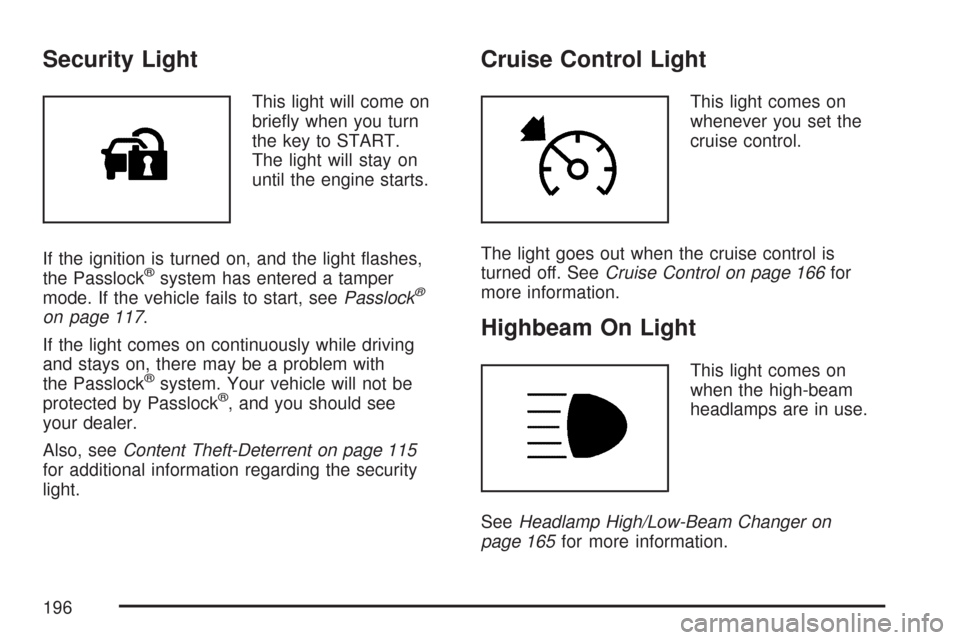
This light will come on
briey when you turn
the key to START.
The light will stay on
until the engine starts.
If the ignition is turned on, and the light ashes,
the Passlock
®system has entered a tamper
mode. If the vehicle fails to start, seePasslock®
on page 117.
If the light comes on continuously while driving
and stays on, there may be a problem with
the Passlock
®system. Your vehicle will not be
protected by Passlock®, and you should see
your dealer.
Also, seeContent Theft-Deterrent on page 115
for additional information regarding the security
light.
Cruise Control Light
This light comes on
whenever you set the
cruise control.
The light goes out when the cruise control is
turned off. SeeCruise Control on page 166for
more information.
Highbeam On Light
This light comes on
when the high-beam
headlamps are in use.
SeeHeadlamp High/Low-Beam Changer on
page 165for more information.
196
Page 197 of 496

Daytime Running Lamps (DRL)
Indicator Light
This light turns
on whenever the
Daytime Running
Lamps are on.
SeeDaytime Running Lamps (DRL) on page 171
for more information.
Fuel Gage
When the ignition
is on, the fuel gage
tells you about
how much fuel you
have remaining in
the fuel tank.Here are four things that some owners ask
about. None of these indicate a problem with
your fuel gage:
At the gas station, the gas pump shuts off
before the gage reads full.
It takes a little more or less fuel to ll up than
the gage indicated. For example, the gage
may have indicated the tank was half full,
but it actually took a little more or less than
half the tank’s capacity to ll the tank.
The gage moves a little when you turn a
corner or speed up.
The gage does not go back to empty when
you turn off the ignition.
When the fuel in the fuel tank is low, you will see
a LOW FUEL message on the Driver Information
Center (DIC) display. SeeDIC Warnings and
Messages on page 202for more information.
197