Page 346 of 496
What to Use
Use a mixture of one-half clean, drinkable water
and one-half DEX-COOL®coolant which will
not damage aluminum parts. If you use this coolant
mixture, you do not need to add anything else.
{CAUTION:
Adding only plain water to your cooling
system can be dangerous. Plain water, or
some other liquid such as alcohol, can
boil before the proper coolant mixture will.
Your vehicle’s coolant warning system is
set for the proper coolant mixture. With
plain water or the wrong mixture, your
engine could get too hot but you would
not get the overheat warning. Your engine
could catch re and you or others could
be burned. Use a 50/50 mixture of clean,
drinkable water and the proper coolant.Notice:If you use an improper coolant
mixture, your engine could overheat and be
badly damaged. The repair cost would not be
covered by your warranty. Too much water
in the mixture can freeze and crack the engine,
radiator, heater core, and other parts.
Notice:If you use extra inhibitors and/or
additives in your vehicle’s cooling system,
you could damage your vehicle. Use only
the proper mixture of the engine coolant
listed in this manual for the cooling system.
SeeRecommended Fluids and Lubricants
on page 452for more information.
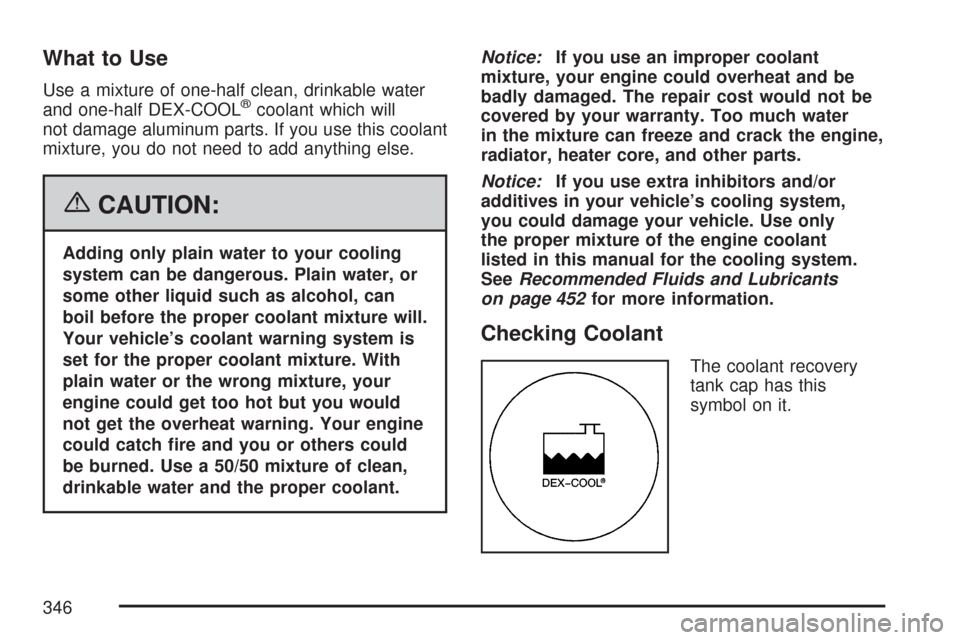
Checking Coolant
The coolant recovery
tank cap has this
symbol on it.
346
Page 347 of 496

It is located toward the rear of the engine
compartment on the passenger’s side of the
vehicle. SeeEngine Compartment Overview
on page 332for more information on location.
The vehicle must be on a level surface. When
your engine is cold, the coolant level should be
at FULL COLD, or a little higher. When your
engine is warm, the level could be above the
FULL COLD level.
Adding Coolant
If you need more coolant, add the proper
DEX-COOL®coolant mixture at the coolant
recovery tank.
{CAUTION:
Turning the radiator pressure cap when
the engine and radiator are hot can allow
steam and scalding liquids to blow out
and burn you badly. With the coolant
recovery tank, you will almost never
have to add coolant at the radiator.
CAUTION: (Continued)
CAUTION: (Continued)
Never turn the radiator pressure
cap — even a little — when the engine
and radiator are hot.
Add coolant mixture at the recovery tank, but be
careful not to spill it.
{CAUTION:
You can be burned if you spill coolant
on hot engine parts. Coolant contains
ethylene glycol, and it will burn if the
engine parts are hot enough. Do not
spill coolant on a hot engine.
Occasionally check the coolant level in the
radiator. For information on how to add
coolant to the radiator, seeCooling System
on page 350.
347
Page 350 of 496
Cooling System
When you decide it is safe to lift the hood,
here is what you will see:
A. Coolant Recovery Tank
B. Engine Cooling Fan
C. Radiator Pressure Cap
If the coolant inside the coolant recovery tank is
boiling, do not do anything else until it cools down.
The vehicle should be parked on a level surface.When the engine is cold, the coolant level should
be at least up to the FULL COLD mark. If it is
not, you may have a leak at the pressure cap or
in the radiator hoses, heater hoses, radiator, water
pump or somewhere else in the cooling system.
350
Page 351 of 496

{CAUTION:
Heater and radiator hoses, and other
engine parts, can be very hot. Do not
touch them. If you do, you can be burned.
Do not run the engine if there is a leak.
If you run the engine, it could lose all
coolant. That could cause an engine re,
and you could be burned. Get any leak
xed before you drive the vehicle.If there seems to be no leak, start the engine
again. The engine cooling fan speed should
increase when idle speed is doubled by pushing
the accelerator pedal down. If it does not,
your vehicle needs service. Turn off the engine.
Notice:Engine damage from running your
engine without coolant is not covered by
your warranty.
Notice:Using coolant other than DEX-COOL
®
may cause premature engine, heater core,
or radiator corrosion. In addition, the engine
coolant could require changing sooner,
at 30,000 miles (50 000 km) or 24 months,
whichever occurs rst. Any repairs would
not be covered by your warranty. Always
use DEX-COOL
®(silicate-free) coolant in
your vehicle.
351
Page 352 of 496

How to Add Coolant to the Coolant
Recovery Tank
If you have not found a problem yet, but the coolant
level is not at the FULL COLD mark, add a 50/50
mixture of clean, drinkable water and DEX-COOL
®
engine coolant at the coolant recovery tank. See
Engine Coolant on page 345for more information.
{CAUTION:
Adding only plain water to your cooling
system can be dangerous. Plain water,
or some other liquid such as alcohol, can
boil before the proper coolant mixture will.
Your vehicle’s coolant warning system is
set for the proper coolant mixture. With
plain water or the wrong mixture, your
engine could get too hot but you would
not get the overheat warning. Your engine
could catch re and you or others could
be burned. Use a 50/50 mixture of clean,
drinkable water and DEX-COOL
®coolant.Notice:In cold weather, water can freeze and
crack the engine, radiator, heater core and
other parts. Use the recommended coolant
and the proper coolant mixture.
{CAUTION:
You can be burned if you spill coolant
on hot engine parts. Coolant contains
ethylene glycol and it will burn if the
engine parts are hot enough. Do not
spill coolant on a hot engine.
When the coolant in the coolant recovery tank
is at the FULL COLD mark, start your vehicle.
352
Page 353 of 496
If the overheat warning continues, there is one
more thing you can try. Add the proper mixture
directly to the radiator, but be sure the cooling
system is cool before you do it.
{CAUTION:
Steam and scalding liquids from a hot
cooling system can blow out and burn you
badly. They are under pressure, and if you
turn the radiator pressure cap — even a
little — they can come out at high speed.
Never turn the cap when the cooling
system, including the radiator pressure
cap, is hot. Wait for the cooling system
and radiator pressure cap to cool if you
ever have to turn the pressure cap.
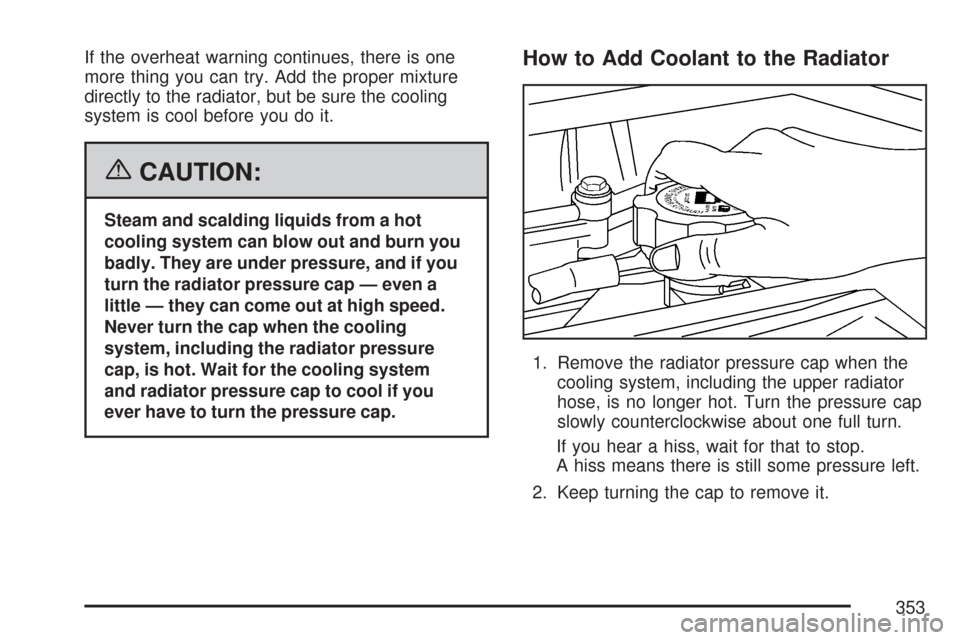
How to Add Coolant to the Radiator
1. Remove the radiator pressure cap when the
cooling system, including the upper radiator
hose, is no longer hot. Turn the pressure cap
slowly counterclockwise about one full turn.
If you hear a hiss, wait for that to stop.
A hiss means there is still some pressure left.
2. Keep turning the cap to remove it.
353
Page 354 of 496
3. Fill the radiator with the proper DEX-COOL®
coolant mixture, up to the base of the ller
neck. SeeEngine Coolant on page 345
for more information about the proper
coolant mixture.
4. Fill the coolant recovery tank to the
FULL COLD mark.
5. Reinstall the cap on the coolant recovery tank,
but leave the radiator pressure cap off.6. Start the engine and let it run until you can
feel the upper radiator hose getting hot.
Watch out for the engine cooling fan.
7. By this time, the coolant level inside the
radiator ller neck might be lower. If the level
is lower, add more of the proper DEX-COOL
®
coolant mixture through the ller neck until the
level reaches the base of the ller neck.
8. Then replace the pressure cap.
At any time during this procedure if coolant begins
to ow out of the ller neck, reinstall the pressure
cap. Be sure to secure it tightly.
354
Page 355 of 496

Engine Fan Noise
This vehicle has a clutched engine cooling fan.
When the clutch is engaged, the fan spins faster
to provide more air to cool the engine. In most
everyday driving conditions, the clutch is not
engaged. This improves fuel economy and reduces
fan noise. Under heavy vehicle loading, trailer
towing and/or high outside temperatures, the
fan speed increases when the clutch engages.
So you may hear an increase in fan noise.
This is normal and should not be mistaken as
the transmission slipping or making extra shifts.
It is merely the cooling system functioning
properly. The fan will slow down when additional
cooling is not required and the clutch disengages.
You may also hear this fan noise when you
start the engine. It will go away as the fan
clutch disengages.
Power Steering Fluid
The power steering uid
reservoir is located near
the front of the engine
compartment, behind
the radiator. SeeEngine
Compartment Overview
on page 332for
reservoir location.
When to Check Power Steering Fluid
It is not necessary to regularly check power
steering uid unless you suspect there is a leak
in the system or you hear an unusual noise.
A uid loss in this system could indicate a problem.
Have the system inspected and repaired.
355