2007 CHEVROLET COBALT fuel
[x] Cancel search: fuelPage 186 of 450

LOW COOLANT
If your vehicle has a 2.0L engine, this message
displays when there is a low level of engine
coolant. Have the cooling system serviced by your
dealer as soon as possible. SeeEngine Coolant
on page 302for more information.
LOW FUEL
This message displays when your vehicle is low
on fuel. Rell the fuel tank as soon as possible.
SeeFuel Gage on page 179,Fuel on page 282,
andFilling the Tank on page 285for more
information.
LOW TRACTION
If your vehicle has the Enhanced Traction System
(ETS), this message displays when the system
is actively limiting wheel spin. Slippery road
conditions may exist if this message displays,
so adjust your driving accordingly. SeeEnhanced
Traction System (ETS) on page 234for more
information.
PARKING BRAKE
This message displays if the parking brake is left
engaged. SeeParking Brake on page 123for
more information.
POWER STEERING
This message displays if a problem has been
detected with the electric power steering. Have
your vehicle serviced by your dealer immediately.
SERVICE AIR BAG
This message displays when there is a problem
with the airbag system. Have your vehicle serviced
by your dealer immediately.
TRUNK AJAR
This message displays when the trunk lid is not
closed completely. Make sure that the trunk
lid is closed completely. SeeTrunk on page 102.
DIC Vehicle Personalization
Your vehicle has personalization capabilities
that allow you to program certain features to a
preferred setting. All of the features listed may not
be available on your vehicle. Only the features
available will be displayed on the DIC.
The default settings for the features were set
when your vehicle left the factory, but may have
been changed from their default state since
that time.
186
Page 251 of 450

Here are some things you can check before a trip:
Windshield Washer Fluid:Is the reservoir
full? Are all windows clean inside and outside?
Wiper Blades:Are they in good shape?
Fuel, Engine Oil, Other Fluids:Have you
checked all levels?
Lamps:Are they all working? Are the
lenses clean?
Tires:They are vitally important to a safe,
trouble-free trip. Is the tread good enough
for long-distance driving? Are the tires
all inated to the recommended pressure?
Weather Forecasts:What is the weather
outlook along your route? Should you
delay your trip a short time to avoid a major
storm system?
Maps:Do you have up-to-date maps?
Highway Hypnosis
Is there actually such a condition as highway
hypnosis? Or is it just plain falling asleep at the
wheel? Call it highway hypnosis, lack of
awareness, or whatever.
There is something about an easy stretch of road
with the same scenery, along with the hum of the
tires on the road, the drone of the engine, and the
rush of the wind against the vehicle that can make
you sleepy. Do not let it happen to you! If it does,
your vehicle can leave the road in less than a
second, and you could crash and be injured.
What can you do about highway hypnosis?
First, be aware that it can happen.
Then here are some tips:
Make sure your vehicle is well ventilated,
with a comfortably cool interior.
Keep your eyes moving. Scan the road ahead
and to the sides. Check your rearview mirrors
and your instruments frequently.
If you get sleepy, pull off the road into a rest,
service, or parking area and take a nap, get
some exercise, or both. For safety, treat
drowsiness on the highway as an emergency.
251
Page 257 of 450

You can run the engine to keep warm, but be
careful.
{CAUTION:
Snow can trap exhaust gases under your
vehicle. This can cause deadly CO
(carbon monoxide) gas to get inside.
CO could overcome you and kill you.
You cannot see it or smell it, so you might
not know it is in your vehicle. Clear away
snow from around the base of your
vehicle, especially any that is blocking the
exhaust pipe. And check around again
from time to time to be sure snow does
not collect there.
Open a window just a little on the side of
the vehicle that is away from the wind.
This will help keep CO out.
Run the engine only as long as you must.
This saves fuel. When you run the engine, make it
go a little faster than just idle. That is, push the
accelerator slightly. This uses less fuel for the heat
that you get and it keeps the battery charged.
257
Page 258 of 450

You will need a well-charged battery to restart the
vehicle, and possibly for signaling later on with
the headlamps. Let the heater run for a while.
Then, shut the engine off and close the window
almost all the way to preserve the heat. Start the
engine again and repeat this only when you
feel really uncomfortable from the cold. But do it
as little as possible. Preserve the fuel as long
as you can. To help keep warm, you can get out
of the vehicle and do some fairly vigorous
exercises every half hour or so until help comes.
If Your Vehicle is Stuck in Sand,
Mud, Ice, or Snow
In order to free your vehicle when it is stuck,
you will need to spin the wheels, but you do not
want to spin your wheels too fast. The method
known as rocking can help you get out when you
are stuck, but you must use caution.
{CAUTION:
If you let your vehicle’s tires spin at high
speed, they can explode, and you or others
could be injured. And, the transaxle or
other parts of the vehicle can overheat.
That could cause an engine compartment
re or other damage. When you are stuck,
spin the wheels as little as possible. Do not
spin the wheels above 35 mph (55 km/h) as
shown on the speedometer.
Notice:Spinning the wheels can destroy parts
of your vehicle as well as the tires. If you spin
the wheels too fast while shifting the transaxle
back and forth, you can destroy the transaxle.
SeeRocking Your Vehicle to Get It Out on
page 259.
For information about using tire chains on your
vehicle, seeTire Chains on page 357.
258
Page 263 of 450

Certication Label
A vehicle specic Certication label, found on the
rear edge of the driver’s door, tells you the
gross weight capacity of your vehicle, called the
Gross Vehicle Weight Rating (GVWR). The GVWR
includes the weight of the vehicle, all occupants,
fuel, and cargo. Never exceed the GVWR for
your vehicle, or the Gross Axle Weight Rating
(GAWR) for either the front or rear axle.And, if you do have a heavy load, you should
spread it out. See “Steps for Determining Correct
Load Limit” earlier in this section.
{CAUTION:
Do not load your vehicle any heavier than
the Gross Vehicle Weight Rating (GVWR),
or either the maximum front or rear Gross
Axle Weight Rating (GAWR). If you do,
parts on your vehicle can break, and it
can change the way your vehicle handles.
These could cause you to lose control
and crash. Also, overloading can shorten
the life of your vehicle.
263
Page 268 of 450

Towing a Trailer
(Automatic Transaxle)
{CAUTION:
If you do not use the correct equipment
and drive properly, you can lose control
when you pull a trailer. For example, if the
trailer is too heavy, the brakes may not
work well — or even at all. You and your
passengers could be seriously injured.
You may also damage your vehicle; the
resulting repairs would not be covered by
your warranty. Pull a trailer only if you
have followed all the steps in this section.
Ask your dealer/retailer for advice and
information about towing a trailer with
your vehicle.Your vehicle can tow a trailer if it is equipped with
the proper trailer towing equipment. If your
vehicle is not equipped as stated above, do not
tow a trailer. To identify the trailering capacity
of your vehicle, you should read the information in
“Weight of the Trailer” that appears later in this
section. Trailering is different than just driving your
vehicle by itself. Trailering means changes in
handling, acceleration, braking, durability and fuel
economy. Successful, safe trailering takes
correct equipment, and it has to be used properly.
That is the reason for this part. In it are many
time-tested, important trailering tips and safety
rules. Many of these are important for your safety
and that of your passengers. So please read
this section carefully before you pull a trailer.
Load-pulling components such as the engine,
transaxle, wheel assemblies and tires are forced
to work harder against the drag of the added
weight. The engine is required to operate
at relatively higher speeds and under greater
loads, generating extra heat. Also, the trailer adds
considerably to wind resistance, increasing the
pulling requirements.
268
Page 277 of 450
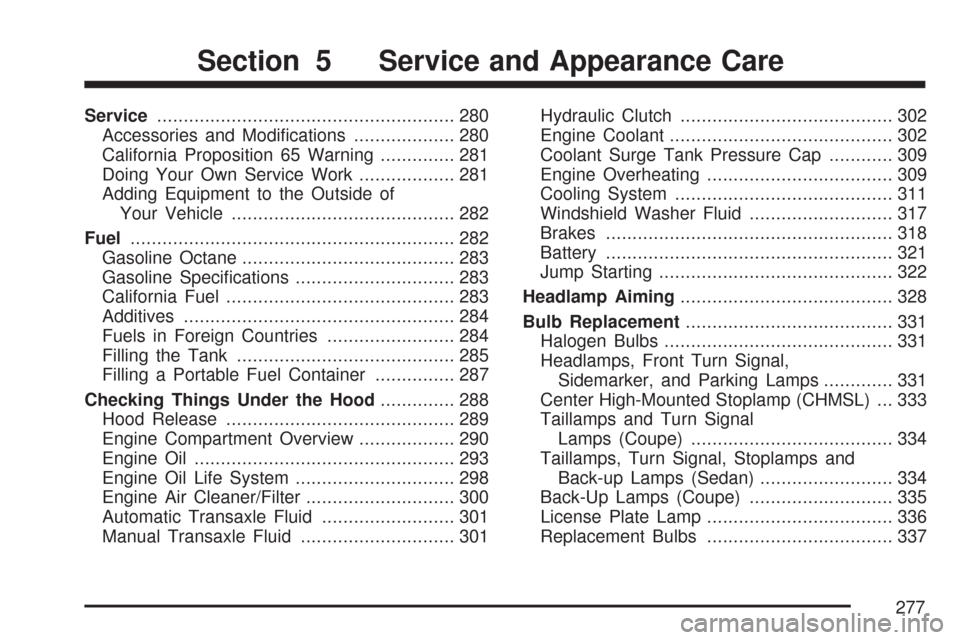
Service........................................................ 280
Accessories and Modications................... 280
California Proposition 65 Warning.............. 281
Doing Your Own Service Work.................. 281
Adding Equipment to the Outside of
Your Vehicle.......................................... 282
Fuel............................................................. 282
Gasoline Octane........................................ 283
Gasoline Specications.............................. 283
California Fuel........................................... 283
Additives................................................... 284
Fuels in Foreign Countries........................ 284
Filling the Tank......................................... 285
Filling a Portable Fuel Container............... 287
Checking Things Under the Hood.............. 288
Hood Release........................................... 289
Engine Compartment Overview.................. 290
Engine Oil................................................. 293
Engine Oil Life System.............................. 298
Engine Air Cleaner/Filter............................ 300
Automatic Transaxle Fluid......................... 301
Manual Transaxle Fluid............................. 301Hydraulic Clutch........................................ 302
Engine Coolant.......................................... 302
Coolant Surge Tank Pressure Cap............ 309
Engine Overheating................................... 309
Cooling System......................................... 311
Windshield Washer Fluid........................... 317
Brakes...................................................... 318
Battery...................................................... 321
Jump Starting............................................ 322
Headlamp Aiming........................................ 328
Bulb Replacement....................................... 331
Halogen Bulbs........................................... 331
Headlamps, Front Turn Signal,
Sidemarker, and Parking Lamps............. 331
Center High-Mounted Stoplamp (CHMSL) ... 333
Taillamps and Turn Signal
Lamps (Coupe)...................................... 334
Taillamps, Turn Signal, Stoplamps and
Back-up Lamps (Sedan)......................... 334
Back-Up Lamps (Coupe)........................... 335
License Plate Lamp................................... 336
Replacement Bulbs................................... 337
Section 5 Service and Appearance Care
277
Page 282 of 450

Your vehicle has an airbag system. Before
attempting to do your own service work, see
Servicing Your Airbag-Equipped Vehicle on
page 82.
You should keep a record with all parts receipts
and list the mileage and the date of any service
work you perform. SeeMaintenance Record
on page 410.
Adding Equipment to the Outside
of Your Vehicle
Things you might add to the outside of your
vehicle can affect the airow around it. This may
cause wind noise and affect windshield washer
performance. Check with your dealer before
adding equipment to the outside of your vehicle.
Fuel
Use of the recommended fuel is an important
part of the proper maintenance of your vehicle.
To help keep the engine clean and maintain
optimum vehicle performance, GM recommends
the use of gasoline advertised as TOP TIER
Detergent Gasoline.
The 8th digit of the Vehicle Identication
Number (VIN) shows the code letter or number
that identies your vehicle’s engine. The VIN is at
the top left of the instrument panel. SeeVehicle
Identication Number (VIN) on page 382.
282