2007 CHEVROLET AVALANCHE oil pressure
[x] Cancel search: oil pressurePage 538 of 618
Do not clean your vehicle using the following
cleaners or techniques:
Never use a knife or any other sharp object to
remove a soil from any interior surface.
Never use a stiff brush. It can cause damage
to your vehicle’s interior surfaces.
Never apply heavy pressure or rub
aggressively with a cleaning cloth. Use of
heavy pressure can damage your interior and
does not improve the effectiveness of soil
removal.
Use only mild, neutral-pH soaps. Avoid
laundry detergents or dishwashing soaps with
degreasers. Using too much soap will leave
a residue that leaves streaks and attracts dirt.
For liquid cleaners, about 20 drops per
gallon (3.78 L) of water is a good guide.
Do not heavily saturate your upholstery while
cleaning.
Damage to your vehicle’s interior may result
from the use of many organic solvents such
as naptha, alcohol, etc.
Fabric/Carpet
Use a vacuum cleaner with a soft brush
attachment frequently to remove dust and loose
dirt. A canister vacuum with a beater bar in
the nozzle may only be used on oor carpet and
carpeted oor mats. For soils, always try to remove
them rst with plain water or club soda. Before
cleaning, gently remove as much of the soil
as possible using one of the following techniques:
For liquids: gently blot the remaining soil
with a paper towel. Allow the soil to absorb into
the paper towel until no more can be
removed.
For solid dry soils: remove as much as
possible and then vacuum.
To clean, use the following instructions:
1. Saturate a lint-free, clean white cloth with
water or club soda.
2. Wring the cloth to remove excess moisture.
538
Page 564 of 618
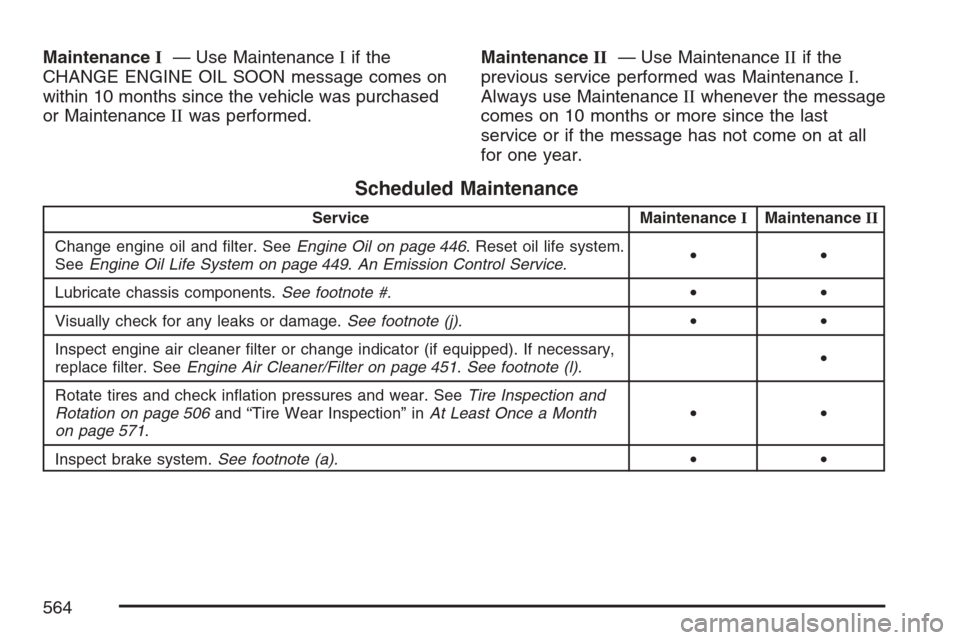
MaintenanceI— Use MaintenanceIif the
CHANGE ENGINE OIL SOON message comes on
within 10 months since the vehicle was purchased
or MaintenanceIIwas performed.MaintenanceII— Use MaintenanceIIif the
previous service performed was MaintenanceI.
Always use MaintenanceIIwhenever the message
comes on 10 months or more since the last
service or if the message has not come on at all
for one year.
Scheduled Maintenance
Service MaintenanceIMaintenanceII
Change engine oil and lter. SeeEngine Oil on page 446. Reset oil life system.
SeeEngine Oil Life System on page 449.An Emission Control Service.••
Lubricate chassis components.See footnote #.••
Visually check for any leaks or damage.See footnote (j).••
Inspect engine air cleaner lter or change indicator (if equipped). If necessary,
replace lter. SeeEngine Air Cleaner/Filter on page 451.See footnote (l).•
Rotate tires and check ination pressures and wear. SeeTire Inspection and
Rotation on page 506and “Tire Wear Inspection” inAt Least Once a Month
on page 571.••
Inspect brake system.See footnote (a).••
564
Page 569 of 618

(f)Lubricate all key lock cylinders, hood latch
assembly, secondary latch, pivots, spring anchor,
release pawl, midgate hinges, side storage
box door hinges, tailgate hinges, tailgate linkage,
outer tailgate handle pivot points, latch bolt,
fuel door hinge, locks, and folding seat hardware.
More frequent lubrication may be required
when exposed to a corrosive environment.
Applying silicone grease on weatherstrips with a
clean cloth will make them last longer, seal better,
and not stick or squeak.
(g)Check vent hose at transfer case for kinks and
proper installation.
(h)Change automatic transmission uid and lter
if the vehicle is mainly driven under one or
more of these conditions:
In heavy city traffic where the outside
temperature regularly reaches 90°F (32°C)
or higher.
In hilly or mountainous terrain.
When doing frequent trailer towing.
Uses such as found in taxi, police, or
delivery service.(i)Drain, ush, and rell cooling system. This
service can be complex; you should have
your dealer perform this service. See Engine
Coolant on page 457 for what to use. Inspect
hoses. Clean radiator, condenser, pressure cap,
and ller neck. Pressure test the cooling
system and pressure cap.
(j)A uid loss in any vehicle system could indicate
a problem. Have the system inspected and
repaired and the uid level checked. Add uid if
needed.
(k)Inspect system. Check all fuel and vapor lines
and hoses for proper hook-up, routing, and
condition. Check that the purge valve works
properly, if equipped. Replace as needed.
(l)If you drive regularly under dusty conditions,
inspect the lter at each engine oil change.
(m)Visually inspect belt for fraying, excessive
cracks, or obvious damage. Replace belt if
necessary.
569
Page 571 of 618

At Least Once a Month
Tire Ination Check
Visually inspect your vehicle’s tires and make
sure they are inated to the correct pressures.
Do not forget to check the spare tire. See
Ination - Tire Pressure on page 500. Check to
make sure the spare tire is stored securely.
SeeChanging a Flat Tire on page 516.
Tire Wear Inspection
Tire rotation may be required for high mileage
highway drivers prior to the Engine Oil Life
System service notication. Check the tires for
wear and, if necessary, rotate the tires. See
Tire Inspection and Rotation on page 506.
At Least Once a Year
Starter Switch Check
{CAUTION:
When you are doing this inspection, the
vehicle could move suddenly. If the vehicle
moves, you or others could be injured.
1. Before you start, be sure you have enough
room around the vehicle.
2. Firmly apply both the parking brake and
the regular brake. SeeParking Brake
on page 138.
Do not use the accelerator pedal, and be ready
to turn off the engine immediately if it starts.
3. Try to start the engine in each gear.
The vehicle should start only in PARK (P) or
NEUTRAL (N). If the vehicle starts in any
other position, contact your GM Goodwrench
®
dealer for service.
571
Page 608 of 618

F
Filter
Engine Air Cleaner................................... 451
Finish Damage............................................ 544
Fixed Mast Antenna.................................... 349
Flashers, Hazard Warning........................... 206
Flash-to-Pass.............................................. 209
Flat Tire...................................................... 515
Flat Tire, Changing...................................... 516
Flat Tire, Storing......................................... 533
Fluid
Automatic Transmission............................ 454
Power Steering........................................ 469
Windshield Washer.................................. 470
Fog Lamp Light........................................... 255
Fog Lamps.................................................. 218
Four-Wheel Drive...............................132, 483
Front Armrest Storage Area......................... 171
Front Axle................................................... 484
Fuel............................................................ 435
Additives.................................................. 437
California Fuel.......................................... 436
E85 (85% Ethanol)................................... 438
Filling a Portable Fuel Container.............. 442
Filling Your Tank...................................... 440
Fuels in Foreign Countries....................... 439Fuel (cont.)
Gage....................................................... 256
Gasoline Octane...................................... 436
Gasoline Specications............................ 436
Fuses
Center Instrument Panel Fuse Block........ 550
Fuses and Circuit Breakers...................... 548
Instrument Panel Fuse Block................... 548
Underhood Fuse Block............................. 551
Windshield Wiper..................................... 547
G
Gage
Engine Coolant Temperature.................... 249
Fuel......................................................... 256
Oil Pressure............................................. 253
Speedometer........................................... 241
Tachometer.............................................. 241
Voltmeter Gage........................................ 246
Garage Door Opener..........................159, 160
Gasoline
Octane..................................................... 436
Specications........................................... 436
Glove Box................................................... 170
GM Mobility Reimbursement Program.......... 588
608
Page 610 of 618

L
Labeling, Tire Sidewall................................. 493
Lamps
Battery Run-Down Protection................... 221
Dome....................................................... 220
Dome Lamp Override............................... 220
Electric Power Management..................... 220
Exterior.................................................... 215
Exterior Cargo.......................................... 219
Fog .......................................................... 218
Reading................................................... 220
LATCH System
Child Restraints......................................... 57
Level Control............................................... 413
License Plate Lamps................................... 490
Light
Airbag Readiness..................................... 242
Anti-Lock Brake System Warning............. 248
Brake System Warning............................. 246
Charging System..................................... 245
Cruise Control.......................................... 255
Fog Lamp................................................ 255
Highbeam On.......................................... 256
Malfunction Indicator................................ 250Light (cont.)
Oil Pressure............................................. 254
Passenger Airbag Status Indicator............ 243
Passenger Safety Belt Reminder.............. 242
Safety Belt Reminder............................... 241
Security................................................... 255
StabiliTrak
®Indicator................................ 248
Tire Pressure........................................... 250
Tow/Haul Mode........................................ 256
Lighting
Entry/Exit................................................. 220
Loading Your Vehicle................................... 402
Locking Rear Axle....................................... 359
Lockout Protection....................................... 104
Locks
Delayed Locking...................................... 103
Door........................................................ 102
Lockout Protection................................... 104
Power Door............................................. 103
Programmable Automatic Door Locks....... 103
Rear Door Security Locks........................ 104
Loss of Control........................................... 367
Luggage Carrier.......................................... 171
Lumbar
Power Controls.......................................... 11
610
Page 612 of 618

O
Odometer.................................................... 241
Odometer, Trip............................................ 241
Off-Road Driving.......................................... 368
Off-Road Recovery...................................... 365
Oil
Engine..................................................... 446
Pressure Gage......................................... 253
Pressure Light.......................................... 254
Oil, Engine Oil Life System......................... 449
Older Children, Restraints............................. 45
Online Owner Center................................... 585
OnStar
®System, see OnStar®Manual........ 156
Operation, Universal Home
Remote System..............................161, 166
Other Warning Devices................................ 206
Outlet Adjustment........................................ 238
Outlet(s), Accessory Power.......................... 226
Outside
Power Foldaway Mirrors........................... 153
Power Mirrors.......................................... 152
Overheated Engine Protection
Operating Mode....................................... 463
Owner Checks and Services....................... 570
Owners, Canadian.......................................... 3
P
Paint, Damage............................................ 544
Park Aid...................................................... 222
Park (P)
Shifting Into............................................. 139
Shifting Out of......................................... 141
Parking
Assist....................................................... 222
Brake....................................................... 138
Over Things That Burn............................ 142
Passenger Airbag Status Indicator............... 243
Passenger Sensing System........................... 81
Passing....................................................... 365
PASS-Key
®III+........................................... 120
PASS-Key®III+ Operation........................... 121
Power
Accessory Outlet(s).................................. 226
Door Locks.............................................. 103
Electrical System..................................... 547
Lumbar Controls........................................ 11
Retained Accessory (RAP)....................... 124
Running Boards....................................... 115
Seat.......................................................... 10
Steering Fluid.......................................... 469
Windows.................................................. 117
612