2007 BUICK LUCERNE spare wheel
[x] Cancel search: spare wheelPage 324 of 496
Tire Inspection and Rotation...................... 398
When It Is Time for New Tires.................. 400
Buying New Tires...................................... 400
Different Size Tires and Wheels................ 402
Uniform Tire Quality Grading..................... 402
Wheel Alignment and Tire Balance............ 404
Wheel Replacement.................................. 404
Tire Chains............................................... 406
If a Tire Goes Flat.................................... 407
Changing a Flat Tire................................. 408
Removing the Spare Tire and Tools.......... 409
Removing the Flat Tire and
Installing the Spare Tire......................... 410
Storing a Flat or Spare Tire and Tools...... 416
Compact Spare Tire.................................. 418
Appearance Care........................................ 418
Cleaning the Inside of Your Vehicle.......... 418
Fabric/Carpet............................................. 420
Leather...................................................... 421
Instrument Panel, Vinyl, and
Other Plastic Surfaces........................... 421
Care of Safety Belts.................................. 422
Weatherstrips............................................ 422Washing Your Vehicle............................... 422
Cleaning Exterior Lamps/Lenses................ 422
Finish Care............................................... 423
Windshield and Wiper Blades.................... 423
Aluminum or Chrome-Plated Wheels......... 424
Tires......................................................... 424
Sheet Metal Damage................................. 425
Finish Damage.......................................... 425
Underbody Maintenance............................ 425
Chemical Paint Spotting............................ 425
Vehicle Care/Appearance Materials............ 426
Vehicle Identication.................................. 427
Vehicle Identication Number (VIN)........... 427
Service Parts Identication Label............... 427
Electrical System........................................ 428
Add-On Electrical Equipment..................... 428
Power Windows and Other Power
Options.................................................. 428
Fuses and Circuit Breakers....................... 428
Underhood Fuse Block.............................. 428
Rear Underseat Fuse Block....................... 431
Capacities and Specications.................... 436
Section 5 Service and Appearance Care
324
Page 393 of 496

For additional information regarding how much
weight your vehicle can carry, and an example of
the Tire and Loading Information label, see
Loading Your Vehicle on page 307. How you load
your vehicle affects vehicle handling and ride
comfort. Never load your vehicle with more weight
than it was designed to carry.
When to Check
Check your tires once a month or more. Do not
forget to check the compact spare tire, it should be
at 60 psi (420 kPa). For additional information
regarding the compact spare tire, seeCompact
Spare Tire on page 418.
How to Check
Use a good quality pocket-type gage to check tire
pressure. You cannot tell if your tires are
properly inated simply by looking at them. Radial
tires may look properly inated even when they
are under-inated. Check the tire’s ination
pressure when the tires are cold. Cold means your
vehicle has been sitting for at least three hours
or driven no more than 1 mile (1.6 km).Remove the valve cap from the tire valve stem.
Press the tire gage rmly onto the valve to
get a pressure measurement. If the cold tire
ination pressure matches the recommended
pressure on the Tire and Loading Information
label, no further adjustment is necessary. If the
ination pressure is low, add air until you reach the
recommended amount.
If you overll the tire, release air by pushing on
the metal stem in the center of the tire valve.
Re-check the tire pressure with the tire gage.
Be sure to put the valve caps back on the valve
stems. They help prevent leaks by keeping out dirt
and moisture.Tire Pressure Monitor System
Your vehicle has a Tire Pressure Monitor System
(TPMS). This system uses radio and sensor
technology to check tire pressure levels. The
TPMS sensors are mounted onto each tire and
wheel assembly, except for the spare tire.
The TPMS sensors monitor the air pressure in
your vehicle’s tires and transmit tire pressure
readings to a receiver located in the vehicle.
393
Page 397 of 496
The TPMS matching process is outlined below:
1. Set the parking brake.
2. Turn the ignition switch to RUN with the
engine off.
3. Using the DIC, press the vehicle information
button until the LEARN TIRE POSITIONS
message displays.
4. Press the set/reset button to allow the system
to learn the tire positions. The horn will sound
twice to indicate the receiver is ready, and
the TIRE LEARNING ACTIVE message
will display. The TPMS system is ready for
the sensor matching process to begin.
5. Start with the driver’s side front tire.
6. Remove the valve cap from the tire’s valve
stem. Activate the TPMS sensor by increasing
or decreasing the tire’s air pressure for
ve seconds, or until a horn chirp sounds.
The horn chirp, which may take up to
30 seconds to sound, conrms that the
sensor identication code has been matched
to the tire/wheel position. To decrease the
tire’s air-pressure use the pointed end of the
valve cap, a pencil-style air pressure gage,
or a key.7. Proceed to the passenger’s side front tire, and
repeat the procedure in Step 6.
8. Proceed to the passenger’s side rear tire, and
repeat the procedure in Step 6.
9. Proceed to the driver’s side rear tire, and
repeat the procedure in Step 6.
10. After hearing the conrming horn chirp for the
driver’s side rear tire, the tire learning process
ends. Turn the ignition switch to OFF.
11. Set all four tires to the recommended air
pressure level as indicated on the tire and
loading information label.
12. Put the valve caps back on the valve stems.
The compact spare tire and wheel assembly
does not have a TPMS sensor. If you replace
one of the road tires with the compact spare tire,
the SERVICE TIRE MONITOR SYSTEM
message will be displayed on the DIC display
screen. This message should go off once
you re-install the road tire containing the
TPMS sensor.
397
Page 399 of 496

When rotating your tires, always use the correct
rotation pattern shown here.
Do not include the compact spare tire in your tire
rotation.
After the tires have been rotated, adjust the
front and rear ination pressures as shown
on the Tire and Loading Information label. See
Ination - Tire Pressure on page 392andLoading
Your Vehicle on page 307.Reset the Tire Pressure Monitor System. See
“TPMS Sensor Identication Codes” under
Tire Pressure Monitor System on page 393.
Make certain that all wheel nuts are properly
tightened. See “Wheel Nut Torque” under
Capacities and Specications on page 436.
{CAUTION:
Rust or dirt on a wheel, or on the parts to
which it is fastened, can make wheel nuts
become loose after time. The wheel could
come off and cause an accident. When
you change a wheel, remove any rust or
dirt from places where the wheel attaches
to the vehicle. In an emergency, you can
use a cloth or a paper towel to do this;
but be sure to use a scraper or wire brush
later, if needed, to get all the rust or dirt
off. SeeChanging a Flat Tire on page 408.
399
Page 401 of 496

If the tires have an all-season tread design, the
TPC spec number will be followed by an MS
for mud and snow. SeeTire Sidewall Labeling on
page 386for additional information.
{CAUTION:
Mixing tires could cause you to lose
control while driving. If you mix tires of
different sizes, brands, or types (radial
and bias-belted tires), the vehicle may not
handle properly, and you could have a
crash. Using tires of different sizes,
brands, or types may also cause damage
to your vehicle. Be sure to use the correct
size, brand, and type of tires on all
wheels. It is all right to drive with your
compact spare temporarily, as it was
developed for use on your vehicle. See
Compact Spare Tire on page 418.
{CAUTION:
If you use bias-ply tires on your vehicle,
the wheel rim anges could develop
cracks after many miles of driving. A tire
and/or wheel could fail suddenly, causing
a crash. Use only radial-ply tires with the
wheels on your vehicle.
If you must replace your vehicle’s tires with those
that do not have a TPC Spec number, make
sure they are the same size, load range, speed
rating, and construction type (radial and
bias-belted tires) as your vehicle’s original tires.
Your vehicle’s original equipment tires are listed on
the Tire and Loading Information label. This
label is attached to the vehicle’s center pillar
(B-pillar). SeeLoading Your Vehicle on page 307,
for more information about the Tire and Loading
Information label and its location on your vehicle.
401
Page 402 of 496

Different Size Tires and Wheels
If you add wheels or tires that are a different size
than your original equipment wheels and tires,
this may affect the way your vehicle performs,
including its braking, ride and handling
characteristics, stability, and resistance to rollover.
Additionally, if your vehicle has electronic
systems such as, anti-lock brakes, traction control,
and electronic stability control, the performance
of these systems can be affected.
{CAUTION:
If you add different sized wheels, your
vehicle may not provide an acceptable
level of performance and safety if tires not
recommended for those wheels are
selected. You may increase the chance
that you will crash and suffer serious
injury. Only use GM specic wheel and
tire systems developed for your vehicle,
and have them properly installed by a GM
certied technician.SeeBuying New Tires on page 400and
Accessories and Modications on page 325for
additional information.
Uniform Tire Quality Grading
Quality grades can be found where applicable on
the tire sidewall between tread shoulder and
maximum section width. For example:
Treadwear 200 Traction AA Temperature A
The following information relates to the system
developed by the United States National Highway
Traffic Safety Administration (NHTSA), which
grades tires by treadwear, traction, and
temperature performance. This applies only to
vehicles sold in the United States. The grades are
molded on the sidewalls of most passenger car
tires. The Uniform Tire Quality Grading (UTQG)
system does not apply to deep tread, winter-type
snow tires, space-saver, or temporary use
spare tires, tires with nominal rim diameters of
10 to 12 inches (25 to 30 cm), or to some
limited-production tires.
402
Page 409 of 496
Removing the Spare Tire and Tools
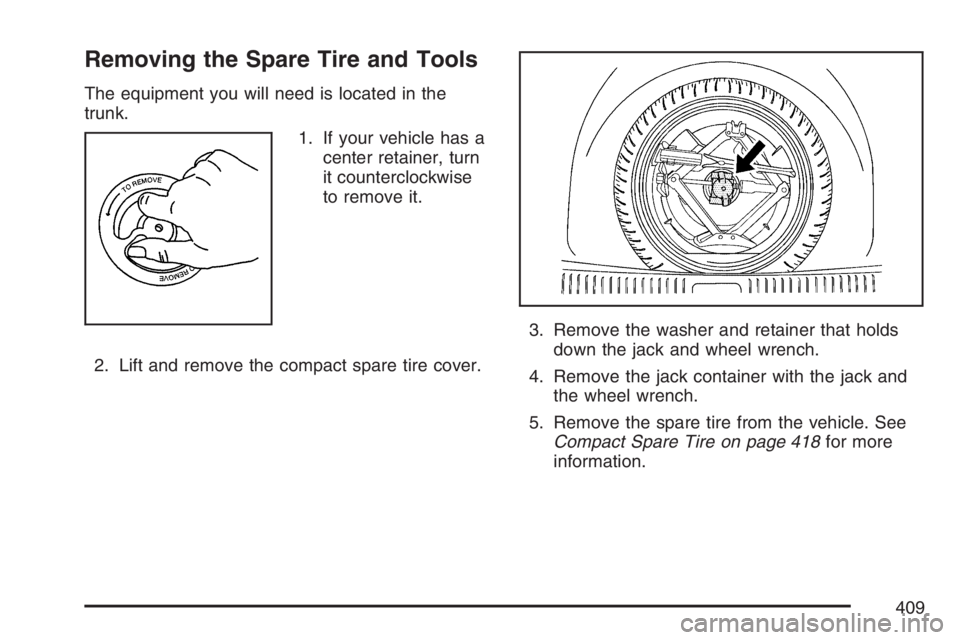
The equipment you will need is located in the
trunk.
1. If your vehicle has a
center retainer, turn
it counterclockwise
to remove it.
2. Lift and remove the compact spare tire cover.3. Remove the washer and retainer that holds
down the jack and wheel wrench.
4. Remove the jack container with the jack and
the wheel wrench.
5. Remove the spare tire from the vehicle. See
Compact Spare Tire on page 418for more
information.
409
Page 410 of 496
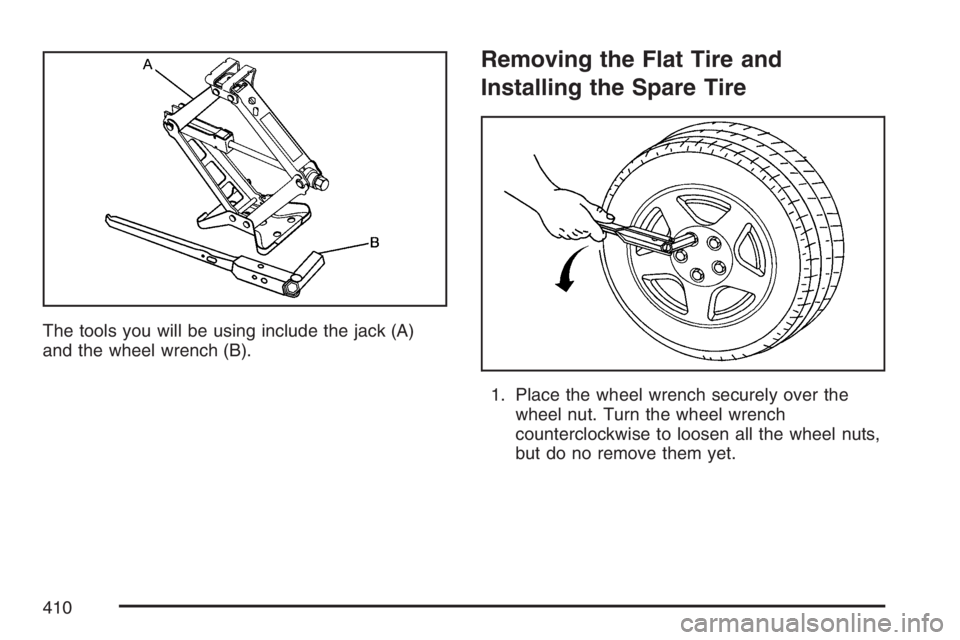
The tools you will be using include the jack (A)
and the wheel wrench (B).
Removing the Flat Tire and
Installing the Spare Tire
1. Place the wheel wrench securely over the
wheel nut. Turn the wheel wrench
counterclockwise to loosen all the wheel nuts,
but do no remove them yet.
410