Page 312 of 496

If you put things inside your vehicle, like suitcases,
tools, packages, or anything else, they will go
as fast as the vehicle goes. If you have to stop or
turn quickly, or if there is a crash, they will
keep going.
{CAUTION:
Things you put inside your vehicle can
strike and injure people in a sudden stop
or turn, or in a crash.
Put things in the trunk of your vehicle.
In a trunk, put them as far forward as
you can. Try to spread the weight
evenly.
Never stack heavier things, like
suitcases, inside the vehicle so that
some of them are above the tops of
the seats.
Do not leave an unsecured child
restraint in your vehicle.
When you carry something inside the
vehicle, secure it whenever you can.
Automatic Level Control
This feature keeps the rear of your vehicle level
as the load changes. It is automatic, you do
not need to adjust anything. This type of level
control is fully automatic and will provide a better
leveled riding position as well as better handling
under a variety of passenger and loading
conditions. An air compressor connected to the
rear shocks will raise or lower the rear of the
vehicle to maintain proper vehicle height.
The system is activated when the ignition key is
turned to RUN and will automatically adjust vehicle
height thereafter. The system may exhaust
(lower vehicle height) for up to ten minutes after
the ignition key has been turned to OFF. You may
also hear the air compressor operating when
the height is being adjusted.
312
Page 319 of 496

Trailer Wiring Harness
All of the electrical circuits required for your trailer
lighting system can be accessed at the driver’s
side rear lamp connector. This connector is located
under the carpet on the rear corner of the trunk
compartment.
Driving with a Trailer
Towing a trailer requires a certain amount of
experience. Before setting out for the open road,
you will want to get to know your rig. Acquaint
yourself with the feel of handling and braking with
the added weight of the trailer. And always
keep in mind that the vehicle you are driving is
now a good deal longer and not nearly as
responsive as your vehicle is by itself.
Before you start, check all trailer hitch parts and
attachments, safety chains, electrical connector,
lamps, tires and mirror adjustment. If the trailer
has electric brakes, start your vehicle and
trailer moving and then apply the trailer brake
controller by hand to be sure the brakes are
working. This lets you check your electrical
connection at the same time.During your trip, check occasionally to be sure
that the load is secure, and that the lamps and any
trailer brakes are still working.
Following Distance
Stay at least twice as far behind the vehicle ahead
as you would when driving your vehicle without
a trailer. This can help you avoid situations
that require heavy braking and sudden turns.
Passing
You will need more passing distance up ahead
when you are towing a trailer. And, because
the vehicle is a good deal longer, you will need to
go much farther beyond the passed vehicle
before you can return to your lane.
319
Page 371 of 496
{CAUTION:
A battery that is not properly vented can
let sulfuric acid fumes into the area under
the rear seat cushion. These fumes can
damage your rear seat safety belt
systems. You may not be able to see this
damage, and the safety belts might not
provide the protection needed in a crash.
If a replacement battery is ever needed, it
must be vented in the same manner as
the original battery. Always make sure
that the vent hose is properly reattached
before reinstalling the seat cushion.To be sure the vent hose (A) is properly attached,
the vent hose connectors (B) must be securely
reattached to the vent outlets (C) on each side of
the battery, and the vent assembly grommet (D)
must be secured to the oor pan (E).
371
Page 383 of 496

License Plate Lamp
To replace one of these bulbs, do the following:
1. Remove the license plate.
2. Reach up through the opening above the
license plate to access the two license
plate lamps.
3. Turn the socket counterclockwise to remove.
4. Grasp the bulb in the socket and pull
straight out.
5. Push the bulb straight into the socket until it
clicks to secure it.
6. Reverse Steps 1 through 3 to reinstall the
bulb socket.
Replacement Bulbs
Exterior Lamps Bulb Number
Back-up Lamp 921
Sidemarker, License Plate Lamp,
and Auxiliary Taillamp194
Stoplamp, Taillamp, and Turn
Signal Lamp3057K
For replacement bulbs not listed here, contact
your dealer.
Windshield Wiper Blade
Replacement
Windshield wiper blades should be inspected for
wear or cracking. SeeScheduled Maintenance
on page 442.
It is a good idea to clean or replace the wiper
blade assembly on a regular basis or when worn.
For proper windshield wiper blade length and
type, seeNormal Maintenance Replacement Parts
on page 453.
383
Page 406 of 496
Tire Chains
{CAUTION:
If your vehicle has P235/55R17, or
P245/50R18 size tires, do not use tire
chains. There is not enough clearance.
Tire chains used on a vehicle without the
proper amount of clearance can cause
damage to the brakes, suspension, or
other vehicle parts. The area damaged by
the tire chains could cause you to lose
control of your vehicle and you or others
may be injured in a crash.
Use another type of traction device only if
its manufacturer recommends it for use
on your vehicle and tire size combination
and road conditions.
CAUTION: (Continued)
CAUTION: (Continued)
Follow that manufacturer’s instructions.
To help avoid damage to your vehicle,
drive slowly, readjust or remove the
device if it is contacting your vehicle, and
do not spin your vehicle’s wheels.
If you do nd traction devices that will t,
install them on the front tires.
Notice:If your vehicle has P225/60R16 size
tires, use tire chains only where legal and only
when you must. Use only SAE Class S-type
chains that are the proper size for your
tires. Install them on the front tires and tighten
them as tightly as possible with the ends
securely fastened. Drive slowly and follow the
chain manufacturer’s instructions. If you
can hear the chains contacting your vehicle,
stop and retighten them. If the contact
continues, slow down until it stops. Driving
too fast or spinning the wheels with chains on
will damage your vehicle.
406
Page 410 of 496
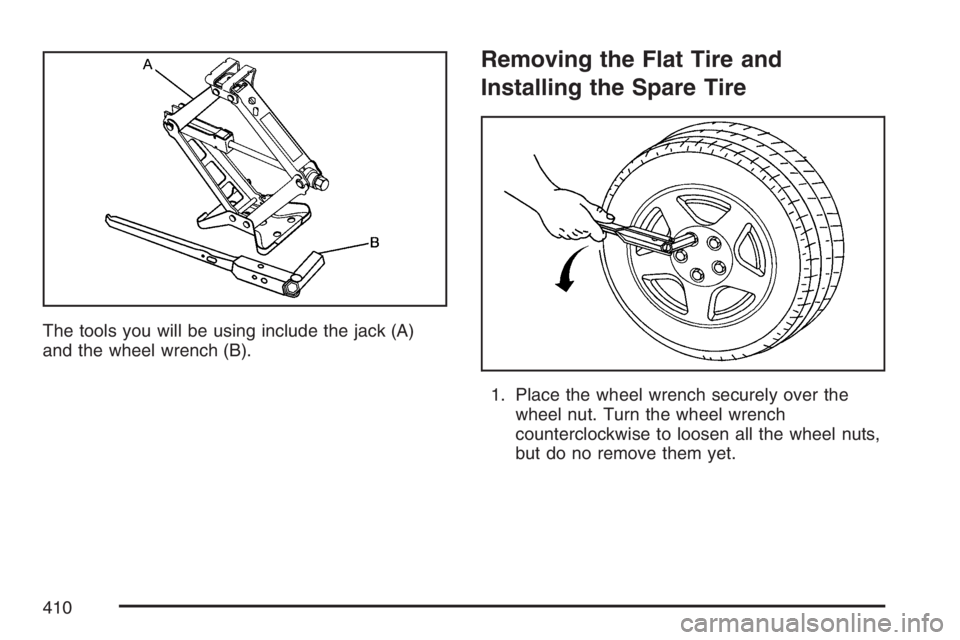
The tools you will be using include the jack (A)
and the wheel wrench (B).
Removing the Flat Tire and
Installing the Spare Tire
1. Place the wheel wrench securely over the
wheel nut. Turn the wheel wrench
counterclockwise to loosen all the wheel nuts,
but do no remove them yet.
410
Page 417 of 496
A. Center Retainer
B. Compact Spare Tire Cover
C. Retainer
D. Washer
E. Jack Container
F. Spare Tire
G. Wheel Wrench
H. Jack
I. Foam Insert
J. Bolt
1. Open the trunk. SeeTrunk on page 106for
more information.
2. Make sure the foam insert (I) is in place in the
trunk compartment.
3. Reinstall the compact spare tire (F) making
sure to line up the wheel center hole with the
bolt (J). Then place it on the compartment
oor.4. Insert the jack container (E) into the spare
tire (F).
5. Insert the wheel wrench (G) and jack (H) into
the center of the compact spare tire making
sure to line up the wheel nut hole with
the bolt (I) on the compartment oor.
6. Secure the compact spare tire and the jack
container (E) with the washer (D) and the
retainer (C).
7. Reinstall the compact spare tire cover (B).
8. Secure with the center retainer (A).
The compact spare tire is for temporary use only.
Replace the compact spare tire with a full-size
tire as soon as you can. SeeCompact Spare Tire
on page 418for more information.
417
Page 432 of 496
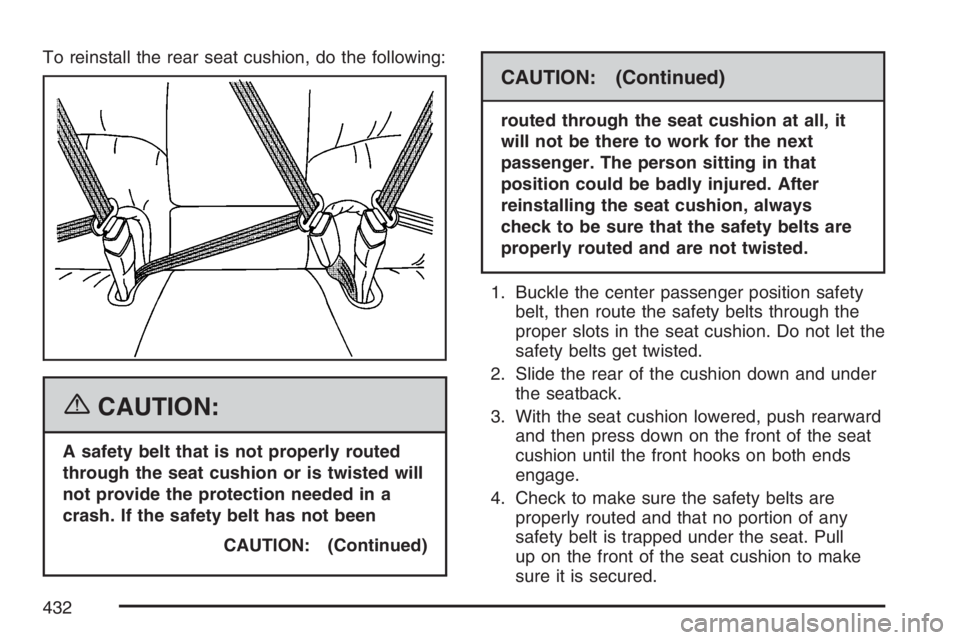
To reinstall the rear seat cushion, do the following:
{CAUTION:
A safety belt that is not properly routed
through the seat cushion or is twisted will
not provide the protection needed in a
crash. If the safety belt has not been
CAUTION: (Continued)
CAUTION: (Continued)
routed through the seat cushion at all, it
will not be there to work for the next
passenger. The person sitting in that
position could be badly injured. After
reinstalling the seat cushion, always
check to be sure that the safety belts are
properly routed and are not twisted.
1. Buckle the center passenger position safety
belt, then route the safety belts through the
proper slots in the seat cushion. Do not let the
safety belts get twisted.
2. Slide the rear of the cushion down and under
the seatback.
3. With the seat cushion lowered, push rearward
and then press down on the front of the seat
cushion until the front hooks on both ends
engage.
4. Check to make sure the safety belts are
properly routed and that no portion of any
safety belt is trapped under the seat. Pull
up on the front of the seat cushion to make
sure it is secured.
432