2007 BUICK LUCERNE battery
[x] Cancel search: batteryPage 139 of 496
OnStar®service that involves location information
about your vehicle cannot work unless GPS
satellite signals are unobstructed and available in
that place as well.
Your vehicle must have a working electrical
system (including adequate battery power) for the
OnStar
®equipment to operate. There are other
problems OnStar®cannot control that may prevent
OnStar®from providing OnStar®service to you
at any particular time or place. Some examples are
damage to important parts of your vehicle in an
accident, hills, tall buildings, tunnels, weather
or wireless phone network congestion.
Your Responsibility
You may need to increase the volume of your radio
to hear the OnStar®advisor. If the light next to the
OnStar®buttons is red, this means that your system
is not functioning properly and should be checked
by a dealer. If the light appears clear (no light is
appearing), your OnStar
®subscription has expired.
You can always press the OnStar®button to
conrm that your OnStar®equipment is active.
Universal Home Remote
System
Universal Home Remote System
(With One Triangular LED)
The Universal Home Remote System
provides a way to replace up to three hand-held
Radio-Frequency (RF) transmitters used to activate
devices such as garage door openers, security
systems, and home lighting.
This device complies with Part 15 of the FCC
Rules. Operation is subject to the following
two conditions:
1. This device may not cause harmful
interference.
2. This device must accept any interference
received, including interference that may
cause undesired operation.
The FCC Grant of Equipment Authorization
Certicate number is CB2OHHL3.
139
Page 142 of 496
Do not use the this system with any garage door
opener that does not have the stop and reverse
feature. This includes any garage door opener
model manufactured before April 1, 1982.
Read the instructions completely before attempting
to program the transmitter. Because of the steps
involved, it may be helpful to have another person
available to assist you in programming the
transmitter.
Be sure to keep the original remote control
transmitter for use in other vehicles, as well as,
for future programming. You only need the
original remote control transmitter for xed code
programming. It is also recommended that upon
the sale or lease termination of the vehicle, the
programmed buttons should be erased for security
purposes. See “Erasing your Universal Home
Remote Buttons” later in this section.
Be sure that people and objects are clear
of the garage door or security device you are
programming. When programming a garage
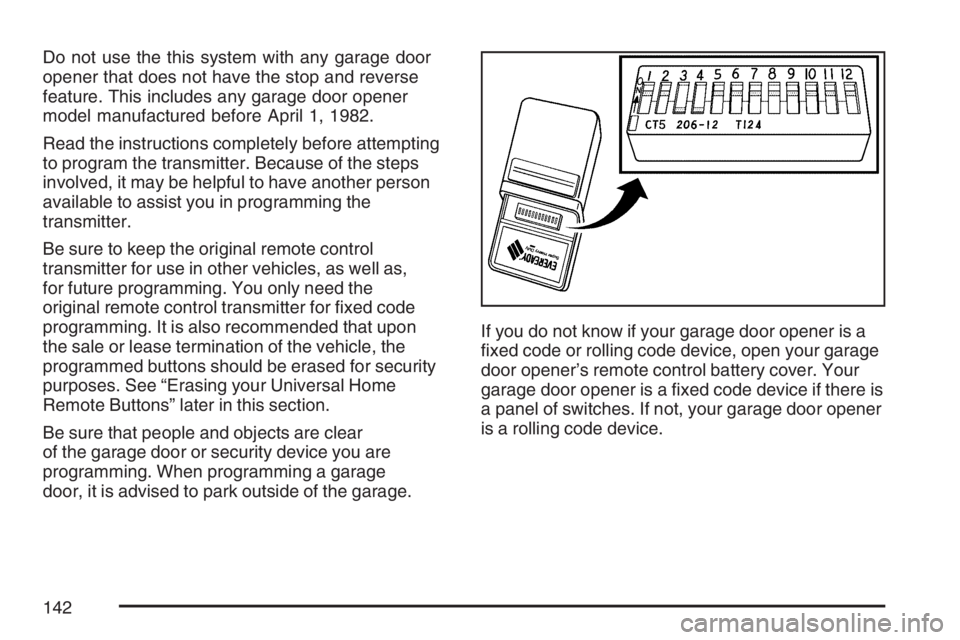
door, it is advised to park outside of the garage.If you do not know if your garage door opener is a
xed code or rolling code device, open your garage
door opener’s remote control battery cover. Your
garage door opener is a xed code device if there is
a panel of switches. If not, your garage door opener
is a rolling code device.
142
Page 143 of 496

Programming Universal Home
Remote — Fixed Code
Fixed Code garage door openers are used for
garage doors produced prior to 1996. Fixed code
uses the same coded signal every time, which
is manually programmed by setting DIP switches
for a unique personal code.
Follow these steps to program up to
three channels:
1. Remove the battery cover of the hand-held
transmitter.
2. Write down the eight to 12 coding switch
settings from left to right. When the switch
is in the up position, write “on,” and when a
switch is in the down position, write “off”.
If a switch is set between the up and down
position, write “middle”.
3. Enter these positions into the Universal Home
Remote System as follows.
Press and release all three buttons at the same
time to put the device into programming mode.
Example of Switch Settings
143
Page 147 of 496

Universal Home Remote
System Operation
(With One Triangular LED)
Your vehicle may have the Universal Home Remote
System. If there is one triangular Light Emitting
Diode (LED) above the Universal Home Remote
buttons, follow the instructions below. If your
vehicle has three round LED above the Universal
Home Remote buttons, follow the instructions under
Universal Home Remote System Operation (with
three round LED).
Do not use the Universal Home Remote with any
garage door opener that does not have the stop
and reverse feature. This includes any garage door
opener model manufactured before April 1, 1982.If you have a newer garage door opener with rolling
codes, please be sure to follow Steps 6 through 8 to
complete the programming of your Universal Home
Remote Transmitter.
Read the instructions completely before attempting
to program the Universal Home Remote. Because
of the steps involved, it may be helpful to have
another person available to assist you in the
programming steps.
Keep the original hand-held transmitter for use in
other vehicles as well as for future Universal Home
Remote programming. It is also recommended that
upon the sale of the vehicle, the programmed
Universal Home Remote buttons should be erased
for security purposes. See “Erasing Universal
Home Remote Buttons” later in this section or, for
assistance, seeCustomer Assistance Offices on
page 464.
Be sure that people and objects are clear of the
garage door or gate operator you are programming.
When programming a garage door, it is advised to
park outside of the garage.
It is recommended that a new battery be installed in
your hand-held transmitter for quicker and more
accurate transmission of the radio-frequency signal.
147
Page 155 of 496

Instrument Panel Overview........................ 158
Hazard Warning Flashers.......................... 160
Other Warning Devices............................. 160
Horn.......................................................... 160
Tilt Wheel.................................................. 161
Heated Steering Wheel............................. 161
Turn Signal/Multifunction Lever.................. 162
Turn and Lane-Change Signals................. 162
Headlamp High/Low-Beam Changer.......... 163
Flash-to-Pass............................................ 164
Windshield Wipers..................................... 164
Rainsense™ II Wipers............................... 165
Windshield Washer.................................... 166
Cruise Control........................................... 167
Exterior Lamps.......................................... 170
Wiper Activated Headlamps....................... 171
Headlamps on Reminder........................... 171
Daytime Running Lamps (DRL)................. 172
Fog Lamps................................................ 173
Cornering Lamps....................................... 173
Exterior Lighting Battery Saver.................. 173
Instrument Panel Brightness...................... 174
Courtesy Lamps........................................ 174
Entry Lighting............................................ 174Delayed Entry Lighting.............................. 174
Theater Dimming....................................... 175
Delayed Exit Lighting ................................. 175
Perimeter Lighting..................................... 175
Front Reading Lamps................................ 175
Electric Power Management...................... 176
Inadvertent Power Battery Saver............... 177
Battery Run-Down Protection..................... 177
Ultrasonic Rear Parking Assist (URPA)...... 178
Accessory Power Outlet(s)........................ 181
Ashtray(s) and Cigarette Lighter................ 182
Climate Controls......................................... 182
Climate Control System............................. 182
Dual Automatic Climate Control System.... 186
Outlet Adjustment...................................... 192
Passenger Compartment Air Filter............. 192
Warning Lights, Gages, and Indicators..... 194
Instrument Panel Cluster........................... 194
Speedometer and Odometer...................... 196
Trip Odometer........................................... 196
Tachometer............................................... 196
Safety Belt Reminder Light........................ 196
Section 3 Instrument Panel
155
Page 173 of 496

Fog Lamps
-(Fog Lamps):If your vehicle has fog lamps,
the button is located on the exterior lamps control.
The exterior lamps control is located on the
instrument panel to the left of the steering column.
Your ignition must be in RUN for the fog lamps to
illuminate.
To turn the fog lamps on, press the exterior lamps
button. A light will come on in the instrument
panel cluster to let you know that the fog lamps
are on. SeeInstrument Panel Cluster on page 194.
Press the exterior lamps button again to turn the
fog lamps off.
The ignition must be in RUN and the parking
lamps must be on for your fog lamps to work.
The fog lamps will go off while you change
to high-beam headlamps.
Some localities have laws that require the
headlamps to be on along with the fog lamps.
Cornering Lamps
If your vehicle has this feature, the cornering lamps
come on when: the headlamps or parking lamps are
on, the vehicle is not in PARK (P), and you signal a
turn with the turn signal/multifunction lever. They
provide more light for cornering.
Exterior Lighting Battery Saver
If the exterior lamp button has been left on, the
exterior lamps will turn off about 10 minutes after
the ignition is turned to OFF and a door has been
opened. This protects against draining the battery
in case you have accidentally left the headlamps or
parking lamps on. If you need to leave the lamps on
for more than 10 minutes, use the manual control to
turn the lamps back on after the ignition is turned to
OFF and any door is opened.
173
Page 176 of 496

Electric Power Management
The vehicle has Electric Power Management
(EPM) that estimates the battery’s temperature and
state of charge. It then adjusts the voltage for
best performance and extended life of the battery.
When the battery’s state of charge is low, the
voltage is raised slightly to quickly put the charge
back in. When the state of charge is high, the
voltage is lowered slightly to prevent overcharging.
If the vehicle has a voltmeter gage or voltage
display on the Driver Information Center (DIC),
you may see the voltage move up or down. This
is normal. If there is a problem, an alert will
be displayed.
The battery can be discharged at idle if the
electrical loads are very high. This is true for all
vehicles. This is because the generator (alternator)
may not be spinning fast enough at idle to produce
all the power that is needed for very high electrical
loads.A high electrical load occurs when several of the
following loads are on: headlamps, high beams, fog
lamps, rear window defogger, climate control fan at
high speed, heated seats, engine cooling fans,
trailer loads, and loads plugged into accessory
power outlets.
EPM works to prevent excessive discharge of the
battery. It does this by balancing the generator’s
output and the vehicle’s electrical needs. It can
increase engine idle speed to generate more
power, whenever needed. It can temporarily
reduce the power demands of some accessories.
Normally, these actions occur in steps or levels,
without being noticeable. In rare cases at the
highest levels of corrective action, this action
may be noticeable to the driver. If so, a Driver
Information Center (DIC) message might be
displayed, such as Battery Saver Active or Service
Battery Charging System. If this message is
displayed, it is recommended that the driver
reduce the electrical loads as much as possible.
SeeDIC Warnings and Messages on page 221.
176
Page 177 of 496

Inadvertent Power Battery Saver
This feature is designed to protect your vehicle’s
battery against drainage from the interior lamps, or
garage door opener. When the ignition is turned
off, the power to these features will automatically
turn off after 10 minutes. Power will be restored
for an additional 10 minutes if any door is opened,
the trunk is opened or the courtesy lamp switch
is turned on.
Battery Run-Down Protection
This vehicle has a feature to help prevent the
battery from being drained, if the interior courtesy
lamps, reading/map lamps, visor vanity lamps
or trunk lamp are accidentally left on. If any
of these lamps are left on, they will automatically
turn off after 10 minutes, if the ignition is off.
The lamps will not come back on again until one
of the following occurs:
The ignition is turned on.
The exterior lamps control is turned off, then
on again.
The headlamps will timeout after 10 minutes, if they
are manually turned on before the ignition is off.
177