Page 35 of 512
Rear Safety Belt Comfort Guides
Rear shoulder belt comfort guides may provide
added safety belt comfort for older children
who have outgrown booster seats and for some
adults. When installed on a shoulder belt, the
comfort guide positions the belt away from
the neck and head.There is one guide for each outboard passenger
position in the rear seat. Here is how to install
a comfort guide to the safety belt:
1. Pull the elastic cord out from between the
edge of the seatback and the interior body
to remove the guide from its storage clip.
35
Page 37 of 512
{CAUTION:
A safety belt that is not properly worn may
not provide the protection needed in a
crash. The person wearing the belt could
be seriously injured. The shoulder belt
should go over the shoulder and across
the chest. These parts of the body are best
able to take belt restraining forces.
4. Buckle, position, and release the safety belt
as described inRear Seat Passengers on
page 32. Make sure that the shoulder
belt crosses the shoulder.
To remove and store the comfort guide, squeeze
the belt edges together so that you can take them
out of the guide. Pull the guide upward to expose its
storage clip, and then slide the guide onto the clip.
Turn the guide and clip inward and slide them in
between the seatback and the interior body,
leaving only the loop of the elastic cord exposed.
37
Page 44 of 512
Q:What are the different types of add-on
child restraints?
A:Add-on child restraints, which are purchased by
the vehicle’s owner, are available in four basic
types. Selection of a particular restraint should
take into consideration not only the child’s
weight, height, and age but also whether or not
the restraint will be compatible with the motor
vehicle in which it will be used.
For most basic types of child restraints, there
are many different models available. When
purchasing a child restraint, be sure it is
designed to be used in a motor vehicle. If it is,
the restraint will have a label saying that it
meets federal motor vehicle safety standards.
The restraint manufacturer’s instructions that
come with the restraint state the weight and
height limitations for a particular child restraint.
In addition, there are many kinds of restraints
available for children with special needs.
{CAUTION:
Newborn infants need complete support,
including support for the head and neck.
This is necessary because a newborn
infant’s neck is weak and its head weighs
so much compared with the rest of its
body. In a crash, an infant in a rear-facing
seat settles into the restraint, so the crash
forces can be distributed across the
strongest part of an infant’s body, the back
and shoulders. Infants always should be
secured in appropriate infant restraints.
44
Page 46 of 512
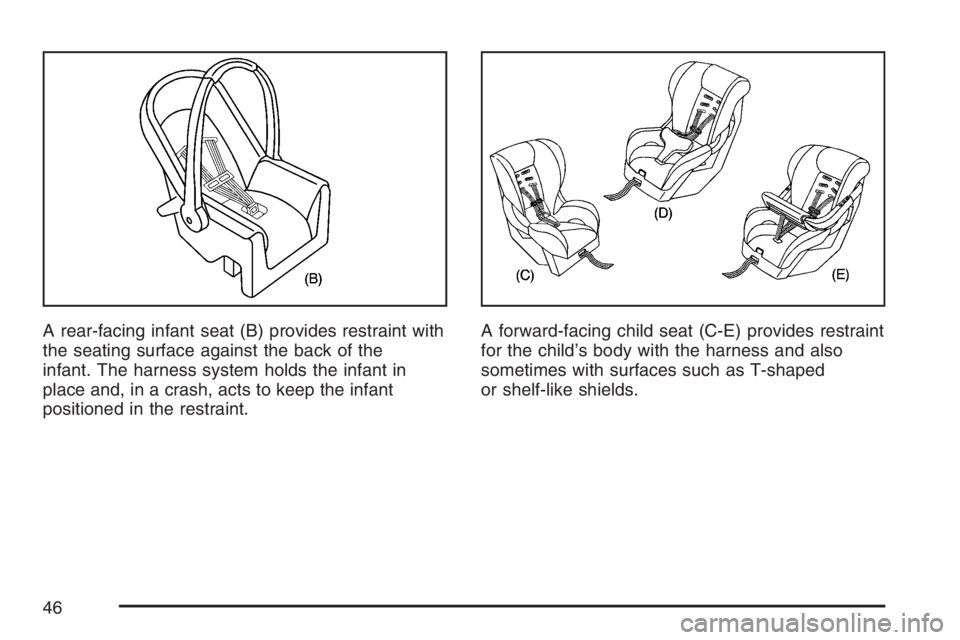
A rear-facing infant seat (B) provides restraint with
the seating surface against the back of the
infant. The harness system holds the infant in
place and, in a crash, acts to keep the infant
positioned in the restraint.A forward-facing child seat (C-E) provides restraint
for the child’s body with the harness and also
sometimes with surfaces such as T-shaped
or shelf-like shields.
46
Page 47 of 512

A booster seat (F-G) is a child restraint designed to
improve the t of the vehicle’s safety belt system.
Some booster seats have a shoulder belt
positioner, and some high-back booster seats have
a ve-point harness. A booster seat can also help a
child to see out the window.
Q:How Should I Use a Child Restraint?
A:A child restraint system is any device designed
for use in a motor vehicle to restrain, seat, or
position children. A built-in child restraint
system is a permanent part of the motor
vehicle. An add-on child restraint system is
a portable one, which is purchased by the
vehicle’s owner. To help reduce injuries, an
add-on child restraint must be secured in the
vehicle. With built-in or add-on child restraints,
the child has to be secured within the child
restraint.
When choosing an add-on child restraint, be
sure the child restraint is designed to be used in
a vehicle. If it is, it will have a label saying that it
meets federal motor vehicle safety standards.
Then follow the instructions for the restraint.
You may nd these instructions on the restraint
itself or in a booklet, or both.
47
Page 50 of 512
Where to Put the Restraint
Accident statistics show that children are safer if
they are restrained in the rear rather than the front
seat. We recommend that child restraints be
secured in a rear seat, including an infant riding
in a rear-facing infant seat, a child riding in a
forward-facing child seat and an older child riding
in a booster seat.
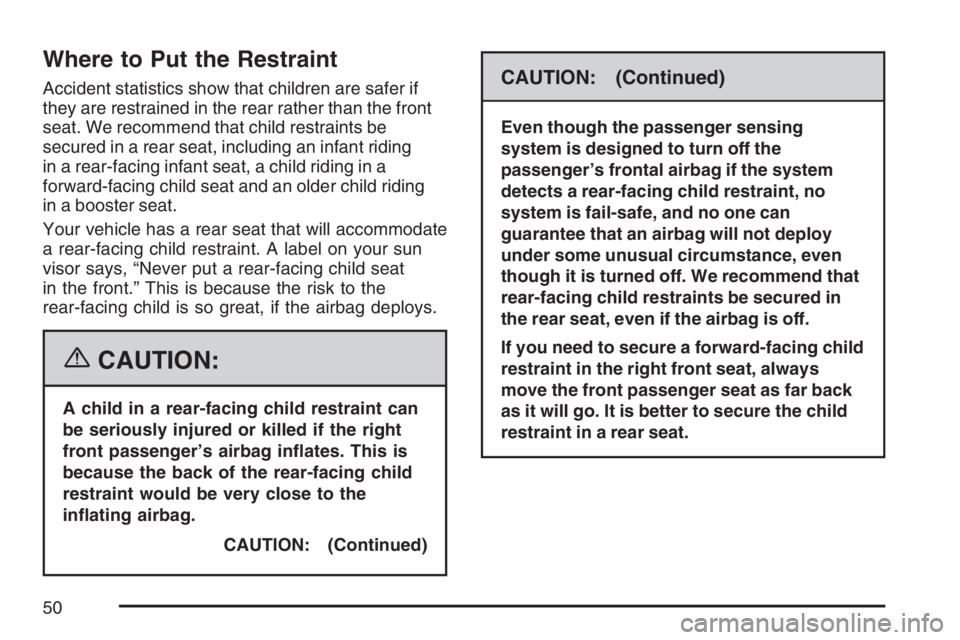
Your vehicle has a rear seat that will accommodate
a rear-facing child restraint. A label on your sun
visor says, “Never put a rear-facing child seat
in the front.” This is because the risk to the
rear-facing child is so great, if the airbag deploys.
{CAUTION:
A child in a rear-facing child restraint can
be seriously injured or killed if the right
front passenger’s airbag inates. This is
because the back of the rear-facing child
restraint would be very close to the
inating airbag.
CAUTION: (Continued)
CAUTION: (Continued)
Even though the passenger sensing
system is designed to turn off the
passenger’s frontal airbag if the system
detects a rear-facing child restraint, no
system is fail-safe, and no one can
guarantee that an airbag will not deploy
under some unusual circumstance, even
though it is turned off. We recommend that
rear-facing child restraints be secured in
the rear seat, even if the airbag is off.
If you need to secure a forward-facing child
restraint in the right front seat, always
move the front passenger seat as far back
as it will go. It is better to secure the child
restraint in a rear seat.
50
Page 53 of 512
Your child restraint may have a single tether (A)
or a dual tether (C). Either will have a single
attachment (B) to secure the top tether to
the anchor.
Some child restraints that have top tethers are
designed for use with or without the top tether being
attached. Others require the top tether always to
be attached. In Canada, the law requires that
forward-facing child restraints have a top tether,
and that the tether be attached. In the United
States, some child restraints also have a top tether.
Be sure to read and follow the instructions for your
child restraint.
If the child restraint does not have a top tether,
one can be obtained, in kit form, for many child
restraints. Ask the child restraint manufacturer
whether or not a kit is available.Lower Anchor and Top Tether Anchor
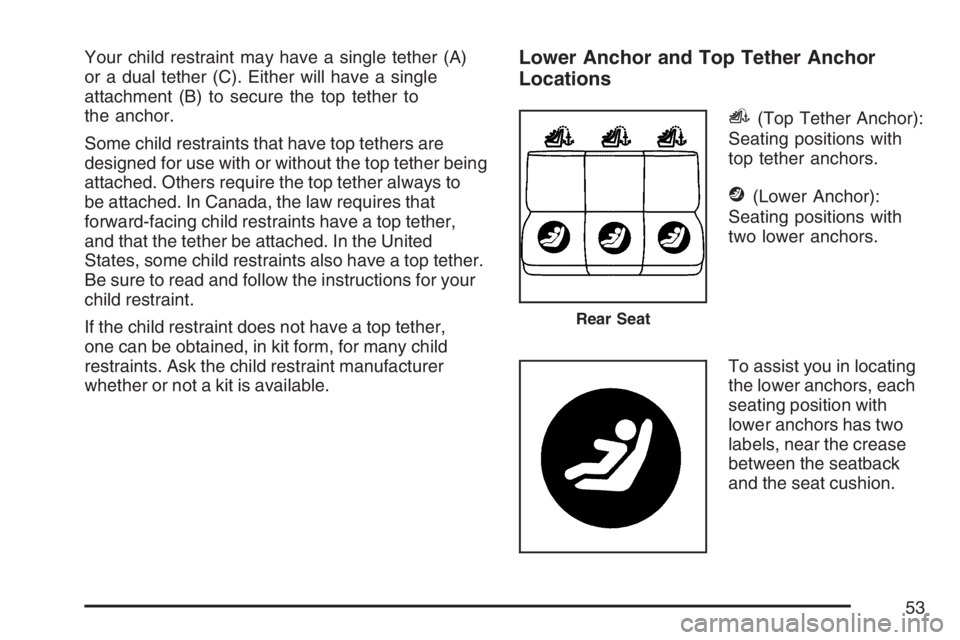
Locations
i(Top Tether Anchor):
Seating positions with
top tether anchors.
j(Lower Anchor):
Seating positions with
two lower anchors.
To assist you in locating
the lower anchors, each
seating position with
lower anchors has two
labels, near the crease
between the seatback
and the seat cushion.
Rear Seat
53
Page 54 of 512
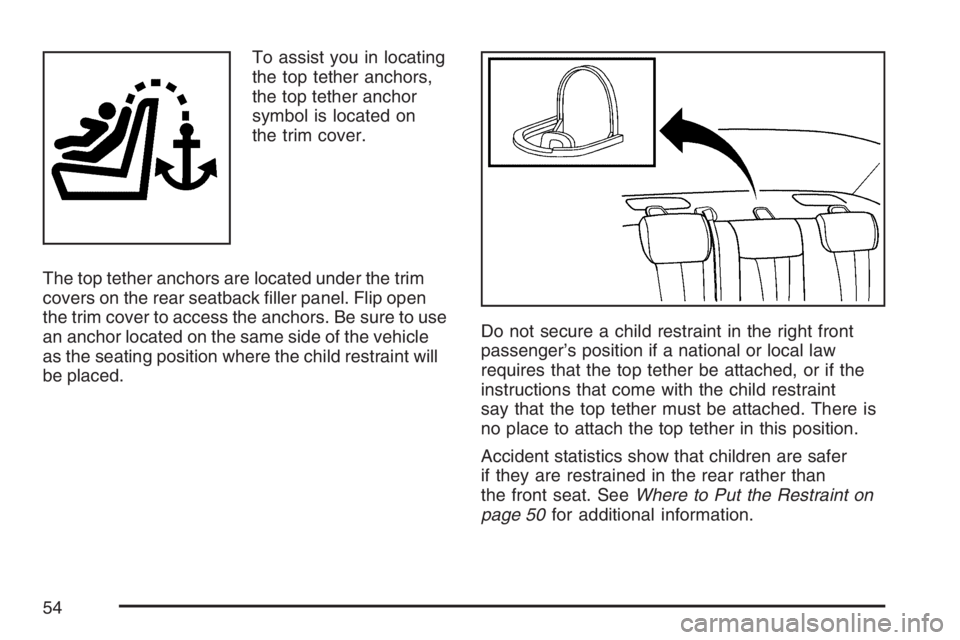
To assist you in locating
the top tether anchors,
the top tether anchor
symbol is located on
the trim cover.
The top tether anchors are located under the trim
covers on the rear seatback ller panel. Flip open
the trim cover to access the anchors. Be sure to use
an anchor located on the same side of the vehicle
as the seating position where the child restraint will
be placed.Do not secure a child restraint in the right front
passenger’s position if a national or local law
requires that the top tether be attached, or if the
instructions that come with the child restraint
say that the top tether must be attached. There is
no place to attach the top tether in this position.
Accident statistics show that children are safer
if they are restrained in the rear rather than
the front seat. SeeWhere to Put the Restraint on
page 50for additional information.
54