2007 BMW X3 3.0SI Lamp
[x] Cancel search: LampPage 107 of 139
Reference
At a glance
Controls
Driving tips
Mobility
105
Please have your BMW Sports Activity
Vehicle Center work on lamps whose
replacement is not described here.<
Light-emitting diodes LEDs
Light-emitting diodes installed behind translu-
cent lenses serve as the light source for many of
the controls and displays in your vehicle. These
light-emitting diodes are related to ordinary
lasers.
Do not remove the covers, and never
stare into the unfiltered light for several
hours, as irritation of the retina could result.<
Xenon lamps*
The service life of these bulbs is very long and
the probability of failure is very low, provided
that they are not switched on and off an unusual
number of times. If one of these bulbs should
nevertheless fail, it is possible to continue driv-
ing with great caution using the fog lamps, pro-
vided traffic laws in your area do not prohibit
this.
To avoid risk of potentially fatal injuries
due to the extremely high voltages at
which these units operate, service work should
always be entrusted to qualified personnel.<
Halogen low beams
H7 bulb, 55 watts
Always wear gloves and eye protection –
the atmosphere inside the H7 bulb is
pressurized. Failure to observe this precaution
can lead to injuries should the bulb be dam-
aged.<
For checking and adjusting headlamp
aim, please contact your BMW Sports
Activity Vehicle Center.<
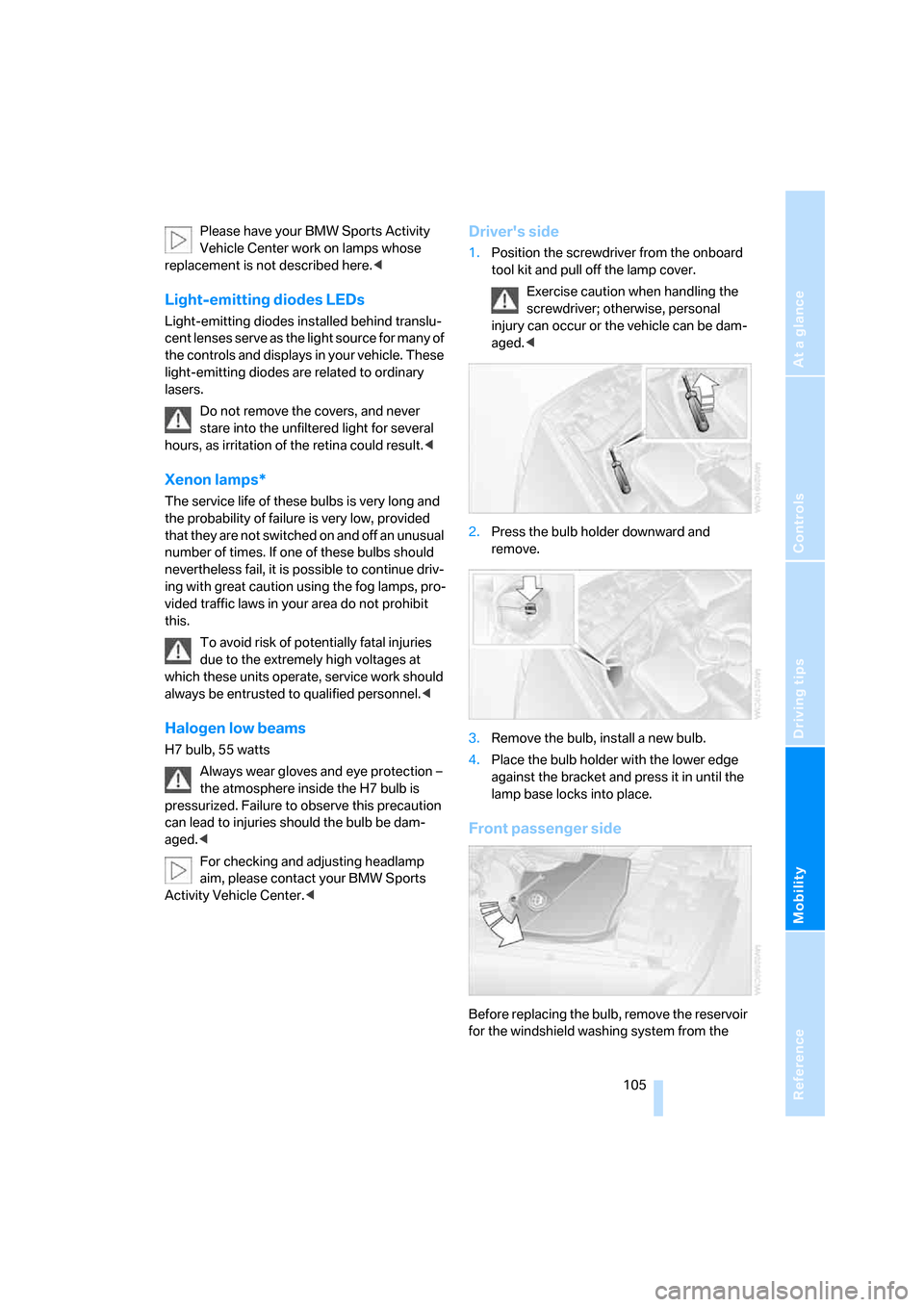
Driver's side
1.Position the screwdriver from the onboard
tool kit and pull off the lamp cover.
Exercise caution when handling the
screwdriver; otherwise, personal
injury can occur or the vehicle can be dam-
aged.<
2.Press the bulb holder downward and
remove.
3.Remove the bulb, install a new bulb.
4.Place the bulb holder with the lower edge
against the bracket and press it in until the
lamp base locks into place.
Front passenger side
Before replacing the bulb, remove the reservoir
for the windshield washing system from the
Page 108 of 139

Replacing components
106 bracket. To do so, loosen the bolt, refer to
arrow, and place the reservoir to one side.
Bear in mind that the windshield washing
system reservoir is heavy. Failure to take
this into account can lead to personal injury or
damage to the vehicle.<
For bulb replacement procedure, refer to
Driver's side.
Halogen high beams
H7 bulb, 55 watts
Always wear gloves and eye protection –
the atmosphere inside the H7 bulb is
pressurized. Failure to observe this precaution
can lead to injuries should the bulb be dam-
aged.<
For checking and adjusting headlamp
aim, please contact your BMW Sports
Activity Vehicle Center.<
Driver's side
1.Open the clip and remove the lamp cover.
2.Press the bulb holder downward and
remove, refer to Low beams.
3.Pull off the lamp base; plug in a new lamp
base.
4.Place the lamp base with the lower edge
against the bracket and press it in until the
lamp base locks into place.
Make sure that the cover does not fall into
the engine compartment; otherwise, the
vehicle can be damaged or other road users can
be endangered.<
Front passenger side
Before replacing the bulb, remove the reservoir
of the windshield washer system from the
bracket, refer to Halogen low beams on
page105.
For bulb replacement procedure, refer to
Driver's side.
Parking and roadside parking lamps
W5W bulb, 5 watts
A bulb is located over each high beam.
1.Remove bulb cover for high beams, refer to
Halogen high beams.
2.Remove bulb holder.
3.Remove and replace the bulb.
Turn signal, front
PSY24WSV bulb, 24 watts
Access to the turn signal is at the edge of the
lamp unit, refer to arrow.
Make sure that the lamp base does not fall
into the engine compartment; otherwise,
the vehicle can be damaged or other road users
can be endangered.<
1.Turn the lamp base and remove it.
2.Replace the bulb.
3.Insert the lamp base. If it does not snap into
place immediately, turn the lamp base until
it does.
Page 109 of 139

Reference
At a glance
Controls
Driving tips
Mobility
107
Side-mounted turn signals
W5W bulb, 5 watts
1.Use finger pressure against the rear end of
the lamp, refer to arrow, to press it forward
for removal.
2.Apply gentle pressure to the bulb while
turning it to the left and pull it out.
3.Install in the reverse order.
Front fog lamps
H11 bulb, 55 watts
Always wear gloves and eye protection –
the atmosphere inside the H11 bulb is
pressurized. Failure to observe this precaution
can lead to injuries should the bulb be dam-
aged.<
1.Pull the cover in front of the fog lamp for-
ward.
2.Loosen the screw, refer to arrow, pivot
headlamp out on this side and remove
toward the front.
3.Turn the lamp base at the back of the head-
lamp to the left and remove it.
4.Disconnect the cable connector.
5.Slide new bulb onto plug connector; be sure
it snaps firmly into place.6.Install in the reverse order.
Tail lamps
>Turn signal lamp:
PY21WSV bulb, 21 watts
>Other bulbs:
W16W bulb, 16 watts
1Brake lamp
2Parking lamp/rear lamp, LED
3Turn signal
4Backup lamp
5Rear lamp, LED
In the event of a defect involving the lamps 2, 4
and 5, please consult your BMW Sports Activity
Vehicle Center.
Changing
Open the flap in the side panel, refer to page76.
Turn signal lamp:
1.Turn bulb holder to the left, refer to arrow1,
and remove.
2.Apply gentle pressure to the bulb fitting
while turning it to the left, remove and
replace.
Page 110 of 139
Replacing components
108 Brake lamp:
1.Remove bulb holder, refer to arrow 2.
2.Remove and replace the bulb.
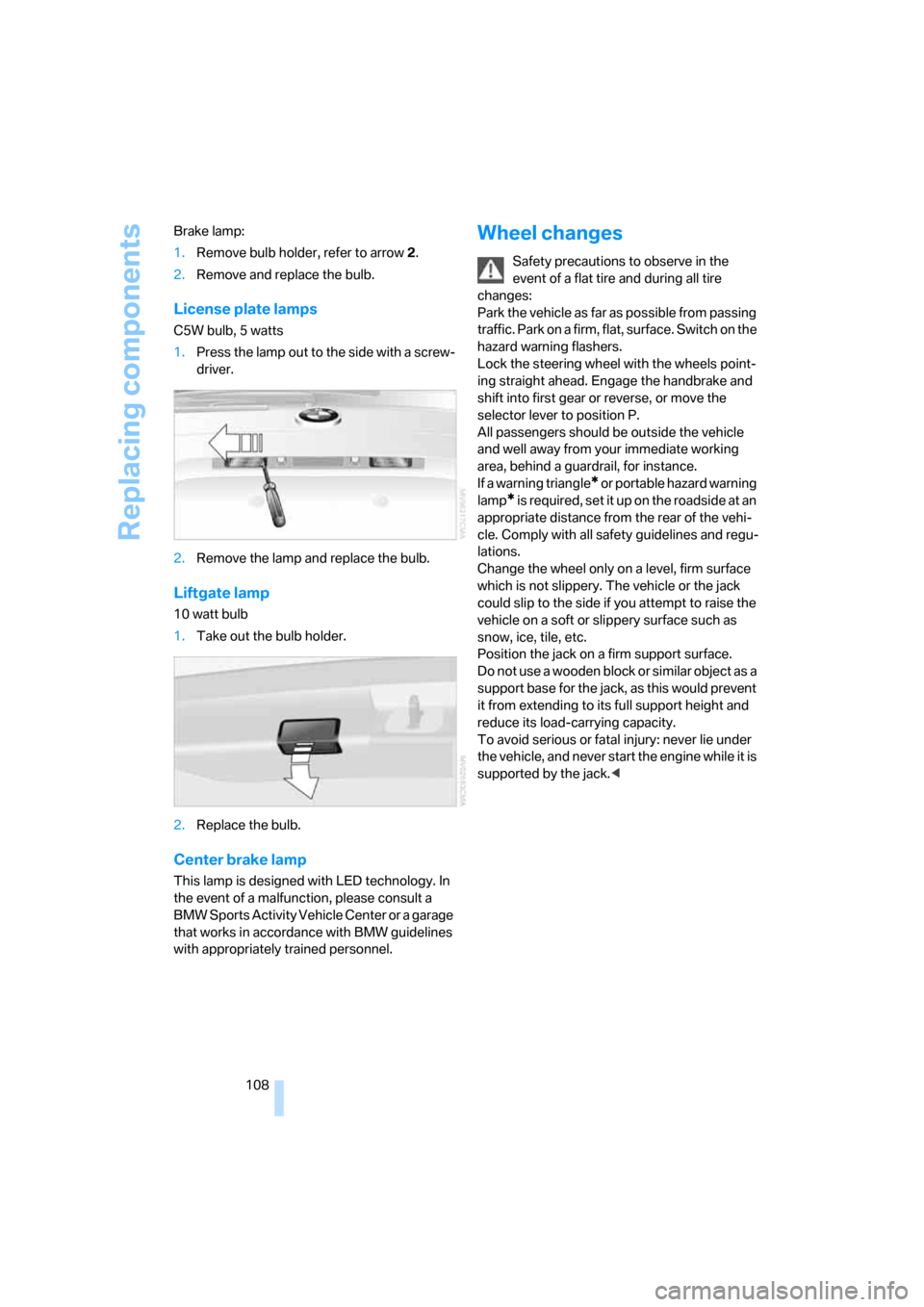
License plate lamps
C5W bulb, 5 watts
1.Press the lamp out to the side with a screw-
driver.
2.Remove the lamp and replace the bulb.
Liftgate lamp
10 watt bulb
1.Take out the bulb holder.
2.Replace the bulb.
Center brake lamp
This lamp is designed with LED technology. In
the event of a malfunction, please consult a
BMW Sports Activity Vehicle Center or a garage
that works in accordance with BMW guidelines
with appropriately trained personnel.
Wheel changes
Safety precautions to observe in the
event of a flat tire and during all tire
changes:
Park the vehicle as far as possible from passing
traffic. Park on a firm, flat, surface. Switch on the
hazard warning flashers.
Lock the steering wheel with the wheels point-
ing straight ahead. Engage the handbrake and
shift into first gear or reverse, or move the
selector lever to position P.
All passengers should be outside the vehicle
and well away from your immediate working
area, behind a guardrail, for instance.
If a warning triangle
* or portable hazard warning
lamp
* is required, set it up on the roadside at an
appropriate distance from the rear of the vehi-
cle. Comply with all safety guidelines and regu-
lations.
Change the wheel only on a level, firm surface
which is not slippery. The vehicle or the jack
could slip to the side if you attempt to raise the
vehicle on a soft or slippery surface such as
snow, ice, tile, etc.
Position the jack on a firm support surface.
Do not use a wooden block or similar object as a
support base for the jack, as this would prevent
it from extending to its full support height and
reduce its load-carrying capacity.
To avoid serious or fatal injury: never lie under
the vehicle, and never start the engine while it is
supported by the jack.<
Page 111 of 139

Reference
At a glance
Controls
Driving tips
Mobility
109
What you will need
Open liftgate and raise or remove floor cover,
refer to page76.
1Vehicle jack
2Lug wrench
3Chock
In order to avoid rattling noises later, note the
position of the tools when you remove them and
return them to their original position when you
are through using them.
Compact wheel
The compact wheel is located under the cargo
area on the undercarriage of the vehicle.
Removing compact wheel
1.Unscrew bolt, refer to arrow1.
2.Fold up lifting handle, refer to arrow2.
3.Turn the handle to the left as far as possible,
refer to arrow3.
Turning the handle releases the com-
pact wheel. Its weight of approx.
18 lbs./8 kg is then entirely supported by
the handle.<4.Slowly lower the handle as far as possible,
refer to arrow4.
5.Pull the compact wheel to the rear so that it
is still securely resting in its compact wheel
receptacle.
6.If need be, turn the wheel in the compact
wheel receptacle so that the attachment of
the retaining strap to the rim points toward
the rear.
7.Rotate the clamp by 180°, refer to arrows 1,
and unhook the retaining strap from the
clamp, refer to arrow 2.
8.Take out the compact wheel toward the
back.
9.Fasten the retaining strap to the compact
wheel receptacle and resecure the compact
wheel receptacle by reversing the above
steps.
The width of the defective wheel prevents
it from fitting into the compact wheel
receptacle in place of the compact wheel
itself.<
Page 113 of 139

Reference
At a glance
Controls
Driving tips
Mobility
111
Protect valve stems with valve stem
seal caps from dirt and contamina-
tion. Dirt in valve stems is a frequent source
of gradual air loss.<
4.Reinitialize the Flat Tire Monitor
* or reset
the Tire Pressure Monitor
*, refer to
pages53, 54.
Do not initialize the Flat Tire Monitor
when driving with a compact wheel.<
5.Replace the defective tire as soon as possi-
ble and have the new wheel/tire balanced.
Driving with compact wheel
Drive reservedly and do not exceed a speed of
50 mph/80 km/h.
Mounting the compact wheel can change the
driving characteristics. For example, it can
reduce tracking stability during braking, extend
braking distances, and alter self-steering char-
acteristics in the limit range. With winter tires,
these characteristics are more pronounced.
Only one compact wheel may be
mounted. You should re-equip with
wheels and tires of the original size as soon as
possible.<
Vehicle battery
Maintenance
The battery is 100 % maintenance-free, i.e., the
electrolyte will last for the life of the battery
when the vehicle is operated in a temperate cli-
mate. Your BMW Sports Activity Vehicle Center
will be happy to advise you on all questions con-
cerning the battery.
Warning lamp
The warning lamp lights up. The battery
is no longer being charged. The alterna-
tor V-belt is defective or there is a mal-
function in the charge current circuit of the
alternator. Have the system checked immedi-
ately.Do not continue driving if the V-belt is
defective. The engine could be damaged
due to overheating.
Moreover, an increased amount of force is
required for steering if there is a sharp drop in
the onboard supply voltage.<
Charging battery
Charge the battery in the vehicle only when the
engine has been switched off. For connections,
refer to Jump starting on page114.
Disposal
Have old batteries disposed of following
replacement at your BMW Sports Activity
Vehicle Center or bring them to a collection
point. Maintain the battery in an upright position
for transport and storage. Always secure the
battery to prevent it from tipping over during
transport.<
Power failure
After a temporary power supply interruption,
some equipment is subject to limited use and
must be reinitialized. Individual settings are also
lost and must be updated again:
>Panorama glass sunroof
It may be only possible to raise the sunroof.
The system must be initialized, refer to
page24.
>Power windows
The pinch protection system must be reini-
tialized, refer to page23.
>Seat and mirror memory
The positions must be stored again, refer to
page30.
>Time
Must be set again, refer to page46.
Page 116 of 139

Giving and receiving assistance
114
First-aid kit*
Some of the articles in the first-aid kit may be
used within a limited time only. Check the expi-
ration dates of the contents regularly and
replace the contents in a timely fashion as
needed.
The first-aid kit is located under the front pas-
senger's seat.
To open: pull the handle and fold the cover
downward.
To close: fold the cover up.
Jump starting
When your battery is discharged, you can use
two jumper cables to start the engine of your
BMW with power from the battery in another
vehicle. You can also use the same method to
help start another vehicle. Use only jumper
cables with fully-insulated clamp handles.
To avoid the risk of potentially fatal injury,
always avoid all contact with electrical
components while the engine is running. Care-
fully comply with the following instructions to
avoid personal injury and/or damage to one or
both vehicles.<
Preparing
1.Check whether the battery of the other
vehicle has a voltage of 12 Volts and
approximately the same capacitance in Ah.
This information can be found on the bat-
tery.
2.Switch off the engine of the vehicle provid-
ing assistance.3.Switch off any electrical systems and com-
ponents in both vehicles.
Ensure that there is no contact between
the bodywork on the two vehicles; other-
wise, there is a danger of short circuits.<
Connecting jumper cables
Connect the jumper cables in the correct
order; failure to do so could generate
sparks and cause injury.<
In your BMW, the so-called jump starting termi-
nal in the engine compartment functions as the
positive battery terminal, also refer to engine
compartment overview on page98. The
symbol + is embossed on the cover.
1.Open the cover of the BMW jump starting
terminal, refer to arrow1.
2.Connect one terminal clamp of the posi-
tive/+ jumper cable to the positive terminal
of the battery or to a jump starting terminal
of the vehicle providing starting assistance.
3.Connect the second terminal clamp of the
positive/+ jumper cable to the positive ter-
minal of the battery or to a jump starting ter-
minal of the vehicle to be started.
4.Connect one terminal clamp of the nega-
tive/– jumper cable to the negative terminal
of the battery or to an engine or body
ground of the vehicle providing assistance.
Your BMW has a special nut that serves as
the body ground or negative terminal, refer
to arrow2.
5.Connect the second terminal clamp of the
negative/– jumper cable to the negative ter-
minal of the battery or to the engine or body
ground of the vehicle to be started.
Page 125 of 139

Reference
At a glance
Controls
Driving tips
Mobility
123
Capacities
Notes
Fuel tank
Fuel reserve US gal/liters
US gal/litersapprox. 17.7/67
approx. 2/8Fuel specification: page89
Windshield washer system
incl. headlamp washer systemUS quarts/liters approx. 3.2/3.0
approx. 6.9/6.5For details: page42