2007 BMW X3 3.0SI Lamp
[x] Cancel search: LampPage 58 of 139
Technology for comfort, convenience and safety
56
Airbags
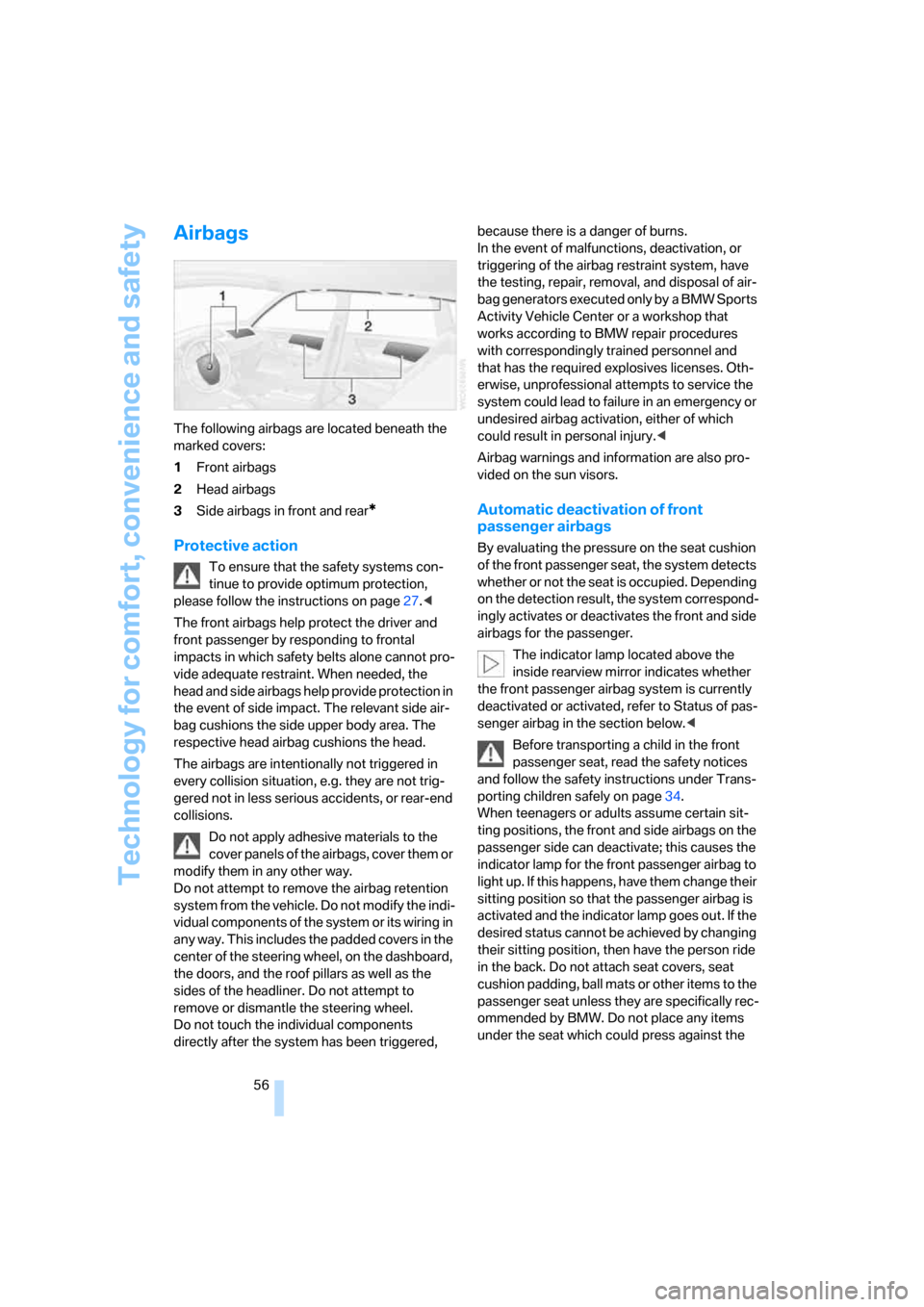
The following airbags are located beneath the
marked covers:
1Front airbags
2Head airbags
3Side airbags in front and rear
*
Protective action
To ensure that the safety systems con-
tinue to provide optimum protection,
please follow the instructions on page27.<
The front airbags help protect the driver and
front passenger by responding to frontal
impacts in which safety belts alone cannot pro-
vide adequate restraint. When needed, the
head and side airbags help provide protection in
the event of side impact. The relevant side air-
bag cushions the side upper body area. The
respective head airbag cushions the head.
The airbags are intentionally not triggered in
every collision situation, e.g. they are not trig-
gered not in less serious accidents, or rear-end
collisions.
Do not apply adhesive materials to the
cover panels of the airbags, cover them or
modify them in any other way.
Do not attempt to remove the airbag retention
system from the vehicle. Do not modify the indi-
vidual components of the system or its wiring in
any way. This includes the padded covers in the
center of the steering wheel, on the dashboard,
the doors, and the roof pillars as well as the
sides of the headliner. Do not attempt to
remove or dismantle the steering wheel.
Do not touch the individual components
directly after the system has been triggered, because there is a danger of burns.
In the event of malfunctions, deactivation, or
triggering of the airbag restraint system, have
the testing, repair, removal, and disposal of air-
bag generators executed only by a BMW Sports
Activity Vehicle Center or a workshop that
works according to BMW repair procedures
with correspondingly trained personnel and
that has the required explosives licenses. Oth-
erwise, unprofessional attempts to service the
system could lead to failure in an emergency or
undesired airbag activation, either of which
could result in personal injury.<
Airbag warnings and information are also pro-
vided on the sun visors.
Automatic deactivation of front
passenger airbags
By evaluating the pressure on the seat cushion
of the front passenger seat, the system detects
whether or not the seat is occupied. Depending
on the detection result, the system correspond-
ingly activates or deactivates the front and side
airbags for the passenger.
The indicator lamp located above the
inside rearview mirror indicates whether
the front passenger airbag system is currently
deactivated or activated, refer to Status of pas-
senger airbag in the section below.<
Before transporting a child in the front
passenger seat, read the safety notices
and follow the safety instructions under Trans-
porting children safely on page34.
When teenagers or adults assume certain sit-
ting positions, the front and side airbags on the
passenger side can deactivate; this causes the
indicator lamp for the front passenger airbag to
light up. If this happens, have them change their
sitting position so that the passenger airbag is
activated and the indicator lamp goes out. If the
desired status cannot be achieved by changing
their sitting position, then have the person ride
in the back. Do not attach seat covers, seat
cushion padding, ball mats or other items to the
passenger seat unless they are specifically rec-
ommended by BMW. Do not place any items
under the seat which could press against the
Page 59 of 139

Reference
At a glance
Controls
Driving tips
Mobility
57
seat from below. Otherwise, a correct analysis
of the seat cushion is not ensured.<
Status of passenger airbags
The indicator lamp for the passenger airbag
indicates the functional status of the front and
side airbag on the passenger side depending on
whether or not the seat is occupied. By lighting
up, the indicator lamp indicates that the pas-
senger airbags deactivated.
>The indicator lamp lights up when a child
sitting as directed in a child restraint system
designed for this is detected.
The front and side airbags on the passenger
side are deactivated.
Most child seats are detected by the
system. It is particularly advisable to
use the child seats approved by NHTSA at
the time the vehicle was produced. After
installing a child's seat, make sure that the
indicator lamp for the front passenger air-
bags has illuminated. This indicates that the
system has detected the child's seat and
that the front passenger airbags have been
deactivated.<
>The indicator lamp does not come on as
long as a person of sufficient size and in a
correct sitting position is detected on the
seat. The front and side airbags for the pas-
senger are activated.
>The indicator lamp does not light up when
the seat is empty.
In this case, the front and side airbags for
the passenger are deactivated.
Operational readiness of airbag system
When the ignition key is moved into position 1,
the warning lamp lights up briefly, thus indicat-
ing the operational readiness of the entire air-
bag system and the safety belt tensioners.
Airbag system malfunction
>Warning lamp does not come on when the
ignition key is moved into position 1.
>The warning lamp lights up continuously.
Have the airbag system checked immedi-
ately if a malfunction occurs; otherwise,
there is a danger of the system failing to
respond in the expected manner to an impact
occurring within its normal response range.<
Page 60 of 139

Lamps
58
Lamps
Parking lamps/low beams
0Lights off and daytime running lamps*
1Parking lamps and daytime running lamps*
2Low beams
3Automatic headlamp control
*, daytime run-
ning lamps
*, and Adaptive Head Light*
If you open the driver's door when the ignition is
switched off, then the exterior lighting is
switched off if the light switch is in position0, 2,
or3.
Switch on the parking lamps as needed, switch
position1.
Parking lamps
In switch position1, the vehicle is lit on all sides.
You can use the parking lamps for parking.
The parking lamps will discharge the bat-
tery. For this reason, avoid using them for
extended periods; otherwise, it may no longer
be possible to start the engine. It is preferable to
switch on the one-sided roadside parking
lamps, refer to page59.<
Low beams
The low beams light up when the switch is in
position2 and the ignition is on.
Defective lamps
The indicator lamp lights up:
At least one bulb of the exterior lighting
on the vehicle is defective.
Replacing bulbs, refer to page104.
Pathway lighting
When you activate the headlamp flasher after
parking the vehicle and switching off the lamps,
the low beams will come on for a brief period.
You may also have this function deacti-
vated if you wish.<
Daytime running lamps*
If so desired, the light switch can remain in
position0, 1, or3.
In positions0 and3, after the vehicle is
switched off, the exterior lighting is automati-
cally switched off. In position1, the parking
lamps are lit after the ignition is switched off.
The parking lamps can be switched on as
needed as described under Parking lamps.
You can have the daytime running lamps
activated on your vehicle.<
Automatic headlamp control*
In switch position3, the low beams are
switched on or off automatically, for example in
tunnels, at dawn and dusk, and in the event of
precipitation. The Adaptive Head Light
* is acti-
vated.
When you enter a tunnel with bright ceiling
lighting, this can delay the switching on of your
low beams.
The headlamps can also come on when the sun
is low on the horizon in a blue sky.
The low beams remain switched on
regardless of the ambient light when you
switch on the front fog lamps
*.
When the daytime running lamps are activated,
refer to page58, the low beam headlamps are
always switched on when the switch is in
position3 and the ignition is switched on.<
If so desired, the light switch can remain in
position3. The exterior lamps are automatically
switched off after the vehicle is switched off.
Page 61 of 139

Reference
At a glance
Controls
Driving tips
Mobility
59
Automatic headlamp control cannot
serve as a substitute for the driver's judg-
ment in determining when the vehicle lamps
should be switched on. For example, the sys-
tem cannot detect fog or hazy weather. To
avoid safety risks, you should always switch on
the low beams manually under these condi-
tions.<
You can have the sensitivity of the head-
lamp control adjusted.<
Adaptive Head Light*
The concept
Adaptive Head Light is a variable headlamp
control system that enables better illumination
of the road surface. Depending on the steering
angle and other parameters, the light from the
headlamp follows the course of the road.
In tight curves, e.g. serpentines, or when mak-
ing turns, up to a speed of approx. 43 mph/
70 km/h, a turning lamp is switched on and illu-
minates the inside of the curve.
Activating Adaptive Head Light
With the ignition on, turn the light switch to the
Control automatic driving lamp position, refer to
page58.
The turning lamp is switched on automatically
depending on the steering angle or the turn sig-
nal position.
In order not to blind oncoming traffic, the Adap-
tive Head Light points toward the passenger
side when the vehicle is stopped. When driving
in reverse, only the turning lamp is active and
lights up the region on the outside of the curve.
Malfunction
The LED next to the symbol for automatic head-
lamp control flashes. Adaptive Head Light is
malfunctioning or has failed. Have the system
checked as soon as possible.
High beams/
roadside parking lamps
1High beams
2Headlamp flasher
3Roadside parking lamps
Roadside parking lamps, left or right*
You also have the option of lighting up just one
side of your vehicle when parking. When doing
so, be sure to comply with national regulations.
After switching off the engine, press the lever
up or down past the resistance point, arrow 3.
The roadside parking lamps drain the bat-
tery. For this reason, avoid using them for
extended periods; otherwise, it may no longer
be possible to start the engine.<
Front fog lamps*
Briefly press the button to switch on/off.
The parking lamps or low beams must
be switched on for the fog lamps to
operate. The green indicator lamp lights
up when the fog lamps are on.
Page 62 of 139

Lamps
60 If the automatic headlamp control is acti-
vated, the low beams will come on auto-
matically when you switch on the fog lamps.<
Instrument lighting
Turn the knurled wheel to adjust the illumina-
tion intensity.
Interior lamps
The interior lamps operate automatically.
If you wish, you can have the interior
lamps switch on after you unlock the vehi-
cle mechanically. You may have this function
activated/deactivated if you wish.<
If the interior lamps remain switched on
after locking the vehicle, one of the doors
or the liftgate may not be completely closed.<
Switching interior lamps on and off
Briefly press button 1.
If you want the interior lamps to remain off all
the time, press and hold the button for approx.
3seconds.
Press the button briefly to revert to normal
operation.
You can have your interior lamps set to
dim smoothly to the desired level when
you switch them on or off.<
Front reading lamps*
Switch on and off with buttons 2.
Rear reading lamps*
Switch on and off with the button.
To avoid discharging the battery, all of the
vehicle's interior lamps are automatically
extinguished approx. 15 minutes after the igni-
tion is switched off.<
Page 72 of 139

Practical interior accessories
70 The setting is automatically stored after approx.
10 seconds.
Cup holders
Use lightweight, unbreakable containers;
otherwise, there is a risk of injury in an
accident. Do not push unsuitable containers
into the cup holder as this can damage it.<
Front
Depending on your optional equipment, the
center console contains either one or two cup
holders.
Passenger side*
The cup holder for the front passenger is
located beneath the air vent.
To open: briefly press the cover in the middle.
To close: press the cover in the middle and slide
the cup holder in.
Rear
A cup holder is located in the center armrest at
the rear:
Press the button to open.
Glove compartment
Opening
Pull the handle. The lamp inside the glove com-
partment comes on.
Closing
Fold the cover up.
To prevent injury in the event of an acci-
dent while the vehicle is being driven,
close the glove compartment immediately after
use.<
Locking
Use one of the master keys. A master key is also
required for unlocking.
If you hand over only the spare key, e.g.
for valet parking at a hotel, refer to
page18, then the glove compartment cannot
be unlocked.<
Page 75 of 139

Reference
At a glance
Controls
Driving tips
Mobility
73
Car phone preparation*
Hands-free microphone
In vehicles with car phone preparation*, the
hands-free microphone is located on the head-
liner near the interior lamp.
For more information on the car phone, refer to
the Owner's Manual for Telephone.
Ski bag*
The ski bag allows the safe and clean transport
of up to four pairs of standard skis or up to two
snowboards.
The ski bag allows you to stow skis up to a
length of up to 6.8 ft/2.1 m. When skis of 6.8 ft/
2.1 m in length are loaded, the ski bag will tend
to narrow, reducing its overall capacity.
Loading
1.Fold down the center armrest, pull off the
cover panel, press the button and disen-
gage the door.
2.Press the button again; the door in the
cargo area opens. If you press the button
firmly the first time, this also opens the door
in the cargo area.3.Place the ski bag between the front seats
and load.
The zipper facilitates access to the stowed
items.
4.Insert the latch plate of the ski bag retaining
belt into the center safety belt buckle.
Make sure to load only clean skis into the ski
bag. Wrap sharp edges so that no damage
occurs.
Securing load
After loading, secure the ski bag and its con-
tents. Tension the retaining strap on the ten-
sioning buckle for this purpose.
Always secure the ski bag in this way.
If you fail to do so, it can endanger occu-
pants during braking or evasive maneuvers.<
To store the ski bag, perform the above steps in
reverse order.
Inserting ski bag
The ski bag is located in the cargo area under
the floor cover.
1.Fold down the center armrest and pull off
the cover.
2.Remove the tray behind the cover panel
with a screwdriver. Pivot the handle of the
Page 82 of 139

Things to remember when driving
80
Things to remember when driving
Breaking-in
Moving parts should be allowed to adjust to one
another. To ensure that your vehicle provides
maximum economy throughout a long service
life, we request that you comply with the follow-
ing instructions.
Engine and differential
Always obey all official speed limits.
For the first 1,200 miles/2,000 km
Drive at varying engine and driving speeds, but
do not exceed 4,500 rpm or 100 mph / 160 km/h
in the process.
Generally avoid full throttle or kick-down posi-
tion of the accelerator pedal.
After 1,200 miles/2,000 km
Engine and road speed can be gradually
increased.
Tires
Due to technical factors associated with their
manufacture, tires do not achieve their full trac-
tion potential until after an initial break-in
period. For this reason, drive with extra care
during the initial 200 miles/300 km.
Obey your local and state maximum speed lim-
its.
When the vehicle is operated on wet or
slushy roads, a wedge of water may form
between the tire and the road surface. This phe-
nomenon is referred to as hydroplaning and can
lead to partial or complete loss of traction, vehi-
cle control and braking effectiveness. Reduce
your speed on wet roads.<
Brake system
Your vehicle must travel approx. 300 miles/
500 km before the brake pads and rotors
achieve the optimum pad-surface and wear patterns required for trouble-free operation and
long service life later on.
To break in the separate handbrake drums,
apply the handbrake lightly when coasting to a
stop – at a traffic signal, for instance; use cau-
tion to avoid posing a danger to other road
users.
To avoid corrosion, repeat this procedure from
time to time.
The brake lamps do not come on when the
handbrake is applied.
Vacuum for the brake system servo unit
on your BMW is available only when the
engine is running. When you move the car with
the engine off – e.g., by towing – substantially
higher levels of pedal force will be required to
brake the vehicle.<
Clutch
The function of the clutch reaches its optimum
level only after a distance driven of approx.
300 miles/500 km. During this break-in period,
engage the clutch gently.
Following component replacements
Follow the breaking-in instructions again when-
ever subsequent driving requires replacement
of previously mentioned components.
General driving notes
Close the liftgate
Operate the vehicle only when the liftgate
is completely closed; otherwise, exhaust
fumes could enter the interior of the vehicle.<
If special circumstances should make it abso-
lutely necessary to operate the vehicle with the
liftgate open:
1.Close all windows and the panorama glass
sunroof.